Quick Take
- Why would a wild owl target a person? The explanation involves the season and a bird's sense of home.
- You won't hear it coming, and the reason is built into its wings.
- Its wingspan rivals a grown person's outstretched arms, yet the bird weighs shockingly little.
- The boy now has a survival rule for owl encounters. Is it good advice?
Easton Schwab, 9, was blowing leaves off the driveway of his family’s Gig Harbor, Washington, home on Wednesday when an owl landed on a branch nearby. At first he was excited.
“I just thought it was a cool owl and it like, like, it was like twisting its neck and head all around,” Easton told KING 5.
His mother, Liz Schwab, was outside too. She heard something and assumed it was a squirrel, then saw the bird move.
“I saw the wings open up, the talons come out and just, oh my gosh, I screamed as loud as I could and put my arms around Easton to make sure it didn’t get him,” Liz Schwab said.
The owl struck Easton in the back of the head.
Did the owl attack again?
Yes. Easton and his mother ran inside to tell his father. When they went back out, the owl was still there, and the family said it attacked a second time.
Easton was not injured. “More scary than painful,” he said. The Schwabs have not seen the owl since Wednesday.
Why would a barred owl hit a person?

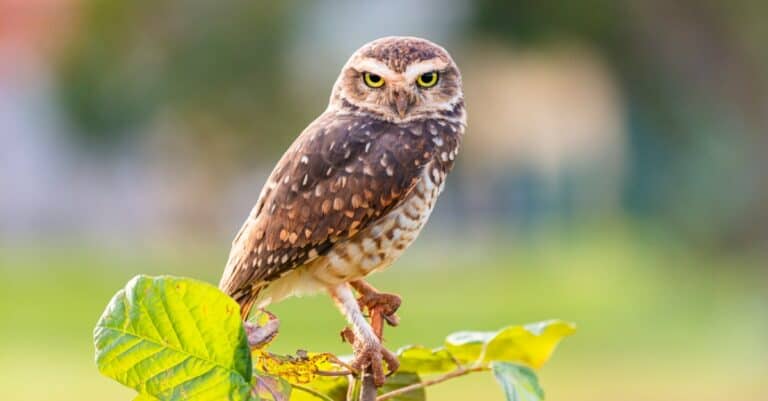
©Jim Cumming/Shutterstock.com
The Washington Department of Fish and Wildlife (WDFW) identified the bird as a barred owl. The department considers attacks rare and says they are more likely in the fall, when days grow shorter. It usually blames them on an owl responding to disturbances in its territory.
Barred owls may defend their territories year-round, according to Seattle Audubon’s BirdWeb. Young birds also disperse in the fall. In one study, juvenile barred owls tagged with satellite transmitters in California traveled up to 62 miles from the territories where they hatched.
So in fall, adults may still be defending territories while young owls are dispersing.
Why is the swoop so hard to see coming?
Barred owls are sit-and-wait predators. They sit quietly on a perch, then swoop silently down on prey. Fringed leading edges and velvety surfaces on their wings reduce the noise of flight.
Easton saw the first half of that sequence: a bird on a branch, turning its head. Owls’ eyes don’t move in their sockets, so they rotate their heads on flexible necks to look around.
Liz Schwab saw the talons come out. Owls have needle-sharp talons, and a barred owl’s feet have two toes pointing forward and two back for a stronger grip.
How big is a barred owl?
Barred owls measure about 16 to 25 inches long, with a wingspan of 38 to 49 inches. Adults commonly weigh about 1 to 2.3 pounds, and females average heavier than males.
With its wings open, a barred owl can span about 4 feet while commonly weighing no more than about 2.3 pounds.
Why are barred owls in Washington neighborhoods?
Barred owls are native to eastern North America and spread west. The first ones were documented in western Washington in 1972.
They are well adapted to Pacific Northwest forests, and they sometimes live in city parks and low-density residential areas, especially in winter.
What should you do if an owl targets you?
Easton has a rule now. “If you see an owl, like, and it, like, opens its wings or like stares you down, cover your neck and head and run,” he said.
Both times the owl struck, Easton went back inside.
WDFW publishes guidance on living with owls. It asks people to make every effort not to disturb an owl during its late winter to spring nesting season.
The leaves are still all over the Schwabs’ yard, and Easton plans to finish the job.