
Quick Take
- One tiny passenger never signed up for this workout. Wait until you see how fast it gets.
- Exercise wheels have one overlooked requirement, and a bigger cat just broke it.
- Is the older cat excited or clueless? The article weighs in.
- Someone steps in just in time. Find out what they were worried about.
Every cat owner knows there’s usually one troublemaker in the house. Sometimes it’s the youngest kitten getting into everything. Other times, it’s the older cat who apparently thinks the family exercise equipment needs a turbocharger.
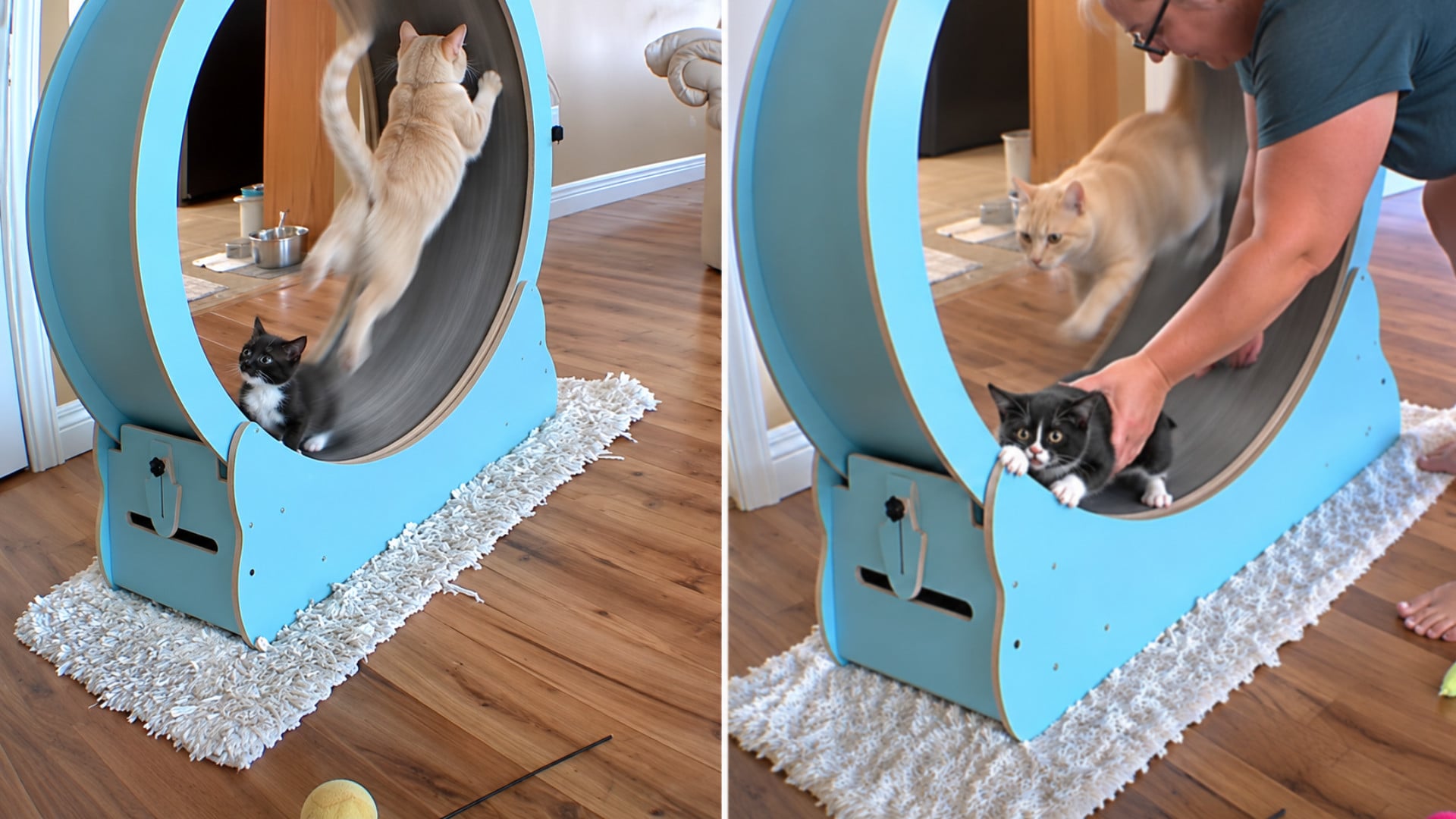
In this hilarious video, a tiny black-and-white kitten is exploring a large cat exercise wheel when its older feline companion decides to join the fun. Unfortunately for the little guy, the bigger cat has a very different idea of what constitutes a reasonable workout.
The older cat hops onto the wheel and starts running at an impressive speed, sending the unsuspecting kitten around and around like a passenger on a carnival ride. What started as a little exercise quickly turns into a full-blown feline spin cycle.
When the Older Cat Takes Over the Treadmill
Cat exercise wheels are designed to let indoor cats walk or run while staying in one place. They’re particularly useful for energetic cats that enjoy running, climbing, and burning off excess energy.
But there’s one rather important detail: The cat using the wheel should be able to control how fast it’s moving.
That becomes a bit of a problem when a larger, faster cat decides to jump aboard while a kitten is already inside.
As the older cat gets moving, the wheel spins faster and the tiny kitten is carried along for the ride. The size difference between the two makes the whole situation even more ridiculous.
It’s like watching someone hop onto a treadmill for a leisurely stroll, only for their gym buddy to crank the speed up to Olympic sprinter territory.
Thankfully, Someone Steps In
As funny as the scene looks, there’s a good reason to keep a close eye on kittens around exercise wheels, especially when multiple cats are using them. A smaller animal can have difficulty keeping its footing when another cat controls the wheel’s speed.
Fortunately, the owner recognizes what’s happening and steps in to help keep the kitten from taking a potentially nasty tumble.
There’s no telling whether the older cat was just excited to run or completely oblivious to its tiny passenger. Either way, the result is one of those wonderfully chaotic moments that make living with cats so entertaining.
And somewhere in that house, there’s probably a little black-and-white kitten reconsidering its gym membership.
All About Cats
The domestic cat (Felis catus) is a small carnivorous mammal belonging to the genus Felis and the family Felidae. Descended primarily from the African wildcat, domestic cats have lived alongside humans for thousands of years. Adult house cats typically weigh between 8 and 12 pounds (3.6–5.4 kg), stand approximately 9–10 inches tall at the shoulder, and measure 18 inches in body length, excluding the tail.
Indoor cats generally live 12–18 years, although some exceed 20 years with proper care. Cats are obligate carnivores with retractable claws, excellent hearing, highly developed night vision, sensitive whiskers, and remarkable agility. Their coats come in numerous colors and patterns, including the black-and-white “tuxedo” pattern seen in this kitten, which describes its coloration rather than a specific breed. Known for their curiosity, playful behavior, and strong hunting instincts, domestic cats are among the world’s most popular companion animals.