Almost everyone born in the United States learns that the country formally declared its independence from Great Britain on July 4, 1776. Most schoolchildren are also taught that the nation’s first settlers from England arrived on the Mayflower ship in 1620.
The pilgrims, as these first settlers are also known, first set anchor in the modern-day town of Plymouth, Massachusetts in late December. Personal accounts detail how the pilgrims were unprepared for the brutal conditions of the New World.
There is strong evidence that half of the Mayflower passengers perished during their first year due to disease, plus a lack of food and shelter. However, what is far less certain is where those unfortunate trailblazers are buried.
Migration from Plymouth Colony
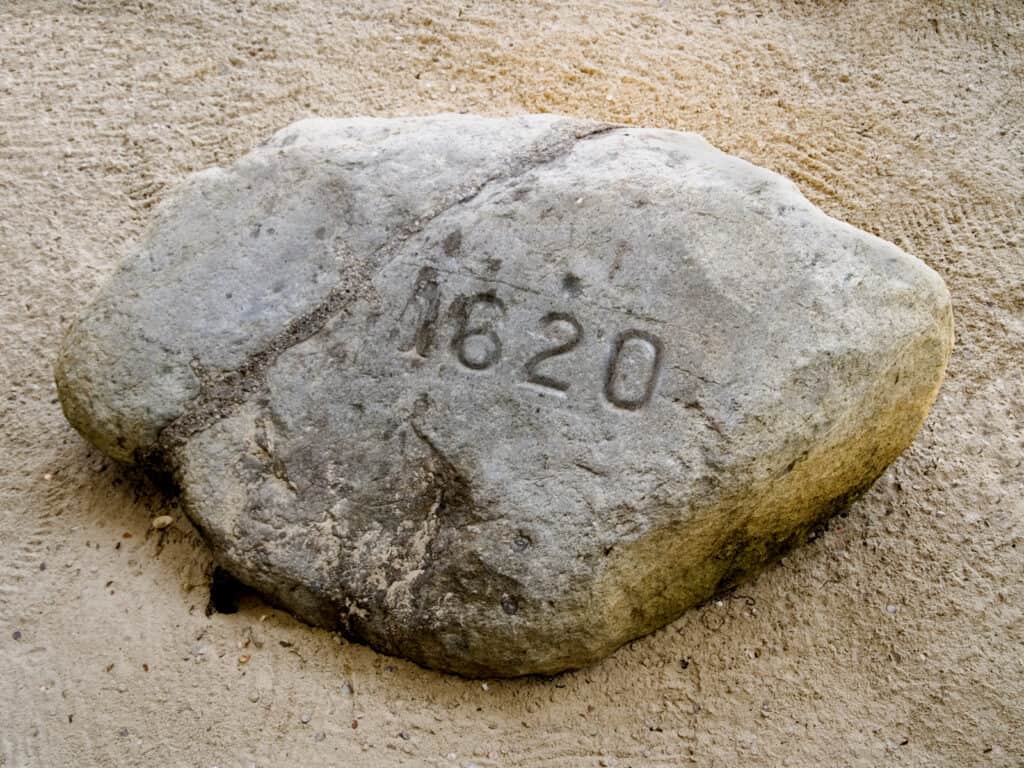
The famous Plymouth Rock in Massachusetts marks where the Mayflower ship supposedly landed in the New World.
©Suchan/Shutterstock.com
Plymouth Colony was the first permanent English settlement in New England. However, most of the original settlers did not stay there.
The Virginia Company of London was founded as a financial backer for the colonization of the New World. The Company covered all the costs of establishing a new colony. In exchange, the monarchy owned the attempted settlement for seven years, during which the pilgrims had to stay in place to work off their debts.
Plymouth was considered a successful settlement, meeting the contract’s requirement in 1627. After, according to Pilgrim Hall Museum, many settlers left Plymouth for the nearby land that was given to them in exchange for fulfilling their part of the agreement.
Cole’s Hill Cemetery
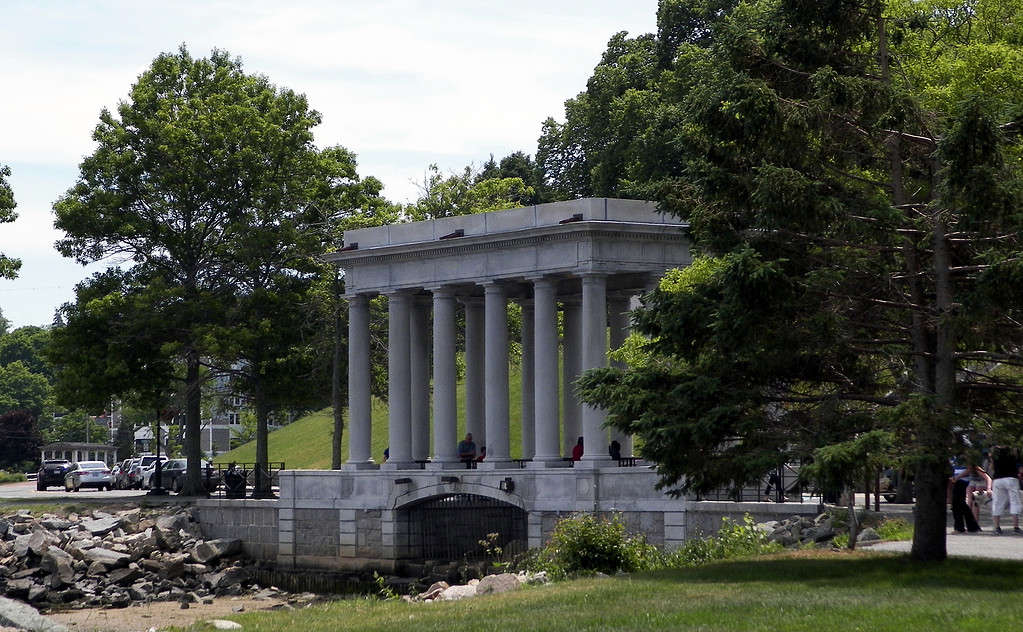
The monument of Plymouth Rock Pavilion is visible with Cole’s Hill in the background.
The settlers’ first winter was unexpectedly harsh. Building began in Plymouth in late December. By winter’s end, around half of those who survived the Mayflower’s maiden voyage were dead.
The bodies of these passengers and crewmates were buried on Cole’s Hill. While there are no stone markers, construction workers first uncovered skeletal remains in 1735.
Pilgrim Memorials, and Guide to Plymouth was published by William Shaw Russell, record-keeper for Plymouth County at the time. In an updated edition of his book, Shaw describes the discovery of additional remains in 1855. According to Shaw, the condition of the remains was consistent with Christian rites at the time. The skulls faced west, there were no coffins, and there were no Native American artifacts buried with the bones. Combined with professional medical examination, this proved that the remains were those of pilgrims who died during that first winter.
While no longer a visible burial ground, Cole’s Hill is a designated National Historic Landmark.
Burial Hill Cemetery

Burial Hill was reportedly used by pilgrims for burials as early as 1622, though there is no current-day evidence to support this claim.
Near to Cole’s Hill is Burial Hill, formerly Fort Hill. According to Shaw, remains found at Cole’s Hill were reinterred next to a monument of Governor William Bradford. Bradford was an original settler of Plymouth and became the colony’s leader after the original died during the first winter.
The Plymouth Colony pilgrims built a fort on Burial Hill between 1621 and 1622. William Bradford described the death and burial of several pilgrims during 1622 in his journal. Tisquantum, also known as Squanto, is believed to be buried at Burial Hill, based on the journal’s entries. Bradford recorded the Native American ally’s death taking place in 1622. However, the exact location of Squanto’s burial plot—and those of pilgrims who died that year—is not explicitly stated.
Both Cole’s Hill and Burial Hill’s earliest grave markers were made of wood and did not survive to provide evidence today. However, Burial Hill’s oldest stone marks the grave of Edward Gray, who died in 1681.
Myles Standish Burial Ground

Myles Standish Burial Ground is located in Duxbury, Massachusetts, and is named after Captain Myles Standish, one of the original Plymouth pilgrims.
Pilgrims in Plymouth were granted new land for farming in 1627. Myles Standish, the commander of the Plymouth Country militia, was given a parcel in what is now Duxbury, Massachusetts.
Duxbury is 5.77 miles north of Plymouth via the connecting bays and about a 10-mile distance by car. Settlers first only stayed in Duxbury to farm in the summer and returned to Plymouth in the winter. However, the farmers requested the area become a separate town from Plymouth. Their request was granted in 1937. The new town was named Duxbury in honor of Myles Standish’s childhood home, Duxbury Hall, in England.
Myles Standish Burial Ground was established in 1638 shortly after the town built its own meeting house. The location now goes by Old Burying Ground or Standish Cemetery. It is unknown if pilgrims continued burying their dead at Cole’s Hill and Burial Hill before the separation of Plymouth and Duxbury in 1637.
A stone bearing Captain Standish’s name and date of death as October 3, 1656, is legitimate. Because of this, the American Cemetery Association named the Standish Burial Grounds the oldest maintained cemetery in the United States.
Charter Street Cemetery
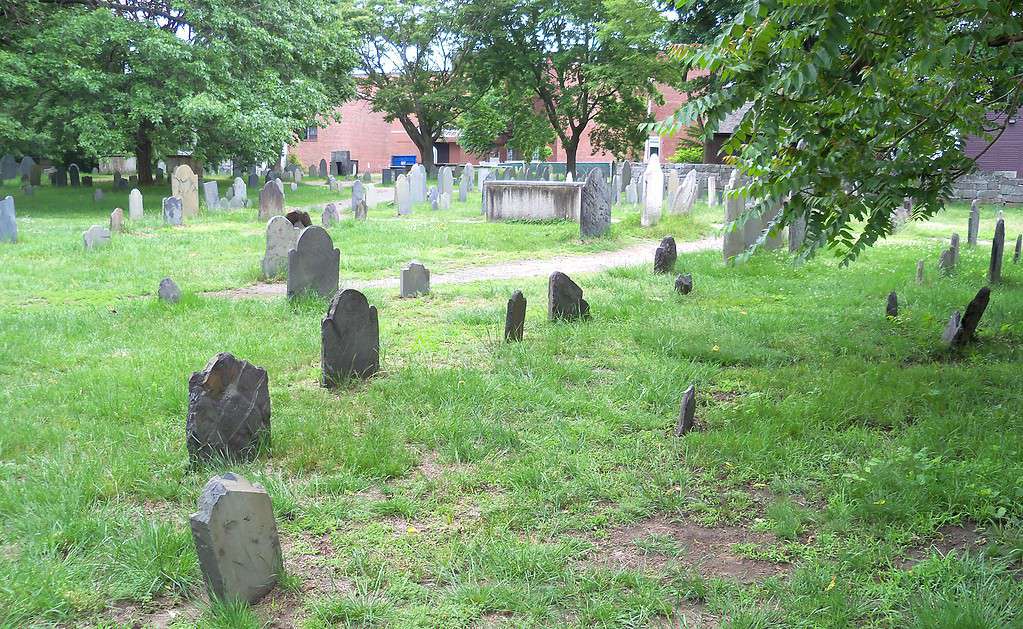
Charter Street Cemetery, once called “Old Burying Point,” is in Salem, Massachusetts. This cemetery includes the only existing headstone of an original Mayflower passenger.
However, some scholars insist there is another cemetery that is the oldest maintained in the United States. While much farther from Plymouth than Duxbury, Salem town records from 1636 and 1637 mention the use of a designated burial spot called “Old Burying Point.”
Old Burying Point Cemetery, now called Charter Street Cemetery is in Salem, Massachusetts. Salem is north of Plymouth by about 40 straight miles, and between 50 and 60 miles by car.
Charter Street Cemetery is also believed to be the resting place of Captain Richard More. More was a young child when he arrived on the Mayflower. His gravestone is the only original marker of a Mayflower pilgrim that still stands today. While the stone lists his death year as 1692, some historical records state he died as late as 1696.
Still, the oldest stone in Charter Street Cemetery is that of Doraty Cromwell, dated the year 1673.
What Is Officially the Oldest Cemetery in the United States?

King’s Chapel Burying Ground in Boston, Massachusetts is another historical graveyard considered the oldest of its kind by many historians.
©Diego Grandi/Shutterstock.com
Other sources provide evidence of even older maintained burial sites in the county. King’s Chapel Burying Ground was founded as the first graveyard in Boston.
Many people use the words “cemetery” and “graveyard” interchangeably. A cemetery is simply a place where people are buried and is not affiliated with a church. Cemeteries are typically larger as they can spread over a wider area without needing to be within the boundaries of church property. Both the religious and nonreligious can be buried in a cemetery.
A graveyard, by contrast, is associated with a church and typically on church grounds. Because of this, only those affiliated with that church’s faith can be buried on its grounds.
King’s Chapel Burying Ground was first used as a resting place in 1630 and was the only one in Boston until 1660. However, its church, King’s Chapel, wasn’t built until 1686. So it can be argued that the Burying Ground was once a cemetery turned graveyard.
Other scholars believe the country’s first burial site was officially in St. Augustine, Florida. While Florida was not a state of the union until 1845, the first established European colony in the nation existed much earlier. St. Augustine was founded in 1565 by Spanish explorers. While no markers exist today, historical records mention the burial of settlers during this time.
The site of the oldest cemetery in the United States is still one of great debate and open to interpretation. Though with so much evidence lost over the centuries, it is hard to pinpoint the exact truth.