
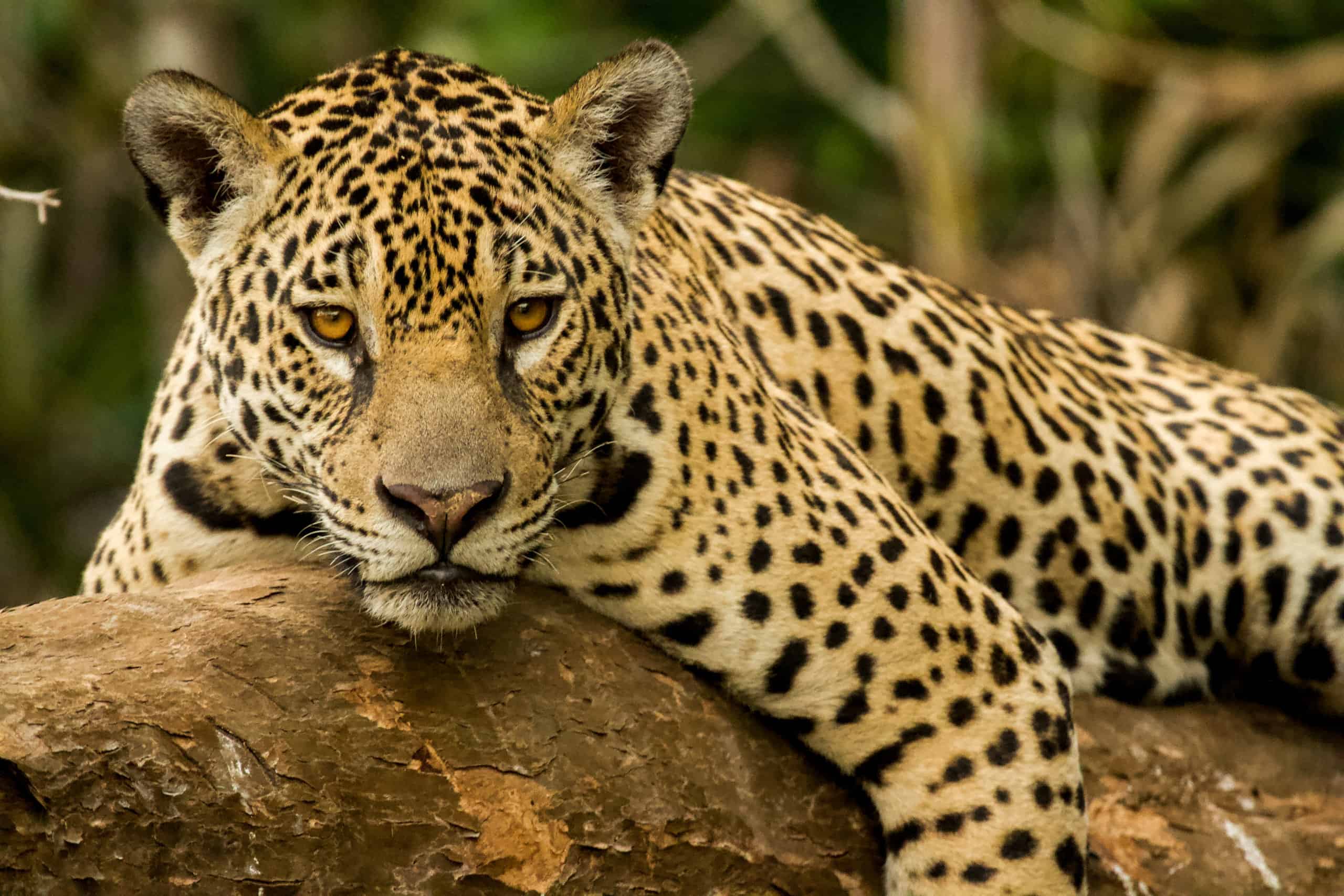

Quick Take
- Most of what science knew about jaguars came from methods that miss something big. What did they overlook?
- Two forces seem to make rival predators tolerate each other. One of them is on the menu.
- Males and females behave very differently around relatives, and the likely reason is dark.
- Before you generalize this to every jaguar, one expert flags a catch about where the data came from.
In Brazil’s northern Pantanal, researchers watched two related male jaguars move and patrol a territory together. A photo from the same project shows two males grooming each other. Both come from a 13-year study led by Valeria Boron of WWF-UK and published in Animal Behaviour, which found jaguars there are far more social than scientists expected.
Aren’t jaguars loners?
Jaguars are widely believed to be solitary cats that tolerate others only when mating or raising cubs. Lions live in prides and male cheetahs sometimes form coalitions, and all other cats were long believed to be solitary, Mongabay reported in 2023.
How did researchers see it?

A male jaguar runs through the water along the Cuiabá River in Brazil's Pantanal. ©imageBROKER.com/Shutterstock.com
©imageBROKER.com/Shutterstock.com
Since 2013, scientists with the Jaguar ID Project have run daily surveys during the Pantanal’s dry season, June to October. They collect photos and videos and have identified 459 individual jaguars by their rosette patterns, and citizen scientists contributed data. The river surveys covered 1,710 days near Porto Jofre.
Boron told Mongabay that most of what scientists previously knew about jaguars came from camera traps and genetic testing, which can’t accurately capture the full range of their interactions.
How often do jaguars get along?
The team recorded 167 interactions between pairs of jaguars, involving 69 of the cats. Only 24.5% were aggressive, BBC Wildlife reported. Another 36.5% were neutral, meaning the cats rested or hunted independently in the same area, and 38.9% were friendly: eating, resting, moving, grooming, hunting or playing together.
Nearly half of the 167 interactions involved two males, 31% involved a male and a female, and 17% involved two females. In one, two sisters from different litters groomed each other.
Why would males tolerate each other?
Family is one reason. Nearly 68% of the friendly interactions were between related jaguars, mostly related males, while most aggressive ones involved cats whose relation to each other was unknown. The two males in the grooming photo were unrelated, according to its caption.
“The kinship hypothesis proposes that related individuals are more likely to relax territorial boundaries and disputes because they are still favouring the success of their genetic lineage,” Boron said.
Food is the other. The Pantanal has the world’s highest density of jaguars, and its abundance of aquatic and land prey makes meetings less likely to escalate into conflict. Caimans, capybaras, turtles and fish thrive in the water, with peccaries on land. A jaguar’s jaws can pierce the skulls of capybaras, peccaries and caimans, and the species eats more than 85 kinds of prey across its range, according to Panthera.
In 2022, researchers documented male jaguar coalitions in the Pantanal and Venezuela’s Llanos that patrolled and marked territory together and shared prey. Two of those coalitions lasted more than seven years. Rich prey leaves females with small, overlapping territories, and the authors suggest males band together to increase their access to females.
Why were females warier?
Among jaguars with known family histories, related males had more positive interactions, and that pattern was absent in females. Boron suspects females, often with cubs, act defensively to protect their young.
“That’s the hypothesis that we have, because there was a record of infanticide in the area by another female,” she said.
Does this apply to jaguars everywhere?
Stijn Verschueren, a conservation biologist at the University of Bern who was not involved in the study, pointed to where the data came from. “All observations come from riverbanks in an area with very high prey and jaguar density, so the results don’t necessarily apply to jaguars elsewhere,” he told Mongabay by email.
At 13 other study sites across the jaguar’s range, scientists had recorded no such cooperation between males, according to the 2022 research. Boron’s team says similar studies could be run in other places with dense jaguar populations, such as the Mamirauá reserve in the Amazon.
