Quick Take
- A deckhand's knife took five minutes to arrive, and the chaos that followed nearly crowded the rescue.
- Did the shark somehow know they were helping? Her biology offers a less sentimental explanation.
- The rope ended up in a government office, and staff said something about it that made history.
- Spot an entangled animal in Hawaii? One quick action matters more than jumping in.
Earlier this month at Turtle Canyon, off Waikiki, staff from Island Splash Tours found a whale shark with a rope tangled around her body, Hawaii News Now reported. Photographer Emma Carlton said the shark sat at the surface for about 10 minutes and let rescuers work at the rope. Freeing her took 30 minutes, and she then dove about 30 feet down.
How did a snorkel trip become a rescue?
Staff were in the water with customers when the boat crew started waving them over. “Normally, that means there’s something cool in the water nearby,” Carlton said. She didn’t notice the rope in the first couple of seconds.
Once they saw it, business owner Preston Heede asked nearby boats for a knife, and a deckhand gave him one after about five minutes. The shark was only about 10 feet below the surface, Carlton said, so he could keep diving down to cut and coming back up.
About 10 to 15 people from other boats joined in, some holding knives and some holding GoPros, and Carlton said it became chaotic. Heede told everyone to cut in one spot, because the rope was as thick as his leg.
Did the shark know they were helping?
That was Carlton’s impression. “It was almost as if the whale shark knew that they were trying to help her because she just sat at the surface for like 10 minutes and just sat there and let them work at the rope,” she said.
Georgia Aquarium lists a whale shark’s cruising speed at about 2.5 knots, or 2.9 mph, and its surface feeding speed at roughly 2 knots, a walking pace. An alarmed whale shark can accelerate for very short bursts, but it cannot sustain fast swimming for long. Its most common feeding method happens at the surface, and when food is dense it will hold still, tilted up toward the surface.
Oceana describes whale sharks as filter feeders with a serene demeanor. They suck in mouthfuls of water through a five-foot-wide mouth lined with filtering pads and strain out plankton and small fish.
How big do whale sharks get?

A whale shark and a diver in deep water (stock photo). ©Katja Tsvetkova/Shutterstock.com
©Katja Tsvetkova/Shutterstock.com
The whale shark is the largest fish in the world, and the largest one measured was 61.7 feet, according to Georgia Aquarium. Common lengths run from 18 to about 33 feet. Carlton later learned this one was a juvenile female and called her a “little teenager”.
Why is rope a danger to a whale shark?
Georgia Aquarium lists entanglement in fishing nets as a threat to the species, alongside boat strikes and swallowing marine debris. In 2016, the global whale shark population was downgraded from Vulnerable to Endangered on the IUCN Red List.
Carlton’s message after the rescue: “Don’t leave any nets or anything behind.”
What happens to the rope?
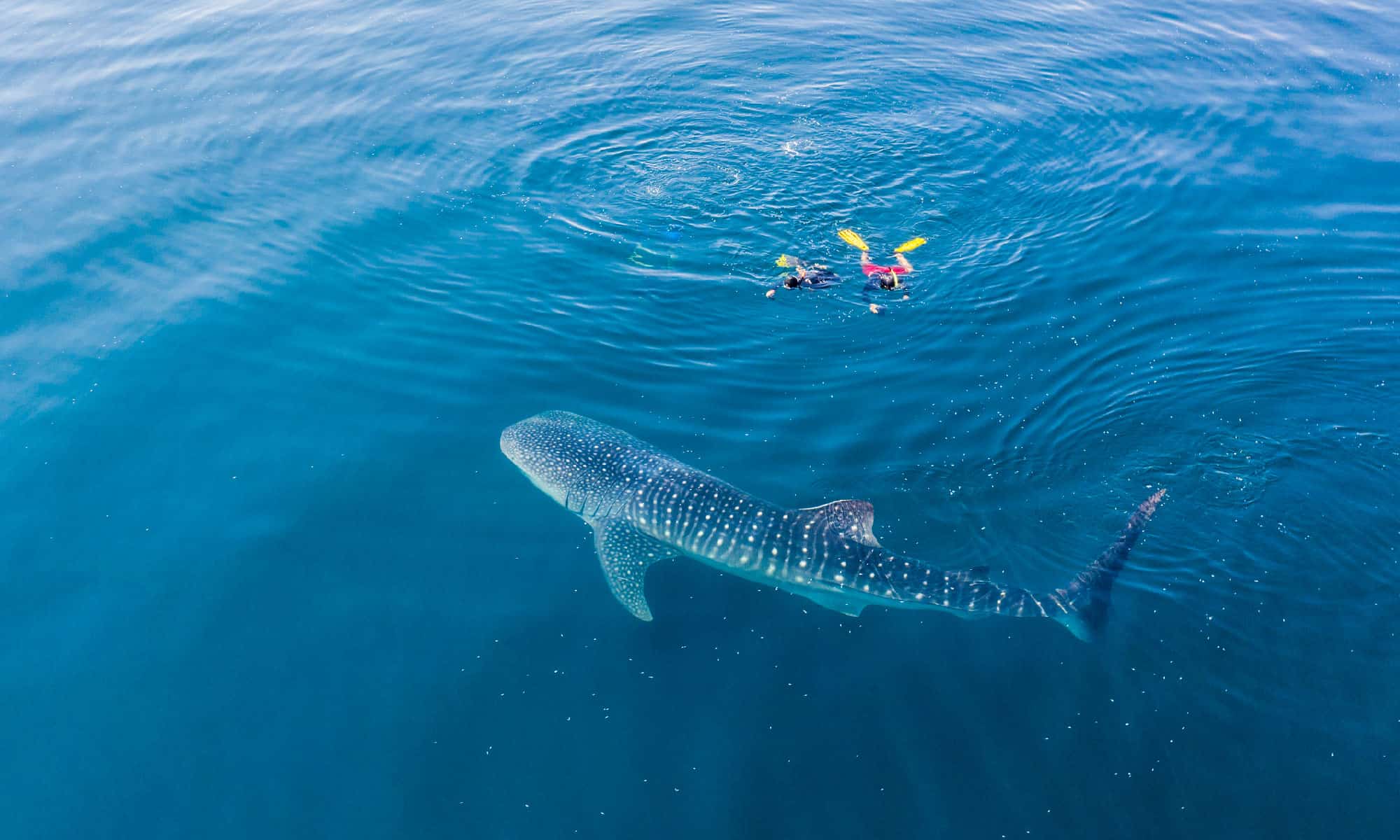
Two snorkelers swim above a whale shark near the surface. ©Velvetfish/iStock.com
©iStock.com/Velvetfish
Heede brought the rope back onto the tour boat, and Carlton dropped it off at the Hawaii Department of Land and Natural Resources on Nov. 11. Staff told her it was the first time gear had ever been removed from a whale shark in Hawaii’s history. They plan to study the rope to determine where it came from and how to remove entanglements from marine life.
What should you do if you see an entangled animal in Hawaii?
Report it by phone. The department’s Division of Boating and Ocean Recreation keeps a page for reporting hooked or entangled marine animals, and it gives the Marine Animal Response Hotline as 1-888-256-9840.