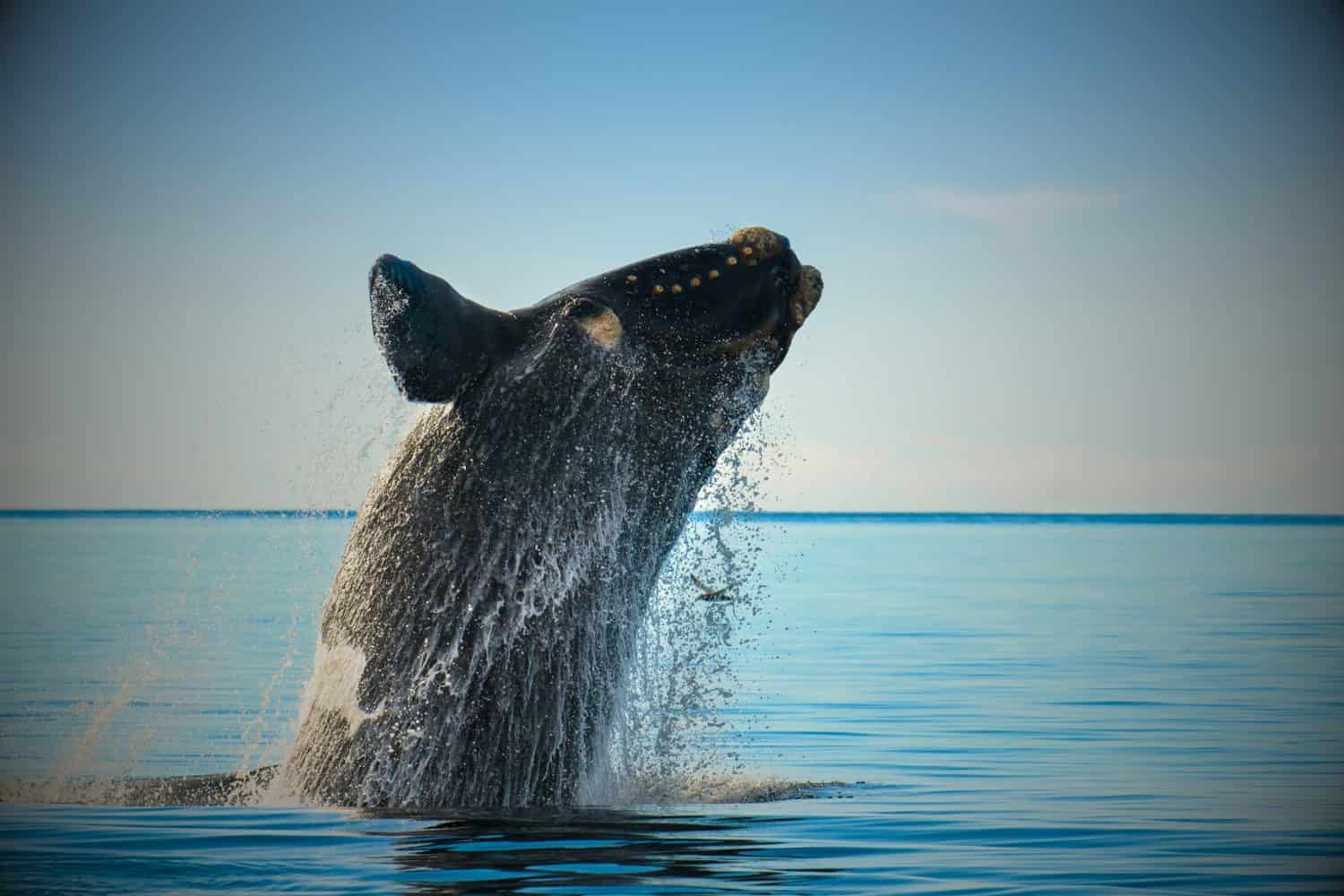

An annual whale report released by the North Atlantic Right Whale Consortium on October 22, 2025, made waves in the conservation community. Every year, the “report card” details the status of North Atlantic right whale populations, tallying mortalities and entanglement events. For 2025, the news is more positive than expected, with an estimated 384 right whales. While it’s only a gain of eight animals relative to 2024, any gain is notable in a species that was nearly extinct a century ago. North Atlantic right whales are widely considered the most imperiled large whale species, though the Gulf of Mexico’s Rice’s whale is also critically endangered.
The ‘Right” Whale Hunting
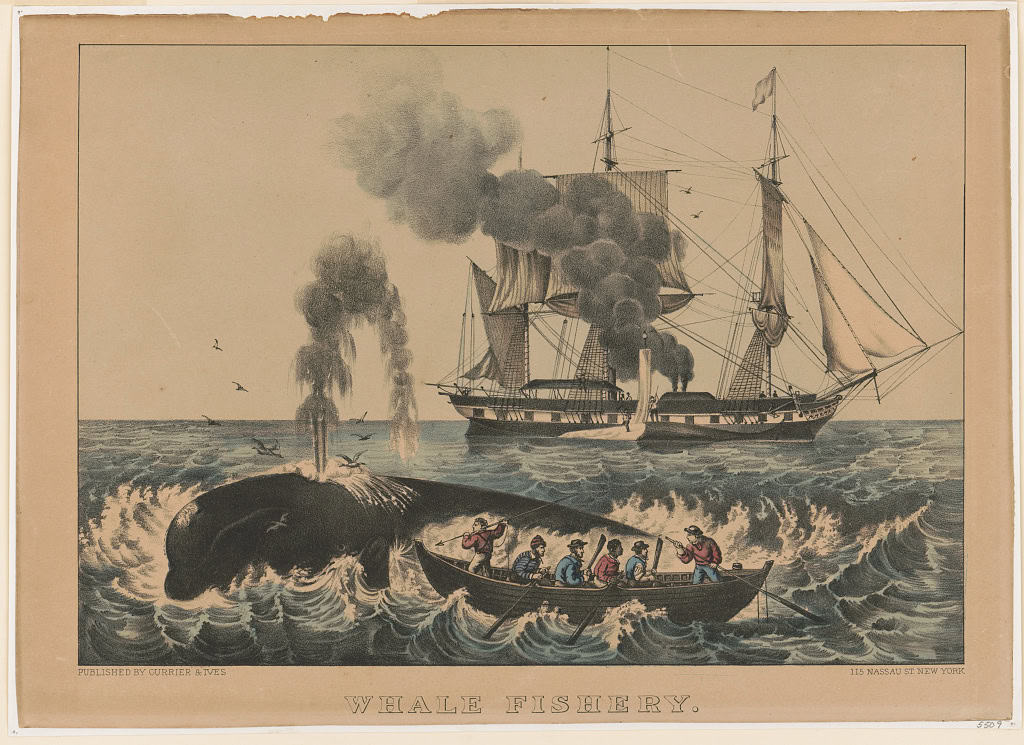
This 19th-century lithograph depicts a group of whalers attacking a right whale. Currier & Ives.
© Library of Congress Prints and Photographs Division, No known restrictions on publication – Original
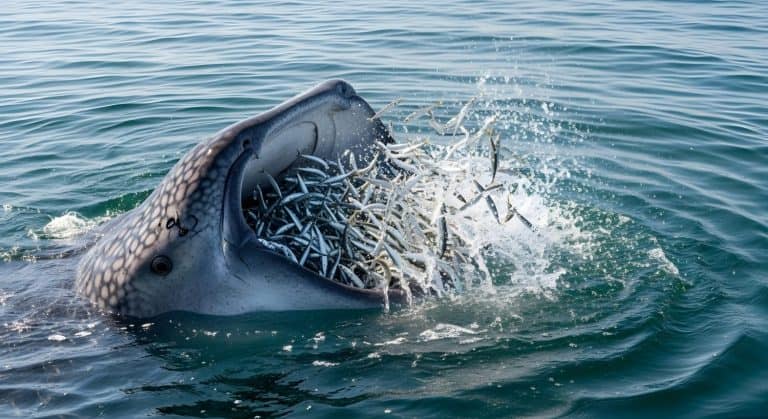
It is thought that North Atlantic right whales (Eubalaena glacialis, nicknamed NARW) were named for their status as the “right” whale to hunt because their bodies floated after they were killed. They are filter-feeders, with rows of baleen inside their massive mouths that act as sieves to filter small prey, such as plankton and fish, from the sea. The stiff baleen was a popular material for making women’s corsets and umbrella handles during the 1800s. Because they’re huge, at 50 feet long and 50 tons, a single right whale provided a hearty supply of blubber and oil for lamp fuel.
Right whale hunting became popular during the 1500s, with European ships crossing the Atlantic to catch whales along the coast of Canada. Summer would bring hundreds of whaling ships to the bays of Newfoundland and Labrador. As soon as North America was settled, Europeans began using America’s eastern shores for their whale hunting business, working up and down the Atlantic Coast. By the early 1890s, commercial whaling had pushed North Atlantic right whales to the brink of extinction, a dramatic change for populations that had peaked at an estimated 21,000 individual whales prior to whaling.
Protecting Right Whales
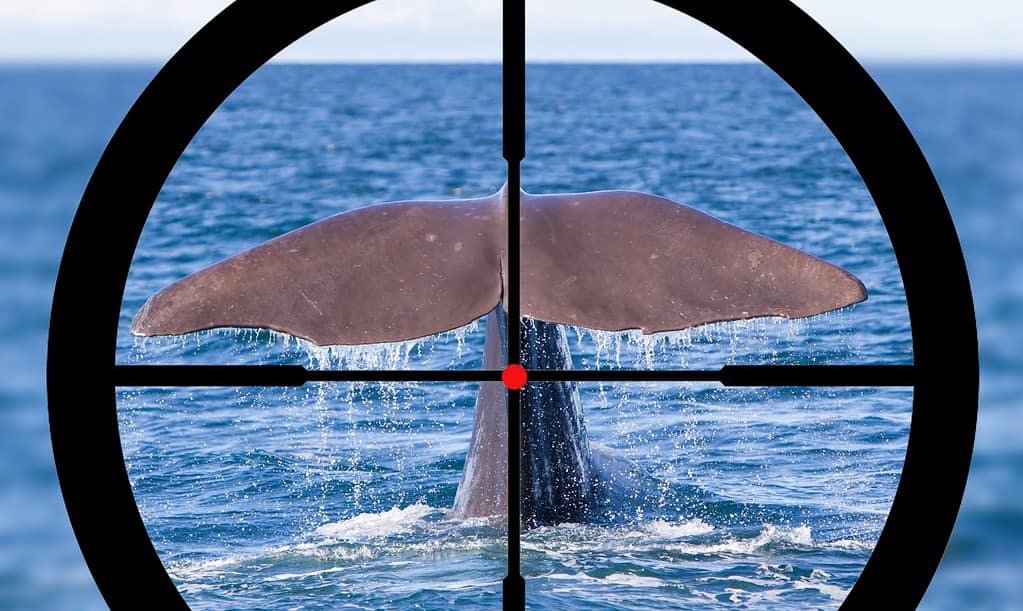
Modern technologies made it easier to hunt whales, such as this sperm whale in the Atlantic Ocean.
©MyImages – Micha/Shutterstock.com
National and international legislation enacted to save whales, plus the natural decline in whaling due to scarcity, largely alleviated the whaling threat to North Atlantic right whales. By the 1970s, they were officially recognized as endangered, protected by the 1972 Marine Mammal Protection Act and 1973 Endangered Species Act. But their populations were so badly decimated that the chance of recovery looked grim.
This explains the excitement over the recent press release from the New England Aquarium’s Anderson Cabot Center for Ocean Life—the organization that monitors right whales. Biologist Heather Pettis shared that “It’s always a great feeling when we can share positive news about this critically endangered species. The slight increase in the estimated population, coupled with no detected mortalities and fewer detected injuries than in the last several years, leaves us cautiously optimistic about the future of North Atlantic right whales.”
An increase in the North Atlantic right whale population is an encouraging sign that recovery is possible, but we are not out of danger yet. The situation is still dire as the same threats remain, including fishing gear entanglement and vessel strikes.
Hanna Vatcher, representative of Oceana, a nonprofit conservation organization
Right Whale Reproduction
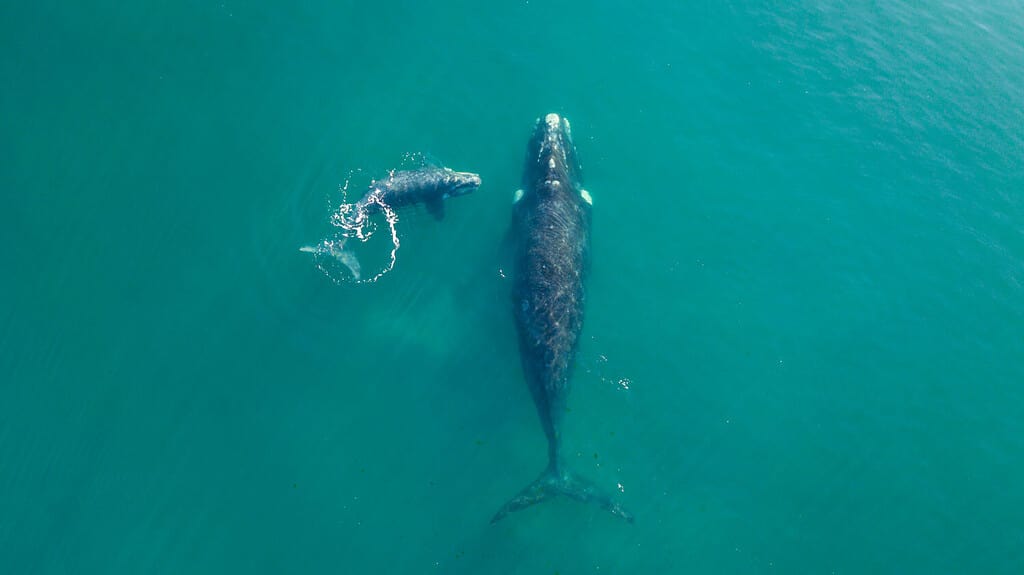
Right whales give birth to just one calf, and pregnancies are at least a few years apart.
©comolok/Shutterstock.com
The current population of 384 North Atlantic right whales is thought to include about 70 breeding females. It takes nearly ten years for a female to reproductively mature. An adult female can give birth to a single calf every three years, though recently, the gap between right whale pregnancies has increased to 6-10 years, perhaps due to stressors like changing availability of food as oceans warm. So, even with 70 breeding females, only a small number of calves are born each year. The pregnancy lasts a year, after which females nurse the calves with high-fat milk for up to two years. During that period, a calf is dependent on its mom for food, protection, and learning.
The calving season starts as early as mid-November, lasting through the winter and trailing off in April. This year, a total of 11 right whale calves were born, of which four belonged to first-time mothers. As mothers get older, they may shorten the interval between calves. Said biologist Phillip Hamilton in a New England Aquarium press release, “In recent years, right whales have been delaying giving birth to their first calf until they are older. It is encouraging to see four of these older females join the reproductive pool this year. The future of the species rests on their broad backs.”
As the calves are getting ready to wean, they migrate alongside their mothers north to New England and Canadian waters, where they gorge on zooplankton throughout the summer. The mothers replenish energy spent in pregnancy and nursing, while the calves mature to feed independently. These new calves are part of a slow population growth that has been observed by experts over the past four breeding seasons, with a modest population increase since it reached a low in 2020.
Unusual Mortality Event (UME)
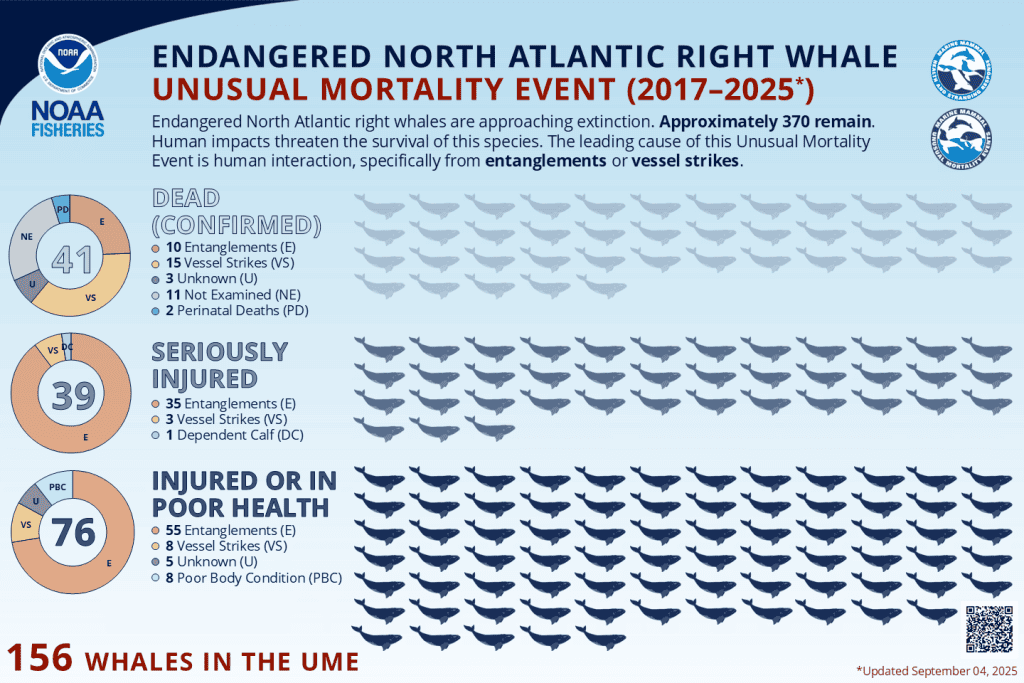
Endangered North Atlantic Right Whale Mortality Event (2017-2025).
©NOAA Fisheries, public domain – Original
Right whales continue to suffer from human stressors, primarily entanglement in fishing gear and collisions with ships. Since 2017, North Atlantic right whales have experienced an ‘Unusual Mortality Event’ (UME) with more than 20 percent of the population in the U.S. and Canada reported as sick, injured, or dead. NOAA Fisheries established the designation “UME” for a situation that ‘involves a significant die-off of any marine mammal population and demands immediate response.’
Right Whales and Shipping
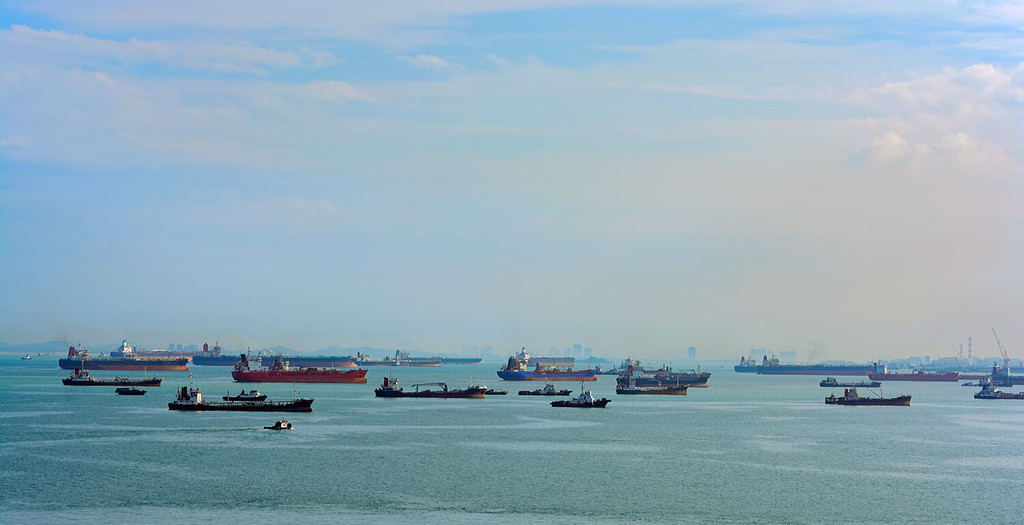
Busy shipping lanes pose dangers to whales, especially for large, slow-swimming species.
©Igor Grochev/Shutterstock.com
The Gulf of St. Lawrence and other northern feeding areas have become increasingly dangerous to whales as large vessels and fishing gear grow more abundant. Whales must evade anchored nets, such as traps used for lobsters and crabs, as well as vessels traveling through the busy shipping lanes. North Atlantic right whales are slow swimmers (moving at about 6 miles/hour) with dark-colored backs and no dorsal fins, making them difficult to see in the water. A study published earlier this year in Proceedings of the Royal Society B found that humpback whales, close relatives of right whales, have such poor eyesight that they may not see boats approaching until it is too late to avoid them.
Unfortunately, however, some whales remain entangled from prior years. A whale caught up in fishing gear, first observed in December 2024, was seen again in April 2025, still entangled. Known in the North American Right Whale Catalog maintained by the New England Aquarium as whale #5110, he was most recently spotted feeding in Cape Cod Bay off the coast of Massachusetts. While it’s a good sign that he is feeding, the fishing lines are caught in his mouth and, with little trailing line, are difficult to remove.
Right Whale Entanglement Stats
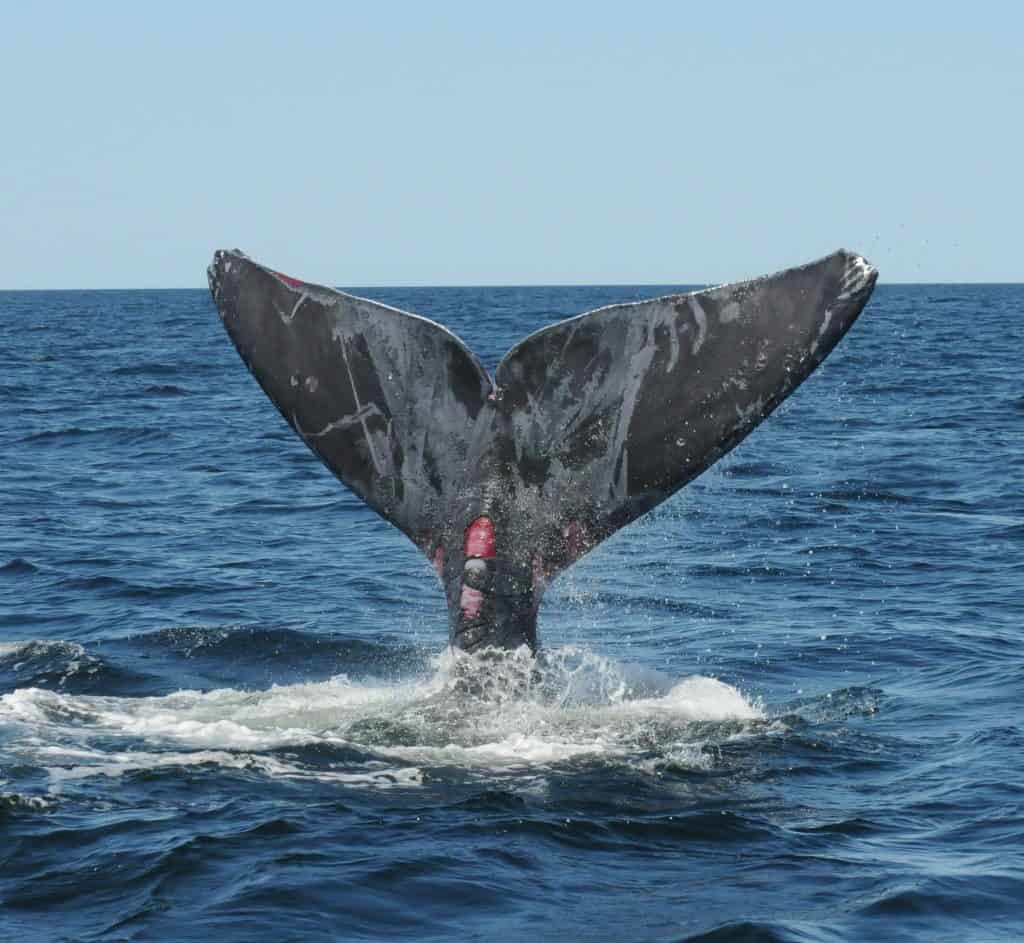
This North Atlantic right whale has evidence of entanglement injuries on its tail.
©NOAA Fisheries, public domain – Original
A study published in the journal Marine Ecology Progress Series tallied signs of entanglement (scars, netting, etc.) on a sample of 626 right whales and found that 82.9 percent had suffered an entanglement. Of those, most had been entangled more than once by fishing gear wrapped around their mouths, flippers, flukes, or entire torsos. A recent follow-up study published in the Proceedings of the Royal Society B used a mark-and-recapture technique to see how entanglement affected the survival of female right whales. Of 199 females seen from 1977 to 2018, those that were entangled had lower chances of breeding and survival. The study authors concluded that the failure of female North Atlantic right whales to recruit to the breeding population due to entanglement is a key driver for the species decline in recent years.
Another threat to whales of increasing concern is ocean noise pollution. Because whales rely on acoustic underwater communication for their complex social interactions, noises from ships, construction, and other human activities may be interfering with their daily lives. The natural sonar of baleen whales, such as North Atlantic right whales, may help them identify places with high densities of prey, avoid obstacles, and find mates. Scientists have observed right whales using vocal communication to socialize in groups at the ocean surface.
Tracking Whale Mortality
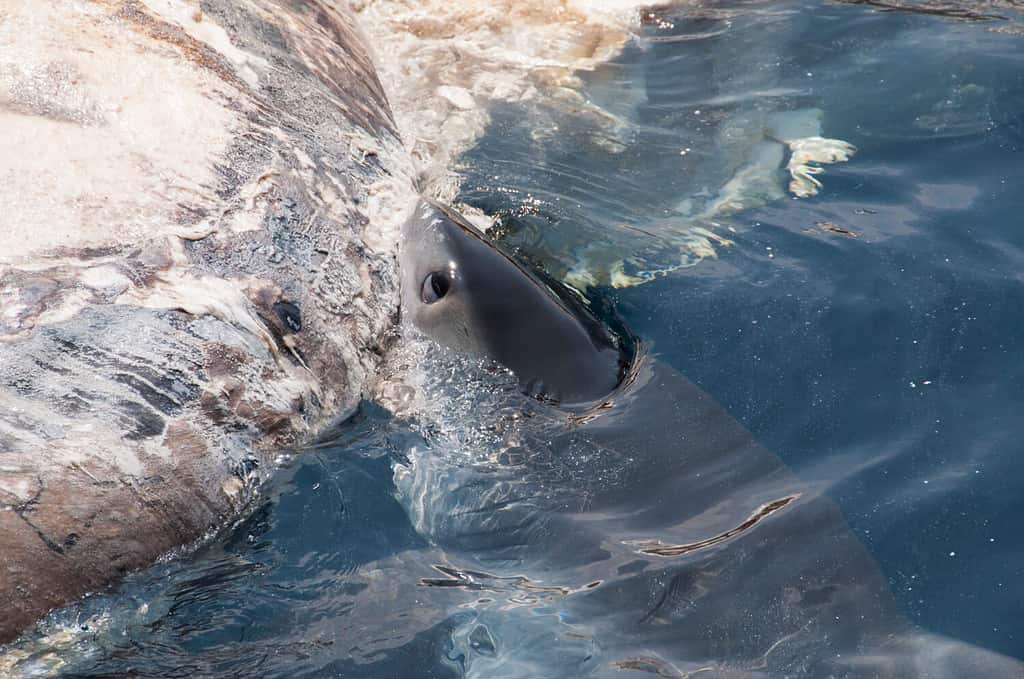
This shark is taking a bite out of a blue whale carcass floating at the surface.
©Alexandra Childs/Shutterstock.com
Thus far, no right whale deaths have been logged in 2025. There has been one reported injury from entanglement and one vessel strike. However, a study published in Conservation Science and Practice revealed that many whale deaths go unseen and, therefore, unreported. The researchers modeled whale populations and found that only about 36 percent of North Atlantic right whale deaths from 1990-2017 were detected. Dead whale carcasses may get scavenged at sea before they are found, such that “annual counts of right whale carcasses do a poor job of indicating total mortality for the year.” So, what these study authors deem “cryptic mortality” must be considered when trying to save whales.
Hanna Vatcher, a representative of a nonprofit conservation organization Oceana, was quoted in a press release saying, “An increase in the North Atlantic right whale population is an encouraging sign that recovery is possible, but we are not out of danger yet. The situation is still dire as the same threats remain, including fishing gear entanglement and vessel strikes.”
Upgrading Technology to Help Whales
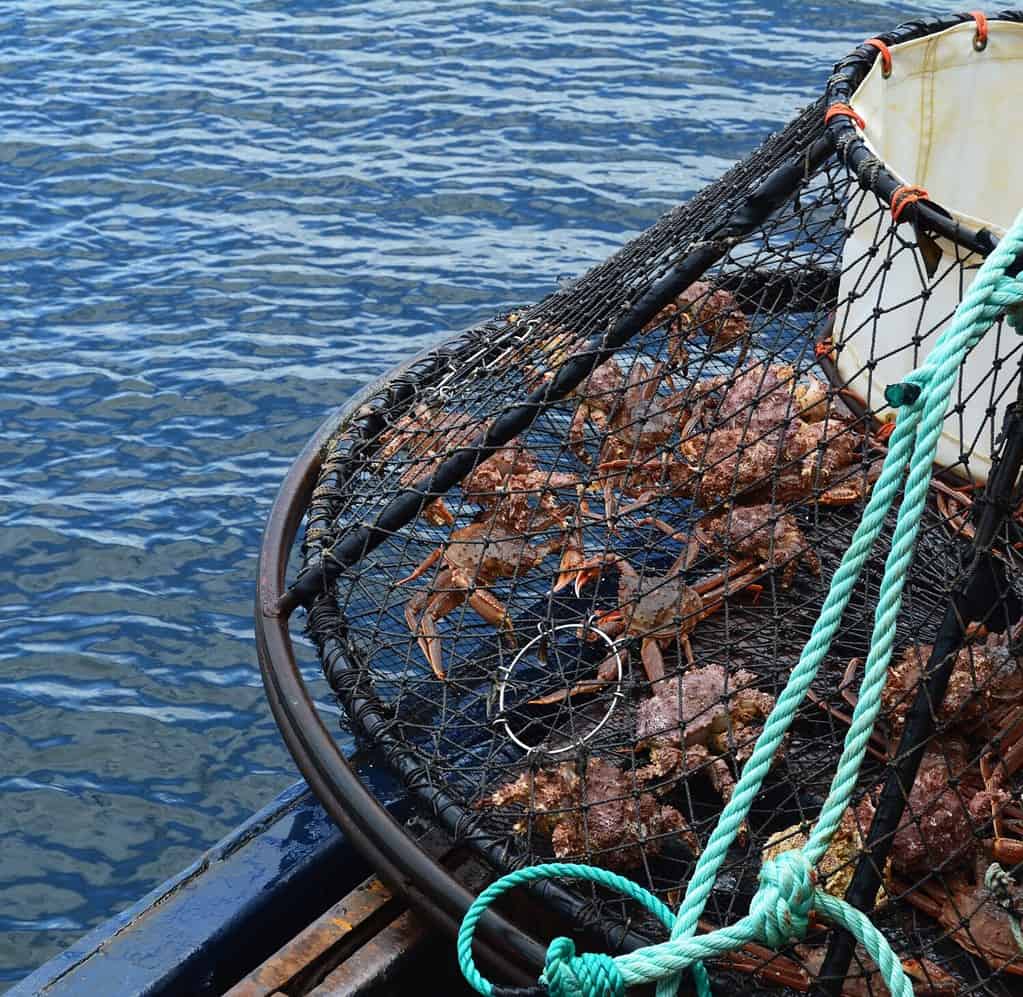
The ropes attached to crab and lobster fishing buoys are an entanglement hazard for whales.
©Vintagepix/Shutterstock.com
Said Pettis in the press release for the report card, “With small population increases year to year, we still need strong protective measures for continued growth. We don’t want to take our foot off the gas when it comes to management and conservation efforts.” Ocean scientists are working on developing, refining, and bringing to market ropeless fishing technologies. For example, a device already in use is a buoy attached to a bottom-stowed coiled rope in a cage instead of a long line in the water column. When fishermen approach the buoy, they can send a signal that brings it to the surface so they can collect the traps.
Scientists are also working to develop systems of thermal infrared (IR) cameras that could detect whales crossing into shipping lanes. Whether mounted on ships or on tall, onshore structures, such cameras have been shown to detect whales from more than 6 miles away. Systematic use of infrared cameras could give ships sufficient warning to slow down as they approach North Atlantic right whales and other species. A study published in Biological Conservation of ship/whale strikes in the Stellwagen Bank National Marine Sanctuary, east of Boston, MA, found that ship speed was correlated with mortality of whales. Limiting ship speed to 16 knots would lower whale mortality by nearly 4 percent, and reducing it to 10 knots would more than halve whale mortality rates.
Networks of Support for Whales
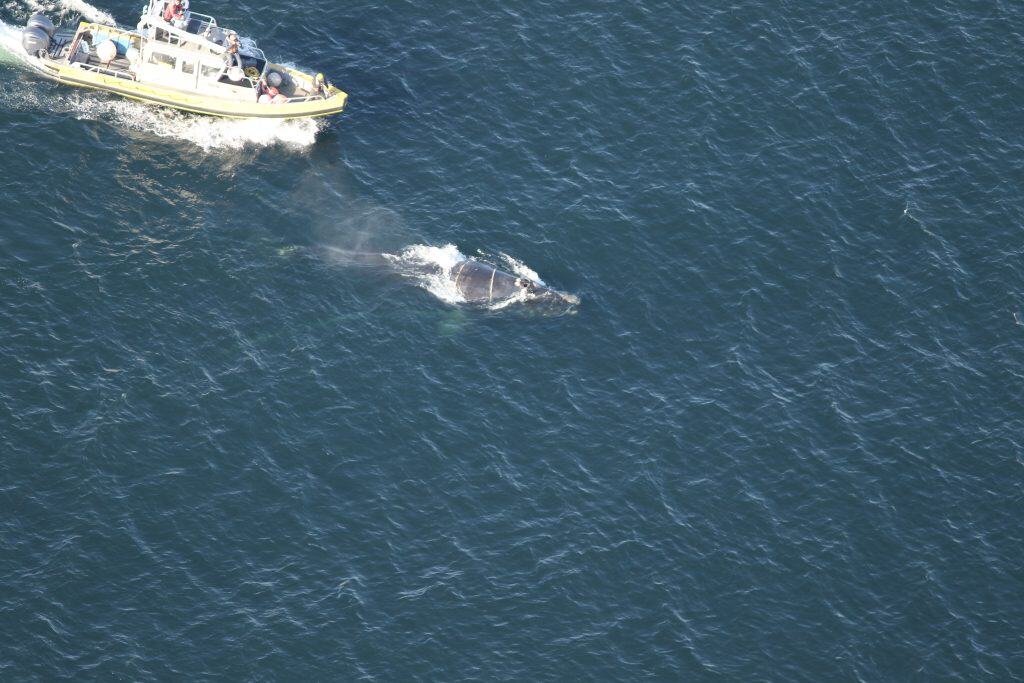
A response team follows an entangled North Atlantic right whale.
©The Center for Coastal Studies (NOAA Permit #24539) – Original
The Disentanglement Network coordinated by the Center for Coastal Studies, scans whale feeding and calving grounds for instances of entanglement. Trained rescue teams attempt to free entangled animals and/or attach a satellite tracking tag so they can continue to follow the animals and try to free them at a later time. Specialized equipment for disentanglement is stored at designated sites along the east coast of the U.S. and Canada. Still, removing tangled ropes from a massive, moving animal is no easy task. As the Network’s website explains, “Disentanglement cases often involve dozens of experts working around the clock creating strategies, techniques, equipment, and logistics for the next attempt.”
Citizen action matters too. A 2024 poll of U.S. voters found that more than eighty percent support measures to protect North Atlantic right whales, whether through adapting human activities, creating mandatory safe zones for the whales, or other policy changes brokered by the U.S. government. If you live near or visit the Atlantic Ocean, you can play a role in whale conservation. Download the Whale Alert app, which helps you stay clear of whales when you’re boating. Also, share any whale sightings, especially of whales in distress. You can report sick or stranded whales of all species to NOAA Fisheries through their Dolphin & Whale 911 app.