
J
Species Profile

Japanese Macaque

Macaca fuscata

Japan's snow monkey, social to the core
Scottmliddell / Creative Commons

Japanese Macaque Distribution

Click a location to explore more animals from that region

Endemic Species
Loading map...

Found in 1 country

At a Glance

Wild Species
Also Known As Snow monkey, Japanese monkey, Nihonzaru, Yukizaru
Diet Omnivore
Activity Diurnal
Lifespan 20 years
Weight 14 lbs
Status Least Concern
Did You Know?

Northernmost non-human primate: natural range reaches about 41 degrees north in northern Honshu Island (Fooden 1990).

Scientific Classification

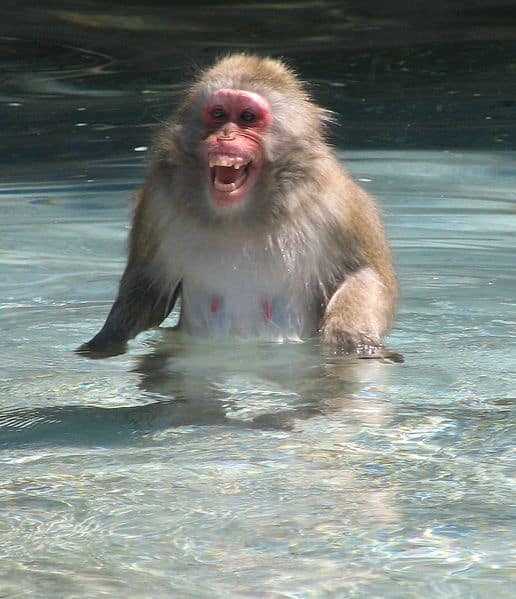
The Japanese macaque (Macaca fuscata) is an Old World monkey endemic to Japan, notable for its tolerance of cold climates and its complex social behavior in multi-male, multi-female troops.

Kingdom
Animalia
Phylum
Chordata
Class
Mammalia
Order
Primates
Family
Cercopithecidae
Genus
Macaca
Species
fuscata

Distinguishing Features

  • Endemic to Japan; among the northernmost-ranging non-human primates
  • Thick winter coat (often gray-brown) and a relatively short tail
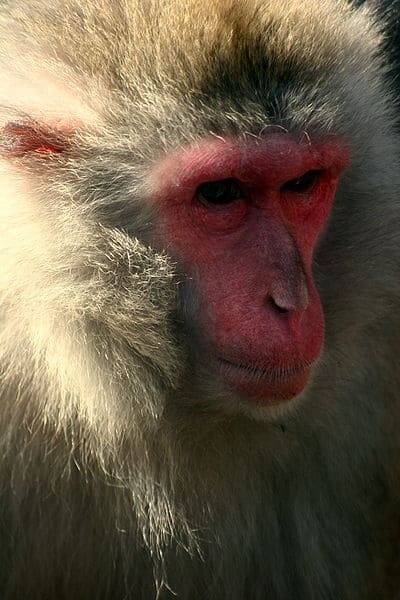
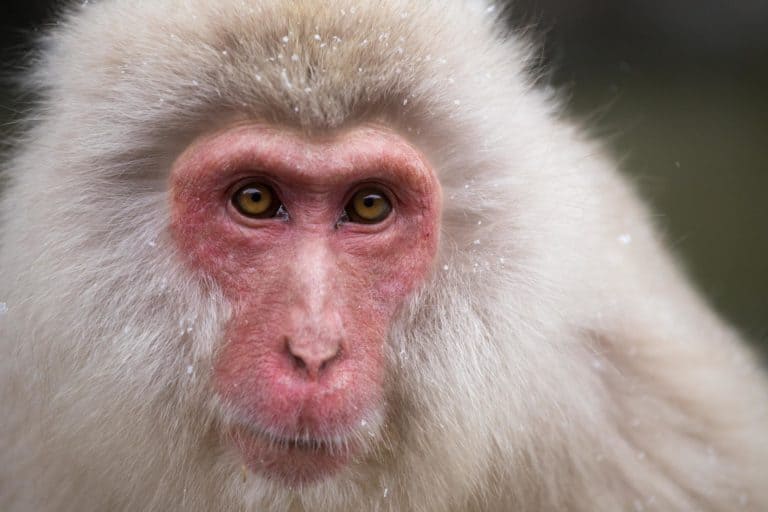
  • Pinkish-red, mostly hairless face
  • Complex social structure with female philopatry and dominance hierarchies
  • Famous for behavioral traditions (e.g., hot-spring use in some populations, food washing in certain groups)

Physical Measurements

Males and females differ in size

Length
1 ft 12 in (1 ft 9 in – 2 ft 2 in)
Weight
26 lbs (22 lbs – 31 lbs)
18 lbs (12 lbs – 24 lbs)
Tail Length
4 in (3 in – 5 in)
4 in (3 in – 5 in)

Appearance

Primary Colors
Secondary Colors
Skin Type Dense double-layer mammalian fur (seasonally thick winter coat) with bare, hairless facial skin and bare rump/perineal skin typical of Old World monkeys (Cercopithecidae)
Distinctive Features
  • Endemic range: naturally occurs only in Japan (primarily Honshu, with populations also on Shikoku and Kyushu; local distributions vary by region and habitat).
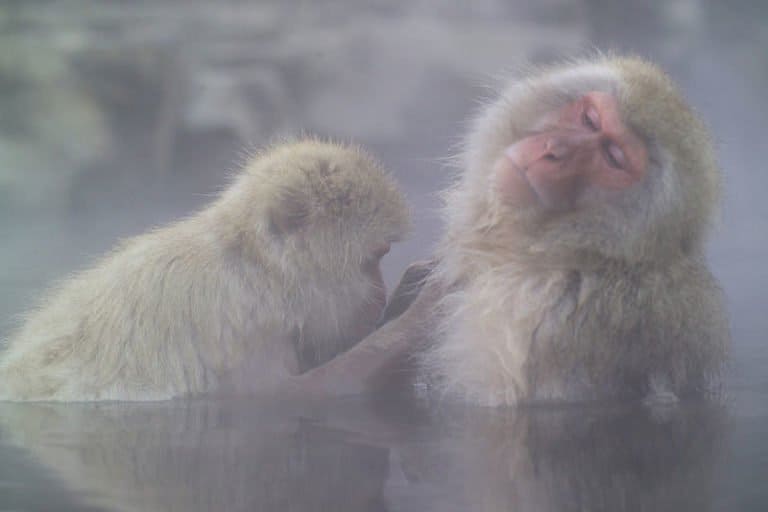
  • They grow a thick winter coat (dense underfur, long guard hairs) and keep warm by huddling, sun-basking, and sheltering. Some groups bathe in hot springs (e.g., Hell Valley Monkey Park, Nagano), but not all.
  • Old World monkey (Cercopithecidae) traits: forward-facing eyes, catarrhine nose, cheek pouches for temporary food storage, and ischial callosities (sitting pads) typical of macaques.
  • Tail is very short ("stump-tailed" appearance for a macaque): typically ~7-12 cm.
  • Adult Japanese macaques: head-body length about 47-60 cm (males) and 44-52 cm (females); weight about 11-14 kg (males) and 8-11 kg (females); some populations have heavier individuals.
  • Longevity: commonly ~15-20 years in the wild; can exceed 30 years in captivity (reported maxima in the mid-to-late 30s).
  • Social organization/behavioral traditions (species-typical): multi-male/multi-female troops with strong matrilines and dominance hierarchies; frequent allogrooming; seasonal breeding; culturally transmitted foraging/handling behaviors documented in some troops (e.g., provisioned-population traditions such as food-washing or object-manipulation).
  • Diet appearance-relevant note (omnivorous generalist): seasonal diet shifts (fruits, seeds, leaves, buds, bark, invertebrates, and occasional small vertebrates/anthropogenic foods) can influence body condition and coat quality across seasons.

Sexual Dimorphism

Sexual dimorphism is pronounced: adult males are substantially larger and more robust than females and tend to have larger canine teeth and more massive heads/shoulders, consistent with multi-male mating competition in a multi-male/multi-female troop system.

  • Larger average body mass and longer head-body length than females (commonly ~11-14 kg and ~47-60 cm).
  • More robust build (broader shoulders/chest) and larger head/jaw musculature; larger canine teeth on average.
  • External genitalia conspicuous; adult males may appear 'heavier' in winter due to both mass and fuller coat.
  • Smaller average body mass and length than males (commonly ~8-11 kg and ~44-52 cm).
  • More gracile build; canine teeth smaller on average than males.
  • Visible nipples/mammary development, especially in lactating females; perineal region can appear more swollen/colored during reproductive cycling depending on individual and season.

Did You Know?

Northernmost non-human primate: natural range reaches about 41 degrees north in northern Honshu Island (Fooden 1990).

Short tail, big warmth: tail length typically ~7-12 cm, far shorter than many macaques (Fooden 1990).

Size (adult): head-body length male 47-60 cm, female 42-54 cm; mass averages male about 11.3 kg, female about 8.4 kg (Fooden 1990; Nowak 1999).

Longevity: up to ~27 years recorded in the wild and >30 years in captivity (captivity records commonly ~32 years) (Nowak 1999; zoo longevity records).

They use cheek pouches (a Cercopithecidae trait) to quickly gather food and eat later in safer spots.

A famous troop on Koshima Island pioneered "sweet-potato washing" (first reported 1953) and the behavior spread socially-one of the classic examples of primate cultural transmission (Kawai 1965).

Winter bathing in hot springs (e.g., Jigokudani) is a learned, group-influenced tradition rather than a universal species trait-some troops do it, others don't.

Unique Adaptations

  • Cold-climate tolerance supported by dense winter pelage and strong seasonal coat change (noted in morphological descriptions of the species).
  • Compact extremities and short tail (~7-12 cm) reduce exposed surface area-consistent with cold-adapted body plans (Fooden 1990).
  • Dietary flexibility: can switch from fruit-rich diets to fallback foods (buds, bark, evergreen leaves) and animal matter when seasonal resources crash.
  • Behavioral plasticity: rapid adoption and social spread of novel foraging techniques (classic "primate culture" case studies from Japanese long-term research sites).
  • Group-level thermoregulation: frequent huddling and close-contact resting, leveraging sociality to conserve heat.
  • Efficient food handling: cheek pouches allow "grab-and-go" foraging in risky or competitive contexts (Cercopithecidae trait expressed in Macaca).

Interesting Behaviors

  • Multi-male, multi-female troops with female philopatry: females typically remain in natal groups while males disperse, creating stable matrilines and dominance ranks (Cercopithecine pattern; well documented in M. fuscata field studies).
  • Matrilineal rank inheritance: daughters tend to occupy ranks similar to their mothers, and grooming/coalitions commonly track kinship and rank.
  • Seasonal time-budget shifts: increased foraging and bark/leaf use in winter when fruits are scarce; opportunistic intake of invertebrates year-round (omnivorous generalist).
  • Cheek-pouch foraging: rapid collection under competition, followed by processing/chewing when less harassed.
  • Allogrooming as "social currency": used for tension reduction, reconciliation after conflict, and maintaining alliances.
  • Cultural/learned traditions (population-specific): sweet-potato washing, wheat-sifting in water, and "stone-handling" play (reported in multiple troops), showing socially biased learning rather than purely individual trial-and-error.
  • Thermoregulatory behavior: huddling, sun-basking, and (in some populations) hot-spring bathing to reduce cold stress during snowy periods.

Cultural Significance

The Japanese macaque (Macaca fuscata) is very visible in Japan, appearing in folktales, proverbs, and shrine art like the Three Wise Monkeys. Snow monkeys at hot springs are a winter symbol and attract many nature tourists.

Myths & Legends

The Monkey and the Crab: a well-known Japanese folktale in which a monkey tricks a crab; the crab (with allies) ultimately takes revenge-often told as a moral tale about deceit and justice.

Peach Boy: in many versions, a monkey joins Peach Boy's animal companions (with a dog and a pheasant) to defeat demons on Demon Island, highlighting the monkey as a clever, useful ally.

The Three Wise Monkeys: a famous moral motif enshrined in Japan (notably at Nikko), using monkeys to embody the principle of avoiding evil through sight, hearing, and speech.

A traditional Japanese calendrical folk belief: in some traditions, "three worms" report a person's sins on certain nights; monkey imagery became associated with related monuments and protective observances in parts of Japan.

In Japanese tradition, the Japanese macaque (Macaca fuscata) was used as a protective shrine figure: talismans and images served as charms to keep harm away and link people with the spirit world.

Conservation Status

LC Least Concern

Widespread and abundant in the wild.

Population Decreasing

Protected Under

  • CITES Appendix II (Macaca fuscata is listed; international trade is regulated).
  • Japan: occurs widely in protected areas (e.g., National Parks) under the Natural Parks Act framework; site-based protection varies by prefecture.
  • Japan: management is strongly shaped by wildlife protection/management and nuisance wildlife control frameworks (prefectural control programs may authorize capture/removal in conflict areas).
  • HUBS (group landscape-macaques, genus Macaca): conservation statuses range from Least Concern to Critically Endangered across species; common threats include habitat loss/fragmentation (agriculture, logging, infrastructure), hunting and conflict-driven culling, wildlife trade (notably for some Southeast Asian taxa), and human disturbance/provisioning. Notable high-risk macaques include several island/endemic taxa facing severe habitat loss and hunting pressure (e.g., some Sulawesi and Philippine macaques assessed as Endangered/Critically Endangered on the IUCN Red List).

Life Cycle

Birth 1 infant
Lifespan 20 years

Lifespan

In the Wild
15–27 years
In Captivity
20–32 years

Reproduction

Mating System Polygynandry
Social Structure Aggregation Group
Breeding Pattern Seasonal
Fertilization Internal Fertilization
Birth Type Internal_fertilization

Behavior & Ecology

Social Troop Group: 50
Activity Diurnal
Diet Omnivore Energy-rich, easily processed plant foods-especially fleshy fruits when available; otherwise hard mast such as acorns (Quercus spp.) is heavily targeted seasonally.

Temperament

Female-philopatric, matriline-based society with stable long-term female kin bonds; males typically disperse (Sugiyama 1960; Thierry 2007).
Generally 'despotic' dominance style: frequent clear-cut agonistic outcomes, rank-dependent priority of access to food/space, and policing by high-ranking individuals in some troops (Thierry 2007; Sueur et al. 2011).
Strong affiliative behavior via grooming (including reciprocal and rank-biased grooming); grooming networks show central 'hub' individuals (often high-ranking adult females) and can reorganize after births, deaths, and rank changes (Sueur et al. 2011).
Seasonal behavioral flexibility in cold climates: increased huddling/contact sitting and reduced travel/activity budgets in winter; some populations exhibit thermoregulatory behaviors such as hot-spring bathing where available (Anderson 1987).
Life history (species-specific): reported maximum longevity ~27 years in the wild and >30 years in captivity in long-term records (often ~32 years cited) (e.g., IUCN Red List accounts; primate life-history compilations).

Communication

Coo calls Contact/coordination; common during group movement and spacing
Screams/squeals Distress; frequently during aggression, infant handling conflicts
Threat/grunt/bark-like calls Agonistic contexts; deterrence and escalation
Girneys/soft affiliative vocalizations Often during close-range friendly approaches, infant handling, reassurance
Male copulation/mating-season calls Context-specific; varies by troop and mating competition
Facial expressions: lipsmack Affiliative), bared-teeth display (submission/appeasement), open-mouth threat (aggression
Body postures and gestures: presenting, lunging, chasing, mounting, and displacement activities used in dominance interactions Thierry 2007
Tactile communication: grooming as a primary social currency for affiliation, reconciliation, and tension reduction; infant handling and contact-sitting/huddling for bonding and thermoregulation Sueur et al. 2011; Anderson 1987
Olfactory cues at close range Sniffing/inspection in social and sexual contexts), though less emphasized than visual/vocal channels in macaques (general macaque pattern; Thierry 2007

Habitat

Forest Deciduous Forest Coniferous Forest Woodland Mountain Alpine Meadow Coastal River/Stream Agricultural/Farmland Suburban Urban +5
Biomes:
Temperate Forest Temperate Rainforest Alpine
Terrain:
Mountainous Hilly Plateau Plains Valley Coastal Island Riverine Rocky +3
Elevation: Up to 9842 ft 6 in

Ecological Role

Omnivorous forest-edge and temperate-forest consumer; important plant-part browser/seed predator and also a seed-dispersing frugivore; opportunistic invertebrate predator linking trophic levels.

Seed dispersal for fleshy-fruited plants via endozoochory (when seeds survive gut passage) and spitting/discarding during processing Seed predation and mast-crop regulation through heavy consumption of nuts/seeds (especially Quercus acorns) Herbivory/browsing that can shape understory composition (leaves, buds, bark) Invertebrate population suppression through opportunistic predation Nutrient cycling via fecal deposition and movement of organic matter across habitat patches (including forest-field edges in crop-raiding areas)

Diet Details

Main Prey:
Insects Arachnids Terrestrial invertebrates Bird eggs and nestlings Small vertebrates Intertidal invertebrates
Other Foods:
Fleshy fruits Nuts and hard mast Seeds Leaves Mature leaves Buds and shoots Flowers Bark and cambium Herbaceous plants and grasses Fungi Lichens and mosses Roots and tubers Seaweeds and coastal plant material Agricultural crops +8

Human Interaction

Domestication Status

Wild

Macaca fuscata, the Japanese macaque, is wild and not domesticated. It lives only in Japan. People interact through long studies and feeding, tourist parks that feed troops (Jigokudani, Takasakiyama), captivity in zoos and research colonies, and conflict control for crop raiding (harassment, trapping, removal, sometimes culling). They show learned traditions like sweet‑potato and wheat washing (Koshima, 1950s) and stone‑handling.

Danger Level

Moderate
  • bites and scratches, especially in habituated/provisioned troops or during feeding attempts; can cause serious lacerations and secondary bacterial infection
  • zoonotic disease exposure typical of macaques (e.g., enteric pathogens via fecal contamination); macaques are recognized reservoirs for cercopithecine herpesvirus 1 (B virus) in the genus Macaca-human infection is rare but potentially severe if exposure occurs via bites/scratches or mucous membranes
  • aggressive incidents linked to food-conditioning (snatching items, threatening displays, chasing), particularly where tourists feed or approach too closely
  • traffic-related hazards where troops cross roads near human settlements (risk primarily to humans via collisions/avoidance maneuvers rather than direct attack)

As a Pet

Not Suitable as Pet

Legality: Generally unsuitable and often illegal to keep Japanese macaques (Macaca fuscata). International trade is CITES Appendix II. In the U.S. rules vary and CDC largely bars pet import. Japan tightly restricts private keeping; special permits needed.

Care Level: Expert Only

Purchase Cost: $4,000 - $12,000
Lifetime Cost: $80,000 - $250,000

Economic Value

Uses:
Ecotourism and recreation Biomedical and behavioral research Zoo and educational display Agricultural damage and pest management costs Cultural/iconic value (media, regional branding)
Products:
  • tourism revenue from monkey parks and hot-spring viewing sites
  • research outputs (neuroscience, behavior, social structure, thermoregulation/cold adaptation)
  • educational programming and zoo admissions
  • management services and mitigation equipment (exclusion fencing, deterrents)
  • licensed imagery/branding tied to 'snow monkey' cultural identity

Relationships

Related Species 10

Rhesus macaque
Rhesus macaque Macaca mulatta Shared Genus
Long-tailed macaque
Long-tailed macaque Macaca fascicularis Shared Genus
Barbary macaque Macaca sylvanus Shared Genus
Southern pig-tailed macaque Macaca nemestrina Shared Genus
Taiwan macaque Macaca cyclopis Shared Genus
Tibetan macaque Macaca thibetana Shared Genus
Lion-tailed macaque Macaca silenus Shared Genus
Crested black macaque Macaca nigra Shared Genus
Toque macaque Macaca sinica Shared Genus
Olive baboon
Olive baboon Papio anubis Shared Family

Ecological Equivalents 4

Animals that fill a similar ecological role in their ecosystem

Tibetan macaque Macaca thibetana Temperate montane, largely terrestrial Old World monkey with multi-male/multi-female troops and a broadly omnivorous diet. Overlaps strongly with the Japanese macaque's niche in seasonal forests and cold winters compared with many other macaques.
Golden snub-nosed monkey Rhinopithecus roxellana Cold-tolerant temperate-forest primate in East Asia that lives in large multi-level societies. Like Japanese macaques, it faces strong winter seasonality and relies on flexible foraging when preferred fruits are scarce.
Northern pig-tailed macaque Macaca leonina A forest-edge generalist macaque that frequently uses the ground and human-modified landscapes; ecologically comparable to Japanese macaques in areas where those macaques exploit crops and peri-urban habitats.
Olive baboon
Olive baboon Papio anubis Old World monkey with a comparable social system — multi-male, multi-female troops and dominance hierarchies — and generalist omnivory. Occupies a convergent niche as a large-bodied, terrestrial cercopithecine, although it lives in African savannas rather than Japanese forests.

The Japanese macaque is a medium-sized Monkey found in a variety of different habitats throughout Japan. The Japanese macaque is also known as the “snow monkey” as they are often found living in colder regions of the country where heavy snowfall is common during the winter. They are the world’s most northern living monkey species and have adapted incredibly to their surroundings and changing seasons. There are two different subspecies of Japanese macaque, one which is found across northern and mainland Japan, and the other is restricted to one of the country’s southern islands. The two differ very slightly in size and appearance.
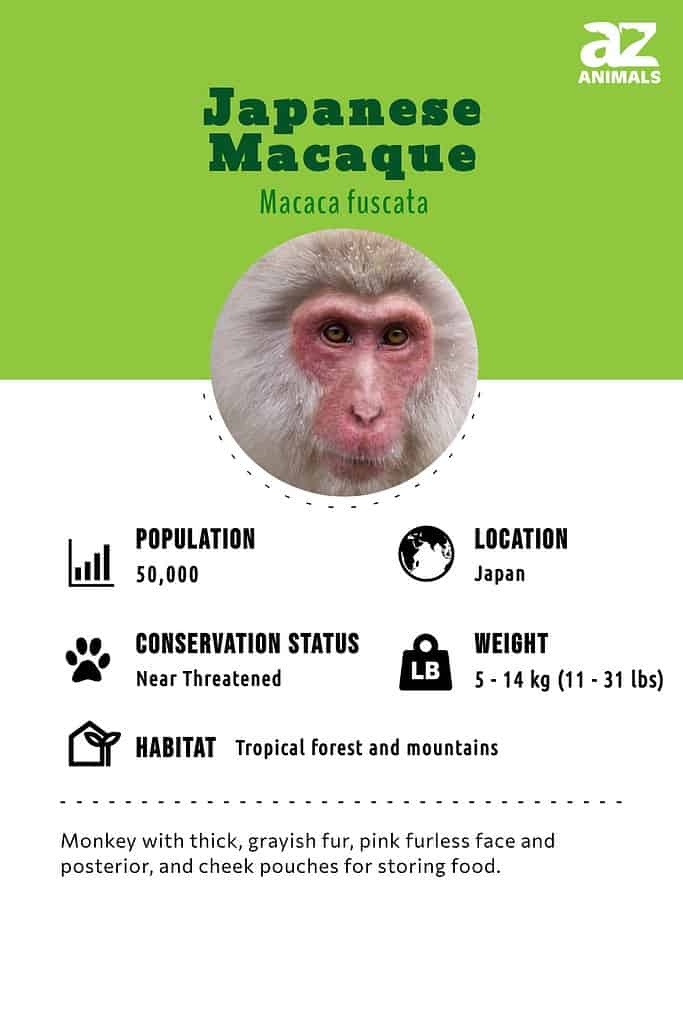
Scientific Name and Species

The Japanese macaque, (Macaca fuscata), is an Old World monkey species that is native to Japan. There are two subspecies:

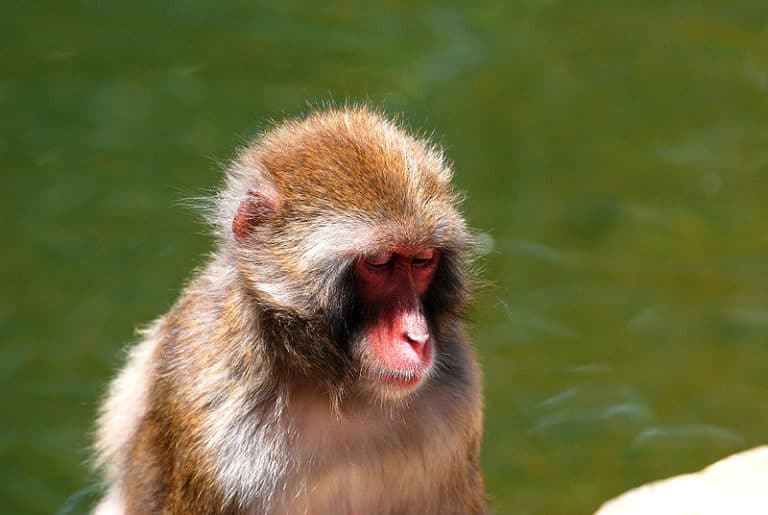
  • The Yakushima macaque (Macaca fuscata yakui), can be found on Yakushima Island and is also known as the Yaku macaque. These macaques are smaller and stockier than their northern counterparts and have black hands and feet. Adult males have a “momoware”, which parts their hair in the middle.
  • Snow monkey (Macaca fuscata), lives in the colder regions of Japan and is renowned for bathing in hot springs. They have thick brown or grayish fur and pink hairless faces and posteriors.

Evolution

The macaque lineage originated around 9 million years ago in Africa, with modern macaques diverging around 5 – 6 million years ago. Those five species are the eastern rhesus macaque (Macaca mulatta), the long-tailed macaque (M. fascicularis), the Japanese macaque (M. fuscata), the pig-tailed macaque (M. nemestria), and the bonnet macaque (M. radiata). The Japanese macaque differentiated from the eastern rhesus macaque during the Pleistocene and the two are closely related. Japanese macaques colonized Japan after the separation of the two species, between 0.31 and 0.88 million years ago. Some scientists do not believe there is enough genetic evidence to consider the two types of Japanese macaques as two separate subspecies.
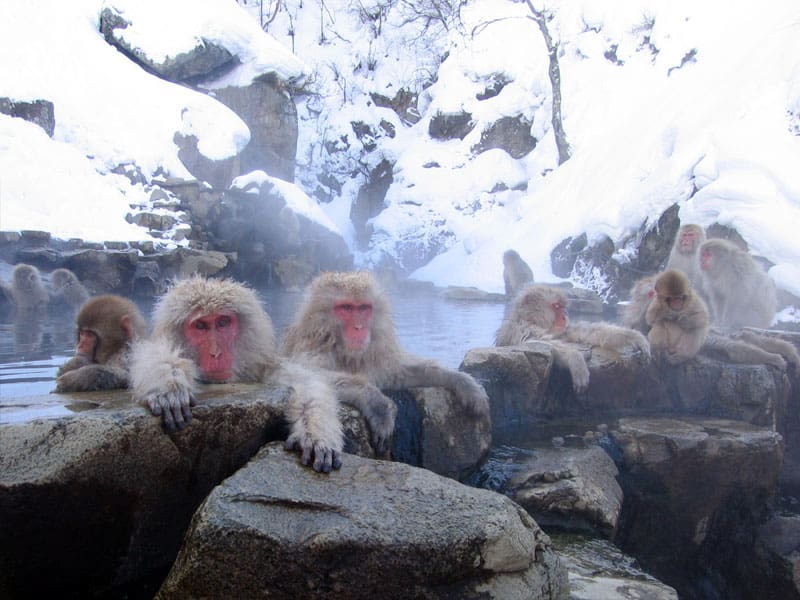
Japanese macaques are renowned for bathing in the Jigokudani Hot Spring.

Anatomy and Appearance

The Japanese macaque has a stocky body with a naked, red face that looks astonishingly human. Their thick, furry coat is usually grey or brown in color, sometimes with a slightly mottled pattern, and grows thicker during the winter months to allow the Japanese macaque to stay warm in freezing conditions. Like other monkey species, the Japanese macaque has opposable thumbs, allowing it to grasp and hold objects and is able to walk on just its hind legs when it has something in its hands. The Japanese macaque also has large pouches in its cheeks, to allow the animal to store food whilst foraging. They have a relatively short tail for their body size (in the same way as other primarily ground-dwelling Monkeys), and males tend to be somewhat larger than their female counterparts.

Distribution and Habitat
japan

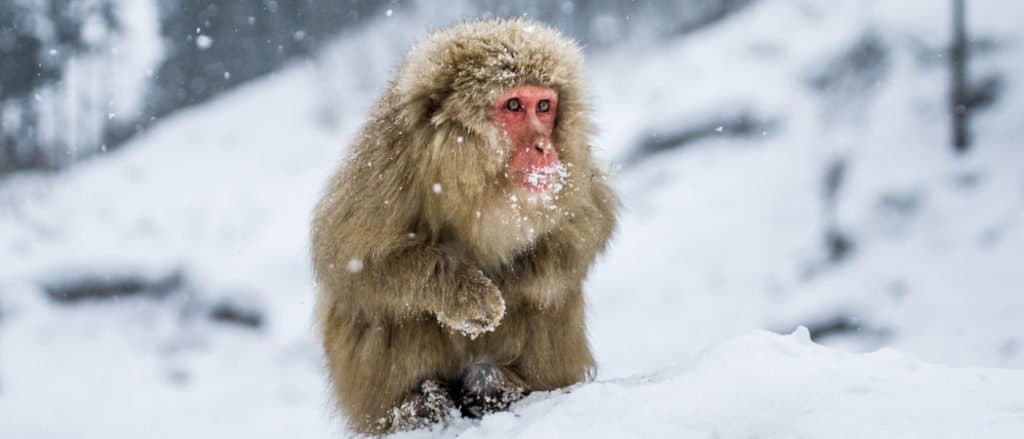
Japanese macaques living in the northern and central parts of Japan have to contend with snowy, cold conditions.

The Japanese Macaque is found in four separate regions in Japan throughout a variety of habitats from subtropical jungles to hot mountain springs, in forested hills, across highlands, and high up in the mountains. In the northern and central parts of Japan, Japanese macaques have to withstand seasonal changes with temperatures ranging from -15 degrees Centigrade in the winter to more than 23 in the summer, where the vegetation primarily consists of deciduous trees and conifers. In their most southern range, on the island of Yaku-Shima, the Japanese macaques live amongst tropical broad-leaf forests that are subjected to less seasonal change. In central Japan, the Japanese macaques are found in the mountains, where they warm themselves in the hot springs that are heated by nearby volcanoes.

Behavior and Lifestyle
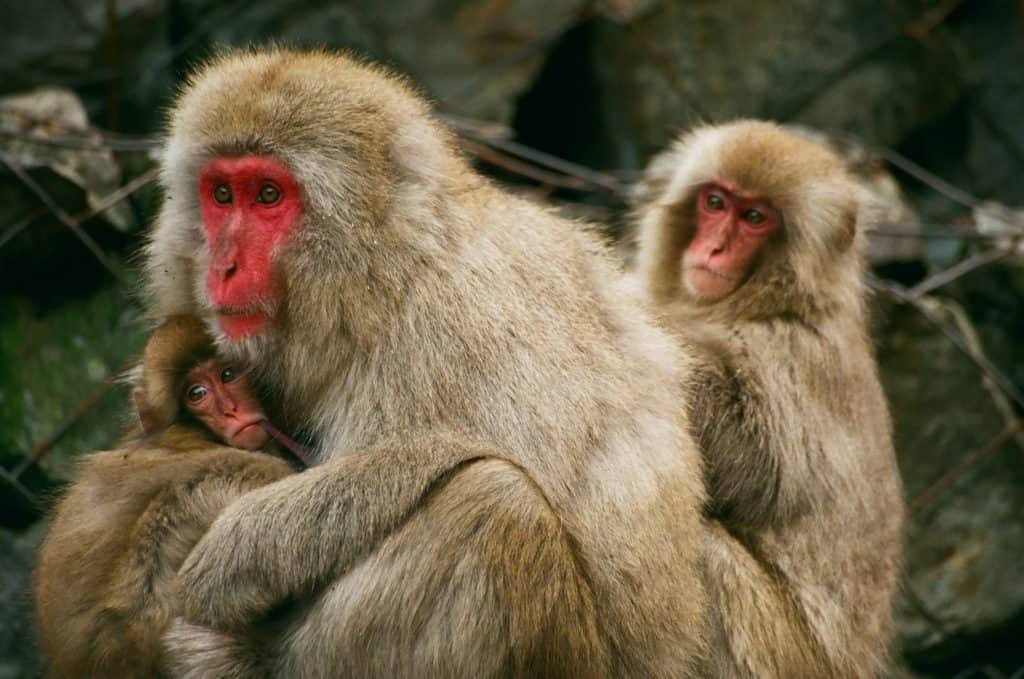
Japanese macaques live in troops of 20 – 30 individuals led by an alpha male.

Japanese macaques live together in troops that are led by the alpha male and usually consist of between 20 and 30 individuals. The alpha male not only helps to sire young, but also decides where the troop should go, and protects it from both predators and other Japanese macaque troops. Social rank is very important in Japanese macaque society and consists of both males and females, with the male’s rank often determined by his age. Offspring are thought to inherit the rank of their mother. Japanese macaques are incredibly sociable animals, particularly the females who tend to remain in the same troop for their whole lives and spend their time together, grooming and raising the troop’s young.

Reproduction and Life Cycles
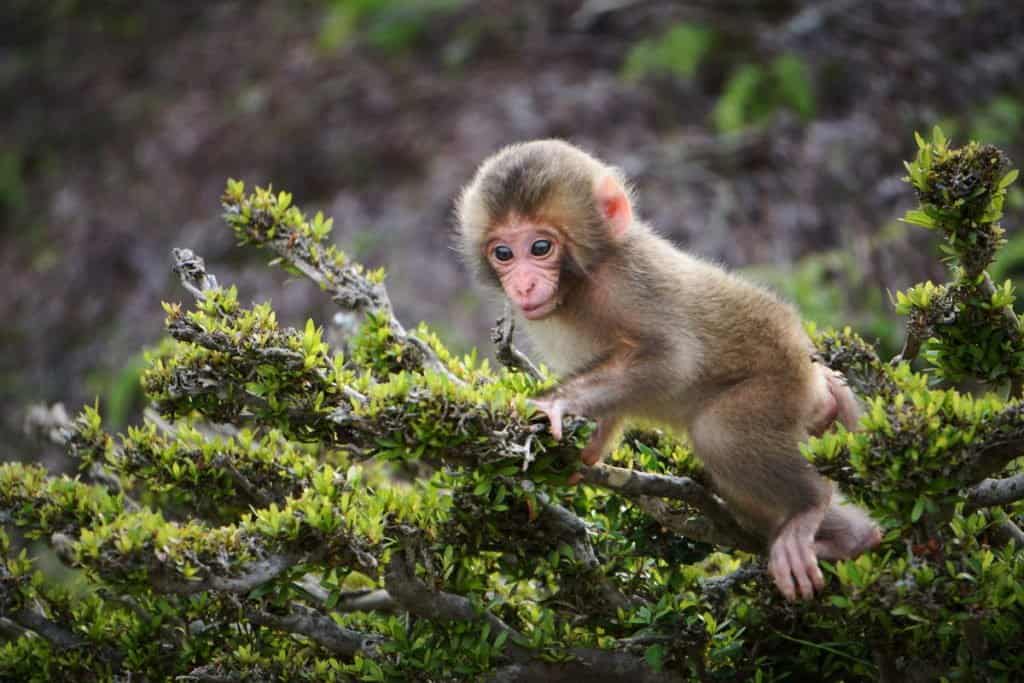
Baby Japanese macaques are dependent on their mothers for the first couple of years.

Female Japanese macaques tend to reach sexual maturity about a year earlier than males, between the ages of four and five. She usually chooses her mate by his rank, and after a gestation period that lasts for up to 6 months, the female gives birth to a single infant. Baby Japanese macaques are incredibly dependent on their mother and remain clinging to her for their first couple of years, meaning that mother and baby often have a very close bond. Once weaned, males often leave the troop and spend their lives traveling between others, while females generally remain in the same troop that they were born into. Japanese macaques tend to live for a relatively long time, often reaching age 30 or more.

Diet and Prey
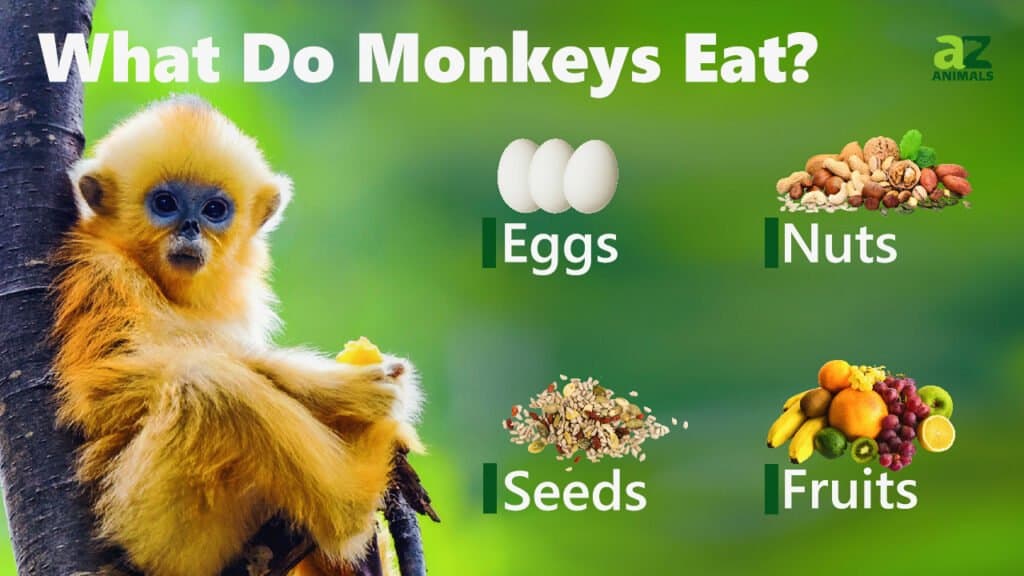
What Do Monkeys Eat image
Monkeys eat eggs, nuts, seeds, and fruits.

The Japanese macaque is an omnivorous animal meaning that it forages for both plants and smaller animals in order to survive. Unlike a number of other monkey species, Japanese macaques are primarily ground-dwelling so the majority of their foraging is done on the ground. They mainly eat fruits, berries, seeds, young leaves, and flowers which they pick from the surrounding vegetation before storing them in their cheek pouches, so that they can continue to gather more. They also supplement their diet with Crabs, Insects, and birds’ eggs particularly during the colder winter months when there are slim pickings on the branches. Japanese macaque babies feed on their mother’s milk until they are able to begin eating more solid foods.

Predators and Threats
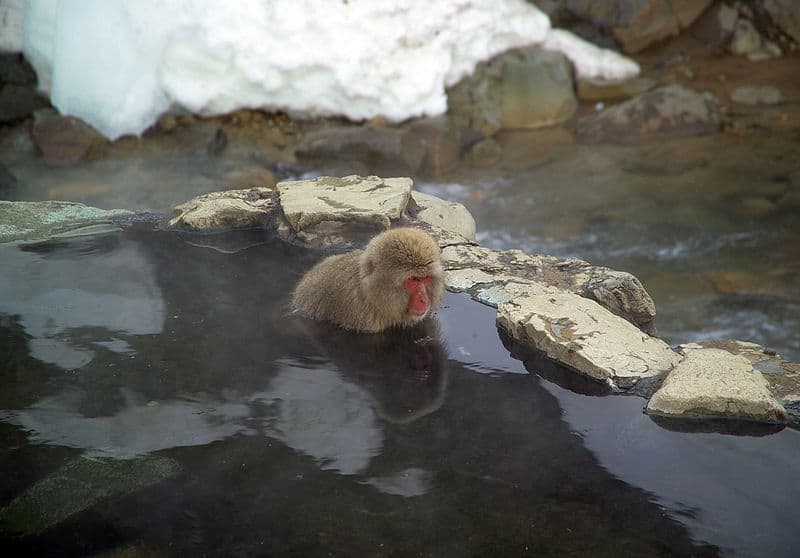
Japanese macaques are mostly threatened by human encroachment on their native ranges.

Due to their fairly large size and diverse habitat ranges, the Japanese macaque has no real predators in their natural environment, perhaps with the exception of the occasional hungry Wolf or feral Dog. Humans are the primary threat to the Japanese macaque as they are often killed by farmers when they approach livestock and crops. However, the only reason that these conflicts occur is that the Japanese macaque is being pushed into smaller and smaller pockets of its native ranges, due to deforestation and growing human settlements. During the colder winter months, Japanese macaque individuals in the north are also known to sleep in the deciduous trees to protect them from being buried in large amounts of snow during the night.

Interesting Facts and Features
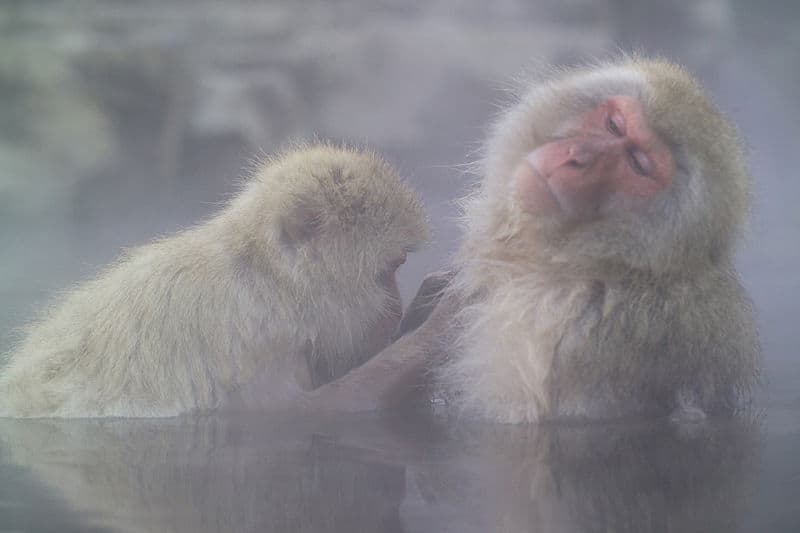
Female Japanese macaques have strict rules about mating to prevent inbreeding and are responsible for discovering the benefits of the hot spring.

The females are actually very picky when choosing a mate, as they will not mate with a male Japanese macaque that they have mated within the past few years, to prevent interbreeding within the troop. Japanese macaques, particularly in the north, have different home ranges for the changing seasons which leads to their wide variety in diet and different habitats. They are incredibly intelligent and adaptable animals and are known to pass new behaviors through the generations. In the mid-1900s a female was seen entering a hot spring to gather dropped soybeans and today, whole troops can be seen resting in the steaming waters to keep themselves warm.

Relationship with Humans
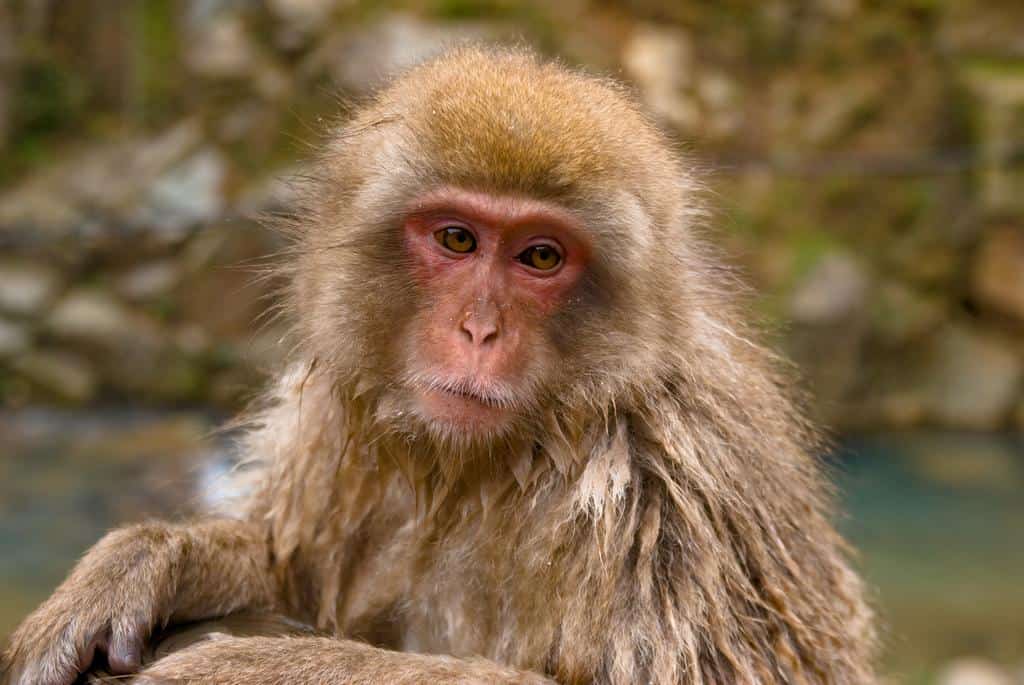
Japanese macaques are often killed by farmers after they raid crops.

Like many of the 22 monkey species found across Japan, the Japanese macaque is often loved and protected by the native people. However, growing human settlements and land clearance for logging and agriculture has meant that Japanese macaques have lost vast areas of their natural habitats, and often have to approach farmland in order to find better food supplies. It is estimated that, despite being a protected species in Japan today, around 5,000 Japanese macaque individuals are killed every year by farmers who claim to be protecting their livestock and their crops. In the Nagano Mountains in central Japan though, the Japanese macaques that bathe in the hot springs have become one of the country’s most desirable tourist attractions.

Conservation Status and Life Today
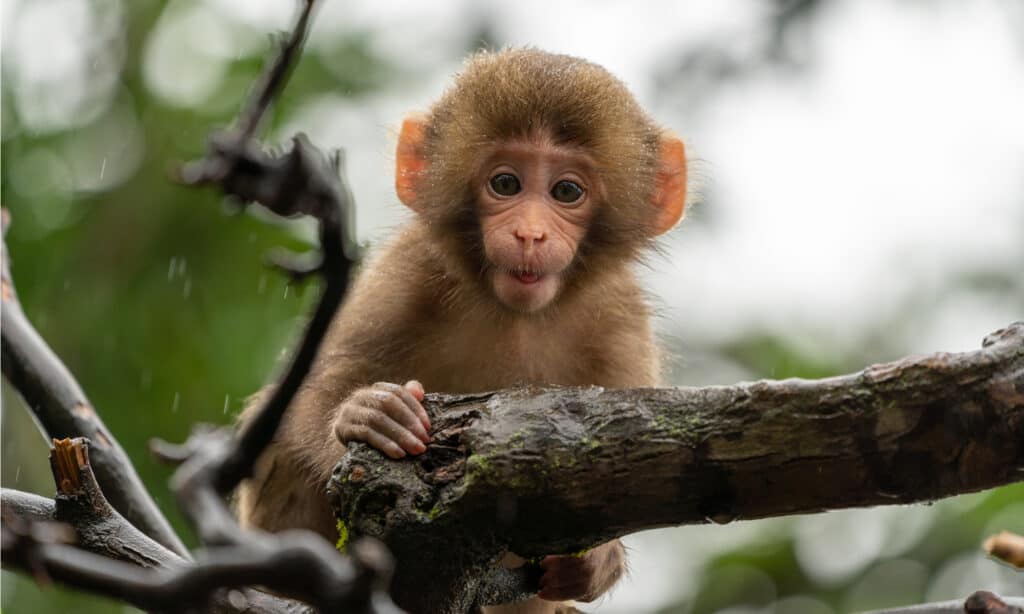
baby Japanese macaque

The Japanese macaque is listed as threatened by the IUCN.

Today, the Japanese macaque has been listed as a Threatened species by the IUCN, with the southern subspecies of the Japanese macaque listed as Endangered. It is estimated that there could be as few as 50,000 individuals remaining in Japan today, but numbers are still declining particularly seeing that they are often killed, as they are seen as pests by local people.

View all 52 animals that start with J
How to say Japanese Macaque in ...
Japanese
ニホンザル
Portuguese
Macaco-japonês
English
Japanese Macaque
Turkish
Japon şebeği

Sources

  1. David Burnie, Dorling Kindersley (2011) Animal, The Definitive Visual Guide To The World's Wildlife / Accessed April 6, 2011
  2. Tom Jackson, Lorenz Books (2007) The World Encyclopedia Of Animals / Accessed April 6, 2011
  3. David Burnie, Kingfisher (2011) The Kingfisher Animal Encyclopedia / Accessed April 6, 2011
  4. Richard Mackay, University of California Press (2009) The Atlas Of Endangered Species / Accessed April 6, 2011
  5. David Burnie, Dorling Kindersley (2008) Illustrated Encyclopedia Of Animals / Accessed April 6, 2011
  6. Dorling Kindersley (2006) Dorling Kindersley Encyclopedia Of Animals / Accessed April 6, 2011
  7. David W. Macdonald, Oxford University Press (2010) The Encyclopedia Of Mammals / Accessed April 6, 2011
  8. Japanese Macaque Information / Accessed April 6, 2011
  9. Japanese Macaque Habitat / Accessed April 6, 2011
  10. About Japanese Macaques / Accessed April 6, 2011
  11. Japanese Macaque Diet / Accessed April 6, 2011
  12. Japanese Macaque Species / Accessed April 6, 2011
Lisha Pace

About the Author

Lisha Pace

After a career of working to provide opportunities for local communities to experience and create art, I am enjoying having time to write about two of my favorite things - nature and animals. Half of my life is spent outdoors, usually with my husband and sweet little fourteen year old dog. We love to take walks by the lake and take photos of the animals we meet including: otters, ospreys, Canadian geese, ducks and nesting bald eagles. I also enjoy reading, discovering books to add to my library, collecting and playing vinyl, and listening to my son's music.

Thank you for reading! Have some feedback for us?


Japanese Macaque FAQs (Frequently Asked Questions)

Japanese Macaques are Omnivores, meaning they eat both plants and other animals.