
Quick Take
- One snail holds a speed record that has stood for over 30 years, and the number might surprise you in ways you don't expect. See archie's record →
- Out of more than 60,000 species of snails and slugs, only one dominates competitive racing, a fact that comes down to geography. Find out which species →
- The World Championship prize for the winning snail is nothing like any other trophy in sports. See the unusual prize →
Snail racing may seem like a comical oxymoron, but it is actually real. It is not likely to end up on ESPN anytime soon, but professional and amateur snail racing does exist. People have been gathering to race snails for longer than you might think. Read on to learn more about snail racing and find out just how fast these snails can go.
What Is Snail Racing?
Although every organization does it somewhat differently, most organizations use a similar format. Generally, a circular track is set up on a flat, elevated surface. A cotton cloth is laid down on the table. The Snail Master keeps the course damp because snails prefer moist conditions and it keeps the snails from drying out as they race. The tracks are usually 13-14 inches, and the snails race from the center to the perimeter.
Competitors bring their own snails or they can sometimes hire a snail onsite. The winning snail from each heat progresses to the finals. Competing snails are often identified by either acrylic paint or numbered stickers on their shells. At the Snail Racing World Championship, the prize for the champion snail is a silver tankard stuffed with lettuce.
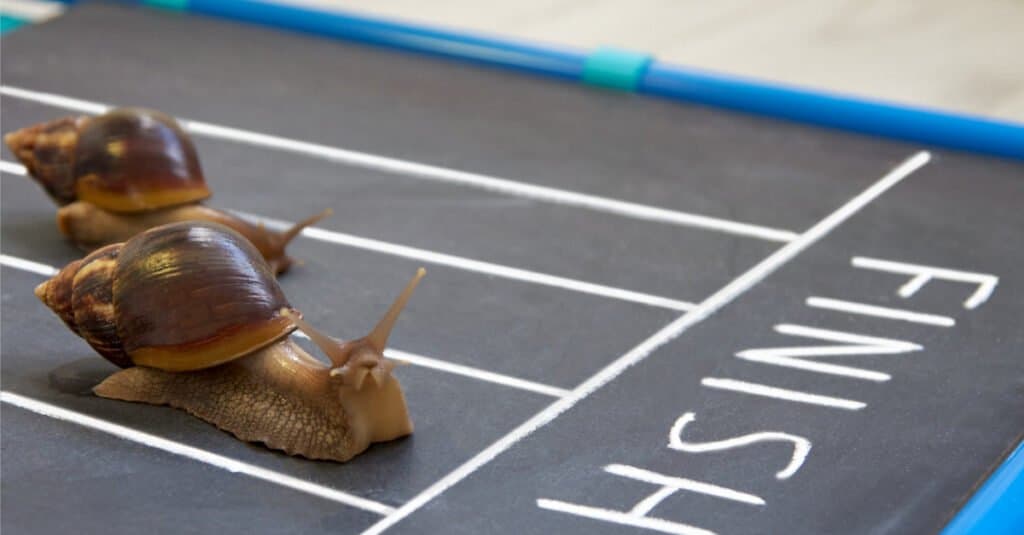
Snail racing may seem like an oxymoron, but the sport has a following, especially in the U.K.
©iStock.com/Aleksandr Zyablitskiy
The Most Popular Snail Racing Species
There are over 60,000 different species of snails and slugs. However, when it comes to snail racing, there is one species that reigns supreme — the brown garden snail, or Cornu aspersum. These snails are native to Europe and have been introduced to many different countries all over the world.
Snail racing has its largest following in the U.K. These land snails are common there, so they became the standard. There may be other snail races that use different species, but the majority of competitions appear to use the garden snail as their preferred species.
Snail Racing Competitions
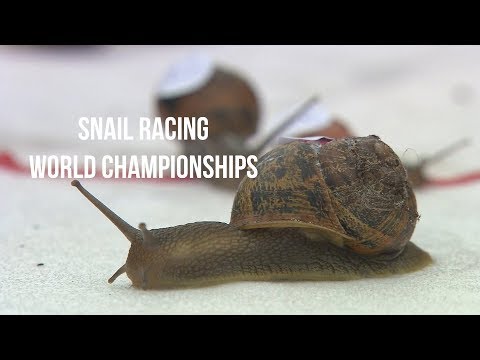
There are a number of snail competitions across the world, but most of the large events happen in the U.K. The World Snail Racing Championships is the biggest snail racing competition in the world. The event happens each year in Congham, Norfolk. It began in the 1960s, when founder Tom Elwes witnessed a snail racing event in France and brought the sport back to England.
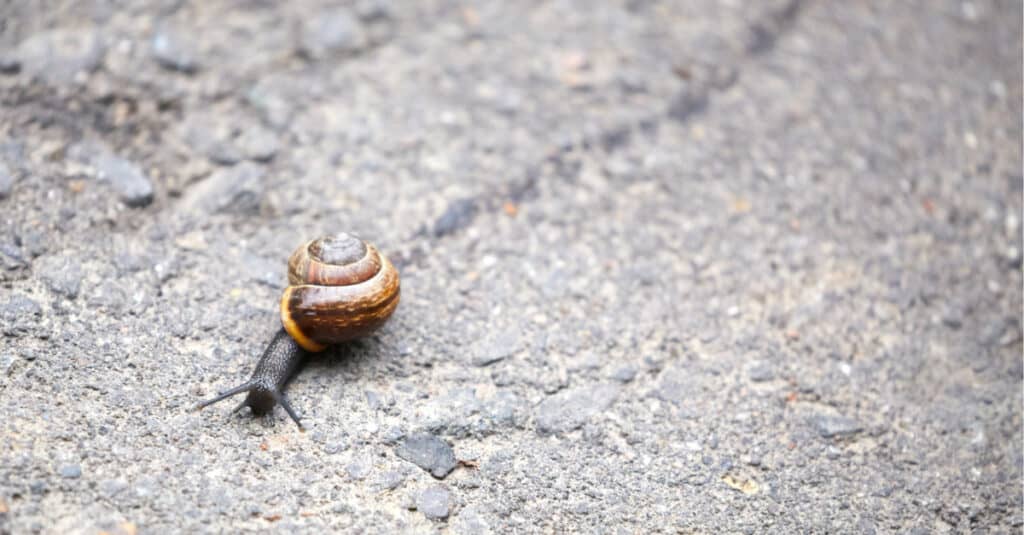
Researchers at the University of Exeter calculated that snails can travel approximately 0.00062 miles per hour.
©iStock.com/akinshin
There was also an official snail race instituted in London back in 1999. It was named the Guinness Gastropod Championship. It had its own commentator, a horse racing expert named John McCririck, who wittily began the race by saying, “Ready, Steady, SLOW!” Since that moment, it has been the official starting call for snail races. The fastest snail ever in this competition had a time of 2 minutes and 20 seconds over a 13-inch course.
Additionally, there is a Grand Championship Snail Race in Cambridgeshire, England that began in 1992. The village where the event is hosted is appropriately named Snailwell. Snail racing is a popular part of its summer fête. Incredibly, they have crowds of up to 400 people each year, although the village population is only around 180.
How Fast Are Snails?
Snails aren’t known for their speed, but just how fast — or slow — are they? Some sources claim that a garden snail can move at speeds of up to .03 mph (0.013 m/s). However, that is unlikely, as that would be many times faster than Archie, the world’s fastest snail racer, was clocked in his record-setting 0.0028 m/s race at the 1995 World Snail Racing competition. Archie has held the record for over 30 years.
Researchers at the University of Exeter tracked 450 garden snails over a period of 72 hours. They calculated that the average snail could travel around 1 meter per hour, or 0.00062 miles per hour. Archie traveled 13 inches in 2 minutes, which is approximately 0.006 mph, making the world record-holder very speedy for a snail.