
What was once an informal chore has evolved into an established part of the pet care industry. While it may not be considered a glamorous occupation, dog walking can be a rewarding and lucrative career. Professional dog walking has become a booming, technology-driven business, and the U.S. dog walking industry is projected to generate $1.3 billion in revenue in 2025. Dog walkers typically earn between $30,000 and $50,000 annually, although in large metropolitan areas where the demand is high, walkers can potentially earn six figures. However, the practice of walking with domesticated dogs dates back thousands of years. Continue reading to learn more about this time-honored profession in AZ-Animals’ brief history of dog walking.
Ancient History

Ancient petroglyphs at Jubbah, Saudi Arabia, depict humans having dominion over animals.
The earliest known depictions of leashed animals are found on rock art in Northwestern Saudi Arabia, at the sites of Shuwaymis and Jubbah. These petroglyphs are between 8,000 and 10,000 years old. In ancient Egypt, a tomb painting dating to approximately 3500 B.C. depicts a man walking his dog on a leash. It is believed that once humans shifted from nomadic hunter-gatherer societies to more agrarian, settled communities, their relationship with dogs changed, and walking them likely became a more deliberate task.
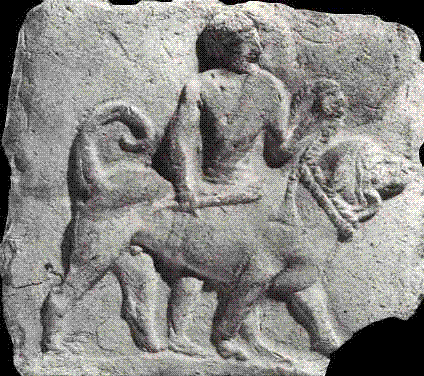
The Molossian bulldog, an extinct, ancient Greek mastiff-type dog known for its massive size, strength, and courage, was used as a hunting dog by Alexander the Great.
©Courtesy of Wikimedia Commons/Public Domain – Original / License
Domesticated dogs primarily served as hunting partners and camp protectors for nomadic hunter-gatherers. The shift to farming created invaluable tasks for dogs, including guarding livestock and property and deterring predators from newly domesticated animals like sheep and goats.
Living in permanent settlements meant dogs were increasingly confined rather than roaming large territories. This created a need for humans to actively provide their dogs with exercise. In the ancient world, the responsibility for walking dogs would have fallen to the dog’s guardian or enslaved individuals.
Middle Ages
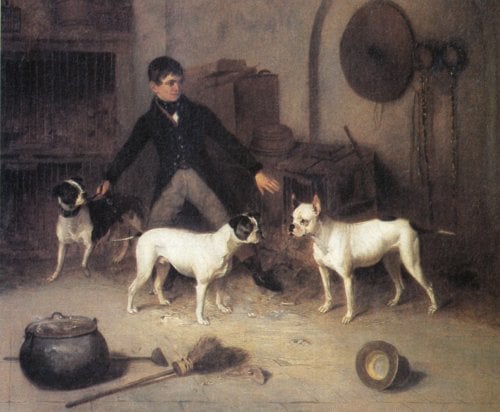
This aquatint by artist Thomas Clayton depicts the kennel boy, Jack Shepherd, with his charges, Duchess, Cribb, and Ball, old English bulldogs that belonged to Jem Burns.
©Courtesy of Thomas Clayton, Public domain, via Wikimedia Commons – Original / License
Before dogs were commonly kept as household companions, their care was typically relegated to employees who handled the working animals. In the Middle Ages, wealthy nobles and hunters hired staff, such as kennel boys, to care for their hounds. These employees had a full range of duties, which would have included exercising the dogs. Dogs were regularly taken for walks to stay healthy and fit for the hunt. Dog handling was considered a skilled craft because hunting dogs were highly valued assets.
The dogs were typically supervised by the kennel master, a servant charged with the training and care of a nobleman’s hunting hounds. Their work was critical to the success of the hunt, a significant pastime for the medieval elite. While the kennel master focused on the dogs’ upkeep and training, they operated within a broader hierarchy of hunting staff, which might be led by a master of hounds or chief huntsman.
Victorian Era
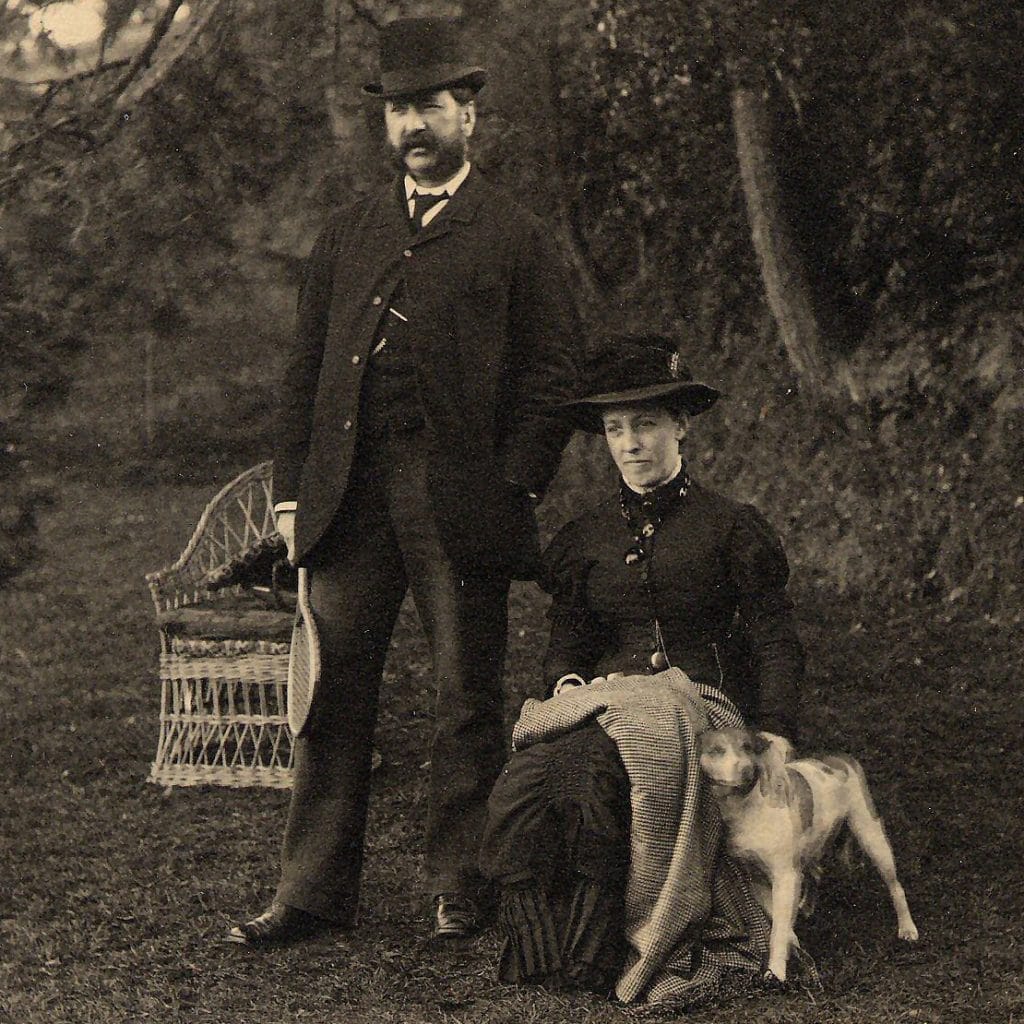
By the end of the 19th century, dogs had moved indoors and become part of the family.
©Historic Family Photograph, Public domain, via Wikimedia Commons – Original / License
The Victorian era saw a cultural transformation in attitudes toward domestic animals. In 19th-century Europe, dog walking reflected a significant shift in the canine’s role from a working animal to a cherished companion, particularly among the middle and upper classes. This led to the institutionalization of dog walking as a standard practice for managing and exercising pets.
In the Victorian era, dog walking shifted from a practice associated with working-class people into a controlled, supervised activity linked to the middle and upper classes. As dogs transitioned from working stock to beloved companions, taking them for walks became a way to provide exercise.
For the wealthy, pets were not just animals, but accessories that signaled one’s elite social standing. Having a servant perform the task of dog walking demonstrated that the family had enough money not to have to perform the task themselves. Instead of being a chore for the family, it was assigned to a member of the staff, emphasizing the household’s affluence. The Victorian era also ushered in the animal welfare movement, which led to laws banning acts like dog-baiting and using dogs to pull carts.
Modern Era

In this 1964 photograph by Neal Boenzi, Jim Buck is shown walking dogs in New York City.
©Courtesy of the armorist style siren photo credit: Neal Boenzi – Original
When dog walking first emerged as an occupation in the mid-20th century, it was considered unusual. The idea of being paid to walk someone else’s pet was a new phenomenon that challenged traditional social norms. While people had been paid to walk dogs before, it was not until 1960 that the profession became a recognized commercial endeavor.
In 1960, a man named Jim Buck left his job as an electronics salesman to become a professional dog walker in New York City. Buck reportedly earned a lucrative income as a professional dog walker. Although exact figures for his weekly earnings are not reliably documented, many sources claim that Buck was making as much as $500 per week in 1964 (equivalent to $5,225 in 2025), when he established the Jim Buck School for Dogs. Buck’s notoriety was such that he appeared on television shows and was the subject of magazine cover stories. Buck is universally credited for creating a commercial market for professional dog walkers. The Jim Buck School for Dogs served clientele on New York’s Upper East Side for nearly 50 years before Buck passed away in July 2013 at the age of 81.
21st Century

©SB Arts Media/Shutterstock.com
In the 21st century, dog walking is a legitimate, in-demand profession that offers flexibility with the potential for high earnings. It is a billion-dollar industry driven by apps that connect pet guardians with independent dog walkers. Tech features like GPS tracking and photo updates provide busy pet parents with peace of mind by offering real-time reassurance that their dogs are being properly cared for.
While today’s dog walkers provide a paid service, the emotional and psychological benefits of the human-canine bond remain as strong as they were in ancient times. From Mesopotamian texts to modern scientific studies, evidence shows that walking a dog is much more than a simple chore.