Quick Take
- These larvae cast fishing lines into the dark of caves, while their parents never even eat.
- The glowworm's silk is weaker than a spider's, and that fragility may be an adaptive feature rather than a flaw.
- The glowworm's light organ is unlike anything found in any other insect on Earth, and it works to attract insect prey.
- Compared to building a spider's web, running a living lure that glows might seem costly, yet the energy math shows it to be an efficient strategy.
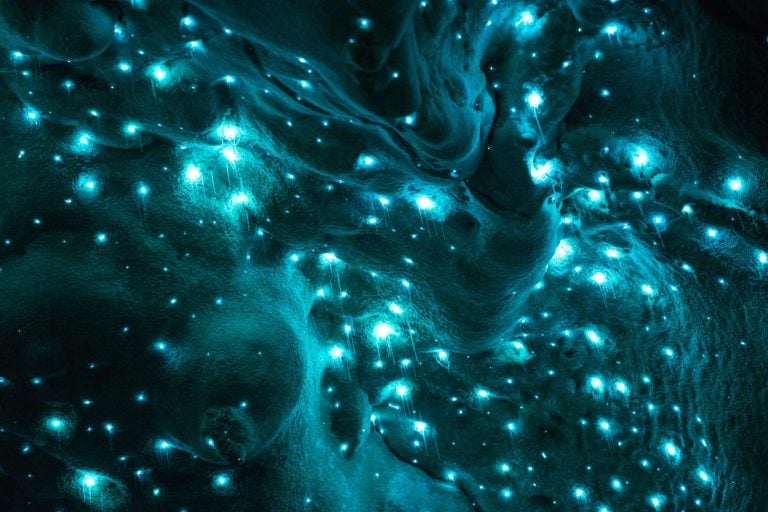
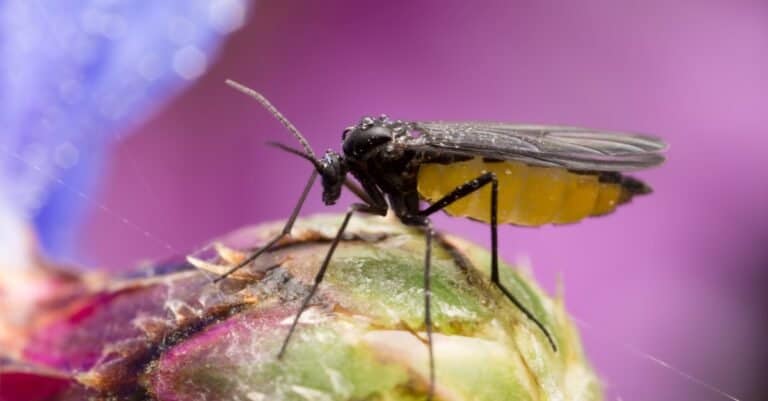
Deep inside some New Zealand caves, visitors may encounter strings of blue-green lights hanging from the ceiling. Those strings are not manmade but the product of an insect—the New Zealand glowworm (Arachnocampa luminosa), a species of fungus gnat whose larvae favor cool, dank places such as caves and wet forest understories.
New Zealand’s bedrock is made of limestone, which is rich in calcium carbonate and therefore easily dissolved by acidic rainwater. Over the past 30 million years, this process has created a vast system of crevices that open into hundreds of humid caves, some containing flowing streams. When the roofs of these caves collapse due to water erosion, additional entrances are created.
Many of these caves contain the bioluminescent strings produced by fungus gnat larvae, or “glowworms.” Adult fungus gnats live only a few days, just long enough to mate, but their larvae, which live for about nine months, produce the glowing strings. They build ‘fishing lines’—hanging strings of silk that are coated at intervals with bead-like, shiny drops of sticky mucus—to catch prey. According to a 1984 study in the Journal of the Royal Society of New Zealand, fishing lines are shorter in windy parts of the cave, where they risk getting tangled, and longer in sheltered areas.
Continue reading
What Makes the Fishing Lines Glow?

Two larvae of Arachnocampa luminosa hang from a cave roof with fishing lines,
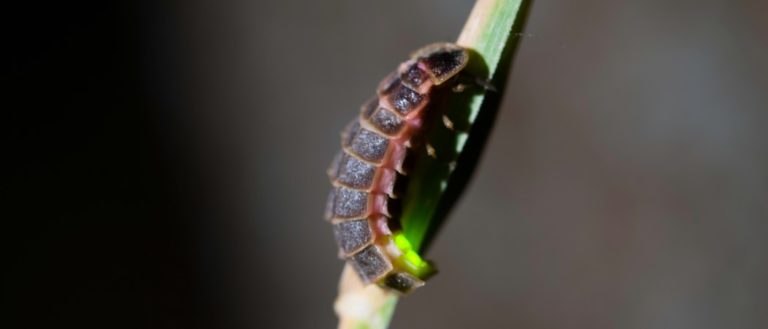
While the fishing lines themselves do not glow, they are illuminated by the blue-green light emitted by the glowworms from a specialized organ on their abdomens. This organ is a swelling at the tip of their excretory tubes (“Malpighian tubules”), a feature not found in any other insect. Natural reflectors above and below this organ direct the light downward, according to a classic 1979 study of their anatomy in Tissue and Cell.
The light attracts small insect prey to the dangling strings, which are then reeled in by the glowworms. Most of the prey are invertebrates that have hatched from aquatic larvae in the streams below. In an experimental study in a cave in Waitomo, New Zealand, transparent sticky traps installed over glowworms caught significantly more invertebrate prey than traps without glowworms, demonstrating the attractive power of the luminescence.

In the daytime, glowworm fishing lines do not appear luminescent.
Do the Lines Glow All the Time?
These glowworms alter their behavior in response to what’s going on in their surroundings. Larvae may glow throughout the night, but as soon as there’s light, they switch off. Pulsing an artificial light in a laboratory setting causes them to decrease and eventually shut off their luminescence. Vibrating their fishing lines, in contrast, causes glowworms to shine brighter. The authors of a 2016 study in the Journal of Comparative Physiology A wrote that “inhibitory and excitatory mechanisms combine to modulate bioluminescence intensity by regulating biochemical reactions or gating the access of air to the light organ.”
A 2011 study in the Journal of Comparative Physiology B found that using bioluminescence to trap prey is an efficient hunting strategy. Building and maintaining fishing lines is less energy-intensive than constructing webs, as spiders do. Even the energy expenditure during continuous bioluminescence by glowworms was relatively low.
Compared to the silk spun by hunting spiders, glowworm silk has distinct properties. For example, according to a 2019 study in Scientific Reports, glowworm silk is only sticky under conditions of high humidity (> 80%), such as those occurring in the limestone caves. The strands break more easily than spider web strands but are much stickier, which works well for the glowworms’ favored prey of small flies. The study authors hypothesize that the low tensile strength of the strands may allow prey that are too large to consume to break free before they destroy the entire fishing line.
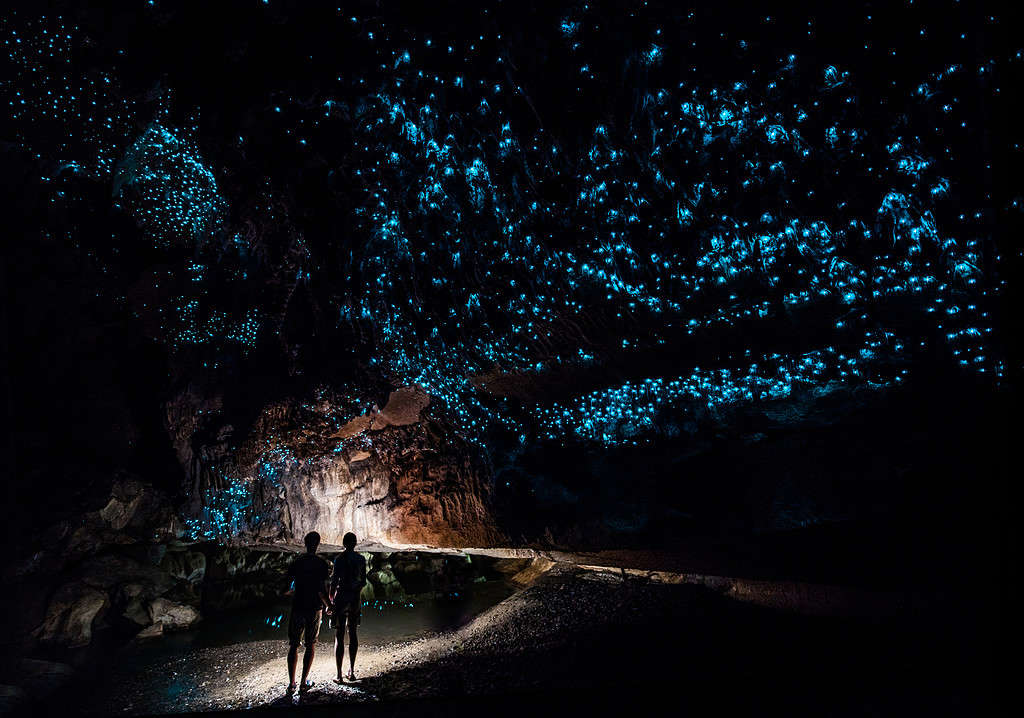
People explore the Glowworm Cathedral at the end of Waipu Cave in New Zealand.
©MarcelStrelow/iStock via Getty Images
These fungus gnat larvae are remarkable for their unique hunting method in the moist limestone caves and humid forests of New Zealand. One of the best places to see this spectacle is the Waitomo Glowworm Caves (note: Waitomo in the Māori language means “water hole”). Or visit one of the many other glowworm hangouts that are accessible by guided tour.
Take the opportunity to bask in the glow of these unusual invertebrates.