Quick Take
- This new marsupial species was discovered without anyone setting a single trap, and the place it was hiding will surprise you. See how it was found →
- Scientists suspected something was wrong with how these marsupials were classified for nearly 30 years, and it took one small physical detail to finally crack the case. Trace the genetic clues →
- A century-old specimen locked in a Swedish museum turned out to be the key to untangling an entirely separate case of mistaken identity. Discover the Swedish specimen →
- This species may already be in serious trouble, and scientists have no way to know how bad it is. The reason why is unsettling. Explore the conservation risks →
Australia is home to some of the world’s most unusual mammals, yet even now, brand-new species are still turning up. Sometimes they’re not found in the wild at all, but in the drawers of a museum. That’s part of the story behind Planigale petrophila, a tiny carnivorous marsupial recently described from the rugged sandstone country of northern Australia. It’s a discovery decades in the making, and it says a lot about how much we still have to learn about our wildlife.
Continue reading

Dr. Linette Umbrello of the Western Australian Museum worked with a pioneering team to examine, for the first time, the genetic relationships among Australia’s carnivorous marsupial species.
©Dr Linette Umbrello © Western Australian Museum – Original / License
A Hunch Buried in the Data
The first clues came long before anyone knew a new species existed. For years, several small marsupials were lumped together under a single name: Planigale ingrami. But something didn’t quite add up. “Their work on this group started back in the 1990s, and it was in a study they published in 2017 that they first noticed some unusual samples among specimens attributed to Planigale ingrami that indicated they might not be the same species,” says Dr. Linette Umbrello, Research Associate at the Western Australian Museum.
That finding kicked off something bigger. “This spurred us to collaborate on an Australia-wide project on planigales,” Dr. Umbrello explains. The project, funded by the Australian Biological Resources Study in 2021, built on decades of earlier research. “In the first phase of this project we described two new planigale species from the Pilbara region in Western Australia, so we knew the group as a whole probably had other new species that needed to be described.”
Building the Case
Suspecting a new species is one thing. Proving it is another. The team needed several lines of evidence to be sure Planigale petrophila wasn’t just a local variant.
They began with genetics. “We obtained many genetic samples from all planigale species across Australia, which gave us more power to detect the different lineages and to identify where they occurred,” Dr. Umbrello says. The results were telling. “We didn’t find any other individuals that were genetically the same as the two Kakadu samples. This indicated that the undescribed species was likely to be quite rare.”
Then came the moment that sealed it. The team returned to two specimens housed at the Museum and Art Gallery of the Northern Territory.
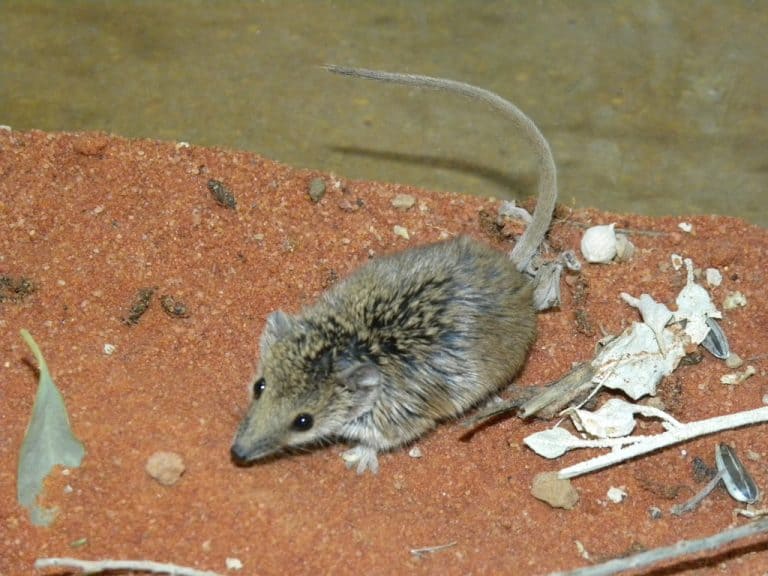
“This was our ‘aha’ moment,” Dr. Umbrello recalls. “The two specimens were clearly physically quite different to any other species of planigale occurring in northern Australia. They had very long tails, very long and flat heads — planigales are known to have very flat heads, and these ones are particularly flat — and their fur is quite dark and grey, while other species in Northern Australia are more brown or tan and with paler bellies.”
Once the team knew what to look for, another clue fell into place. “We found a third specimen in the Queensland Museum collection that had been collected from the same location in Kakadu National Park in the 1970s,” she says.
Even the animal’s habitat set it apart. Most planigales stick to flat, cracked clay plains, sheltering deep in the soil—but not this one. “Planigale petrophila is only known from the rocky plateaus of west Arnhem Land,” Dr. Umbrello notes. This was a striking break from its close relatives.

Planigale petrophila turned out to be a distinct species, not just a local variation.
What We Know, and What We Don’t
With only three specimens on record, much about this little marsupial remains unknown.
“There is much that remains unknown about this new species,” Dr. Umbrello admits. The most recent specimens were trapped atop the sandstone plateau of the West Arnhem Escarpment. “Presumably, they shelter under slabs of rock that litter the surface of this plateau. This is quite a unique habitat type for a planigale, and suggests that Planigale petrophila is a habitat specialist.”
That rocky home hints at something special. “There are other species of mammals and reptiles that are endemic to the Arnhem Escarpment — that is, they don’t occur anywhere else — and Planigale petrophila is likely to be the same.”
As for its daily life, educated guesses fill the gaps. “Planigale petrophila is likely to be a generalist insectivore, like other planigale species, and would prey on a range of small invertebrates which it would hunt for at night,” she says. “Nothing yet is known of their breeding biology or lifespan, but other species are known to have about 6 to 12 young and can live for two years in the wild.” Her team suspects the animal is rare enough that it may warrant being listed as a threatened species.
We obtained many genetic samples from all planigale species across Australia, which gave us more power to detect the different lineages and to identify where they occurred. We didn’t find any other individuals that were genetically the same as the two Kakadu samples. This indicated that the undescribed species was likely to be quite rare.
Dr. Linette Umbrello of the Western Australian Museum
The Power of Museum Drawers
If there is a quiet hero in this story, it is the museum collection. Without those preserved specimens, Planigale petrophila might still be unknown.
“Museum collections were essential in the discovery,” Dr. Umbrello says plainly. “If it weren’t for the three museum specimens of this new species in collections, we would not have known it existed.”
The collections delivered a bonus, too. During the study, the team realized that planigales in the Kimberley region belonged to a species described more than a century ago and held in the Swedish Museum of Natural History. “With help from the curators, who took photos of the specimen for us, we were able to match the morphology with those held in the Western Australian Museum and confirmed they were Planigale subtilissima rather than Planigale ingrami,” she explains. “Museum collections hold a legacy of information and undiscovered species waiting to be described.”
A Warning Written in the Rocks
Naming a species is more than just a scientific milestone; in a place like Kakadu, it has significant implications.
“It shows us that there is still a lot we don’t know about the diversity of our wildlife, and that there is more work to be done,” Dr. Umbrello says. “This is critical in places that are experiencing changes that are detrimental to wildlife.”
Northern Australia has been losing mammals at an alarming rate. “Many mammals that were once common in Kakadu National Park have since declined to very low numbers, which is alarming in a landscape that is far removed from many of the usual environmental pressures,” she says. “Given the declines in other mammal species from Kakadu, we are concerned that Planigale petrophila could have suffered the same fate.”
The trouble is, there’s no baseline to measure against. “We have no data on this species to properly assess population changes over time, since it has only just been formally described,” Dr. Umbrello says. Still, the work continues. “We’ll be undertaking a full conservation assessment to see if it is eligible for listing under the IUCN Red List.”