
Quick Take
- Small cone ants have been spotted licking, nipping, and pulling at larger harvester ants in Arizona.
- The larger ant seems to actively seek out this ‘treatment.’
- The relationship is likely an example of mutualism.
- The harvester ants get parasites and dead tissue cleared away, and the cone ants get a meal.
Mutualism is a type of symbiotic relationship in which both parties gain some form of benefit from their interactions. Many of them involve a type of cleaning service. A typical example is when one fish species removes organic material from another. The fish being cleaned benefits from parasite removal, while the cleaner fish gets a meal. In 2006, an entomologist named Mark Moffett witnessed similar behavior in ants! He has now published his account and the extraordinary photographs in the journal Ecology and Evolution. Read on to find out more about the first known example of one ant species licking and nipping at the body of another species.
Discovering a Novel Ant Partnership in Arizona
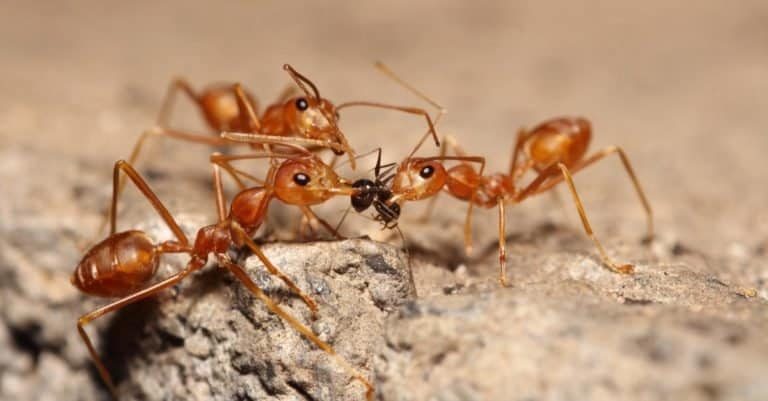
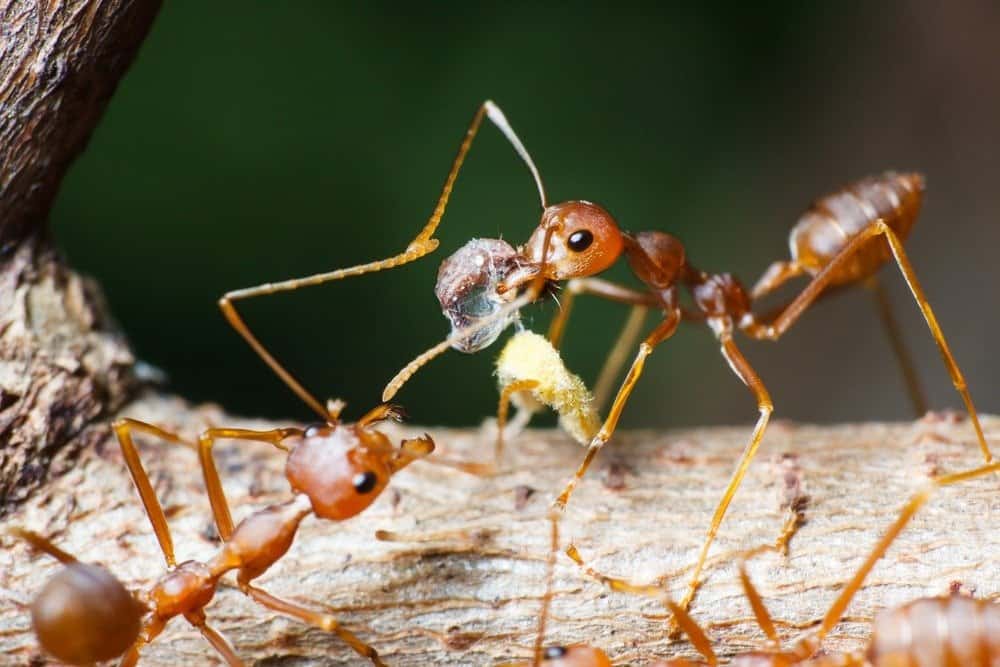
It was mid-June at the Southwestern Research Station in Portal, Arizona, when Mark Moffett was watching some harvester ants (Pogonomyrmex barbatus) come out of their nest. He noticed that a few of them seemed frozen in one spot until a smaller cone ant (Dorymyrmex medeis) arrived and crawled all over their bodies.
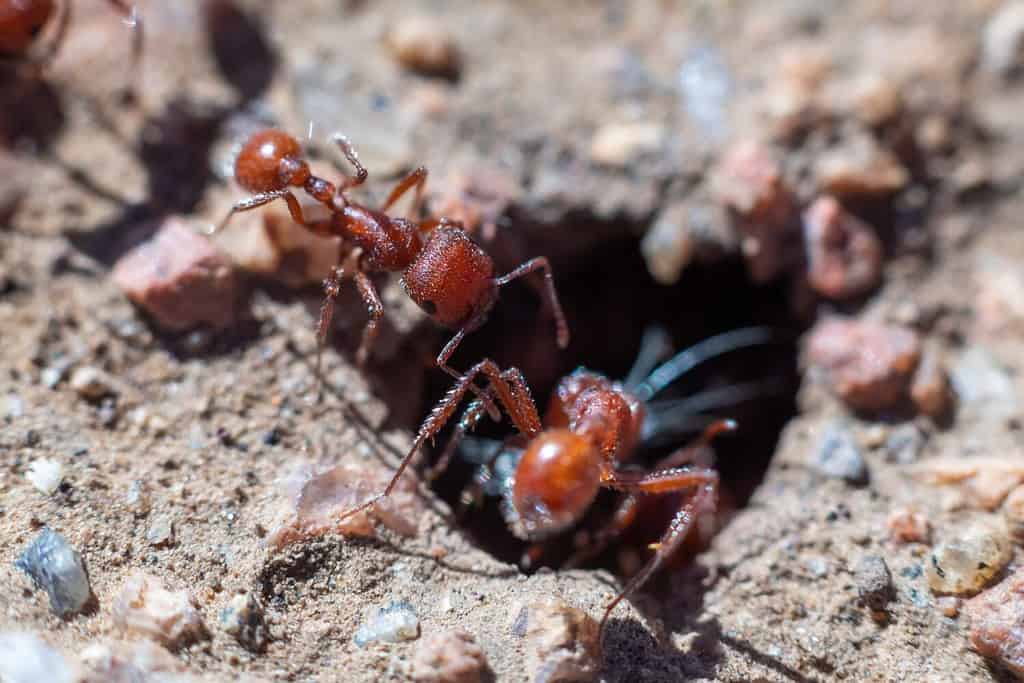
Harvester ants seek out cone ant nests.
©Kessler Bowman/Shutterstock.com
This activity started at sunrise and peaked before 9:00 a.m. The harvester ants seemed to be approaching and waiting outside a Dorymyrmex nest as if waiting to be served. They even adopted a distinctive posture, standing stiffly high on their legs with their abdomen typically lifted and their mandibles (mouthparts) wide open. It took just a minute for the cone ants to emerge, climb onto the larger ant, and start licking, nipping, and pulling.
How Does This Relationship Work?
The larger harvester ant likely gets something from this relationship because ants are generally very intolerant of other ant species near them. Yet, they allow the smaller ants to clamber all over them. The interactions may last only 15 seconds, but can go on for over 5 minutes. As many as five cone ants can attach themselves to a single harvester ant. What’s more, Moffett observed the harvester ants actively backing up into a cone ant nest, as if requesting this attention! They even held open their mandibles. Once they have had enough, however, they flick the cone ants off. Harvester ants are known to groom each other to remove dead tissue and parasites, so perhaps this is a form of enhanced grooming supplied by another species?
The cone ant is also getting something from this encounter. Otherwise, why would they rush out of the nest and make this potentially perilous journey aboard a bigger ant of another species? Moffett discovered that they did not behave like this towards dead harvester ants, so the live ones were providing them with something, probably a tasty meal. This is the first recorded example of a cleaner ant species, as confirmed by research published in April 2026, though further study is needed to fully understand the behavior.