
Quick Take
- A bat so elusive that experts can't even say if it's rare or threatened just turned up somewhere it had no business being. Meet the elusive bat →
- The ecologist who found it wasn't even looking for it, and the tool that cracked the case never touched the bat. How the bat was found →
- Australia may be famous for exotic wildlife, but this discovery suggests its most remote corners are hiding species in plain sight. See the range expansion →
- Scientists still don't know where this bat sleeps, and that missing detail could determine whether it survives. Roosting habits still unknown →
Australia might be the true last frontier of biological mystery. It’s a huge landmass, with thousands of miles of remote, inhospitable terrain that can be nearly impossible to study. Even Australia’s more temperate regions contain dense forests and isolated habitats that still hold plenty of biological mysteries. Case in point: the elusive Arnhem sheath-tailed bat. Recently, an ecologist recorded this bat’s ultrasonic calls more than 650 kilometers east of its previously documented range.
The Arnhem sheath-tailed bat is something of a phantom. While scientists know the basics regarding this creature, much still remains a mystery, as reinforced by this new documented evidence. Observations of this species are rare and have really only happened in the top end of Australia’s Northern Territory. Let’s learn more about this new research, how an ecologist found evidence of the Arnhem sheath-tailed bat far outside of its expected range, and what this discovery tells us about our gaps in understanding regarding elusive species.
The Arnhem Sheath-Tailed Bat
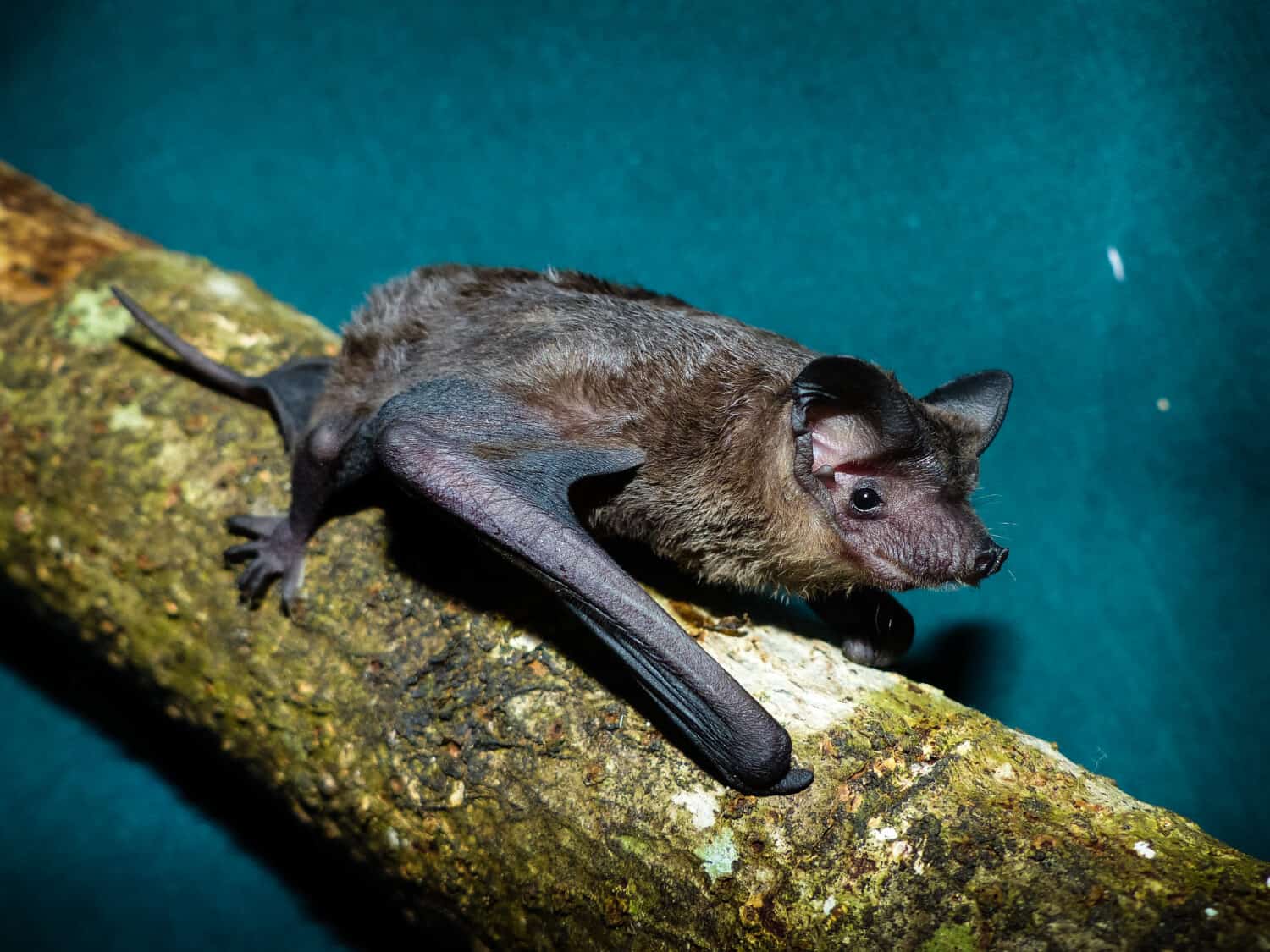
Found in Australia’s Northern Territory, the Arnhem sheath-tailed bat is so elusive that scientists don’t know if it is widespread or threatened.
©Connie Pinson/Shutterstock.com
The Arnhem sheath-tailed bat lives in Australia’s Northern Territory and is notoriously difficult to observe. Also called the Arnhem tomb bat (Taphozous kapalgensis), this microbat species is endemic to the northernmost part of Australia’s Northern Territory. It is medium to small in size, weighing between 25 and 30 grams.
The Arnhem sheath-tailed bat gets its name from its unique tail structure, which protrudes into the upper part of the tail membrane instead of being fully enclosed. These bats have golden-brown to yellowish fur on their backs, and paler-colored fur underneath. They also have long, thin wings designed for breakneck speeds high above the forest canopies.
As for its behavioral tendencies, the Arnhem sheath-tailed bat is an aerial insectivore, opting to stay above the tree line while foraging. When prey is near, these bats use narrow-band echolocation calls to triangulate targets that they pursue rapidly. Beyond that, not much is known about these creatures. Understanding of their more subtle tendencies is lacking, and sightings of them are rare. That’s what makes the latest discovery about their movements all the more surprising.
An Unexpected Discovery
Recently, an ecologist with the Australian Wildlife Conservancy named Oli Aylen added new data points for the mysterious bat species. The Conservancy’s resident bat specialist, Aylen, is also called “Batman” by his colleagues due to his expertise in tracking bats. The discovery happened at Pungalina-Seven Emu Wildlife Sanctuary. This sanctuary is near the Queensland border, southeast of Borroloola and near the Gulf of Carpentaria. While setting up for an unrelated survey, Aylen happened to bring out the right equipment.
He told the NT Independent, “We were actually setting up canopy mist nets around the mangroves at Pungalina. I just happened to also have my handheld bat detector on, capturing the calls of the bats as they flew overhead.”
Aylen’s knowledge of bat echolocation quite literally perked his ears up. He said, “The species has a really short echolocation call, which is highly unusual for bats that call at that frequency. So straight away, I wondered if that’s what it could be.”
Instead of relying on direct observation or outright capture, Aylen relied on acoustic analysis to make a surprising discovery. But first, he had to call in a fellow expert.
Acoustic Analysis

These findings will make the Arnhem sheath-tailed bat a priority for future Australian Wildlife Conservancy surveys.
©Serge Goujon/Shutterstock.com
Aylen sent his curious bat recording to Dr. Damian Milne, fellow bat expert and senior scientist at the Northern Territory Government’s Flora and Fauna Division. Quickly, Dr. Milne identified the echolocation calls as belonging to the Arnhem sheath-tailed bat. This was a surprising finding; Aylen recorded the calls 650 kilometers from the bat’s previous most easterly detection near Jabiru, Northern Territory.
650
km
east of the bat's previous most easterly detection, near Jabiru
Prior reports of the bat near the Northern Territory’s Top End have surfaced over the years. Now, scientists have confirmation. As Aylen told NT Independent, his chance recordings provide real progress. He said, “It’s certainly one of Australia’s most rarely observed species. The bat’s discovery at Pungalina and subsequent range expansion is really exciting. It’s a major step forward in deepening our understanding of where the Arnhem Sheath-tailed Bat occurs.”
Further Study
These findings make Arnhem sheath-tailed bats a priority for future Australia Wildlife Conservancy surveys. It’s probably for the best, since so little is known about this microbat species. As Aylen explained, even bat experts don’t know if Arnhem bats are widespread, rare, or threatened. So little research has been done on this species that their numbers remain nearly impossible to estimate.
If we’re lucky, we may be able to find out where these bats roost, a vital knowledge gap — which will help us further protect this species and the habitat it relies on.
This chance field recording is the Australian Wildlife Conservancy’s most significant addition to research on the species. Future targeted surveys of these bats might unlock more secrets. As Aylen told the NT Independent, “If we’re lucky, we may be able to find out where these bats roost, a vital knowledge gap — which will help us further protect this species and the habitat it relies on.”