
Don’t you wish you could see the world through your dog’s eyes? I sure do — but unfortunately, the closest we can get is knowing the science behind how they see.
Dogs cannot see red, and they also can’t see green. Instead, they see the world similarly to how a person with red-green colorblindness sees it. The colors they can detect best are blue and yellow.
In this article, we’ll talk about whether dogs can see red, what colors they can see, and more!
What Colors Can Dogs Not See?

A dog’s view of a red apple, with actual appearance on the left, and what dogs see on the right.
©Bocskai Istvan/Shutterstock.com
Dogs see similarly to humans with red-green colorblindness. This means they don’t see the colors red or green the same as a person without colorblindness does. They also don’t see purple or orange in the same way, since these colors have red in them.
The colors that dogs see “true” to most humans’ experience are blue and yellow. Other colors look like various shades of gray, brown, and yellow. Dogs can still sometimes distinguish between these colors, though not always.
For instance, it’s likely easier for them to tell red (which they see as brownish-gray) from yellow (which they see normally) than it is to tell orange from green, because orange and green both appear yellow-ish to their eyes.
To know why this is, you first have to understand a little bit about eyes and how they’re structured. Humans and dogs both have photoreceptors known as rods (which help us see in low light) and cones (which help us see in color).
Dogs have one cone for every 20 rods in their eyes, while humans have one cone for every nine rods. This means they see better at night and can better detect motion, but they don’t see colors or detail as well as we do.
In addition, while humans are trichromatic (meaning we have three types of cones), dogs are bichromatic (having only two types of cones).
Do Dogs See in Black and White?
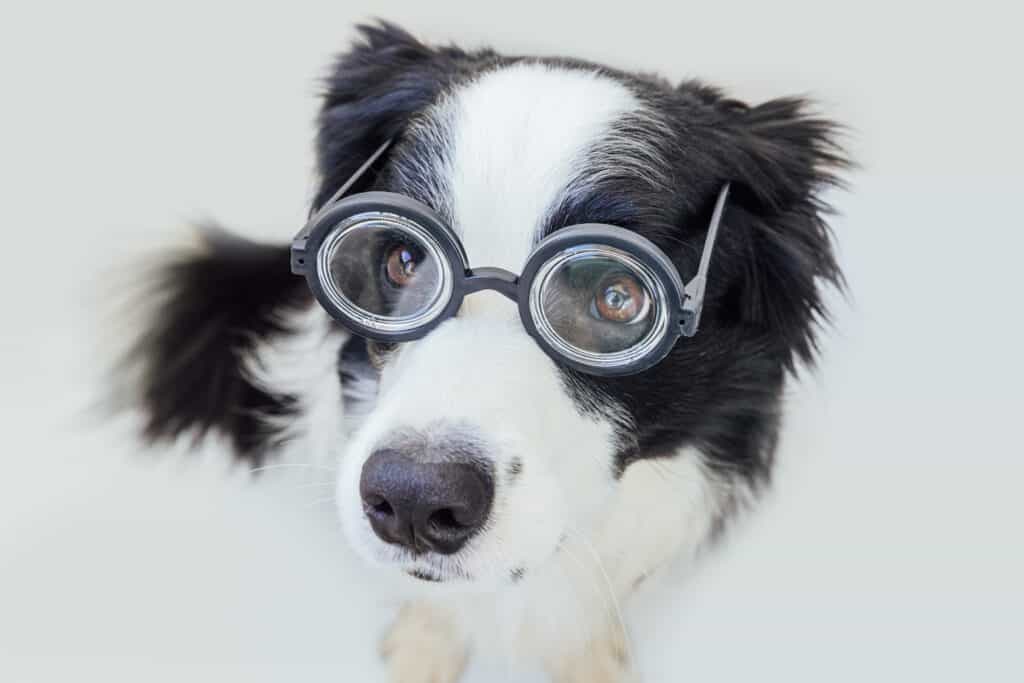
Contrary to what some believe, dogs do not see in black and white. That is a myth.
©iStock.com/Iuliia Zavalishina
No, dogs don’t see in black and white — but scientists used to think so! At this point, it’s an outdated myth.
We know that dogs can see colors because of the photoreceptors in their eye — specifically, the cones. As we discussed above, cones help animals’ eyes to see in color.
Dogs don’t have nearly as many cones as humans, but they do have some which allow them to see shades of yellow and blue.
Like a colorblind human, dogs don’t just see shades of gray in place of the colors they can’t see. Instead, scientists believe they see shades of yellow, gray, and brown.
What Colors Do Dogs See Best?

Because they discern blue and yellow well, dogs live in a more colorful world than many think.
©KRIACHKO OLEKSII/Shutterstock.com
Dogs see yellow and blue best. It’s theorized that they also prefer toys of this color, since they can differentiate them better from other objects.
For instance, it’s easy to lose an orange ball in the grass if dogs see both colors as a shade of yellow. But a bright blue or yellow ball is easier to spot!
It’s also important to know this information for training purposes. For instance, it might be impossible for your dog to know the difference between two alike objects of different colors, so trying to teach them which is which will only frustrate you both.
But using differently shaped items or colors that your dog can differentiate, like blue and yellow, will make for a fun, attainable training goal!
Other Differences Between Dog and Human Eyesight
- Humans have better depth perception than dogs, because human eyes are set closer together.
- Dogs have greater peripheral vision, because their eyes are set further apart.
- Dog pupils dilate further, allowing in more light–further aiding their night vision.
- Dogs have more rods in their eyes, which help them to see at night and detect movements.
- Humans have more cones in our eyes, which help us to see colors and details.
Overall, human eyes are built to see best during the day, while dog’s eyes are built to see best at night.
Why Do Dogs and Humans See Differently?
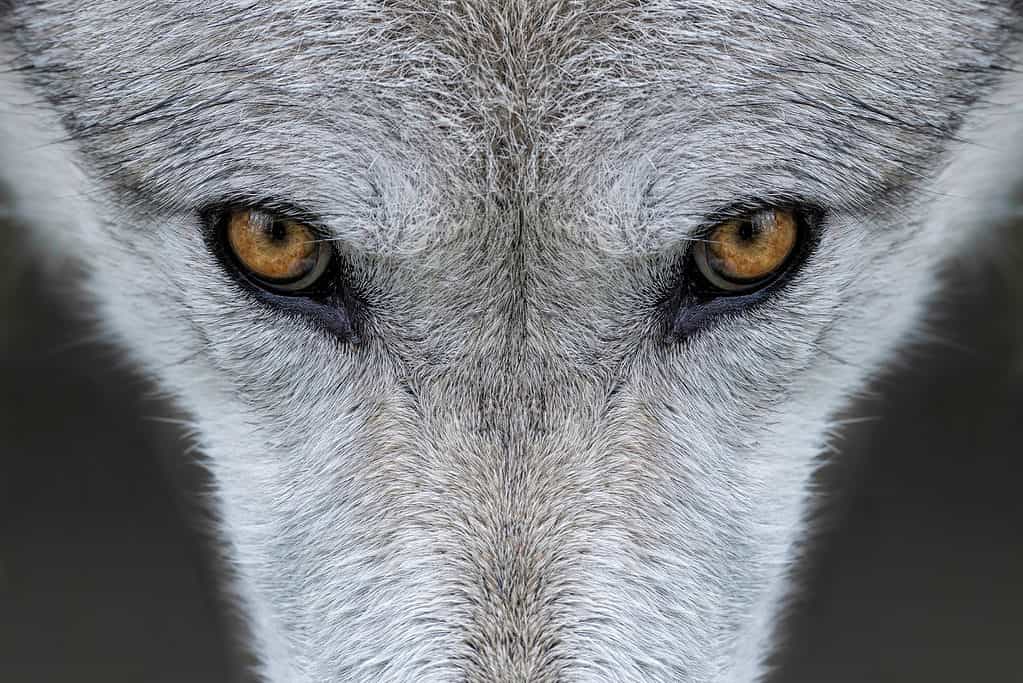
Wolves, the ancestors of our beloved dogs, are crepuscular, meaning they’re active at dawn and dusk. Because of that, their eyes evolved differently than ours.
©iStock.com/gnagel
Dogs have evolved to see differently than humans for good reason. Though we’re both predator species, we evolved to be awake at different times of day.
Humans are diurnal, meaning we’re awake during the day and sleep at night. Wolves, our dogs’ ancestors, are crepuscular. This means they’re most active at dawn and dusk.
So, humans need to see detail and color, but night vision isn’t as necessary for us. Canines need to see in the dark and detect movement, because they need to hunt in the early morning and evening when the sky is still dark. Daytime vision isn’t as important to them, because they tend to be less active or even sleeping when it’s light out.
Up Next…
- Can Dogs See Color? Which Ones?
- Dog Vision: How They Actually See the World
- Can Dogs See Infrared?