
When it comes to mythology, ancient scholars, writers, and believers created dazzling creatures to include in their stories. Some of these creatures helped to describe parts of the world the people of the time had trouble rationalizing, while other times they simply stood as an antagonists against the hero. The chimera and the manticore are two examples of the later — and while sometimes considered one and the same, they are different.
Learn more about both chimeras and manticores including what they looked like, the differences in them, and their links to reality.
What Is a Chimera?

The Chimera was a single being.
©SinArtCreative/iStock via Getty Images
The Chimera wasn’t a race of beings; instead, it was one monster borne of two gods according to Greek mythology.
Origins
In Greek mythology, the pantheon that lived on Mount Olympus included a multitude of heroes while monsters roamed the earth and sea below. Two such monsters — Typhon and Echidna — created offspring together that combined their terribleness into fear-inducing creatures like Cerberus, the Hydra, and the Chimera.
The Chimera wasn’t human but did have the intelligence to follow directions. According to Homer’s Iliad, a man named Amisodarus reared the Chimera to be a “bane of many men.” As such, it went around the nearby towns and villages decimating the cattle.
Scholars hypothesize that people of the time discovered the gas vents in Lycia and were inspired to create a fire-breathing monster similar to the ecological feature.
Appearance
The Chimera was a hybrid being with three heads. In most descriptions, its heads included a lion, a goat, and a snake (or dragon) — though the middle head, the goat, carried most of the power for the being.
In both the Iliad and Hesiod’s works, the chimera is described as “in the fore part a lion, in the hinder a serpent, and in the midst a goat, breathing forth in terrible wise the might of blazing fire.”
Some ancient scholars mentioned the Chimera as female or without a gender.
Behavior
Found in Lycia, the Chimera breathed fire and ate animals/livestock or any other good meal it could reasonably get its hands on. It truly did become a bane of the local’s existence until Bellerophon had the ingenious idea of using a ball of lead on his spear. When the Chimera went to attack by breathing fire, Bellerophon shoved the spear down its mouth and it choked on the molten metal.
What Is a Manticore?
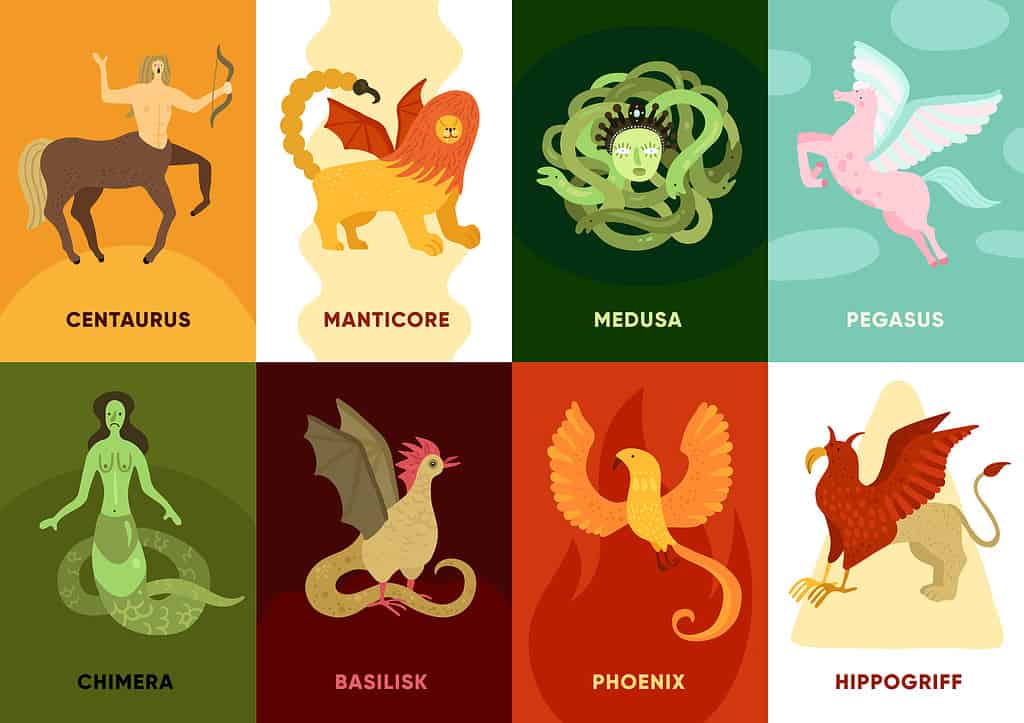
Mythological creatures take many forms, depending on the artist.
©Macrovector/iStock via Getty Images
Manticores come from Persian mythology and are another type of hybrid monster.
Origins
First mentioned as a real creature found in India, ancient natural scientists believed in the existence of the manticore for years. Thanks to a faulty account by Aristotle, people believed the manticore existed until the seventh century C.E. when the then-modern voice of reason, Pliny the Elder, set the record for natural and fantastical history, biology, and more.
Appearance
Manticores have an interesting appearance. Like the Chimera, it is a hybrid — though not borne from other monsters or created from several animals. Instead, manticores have a single head and different animal parts on the rest of their body.
The head is usually depicted as a human male’s head. The body and torso, then, are that of a lion, while the manticore tail can be either a scorpion’s tail or a cat’s tail. Finally, some depictions use wings.
Behavior
Manticores nearly have the brain of a human, so their intelligence and cunning made them exceptionally hard targets for the characters in the stories who faced them. According to legends, manticores would prey on humans and stalk them like cats to ensure a clean, good kill. Manticores would bring down three to six humans at a time and then consume them.
How Are Chimeras and Manticores Different?
Origin mythologies aren’t the only thing different between the Chimera and the manticore.
©tanys04/ via Getty Images
Though both animal hybrids that were considered legendary monsters, the Chimera and the manticore were completely different beings. First, they came from different mythologies; the Chimera is Greek while the first mentions of a manticore were recorded in Persia. Manticores were considered more vicious than chimeras as they actively preyed upon humans while the Chimera stuck more to animals. Finally, the Chimera has three heads while manticores only have one.
Chimera and Manticore Links to Reality
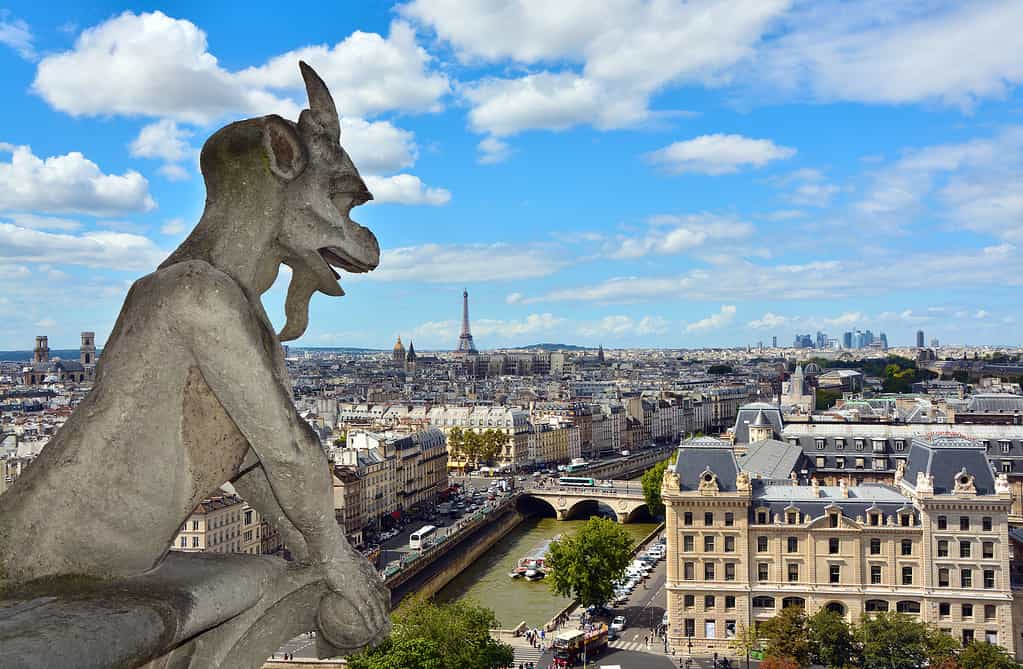
On the Notre Dame Cathedral, a famous Chimera is overlooking the Eiffel Tower.
©Marina79/iStock via Getty Images
Both the Chimera and manticores have found notable success outside of ancient mythologies. Their legends have persisted to the modern day, where entertainment mediums including anime, television shows, literature, and feature films spotlight their existence. However, not every adaptation stays true to the mythologies’ appearance and behavior description of these creatures.
Rick Riordan’s Percy Jackson novels include references to the Chimera while tabletop action role-playing games including Dungeons & Dragons use manticores for imagery and villains. Both beings find themselves in use in art, architecture, and more.