
Quick Take
- Scientists had a long-standing theory about why chimaeras live in the deep ocean, but DNA sequencing flipped it completely upside down. See how DNA changed everything →
- Chimaeras share a key trait with sharks, yet their anatomy diverges in ways that make them stronger than nearly every other vertebrate on the planet. Explore their unique anatomy →
- Every nickname this fish has earned, including ghost shark, rabbitfish, and ratfish, points to a real feature of its body, and one name fits better than all the others. Unpack the nicknames →
In Ancient Greek mythology, the chimera was a monstrous creature. It was a mishmash of different animals, some of which were already dangerous on their own. Fused together, however, the creature became something even more terrifying. The chimera was a lion with a goat’s head on its back and a snake’s head on its tail. It breathed fire, and it unsettled the hearts of men. While the mythical chimera is not real, a creature that lurks in the ocean’s depths and looks like a creepy amalgam of several creatures does exist. Meet Chimaeras, a type of ghostly-looking fish that is at once a shark, rabbit, and even elephant.
The human instinct for classification runs unimpeded until it meets creatures like chimaeras. Because observers are drawn toward familiar labels shaped by their own cultural perceptions, chimaeras go by different names depending on the culture. Some people call them rabbitfish; others call them ghost sharks. No matter the label, however, all of these nicknames speak to one of the more mysterious and ancient creatures of the ocean deep. Let’s learn more about chimaeras, why they are so unique, and why they seem to be a physiological fusion of several very different animals.
Chimaera Breakdown
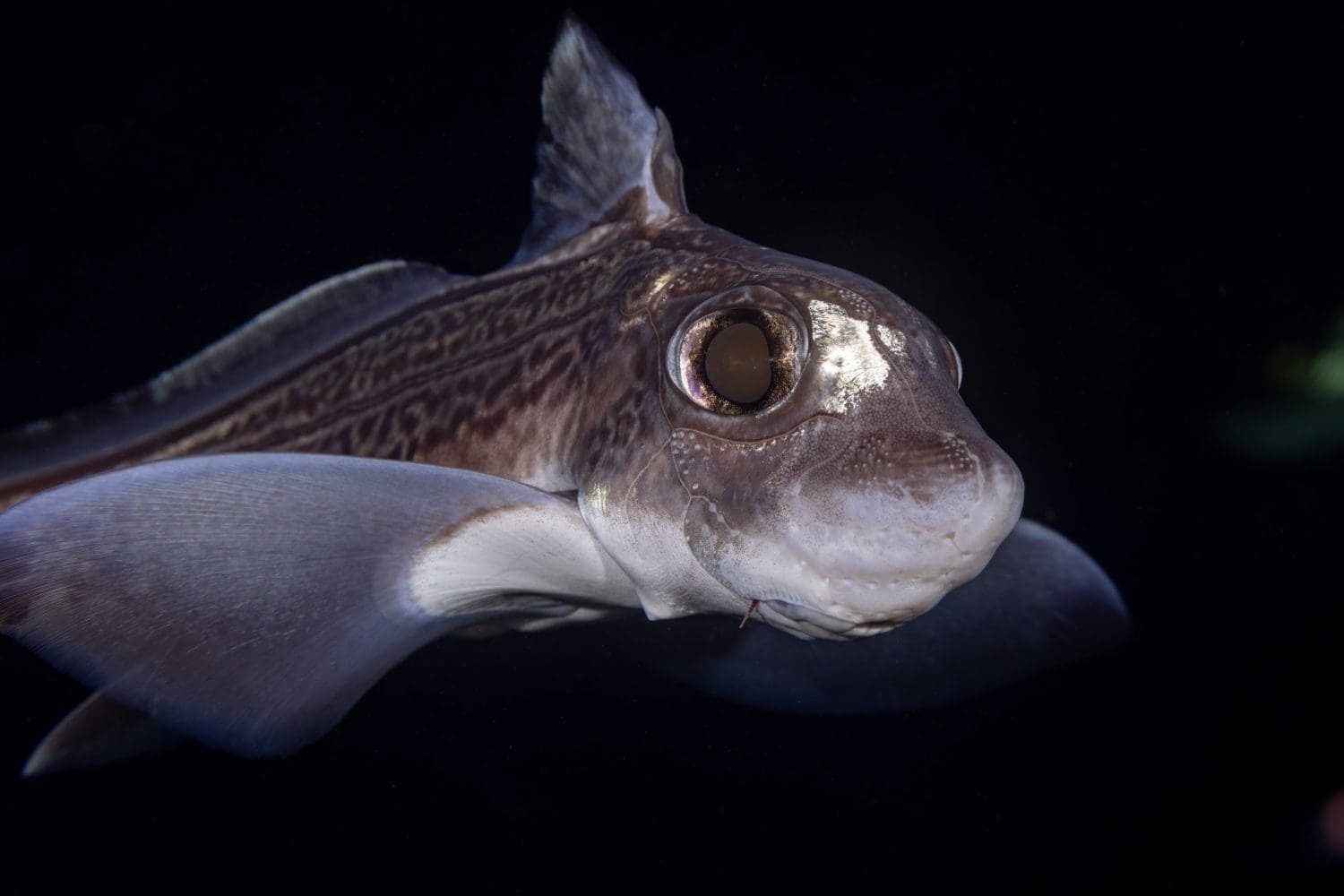
Chimaeras are some of the strangest-looking, deep-sea fish on the planet.
©Heine Jensen/Shutterstock.com
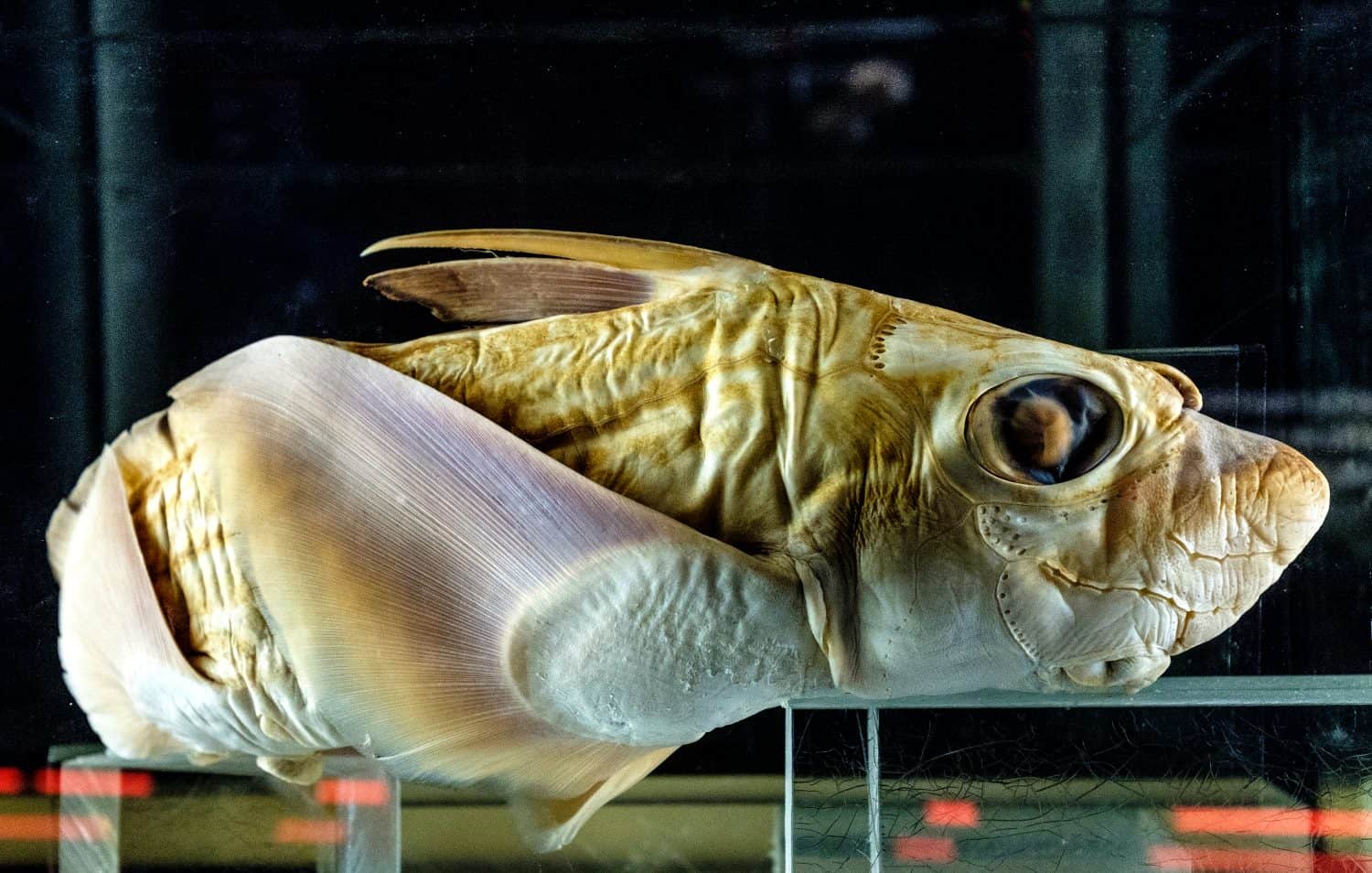
Chimaeriformes is an order that includes a variety of soft-bodied, cartilaginous fish living on temperate ocean floors worldwide. Often called ghost sharks, these fish share attributes with sharks like internal fertilization, but feature physiologies a world apart. Chimaeras have large, bulbous heads, sizable pectoral fins, and tails that often look like upward curving whips. Some chimaera species have venomous spines on the leading edge of their first dorsal fin. Almost all chimaeras have a bundle of electroreceptors in their outsized snouts to help detect prey like sea stars, mollusks, and other shellfish.
While sharks have large, flexible jaws full of replaceable teeth, chimaeras have fixed jaws fused to their skulls. Instead of recyclable teeth, their three pairs of tooth plates grow constantly. Because their teeth are made of strong mineralized tissue, they are stronger than those of most other vertebrates. Considerably front-heavy, chimaeras look unlike most other ocean creatures, despite their resemblance to sharks.
They typically inhabit deep ocean waters, with most species found at depths below 6,000 feet. Only the spotted ratfish and rabbitfish varieties are found in shallower parts of the ocean. Down there, they spend most of their time hunting for mollusks and crustaceans. Chimaeras’ mating habits are most similar to those of sharks: males use specialized appendages for internal fertilization, and females lay eggs in leathery, spindle-shaped cases.
Evolutionary Isolation
The evolutionary history of ghost sharks or chimaeras remained mysterious compared to other creatures for a long time. In recent years, however, scientists have gained a better understanding of their path through time through DNA sequencing.
Chimaeras and their ancient relatives, Holocephali, likely diverged from the group containing modern sharks and rays approximately 410 to 440 million years ago. Several dozen million years later, the oldest known ghost shark fossil was discovered in what is now Russia. Called the Protochimaera, it dated back to the Carboniferous and looked almost exactly like contemporary chimaeras. Around 200 million years ago, chimaeras spread across the world’s oceans, with fossils found in modern-day Russia and thousands of miles away in New Zealand.
Because chimaeras are found almost exclusively in deep waters today, scientists once assumed they had always lived in such environments. Furthermore, they posited that these shark-like fish likely moved into the deep ocean hundreds of millions of years ago to escape the asteroid impact that wiped out the dinosaurs. Modern innovations in DNA sequencing, however, have reversed this theory. Chimaeras are now believed to have spent most of their evolutionary history in warm, shallow waters. Once they reached peak diversity in the Cretaceous period, they started diving deeper down to occupy spaces previously inhabited by formerly thriving species. The only major ghost shark species that still lives near the surface is the plough-nosed chimaera (Callorhinchus).
Taxonomy and Classification
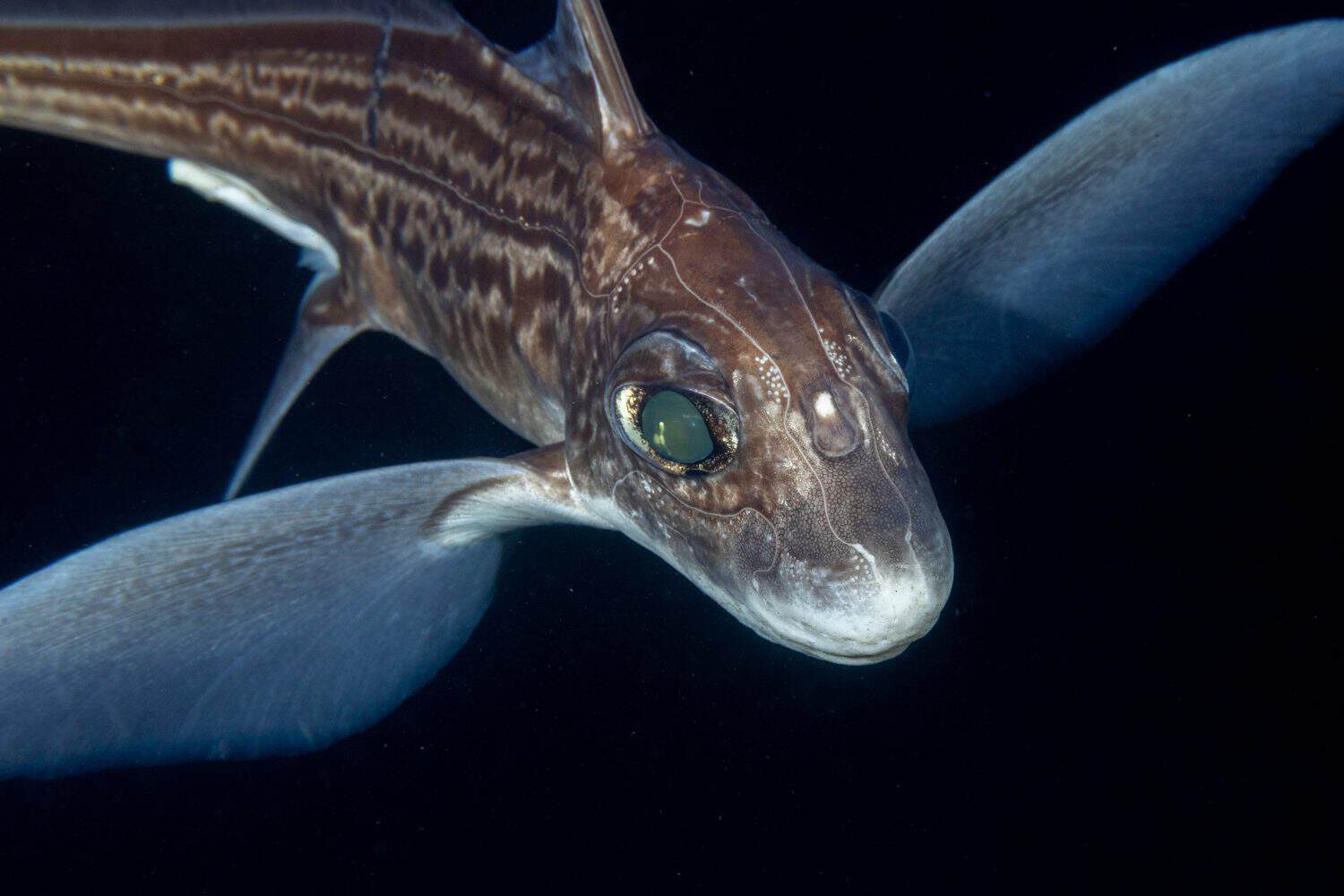
Chimaeras belong to three distinct families, each distinguished by the shape and function of their snouts.
©ArtMediaFactory/Shutterstock.com
The presence of different chimaera species in various parts of the world’s oceans, along with their distinct features, has resulted in interesting classifications. Depending on who you ask, chimaeras may also be called ghost sharks, ratfish, and spookfish. On the cuter end of the spectrum, they are also called rabbitfish or water bunnies. In short, naming a creature that resembles three or four different animals is challenging. Simultaneously, it teaches a helpful lesson about taxonomy.
Depending on which feature you focus on, you might use a different nickname for these fish. Notice their long, thin tails, and you’ll be reminded of a rat. Look at their buck teeth and blunt snout, and you’ll likely see a kind of rabbit skull. When you see their scaleless bodies swimming in dark water, they resemble phantoms or ghosts. Each chimaera’s nickname highlights a different aspect of its unique physiology. Even the term ghost sharks is helpful because it illustrates the fact that chimaeras and sharks share flexible, cartilaginous skeletal structures.
All chimaeras belong to a single evolutionary order, which is divided into three distinct families based on nose shape. The ratfish variety belongs to the Family Chimaeridae. They have blunt snouts, large, glowing eyes, and long, whip-like tails. The spookfish variety belongs to the Family Rhinochimaeridae. They have elongated snouts and look like ghostly jet planes. Finally, plough-nosed chimaeras have flexible, tool-like appendages hanging from their snouts, resembling elephant trunks. The plough-nosed chimaera (American elephantfish) is thus the only chimaera that still lives in sunny, shallow waters.