
Dingoes vs coyotes are both medium-sized canines that are highly adaptable and live in a variety of different habitats. They are both excellent predators and are capable of hunting and killing prey much larger than themselves. However, there are actually a lot of differences between coyotes and dingoes.
Although dingoes are native to Australia, while coyotes are home to North America, they both bear a strong resemblance to wolves. However, neither of these animals is a wolf subspecies.
Aside from the obvious difference in color, other differences include size, hunting method, and diet. But there’s much more to learn about these fascinating animals. Join us as we uncover the key differences between dingoes and coyotes.
This post was updated on October 2025 to clarify life span in captivity, weight ranges, similarities in flexible social behavior/hunting, predators/prey, current scientific consensus regarding classification of dingoes, and coyote taxonomy.

Comparing Coyote vs Dingo
Dingoes are an ancient offshoot of domestic dogs (Canis familiaris dingo), while coyotes (Canis latrans) are a distinct North American wild species. Neither is a subspecies of the other.
Visually, coyotes appear to be very similar to wolves, although slightly smaller, which is why they are also sometimes known as prairie wolves or bush wolves. There are currently 19 recognized subspecies of coyotes with the main differences between them being color and geographical distribution. Coyotes (Canis latrans) are not wolf subspecies; they are a separate species, although they can hybridize with wolves and dogs.
The classification of dingoes is debated; some older sources listed them as Canis lupus dingo, but the current scientific consensus (IUCN, 2024; Mammal Diversity Database v1.13) is that the dingo is a distinct population of the domestic dog (Canis familiaris dingo), not a wolf subspecies. Dingoes descend from ancient domestic dogs brought to Australia roughly 3,500–4,000 years ago, not directly from wolves.
Check out the chart below to learn a few of the main differences.
| Coyote | Dingo | |
| Location | North America, into Central America and Mexico | Australia (excluding southeast and Tasmania) |
| Size | Height – 21 to 24 inches Weight – 20 to 50 pounds | Height – 19 to 23 inches Weight – 22 to 44 pounds |
| Habitat | Grasslands, forests, mountains | Forests, deserts, grassland |
| Color | Typically grey or reddish with white throat and underparts | Ginger / tan, black and tan, white |
| Body Shape | Thin body, face, and muzzle | Lean body, wedge-shaped head, flattish tail carried low |
| Social Behavior | Pack and solitary | Pack animal (mated pair and offspring) |
| Gestation | 60 – 63 days | 61 – 69 days |
| Diet | White-tailed deer, mule deer, fawns, rabbits, hares, rodents, birds, lizards, snakes, insects | Kangaroos, wallabies, wombats, sheep, calves/lambs, possums, rabbits, birds, reptiles, fish, amphibians, insects |
| Hunting Technique | Small prey – stalk and pounce Large prey – attack from the front, biting head and throat | Attack from behind, biting the neck and damaging the trachea |
| Vocalization | Multiple call types – Bark, growl, whine, whimper, howl | Howl, whimper, growl, short bark (rarely used) |
| Predators | Wolves, mountain lions, and humans | Crocodiles (rare), humans |
| Lifespan | 3 years average in the wild 10–14 years in captivity | 5-10 years average in the wild Up to 15 in captivity |
The 4 Key Differences Between Dingoes and Coyotes
Dingo vs Coyote: Color
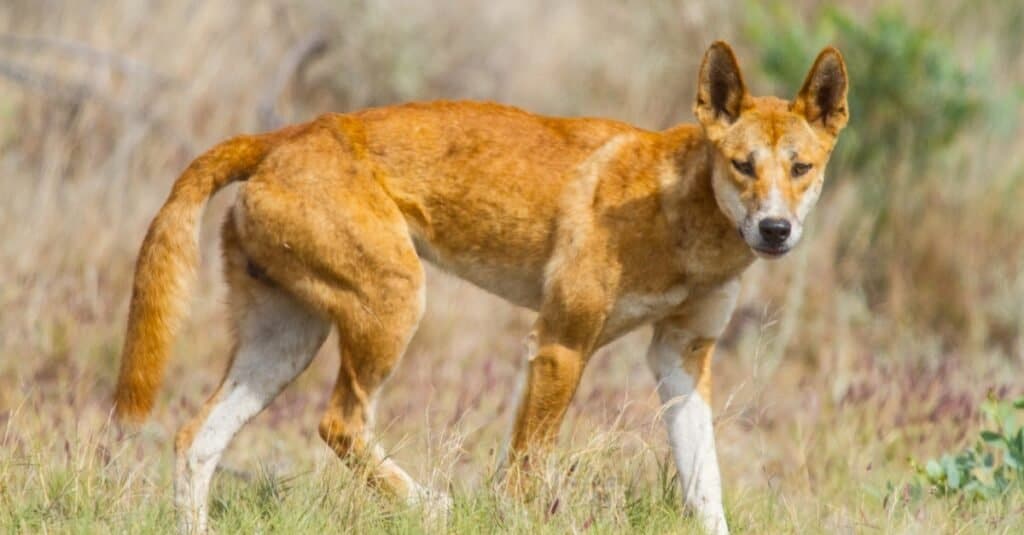
Dingoes are typically a tan color and are often mistaken for wild dogs
©iStock.com/indianoceanimagery
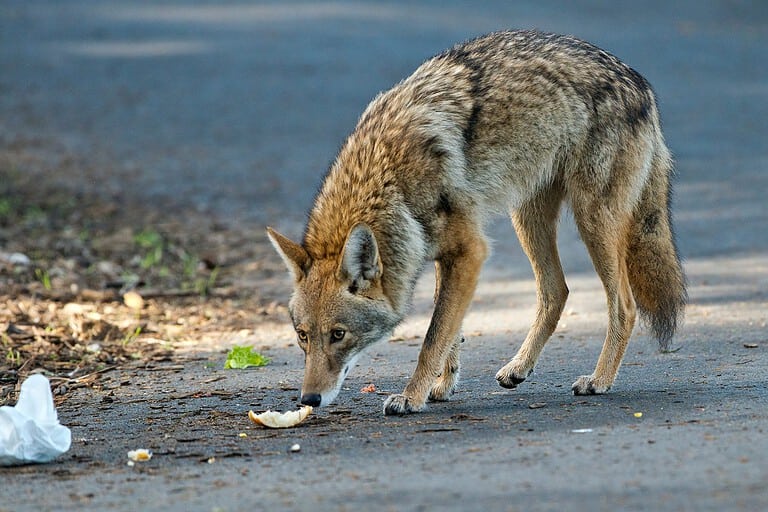
The most obvious difference between dingoes and coyotes is their color. Coyotes are typically grey or reddish colored with white throats and underparts. Dingoes are generally tan colored, or sometimes black and tan or white.
Dingo vs Coyote: Body Shape
As well as being a different color, dingoes and coyotes also have differing body shapes, particularly around the head. Dingoes look very similar to dogs and have a lean body and a wide, wedge-shaped head, which is the widest part of their body. Dingoes are often larger on average (especially males) when compared to coyotes, and more robustly built. They have a fairly flat tail which is carried low rather than curled over the back. Dingoes stand 19 to 23 inches high at the shoulder and weigh between 22 and 44 pounds.
Coyotes, on the other hand, have a thin body, face, and muzzle. Overall, their general shape, particularly around the head is very similar to that of a wolf. Coyotes tend to be 21 to 24 inches at the shoulder and weigh between 20 and 50 pounds.
Dingo vs Coyote: Hunting Technique
Both species are socially flexible, forming family groups or hunting solo depending on prey size and environment. Dingoes generally live in small family groups (breeding pair + subadults), but many hunt alone or in pairs, especially for small prey. Coyotes also show social flexibility, living alone, in pairs, or in packs depending on food availability and territory. Despite these similarities, these two animals differ in their hunting and killing techniques.
Dingoes are a top predator in Australia. They are capable of bringing down large prey such as kangaroos when they hunt as a pack. The size of the prey generally determines whether hunting takes place in packs or solo. Dingoes typically attack and kill from the rear of their prey by biting their neck. This damages the trachea and the blood vessels. They hunt a wide range of prey such as kangaroos, wombats, wallabies, lambs, possums, rabbits, amphibians, and birds. Lone dingoes usually hunt smaller prey such as rabbits.
Coyotes are also capable predators. They hunt white-tailed deer, mule deer, rabbits, fawns, and birds. Prey size matters: coyotes stalk and pounce smaller prey; they chase larger prey. However, coyotes typically attack larger prey from the front by going for the head and neck. Although they predominantly eat meat, they are actually omnivorous, consuming fruit and berries when the need arises.
Dingo vs Coyote: Vocalization
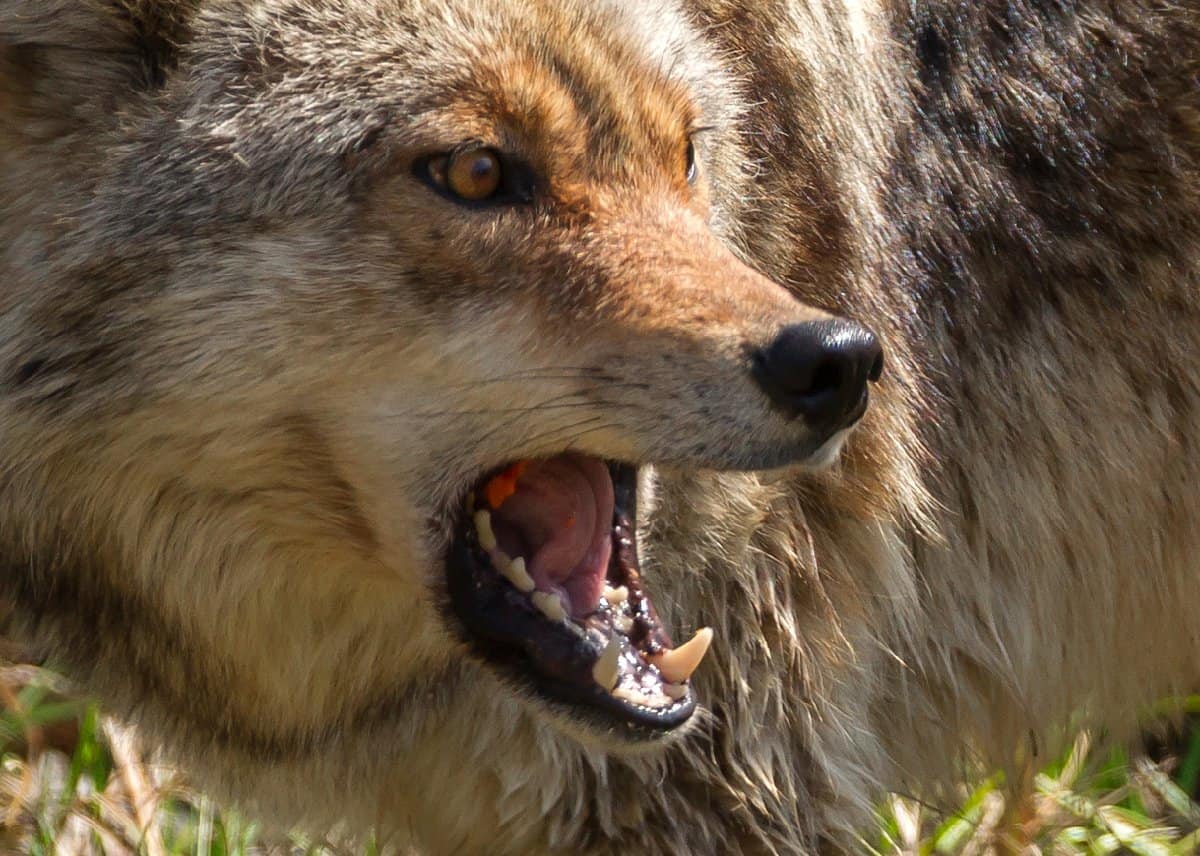
One of the most interesting things about coyotes is the range of sounds that they produce. They are very vocal animals and their species name – Canis latrans – literally means “barking dog”. Coyotes vocalize with multiple call types, including a wide range of barks, growls, whimpers, whines, and howls.
Dingoes aren’t as vocal and don’t produce quite the same number of sounds as coyotes. Although they can bark, their short bark is only used around 5% of the time and is mainly reserved for warnings. They prefer to communicate through howls, whimpers, and growls instead.
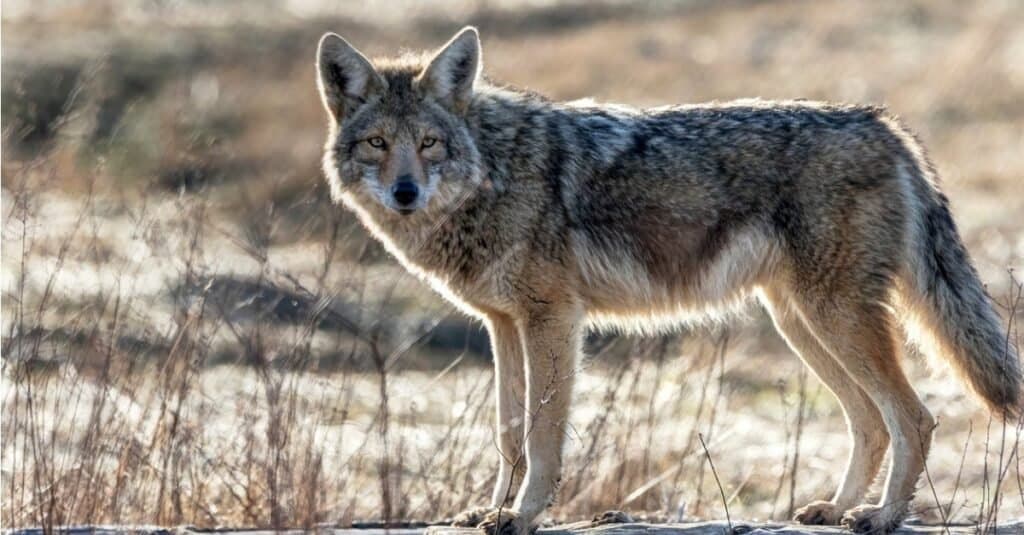
Coyotes are one of the most vocal animals in North America and produce a wide range of sounds
©iStock.com/jamesvancouver
FAQ’s (Frequently Asked Questions)
Are dingoes dogs?
There is often a lot of confusion surrounding the classification of dingoes, which is evident by the number of scientific names that they are called. Dingoes have, at various times, been classed as a wild form of domestic dogs (but not a subspecies of them), a species of their own, and a subspecies of wolves. Dingoes and dogs (and wolves and coyotes) are all members of the Canidae family. However, currently, dingoes are generally classed as Canis lupus dingo which is a subspecies of a wolf.
Are coyotes related to wolves?
Coyotes (Canis latrans), wolves (Canis lupus), and domestic dogs (Canis familiaris) are all very closely related. Studies have shown that coyotes have a large amount of wolf ancestry in them and that wolves have a large amount of coyote ancestry. Therefore, the evolution of both coyotes and wolves is extremely closely linked. Additionally, wolves, coyotes, and dogs are so closely related that they can interbreed – creating hybrid offspring.
Are coyotes and dingoes dangerous to humans?
You might have heard the stories about dingoes stealing babies and children. There is indeed one verified fatal case (Azaria Chamberlain, 1980) and a few confirmed attacks. Dingoes are definitely large enough to be dangerous, but they generally try to avoid conflict with humans. However, they can attack, although many reports state that most are the result of people trying to feed them. It’s a much similar situation with coyotes – they are definitely capable of attacking people, and there are reports of injuries. However, many of these seem to be the result of coyotes in urban areas losing their fear of humans, combined with people trying to feed them.
Which would win in a fight – coyote or dingo?
You might be wondering which would win in a fight – a dingo or a coyote. Although they live in completely different parts of the world (so they are never likely to cross paths), theoretically, a fight between a dingo and a coyote would actually be pretty evenly matched. They’re both excellent hunters that are more than capable of taking down large prey. However, dingoes tend to be stockier and slightly heavier on average, so they would likely have the upper hand in a physical encounter.