Quick Take
- One bite from a fly starts a chain of events that ends under your skin. Which fly, and what does it leave behind?
- Most infected people feel nothing at all. Others get strange swellings that come and go.
- Doctors sometimes decide the safest option is to leave this parasite alone. Why would treatment be riskier than the infection?
- A parasite in one disease zone is quietly sabotaging a campaign against another. The reason is deadly.
Parasitic worms have been living inside human bodies for over 150,000 years. Many of them live in our intestines, but some have chosen a very different part of the body to call home. The aptly named African eye worm can literally be seen making its way across its host’s eyeball. Below, we explore the parasite behind this disturbing phenomenon.
All About the African Eye Worm
The African eye worm (Loa loa) is a filarial nematode. These types of parasitic worms get their name from one of their life stages, which is a microscopic larva called a microfilaria. They are found only in the rainforest belt of western and central Africa. Humans are the only known natural hosts of Loa loa, and they rely on people to complete their life cycle.
African Eye Worm Lifecycle
The human stage of the Loa loa lifecycle begins when a human host is bitten by a fly of the genus Chrysops (also called the deer fly, mango fly, or mangrove fly). The fly bites people to consume blood. But as it feeds, Loa loa larvae pass from the fly’s mouthparts into the human’s body. They stay in subcutaneous tissue where they develop into adults and produce sheathed microfilariae. These can be found in the spinal fluid, urine, sputum, peripheral blood, and lungs of the host.
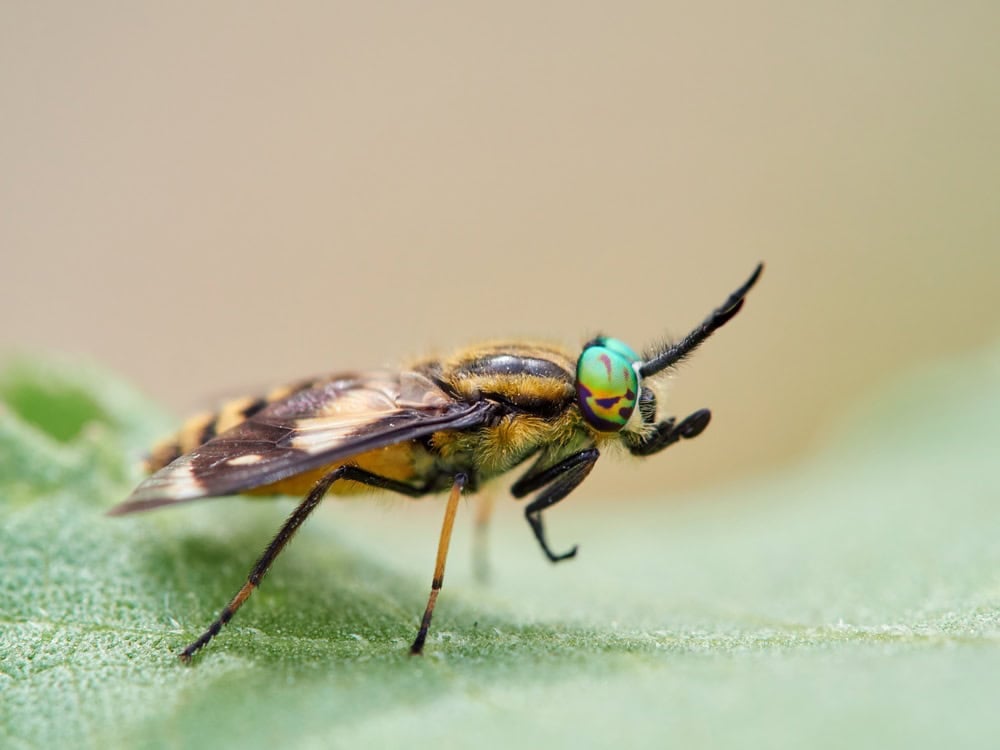
Part of the Loa loa life cycle is in a deer fly.
©Macronatura.es/Shutterstock.com
The fly stage of the lifecycle starts when another fly takes a blood meal from an infected human and ingests the microfilariae. Inside the fly’s gut, they shed their sheaths and penetrate the gut wall, migrating to the thoracic muscles. The larvae go through several life stages and eventually migrate again to the fly’s proboscis (feeding mouthparts). Once the fly takes a blood meal from another human, the life cycle starts again.
How Does the Worm Affect Its Human Host?
An infestation with Loa loa is called loiasis, and it cannot be passed from person to person. It can only be passed by the fly host. Loiasis primarily affects rural populations residing in the forest and adjacent savannah regions of central and west Africa. It’s estimated that 20 million people are chronically infected in these areas. In locations where the condition is prevalent, it causes significant morbidity (ill health) and mortality. On an individual level, however, the severity of symptoms is highly variable.
20
million
people are chronically infected with Loa loa in central and west Africa
The majority of infected people have no symptoms at all. Others develop Calabar swellings. These are areas of angioedema (sudden swelling of deep skin layers). The swellings are itchy rather than painful and can be anywhere in the body. That said, they are more common near joints. Calabar swellings are likely triggered by the host’s body reacting to allergens released by migrating adult worms. In native people from the region, the swellings usually last between one and three days. In visitors, however, they are more severe. They can also clear up before coming back again.
The worms can also be seen migrating across the eyeball (subconjunctivally). Though it’s a very distressing sight, the eye does not normally suffer any permanent damage. In other patients, the worms are seen crawling under the skin. Some sufferers also have widespread itching with muscle and joint pain and fatigue.
Loiasis Diagnosis, Treatment and Prevention
Often, loiasis is diagnosed when a worm is seen migrating across the eye! Also, when an adult worm is removed surgically from the eye or skin, it can be identified to aid diagnosis. Alternatively, microfilariae can be identified in blood by microscopy or quantitative polymerase chain reaction (PCR).
Treating loiasis is complex, and some medications even lead to more serious complications. Therefore, there may be times when doctors decide it is best not to treat it.

Insect repellent helps to prevent deer fly bites.
©Elizaveta Galitckaia/Shutterstock.com
If you can avoid deerfly bites, you can avoid loiasis, so take precautions when in areas where deerflies are common. The CDC recommends that you use Environmental Protection Agency (EPA)-registered insect repellents containing DEET or another EPA-registered active ingredient. Also avoid wood smoke because this attracts the flies. Wearing loose clothing that covers as much of your skin as possible and maintaining insect screens on doors and windows will also help.
Why Loiasis Gets in the Way of Treating River Blindness
Loiasis infections can get in the way of efforts to deal with another public health problem: river blindness. This disease is also called onchocerciasis and is caused by the parasitic worm Onchocerca volvulus. It’s transmitted by infected blackflies and primarily affects rural populations in sub-Saharan Africa and Yemen. The disease was brought under control in some areas by the Onchocerciasis Control Programme (OCP), which ended in 2002. Building on its success, other control programs have used community-directed treatment with a drug called ivermectin (CDTI) alongside vector control. However, this effort has been hampered because many of the target populations also suffer from loiasis.
Individuals with a high number of Loa loa in their bodies can develop potentially fatal neurological complications when they take ivermectin. The reason for this is not fully understood but is likely connected with capillaries being blocked by the worm, while their structure is also altered by the drug. Alternative strategies may therefore be needed to control river blindness and other diseases currently treated with ivermectin, such as lymphatic filariasis (elephantiasis).