
Quick Take
- The fly can't spread this disease alone. It needs a partner. Meet the black fly →
- Millions carry the parasite, yet most never go blind. Why? Why many stay symptom-free →
- A 1980s drug and a surprising pledge turned the tide. One country just made history. Read the elimination story →
Danger lurks in the fast-moving waterways of Africa and South America, and we’re not just talking about apex predators. One danger comes in a small, almost undetectable form: onchocerciasis, more commonly known as river blindness, is the second most common cause of infectious blindness on Earth. Black flies that live on the banks of waterways become infected by a parasitic worm, Onchocerca volvulus. When infected black flies bite a person, they inject larvae from the worm into the victim. As the worms mature, nodules form under the skin. In some cases, it produces vision impairment and even permanent blindness.
According to the World Health Organization, at least 252.3 million people required preventive treatment against onchocerciasis. A few years earlier, in 2017, the Global Burden of Disease study put the number of people infected with the skin disease at 14.6 million; it estimated 1.15 million suffered vision loss. River blindness is one of the greatest, yet subtle threats to public health. Yet, there is cause for celebration. Following the discovery of a drug that targeted parasites in the 1970s, global partnerships, public health initiatives, and large-scale drug delivery helped eliminate river blindness in many rural communities. Let’s learn more about this parasite, how black flies transmit it, what it does to people, and how public health efforts have helped stop its spread.
Infection and Transmission
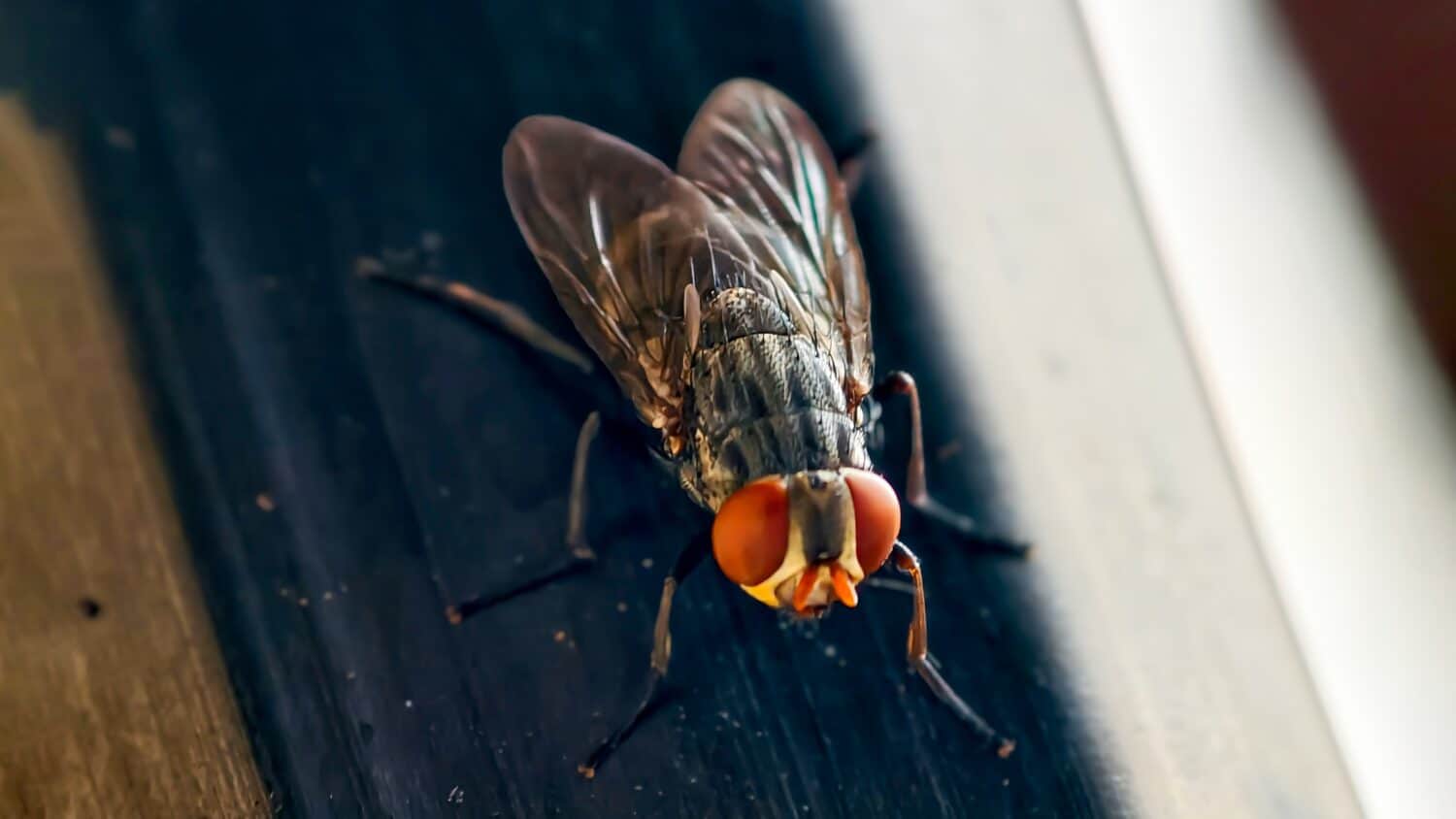
Female black flies from the genus Simulium infect people with the parasitic worms that cause river blindness.
©Aiolhoz/Shutterstock.com
This disease, which has infected millions, begins with the behavior of female black flies in the genus Simulium. Many water-friendly insects prefer still, stagnant water. Black flies, however, breed in fast-moving, oxygen-abundant rivers and streams. Females lay eggs in the currents, and larvae attach to rocks and substrates to filter nutrients.
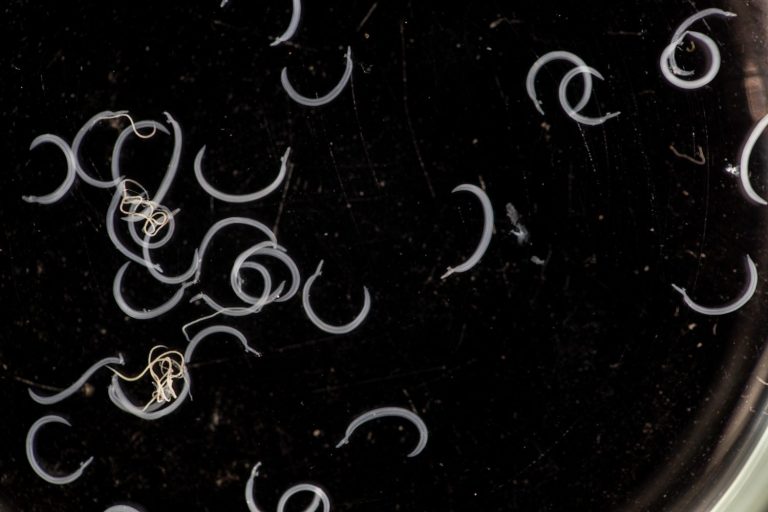
When infected flies feed on human blood, they deposit larvae from Onchocerca volvulus into the skin. Yet, it is a disease feedback loop between flies and humans that makes transmission possible; river blindness requires both hosts to come to fruition. Humans act as a reservoir of these worms, which release larval offspring that migrate through skin tissue. When a fly bites a human, it ingests these larvae. This provides the larvae a place to grow, and upon another blood meal taken by its black fly host, allows the mature larvae to enter another person’s skin. Over the next six to 12 months, the mature larvae grow into adult worms.
Inside the human host, larvae move through skin and eye tissue, as well as blood, for up to two years. It is not their presence, however, that causes river blindness. Instead, when these parasites die in a human body, they trigger inflammatory responses. It can take hundreds to thousands of black fly bites to produce these effects. This may seem like a lot, but in high transmission zones, people are routinely bitten tens to hundreds of thousands of times per year.
Symptoms
As previously stated, the majority of onchocerciasis symptoms come from inflammatory responses to dead or dying larvae inside the body. Yet not all people show symptoms; a recent study estimated at least 20.9 million infected people worldwide. Yet only 14.6 million of them showed skin disease symptoms, and just 1.15 million experienced vision-related symptoms. Even then, real symptoms can take years to manifest.
People with onchocerciasis, by what they experienced
Skin symptoms of onchocerciasis infection include severe itching, swelling, and pigmentation issues (both hyperpigmentation and depigmentation). They can also cause nodules under the skin, skin atrophy, rash, and a hanging groin associated with enlarged lymph nodes. If eye symptoms occur, they appear as eye pain, redness, lesions, corneal clouding, vision impairment, and even permanent blindness.
Public Health Fight

In 2025, Niger became the first region in Africa to be verified by the World Health Organization as having no onchocerciasis transmission.
©Chinedu Chime/Shutterstock.com
River blindness has been a serious problem for decades. No vaccine exists for it. In 1974, the Onchocerciasis Control Programme launched and went on to cover 30 million people in over half a dozen African countries. It wasn’t until the mid-to-late 1980s, however, that onchocerciasis met its match. That is when Merck & Co., Inc.’s ivermectin, an antiparasitic compound that kills microfilariae in humans and temporarily sterilizes adult female parasite worms, was approved for human use. The same year, Merck founded the Mectizan Donation Program to distribute ivermectin free of charge, for as long as needed to eradicate river blindness.
This strategy proved to be remarkably successful. In 2013, Colombia became the first country verified by WHO as having eliminated onchocerciasis, after three years of post-treatment surveillance showed no transmission. A string of countries followed in the next few years, including Ecuador, Mexico, and Guatemala. The biggest achievement, however, came in 2025 when Niger became the first WHO-verified African country to eliminate onchocerciasis transmission.
- 1974 Onchocerciasis Control Programme launches It went on to cover 30 million people in over half a dozen African countries.
- Mid-to-late 1980s Ivermectin approved for human use Merck also founded the Mectizan Donation Program to distribute it free of charge.
- 33 years later
- 2013 Colombia is first country verified to have eliminated onchocerciasis Three years of post-treatment surveillance showed no transmission.
- 12 years later
- 2025 Niger is first WHO-verified African country to eliminate transmission
Ivermectin treatments are administered at least once a year for 10 to 15 years to match the lifespan of the adult parasitic worms. This drawn-out treatment method has been incredibly successful. Combined with global partnerships and charitable drug donations, public health has won a major victory in stopping the spread of river blindness. As such, millions of people can work along Africa and South America’s waterways without fear of infection.