
Quick Take
- Flying fish escape underwater predators by launching into the air, but that split-second decision may put them in even greater danger. Watch them flee →
- Their "wings" aren't really wings, and the way they actually stay airborne surprises most people. See the glide mechanics →
- A single glide carries flying fish much farther than you'd guess, and the actual distance is genuinely hard to believe. See the real distances →
- Escaping one predator while being hunted by another forces flying fish into an almost impossible mid-flight choice. Explore the trade-off →
For a small fish being chased through the open ocean, escaping a hungry predator might seem impossible. But flying fish have an extraordinary survival strategy. They can launch themselves out of the water and glide above the waves, putting hundreds of feet between themselves and whatever is chasing them. Unfortunately, escaping danger below the surface doesn’t necessarily mean they’re safe. As this remarkable BBC Earth footage reveals, another predator may already be waiting overhead.
Watch Flying Fish Take Flight to Escape Predators
In this dramatic sequence from BBC Earth’s The Hunt, a group of flying fish finds itself pursued by dorado, also known as mahi-mahi. With nowhere to hide in the open water, the fish suddenly reveal their most remarkable defense.
Within seconds, they accelerate toward the surface, burst from the ocean, and spread their enormous, winglike fins. Instead of falling immediately back into the water, they glide across the waves, temporarily escaping the predators below.
But the footage takes another dramatic turn. Frigatebirds circling overhead spot the airborne fish and swoop down to snatch them. Suddenly, the flying fish face an almost impossible choice: remain airborne and risk being caught by birds, or dive back into the water where hungry dorado are still hunting.
How Can Flying Fish Glide Above the Ocean?
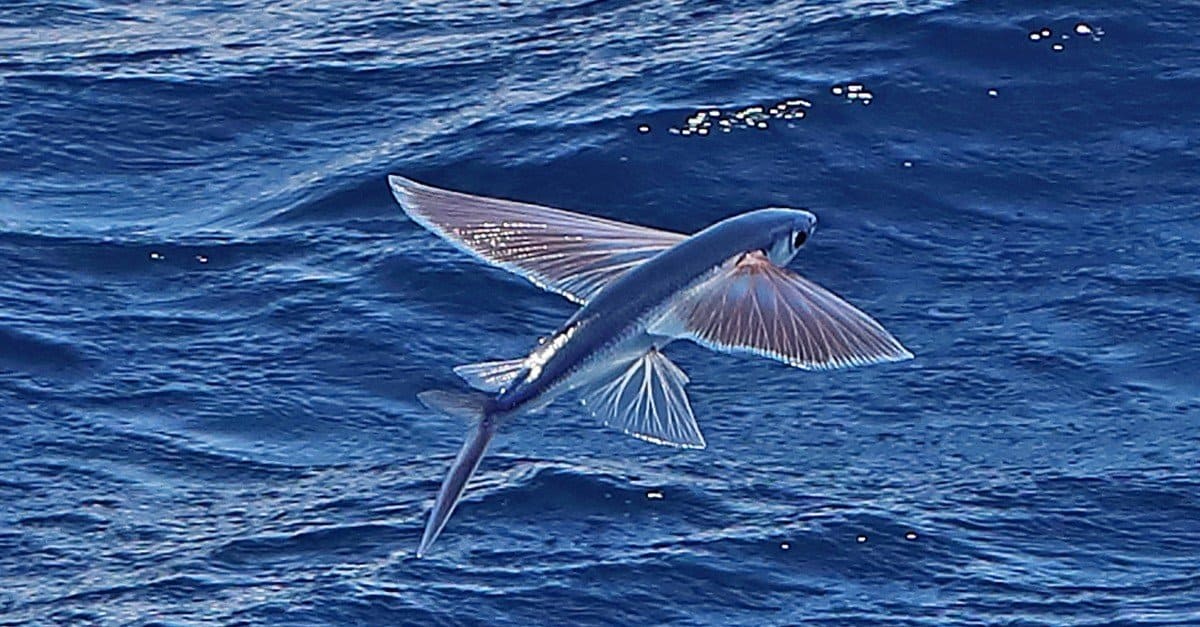
Despite their name, flying fish don’t actually fly the way birds do. They cannot flap their fins to produce sustained, powered flight. Instead, they use tremendous bursts of speed to launch themselves out of the water before extending their specially adapted pectoral fins to glide through the air.
According to the National Wildlife Federation, flying fish can propel themselves out of the water at speeds exceeding 35 miles per hour. Once airborne, their rigid, winglike fins provide lift, allowing them to travel remarkable distances without immediately returning to the ocean.
Their unusually shaped tails also play an important role. The lower portion of the tail is longer than the upper portion, allowing flying fish to generate additional thrust near the water’s surface. This can help them extend a glide or launch themselves back into the air.
How Far Can Flying Fish Actually Travel?
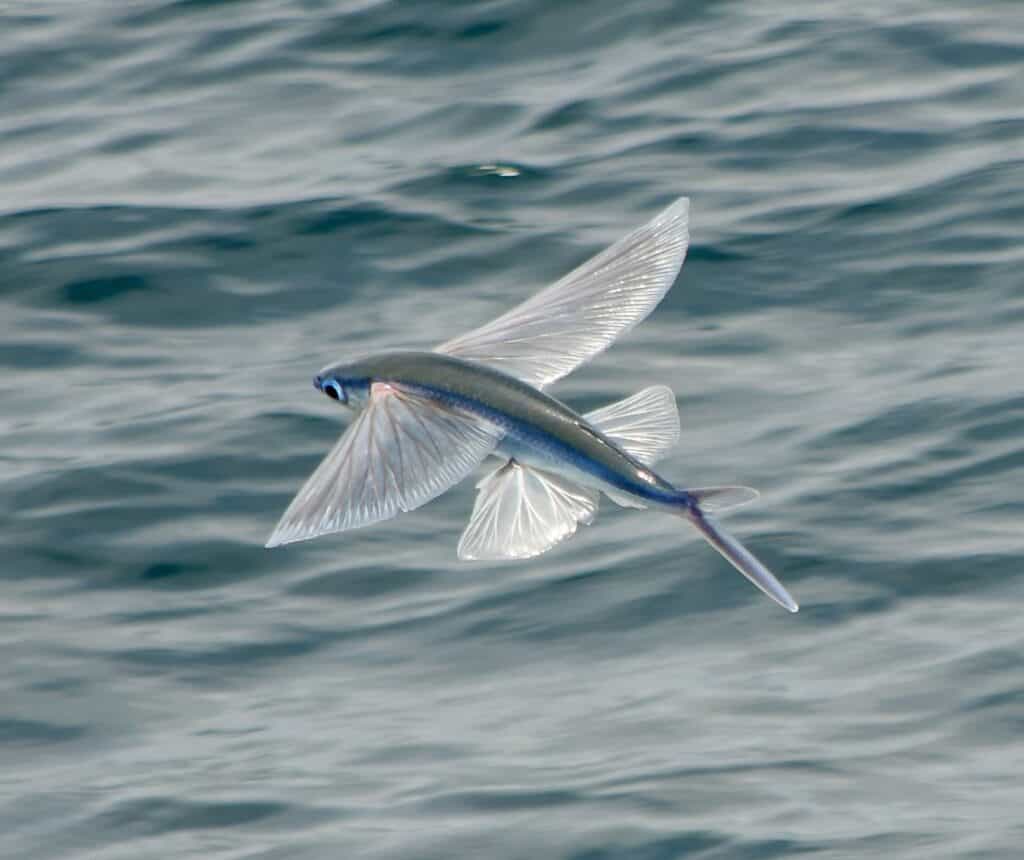
Flying fish use enlarged pectoral fins to glide above the ocean, helping them escape underwater predators.
©Brent Barnes/Shutterstock.com
Flying fish are capable of traveling much farther through the air than most people might expect. The National Wildlife Federation reports that they can glide for distances of up to approximately 650 feet, or 200 meters, under favorable conditions.
A 2019 scientific study examining the aerodynamics of flying fish used computer simulations to investigate their gliding performance. One modeled flight achieved a predicted distance of 45.4 meters, or approximately 149 feet, and a height of 13.2 meters, or about 43 feet. These figures represent results from a particular simulation rather than the absolute limits of flying fish in the wild.
There are roughly 40 species of flying fish, belonging to the family Exocoetidae. They inhabit tropical and temperate waters in the Atlantic, Pacific, and Indian oceans, where their gliding ability provides an important defense against underwater hunters.
Why Does This Incredible Behavior Matter?
Flying fish face an extraordinary range of predators, including tuna, marlin, dorado, squid, and seabirds. Their ability to leave the water gives them another way to evade an approaching hunter, especially when they have little shelter in the open ocean.
However, the BBC Earth footage demonstrates that even an impressive evolutionary adaptation comes with trade-offs. By escaping predators beneath the surface, flying fish may expose themselves to birds capable of catching them in midair.
The encounter offers a fascinating look at the constant struggle between predators and prey. Flying fish have developed an unusual means of escape, while frigatebirds have learned to take advantage of the brief moments when those fish become airborne. It’s a remarkable reminder that in the natural world, escaping one danger can sometimes mean flying straight into another.