
Whether you’re considering using bamboo in your landscape, are a conservationist, or are just interested in identifying your local flora, learning to distinguish between bamboo species and their lookalikes can be helpful. If you’ve been walking around your neighborhood and seen bamboo or bamboo-like plants in your neighbor’s yard or on the side of the road, you may wonder whether you can grow them at home. Maybe you’ve seen a bamboo-like plant flourishing near a pond and are wondering what it is. Or perhaps you’re interested in knowing if plants resembling bamboo have similar growing conditions.
No matter the source of your interest, if you’d like to be able to tell bamboo apart from its lookalikes, then this is an excellent place to start. In this article, we’ll talk a little about the morphological characteristics of most bamboo and give three examples of widely distributed plants that are often mistaken for bamboo.
What Does Bamboo Look Like?
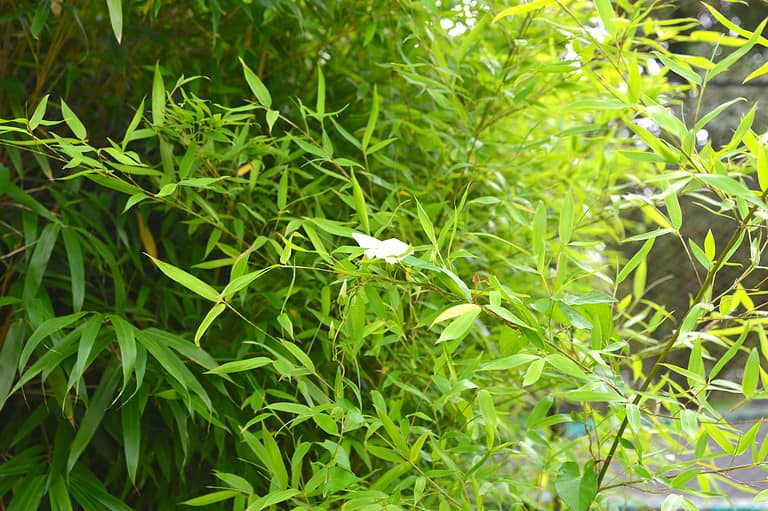
Bamboo plants are perennial, giant grasses best identified by two main parts: the culm and the rhizome.
A bamboo culm is a tall, woody, cane-like structure comprising thick, knuckle-like joints called nodes, and the spaces between each node, called internodes. The plant’s nodes are solid all the way through and are where the plant produces branches and leaves, usually in an alternating fashion along the length of the culm. Different bamboo species may have more or less pronounced nodes, but they all have them. The internodes of the culm may be solid in some species but are often hollow and have firm outer walls of varying thicknesses.
While they may look like roots, rhizomes are horizontal stems that store nutrients and produce new growth. Bamboo rhizomes also comprise nodes and internodes and resemble their above-ground culms. However, nodes on the rhizome may produce either roots or new culms.
How Does Bamboo Grow?
Bamboo plants use their rhizomes to expand outward from their planting site in search of water and nutrients, sending up new culms wherever they go. Bamboo species spread via their rhizomes at different rates and grow to different sizes. While there is variation between species, in most cases, there are two general growth habits that most rhizomes tend to exhibit: clumping-type growth and running-type.
Running-type bamboos produce what are called “leptomorphic” or thin rhizomes. These bamboo species are rather prolific and can spread rapidly underground, often sending up culms sporadically and unpredictably. When examining the base of a running bamboo culm, you will notice that the bottom of the culm attaches to the rhizome at one of its nodes.
Clumping-type bamboo is described as being “pachymorphic” or thick. They grow significantly slower than running types and produce their growth in a more controlled, more densely-packed fashion. Rather than prioritize outward expansion, creating many nodes from which new culms emerge, clumping-type rhizomes turn themselves upward to become culms after spreading a short distance. They then begin to produce additional rhizomatous growth under the soil.
3 Plants That Resemble Bamboo
It is important to note that the characteristics above are not the only ones that can be used to differentiate between bamboo and its lookalikes. Flower characteristics, leaf shape, and texture are essential to plant species indicators. For instance, while some bamboo species flower annually, many only produce flowers once every several decades. Some have flower cycles as long as 150 years.
In addition to examining parts of the plant, paying attention to the growing conditions of the specimen in question can be helpful. For example, bamboo cannot grow when submerged in water. Therefore, plants that thrive in standing water are not truly bamboo.
Now that you understand the essential morphological characteristics shared by valid bamboo species, you should quickly identify plants that look similar but not bamboo.
Horsetail (Equisetum)
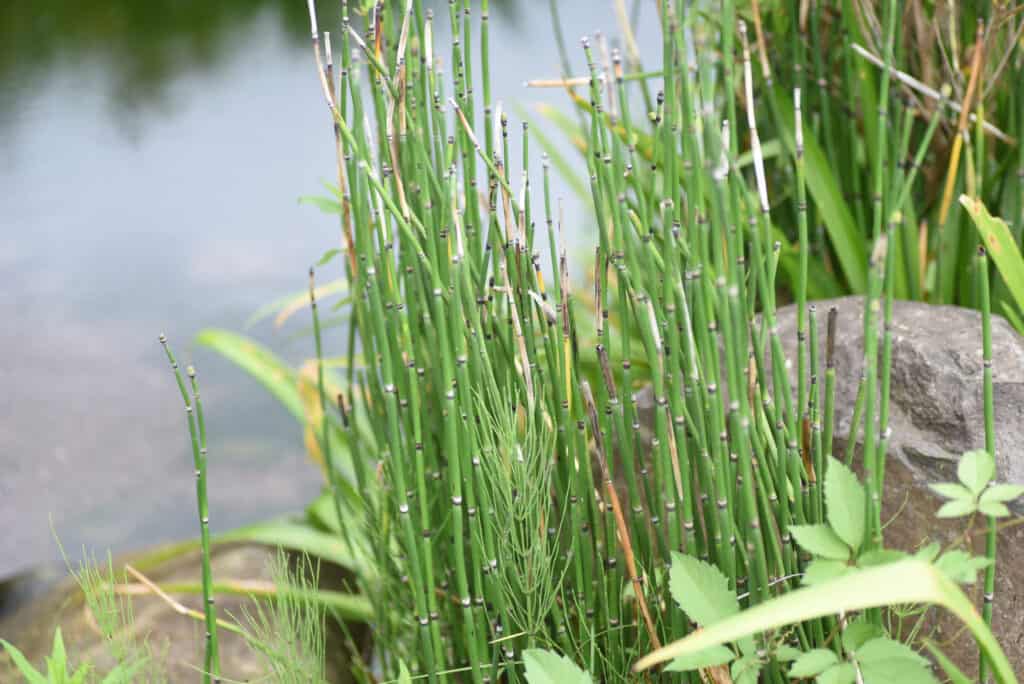
Horsetails are similar to ferns, producing neither flowers nor seeds.
©iStock.com/undefined undefined
Horsetails are particularly interesting bamboo lookalikes. They belong to a single genus of prehistoric plants that can be traced back around 350 million years to the mid-Devonian period. That they have survived this long should tell you how tough they are. Their rhizomes can even grow when submerged in water.
These plants are similar to ferns, producing neither flowers nor seeds. Instead, horsetail plants release spores from reproductive cones that are borne atop their stems. While horsetail stems are slender and cylindrical like bamboo culms, they are not woody. In fact, like other bamboo lookalikes, they tend to be comparatively soft and easy to break. They are rougher in texture and generally have vertical ridges along the stem.
Horsetail species are native to nearly everywhere except for Australia, New Zealand, and Antarctica. They are versatile and durable plants that, similar to bamboo, spread underground with their rhizomes. Once they have colonized an area, they can be difficult to eradicate, as their rhizomes reside deep within the soil. Unsuccessful attempts at digging them up may cause them to break apart, thus producing multiple identical copies of the plant that was just removed.
Giant Reed (Arundo donax)
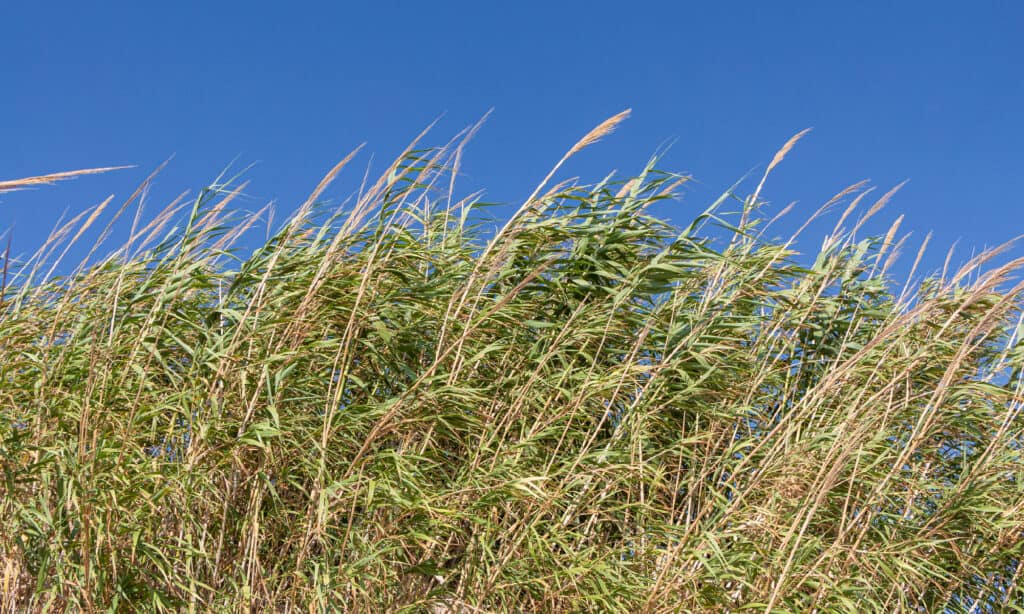
Giant reeds produce long, feathery flower spikes yearly.
©iStock.com/Tatiana Kuklina
This tall reed is, like bamboo, a perennial, rhizome-forming grass. It tends to grow in large clumps along stream banks, lakesides, drainage ditches, and other areas with excellent access to moisture. While it grows to heights of 10-20 feet and produces hollow canes resembling bamboo, this Mediterranean grass species is much more fragile and is not evergreen.
The giant reed may be mistaken for the North American native river cane due to their similar tall, slender, and clumping growth habit. The similar density of their leaves may also be confusing. Each giant reed, however, bears sessile leaves rather than petiolate leaves. This means that the base of each leaf is attached directly to the stem of the plant and does not have a small stalk of its own.
Another important distinguishing feature of giant reeds is their flowers. While these plants produce long, feathery flower spikes yearly, most bamboos rarely flower. Many species flower only once every several decades or more. When they do flower, many species do so gregariously, meaning that large populations of the same species flower at the same time worldwide.
Unlike bamboo, which stays evergreen throughout the year in all but the harshest conditions, the giant reed goes dormant and dies back to the ground yearly. Despite this dormancy period, it can quickly form dense, widely spread colonies and is considered invasive in many locations across North America.
Japanese Knotweed (Polygonum cuspidatum, Fallopia japonica)
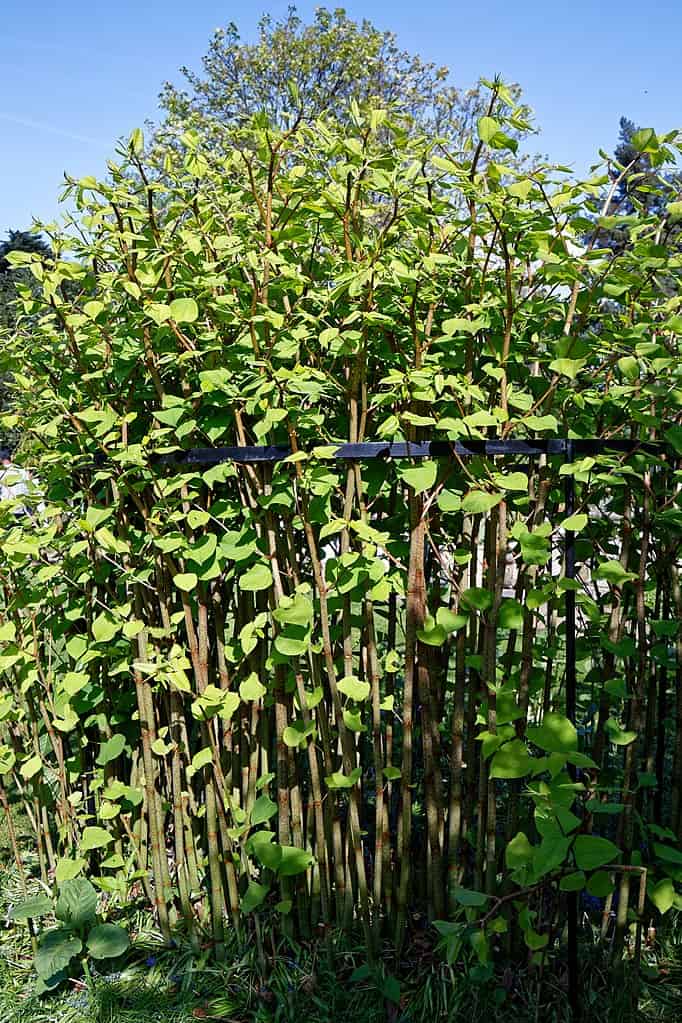
Japanese knotweed has hollow stems divided by thick nodes, forming dense colonies like running bamboo.
Japanese knotweed, also sometimes referred to as Mexican bamboo, is very commonly mistaken for bamboo. It can grow to similar heights, have hollow stems divided by thick nodes, and form dense colonies like running bamboo. It also grows from underground rhizomes. While it seems complicated to differentiate between bamboo and Japanese knotweed, it is pretty simple.
The most easily made distinctions are between each plant’s leaf shapes and the woodiness of its stems. While bamboo possesses glossy, paper-like lanceolate leaves, the leaves of knotweed plants are heart-shaped or spade-shaped and are deeply veined. Knotweed stems, while they have knuckled nodes and hollow internodes, are not made of hard, woody fibers. Though they harden with age and may seem woody, they are made of soft vascular tissue that sheds liquid when cut.