
Quick Take
- Calligraphy beetles, an American genus Calligrapha, display handwriting-like patterns on their backs that help camouflage and confuse predators.
- They live from Canada to Central America in forests and shrublands, tied to hosts like dogwood, alder, or willow.
- Some species are unisexual and reproduce by parthenogenesis.
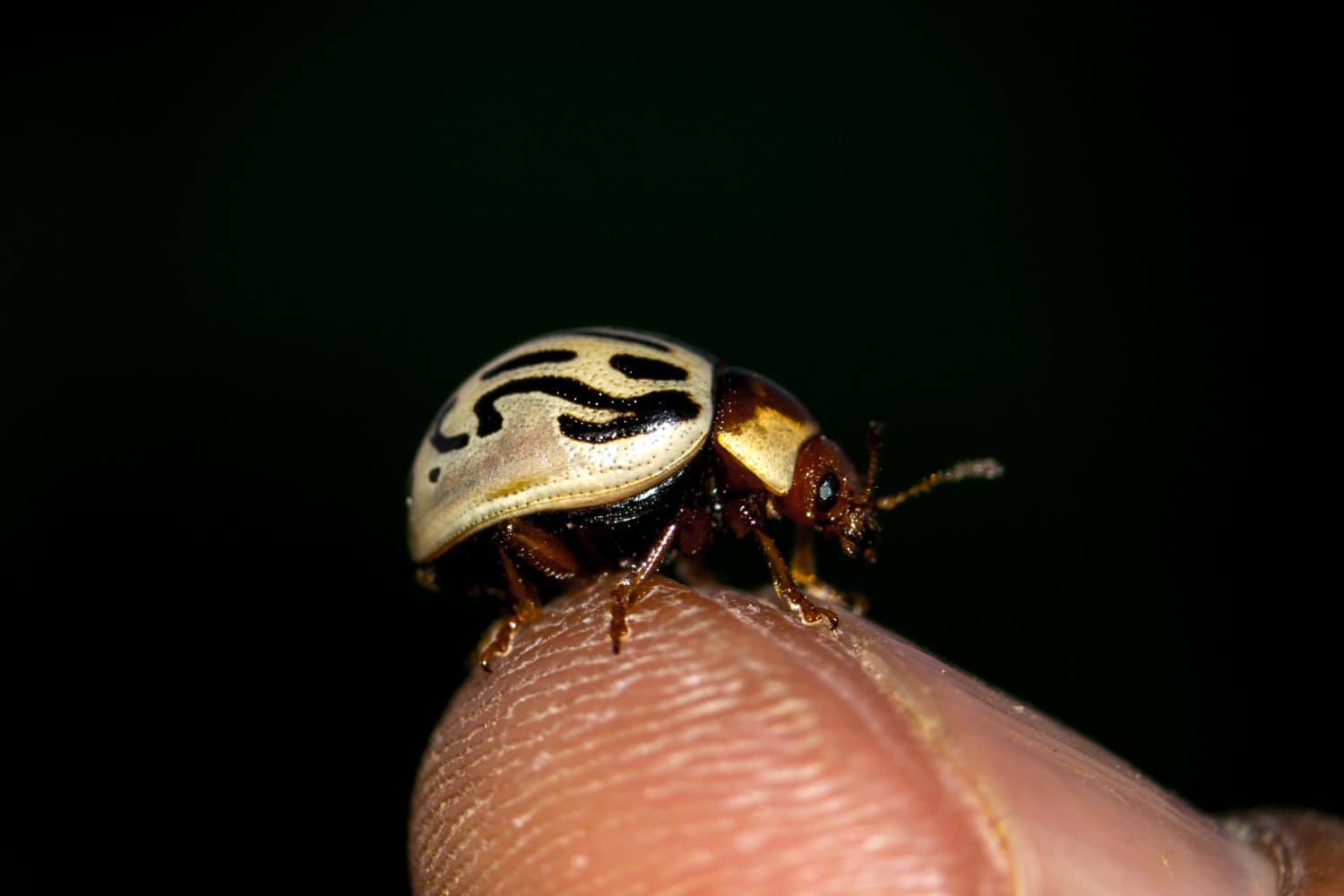
Under leaves in woodlands across North and South America lives a beetle that looks as if someone wrote on it with a fountain pen. Calligraphy beetles, grouped in the genus Calligrapha, carry looping black lines and dots on their hardened wing covers. The designs resemble handwriting on old paper, and each beetle looks like a tiny page of script. These patterns do more than please human eyes. They grow through a complex mix of genetics and development, and they help the beetles survive in a world full of hungry predators.
Where Do Calligraphy Beetles Live?

There are more than 100 named species of calligrapha.
©Nicholas Jacques/Shutterstock.com
Calligrapha is a genus of leaf beetles found in temperate and tropical zones of the Western Hemisphere. More than 100 named species occur from Canada through Central America, with some extending into South America. In North America, calligraphy beetles live in forests, shrublands, and along streams where their host plants grow. Different species tend to specialize in particular shrubs or trees, so the beetles’ ranges often match the distribution of those plants.
The Calligraphy Beetle: Shape And Color
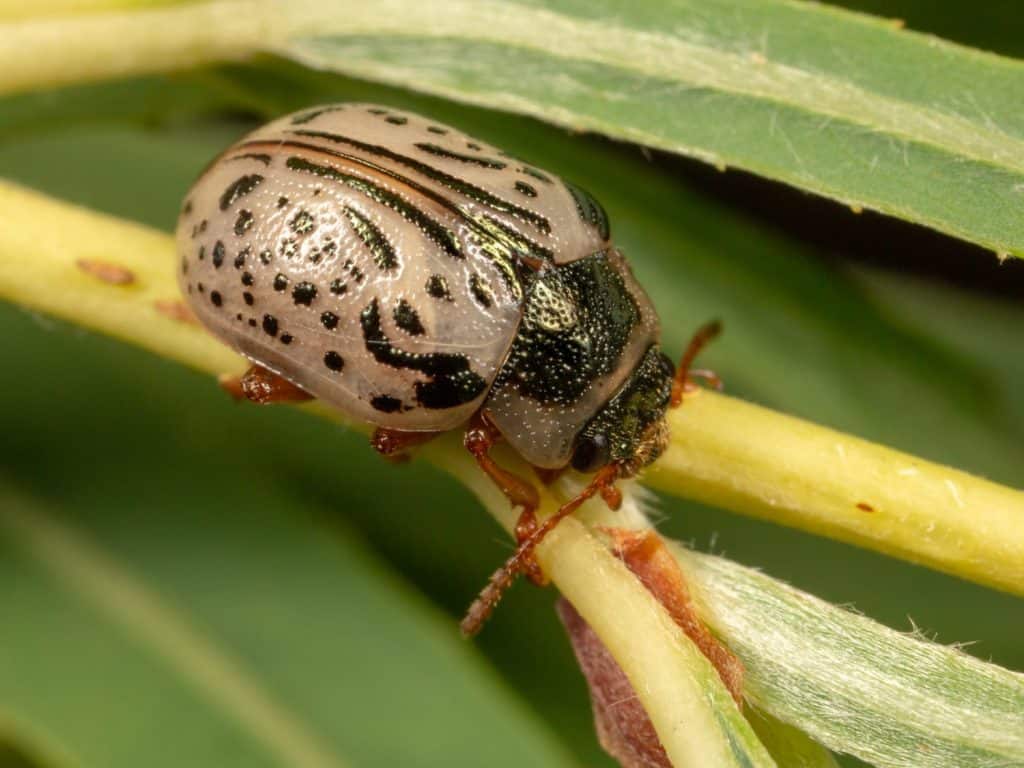
Calligraphy beetles come in a variety of colors and patterns.
©Monique van Someren/Shutterstock.com
Calligraphy beetles belong to the leaf beetle family, Chrysomelidae, and the subfamily Chrysomelinae. Most have a rounded, domed body that measures roughly 7 to 12 millimeters in length, about the size of a small ladybug. Many species show pale backgrounds in white, cream, yellow, or red with dark tracing. Others come in green or bronze tones. Entomologists use these patterns, along with body shape and host plant, to tell species apart. For example, the dogwood calligrapha, Calligrapha philadelphica, has pale wing covers with thin lines and dots, while Calligrapha confluens on alder shows thicker, merged markings.
People who see calligraphy beetles up close usually compare the looping patterns on their shells to familiar writing systems. Some say the lines look like Arabic script with its flowing, connected curves, while others see the bold, tapering strokes of Chinese or Japanese brush calligraphy. A few people even think of old fountain-pen cursive, the kind with elegant loops and flourishes. Whatever the comparison, the markings appear as if the beetle were carrying a tiny scrap of handwriting on its back.
Patterns, Camouflage, and Confusion
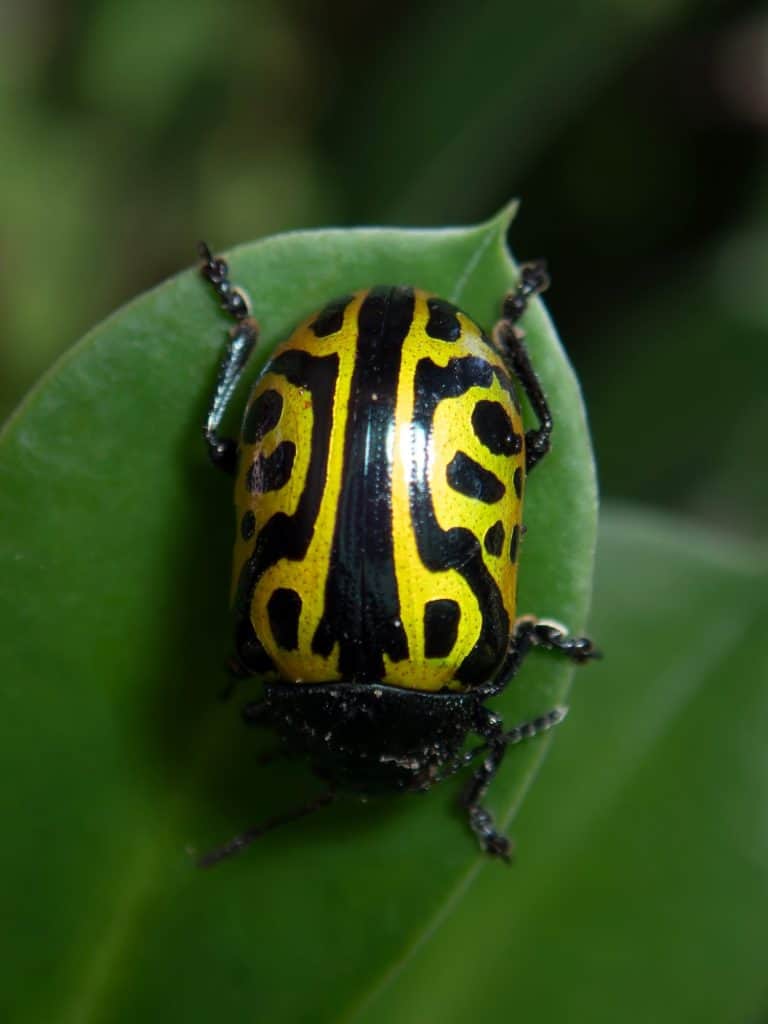
A bird seeing this pattern would have difficulty understanding this is one beetle and not multiple small, recognizable objects.
©juanjomenta/Shutterstock.com
So why would a beetle evolve loops that look like handwriting? Many biologists think the answer lies in camouflage and visual confusion. Dark lines over a light background can break up the beetle’s outline so a bird or lizard sees fragments instead of a clear target. On speckled leaves, bark, or lichen, the script-like marks echo shadows, leaf veins, and cracks. Research on patterned insects shows that such “disruptive coloration” can make it harder for predators to detect prey or to aim a peck at the right place. Calligraphy beetles likely benefit from this same effect as they sit motionless on twigs or leaf surfaces.
Behavior and Predator Avoidance
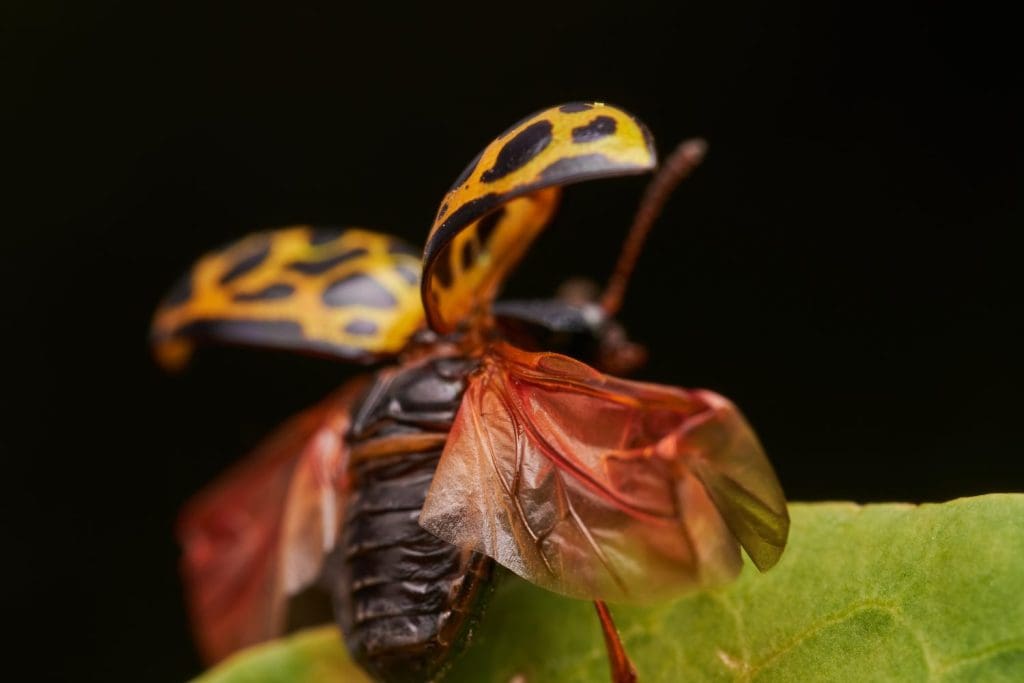
Beetles might drop suddenly to the ground when a predator attacks to confuse them.
©Diaz Aragon/Shutterstock.com
Color is only one part of the survival toolkit. Leaf beetles often freeze when disturbed or drop suddenly from their host plant into the litter below. Calligraphy beetles show similar habits. A flash of patterned wings followed by a quick fall can confuse a predator that relies on movement to track prey. Some species also feed on plants that contain bitter or toxic chemicals. By eating those leaves, the beetles may gain some protection if predators learn that the insects on those plants taste bad. In that case, bold markings could act as a partial warning signal, although camouflage still seems to be the main defense.
Seasonal Life Cycle
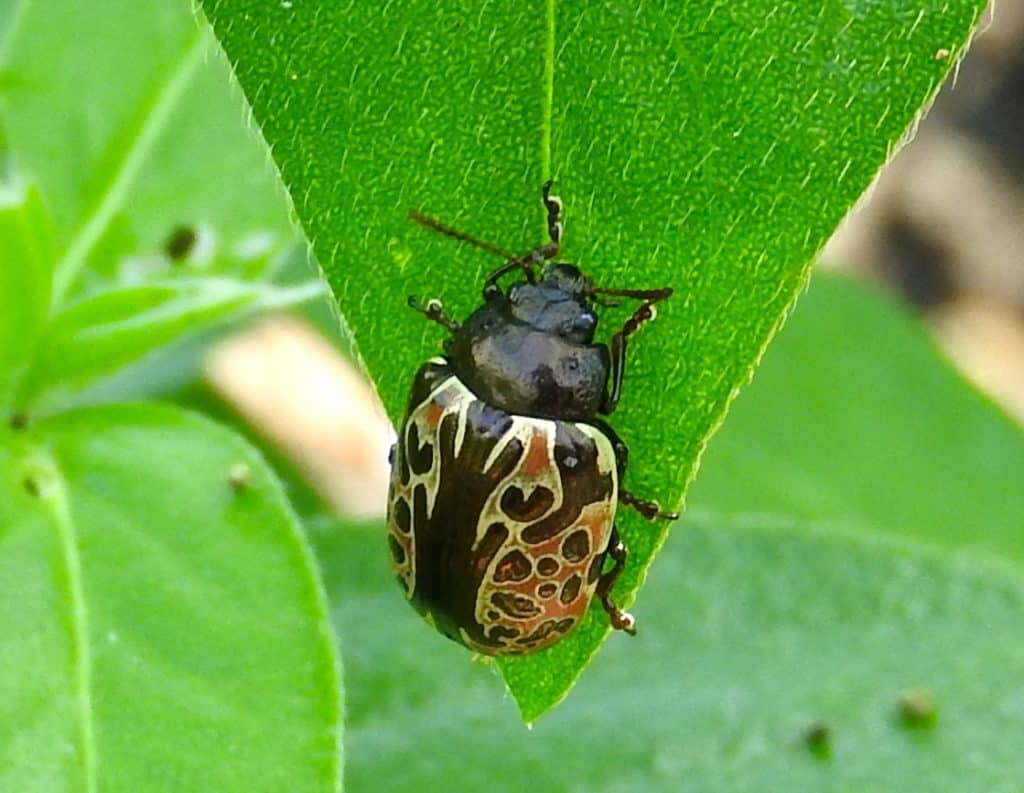
Calligrapha argus.
©Francisco Farriols Sarabia, CC BY 4.0 , via Wikimedia Commons – Original / License
In temperate regions, adult calligraphy beetles usually appear in spring or early summer, often emerging around the same time their host plants put out fresh leaves. After mating, females attach rows or clusters of eggs to leaf undersides or nearby stems. Larvae hatch and chew through the soft tissue, sometimes leaving a thin network of veins behind. This “skeletonized” look is common on heavily fed leaves. Larvae pass through several stages before pupating on the plant or in the surrounding litter. New adults may appear later in the summer. Depending on the species and climate, calligraphy beetles typically overwinter as adults tucked under bark or debris.
Host Plants and Forest Roles
©ram_kishor/Shutterstock.com
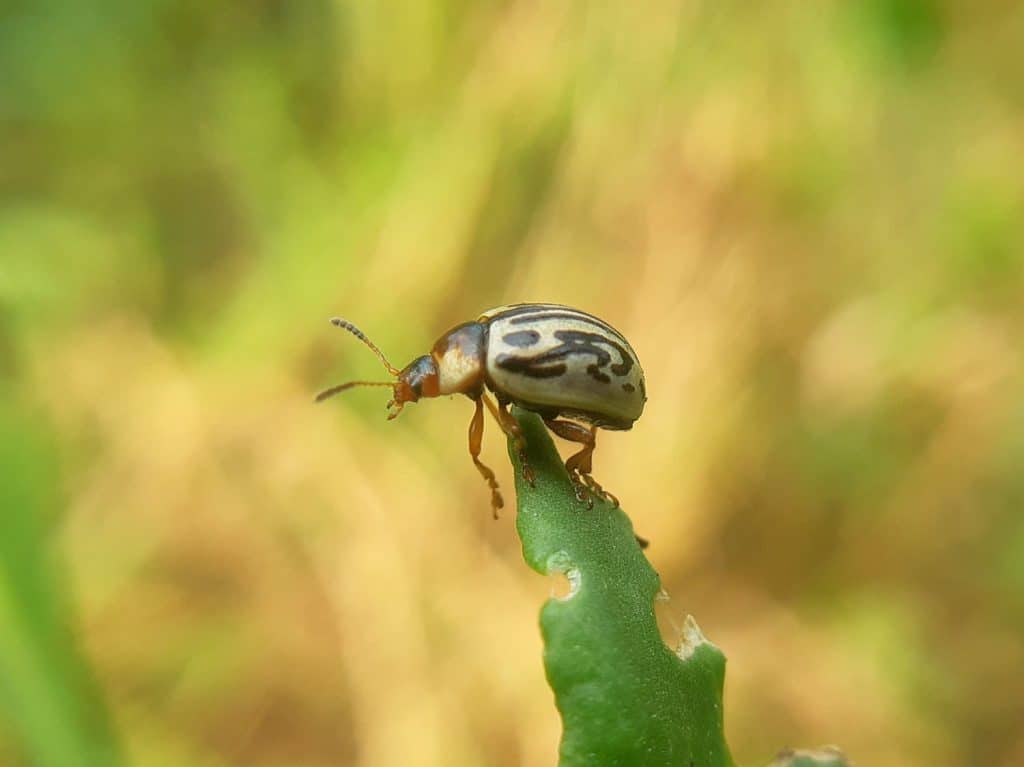
Most calligraphy beetles aren’t major pests. Because each species specializes in just a few host plants—such as dogwood, alder, or willow—their feeding usually remains focused and contained. They chew leaves and can make branches look ragged, but natural predators generally keep their numbers low enough that they don’t cause long-term harm. Even when a local outbreak defoliates a patch of shrubs, the plants typically sprout again without lasting damage. In healthy, diverse forests, these beetles actually play a helpful role by recycling plant material into the food web and supporting the predators that depend on them.
Unusual Reproduction in Some Species
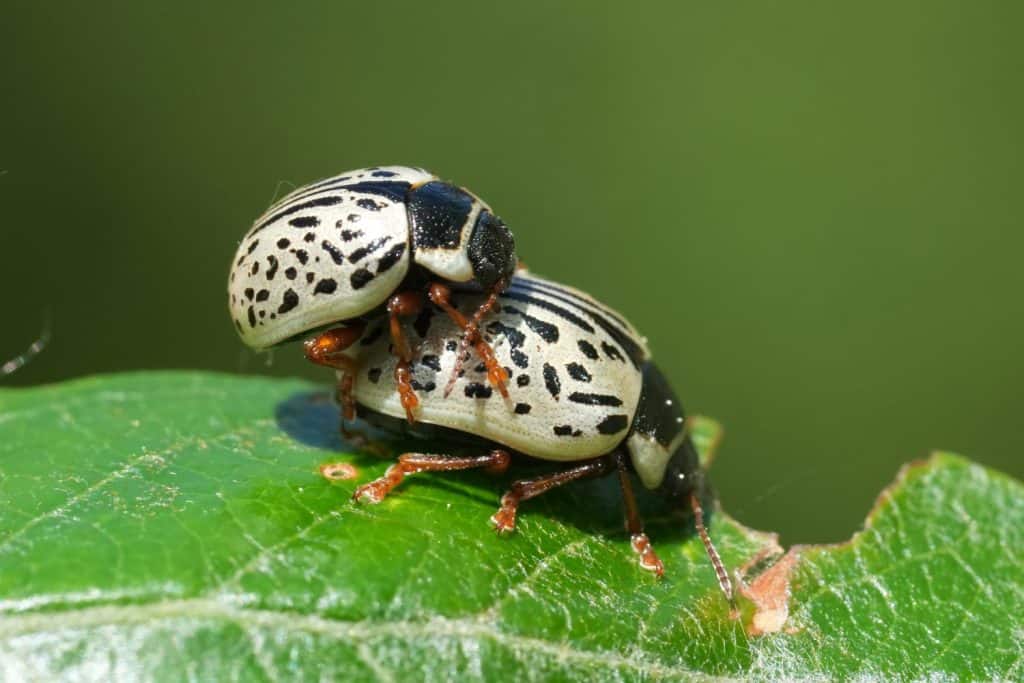
Calligraphy beetles mating.
©HWall/Shutterstock.com
Most calligraphy beetles reproduce in the usual way, with males and females pairing and mating on their host plants. Research on this genus, however, has revealed something surprising. Several species are known to be unisexual: populations contain only females. These beetles reproduce through parthenogenesis, laying viable eggs that develop without fertilization. Genetic studies suggest that such lineages arose through complex hybrid events among ancestral species. For biologists, calligraphy beetles therefore offer more than ornate patterns. They also provide living case studies in how new reproductive strategies and species arise, as lineages adapt to changing environments over long spans of time.
How Scientists Study Their Shells

Researchers study calligraphy beetles in the lab and the field with advanced instruments.
©wavebreakmedia/Shutterstock.com
To understand a calligraphy beetle’s shell, scientists combine classic fieldwork with advanced tools. Under microscopes, they examine the layers of the elytra, from the outer cuticle to the pigmented cells beneath. Biochemists analyze what pigments are present and how they bind to structural proteins. Spectrophotometers measure how the shell reflects and absorbs light, which helps researchers compare camouflage against real backgrounds such as alder leaves or dogwood bark. Genetic sequencing reveals which genes switch on during pupal development to guide pattern formation. Beyond laboratories, artists and science writers compare the loops to calligraphy and ancient script, helping the public see these insects as more than plant pests.
Finding a Calligraphy Beetle Outdoors
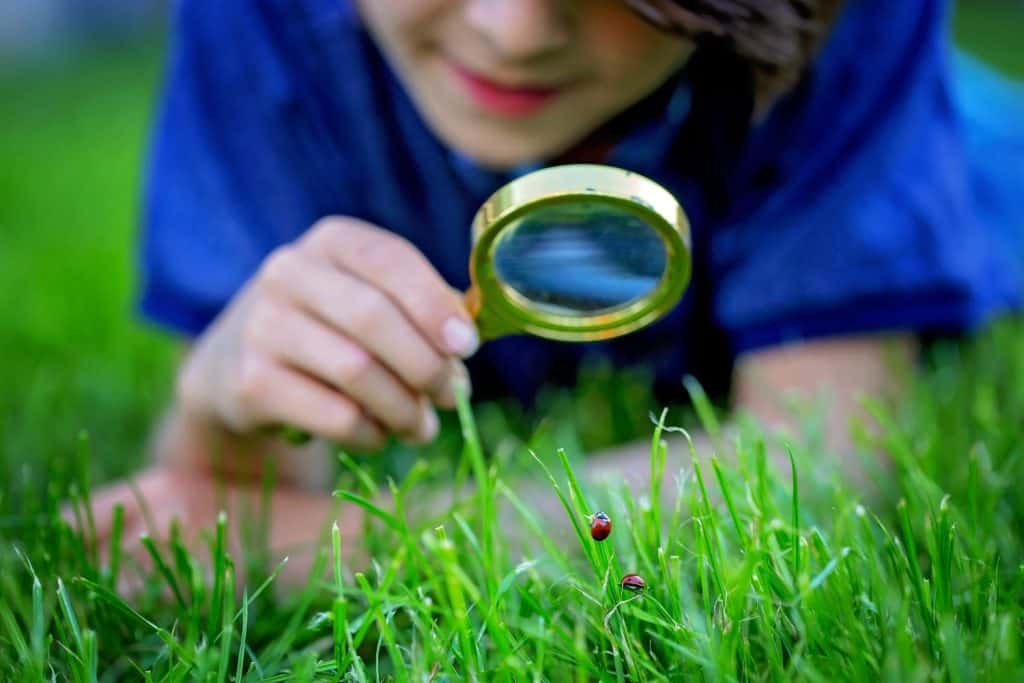
Calligraphy beetles tend to be similar in size to ladybugs, requiring patience to find and observe.
©Tomsickova Tatyana/Shutterstock.com
Spotting a calligraphy beetle in the wild takes patience. Their size, about the length of a grain of rice, and their camouflage make them easy to miss. The best strategy is to search for host plants carefully. Check dogwoods, alders, willows, and favored shrubs for pale beetles with dark curls and dots on the back. On sunny days, calligraphy beetles often sit exposed while feeding or resting, which offers good chances for photographs. Naturalists sometimes collect them gently in clear containers, record images, and then release them. Because markings vary from individual to individual, finding one often feels like discovering a new pattern each time.
Why These Beetles Fascinate People
Calligraphy beetles sit at a meeting point of art and science. To an entomologist, the looping lines record a history of evolution, host plant shifts, and genetic changes. To an artist or photographer, the beetle is a tiny canvas carried through the forest. These insects remind us that adaptation can produce forms that look like deliberate design. Their shells borrow the visual language of ink on paper, yet they arise from cells and proteins responding to developmental cues. Paying close attention to such small creatures encourages a slower, more observant way of looking at leaves, twigs, and the lives that move quietly among them. They may not be communicating with actual writing, but they still have a lot to teach us.