

Gharials have existed on Earth for more than 200 million years and have changed little in their evolution since.
The gharial is a large-sized reptile that is one of the longest of all extant crocodilians at 11.8-21 feet and lives in slow-moving rivers’ murky waters on the Indian subcontinent. Also known as the Indian gharial, gavial, and fish-eating gharial, this member of the crocodilian family is considered Critically Endangered due to severe population declines over the past 100 years. While it shares part of its name and is in the same family, Gavialidae, as the false gharial (Tomistoma schlegelii), they are two separate species.
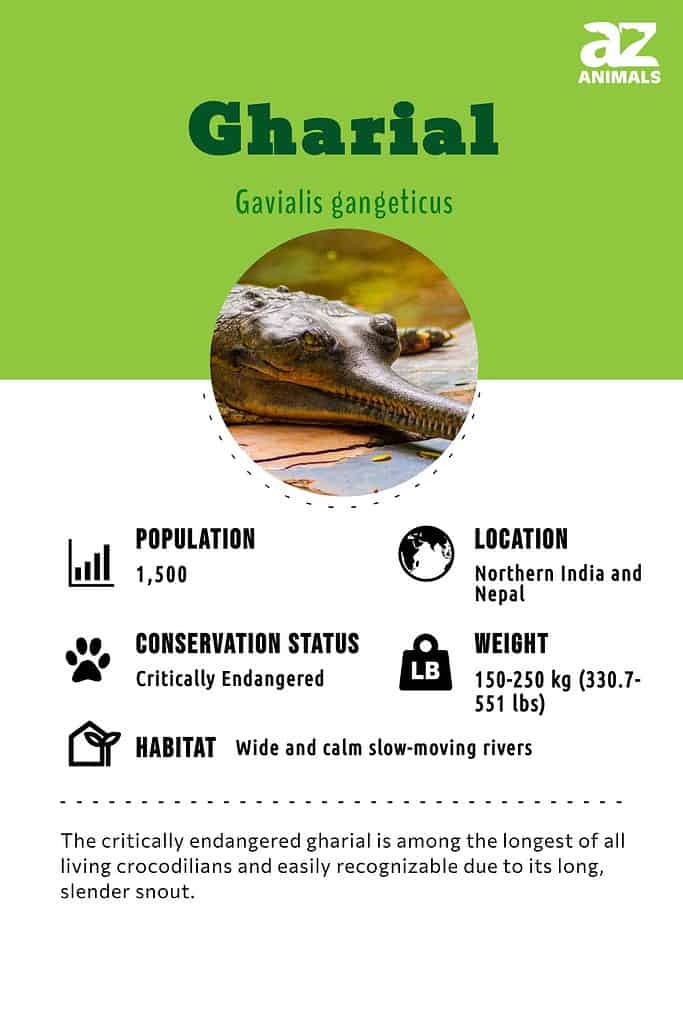
4 Fascinating Facts about Gharials!
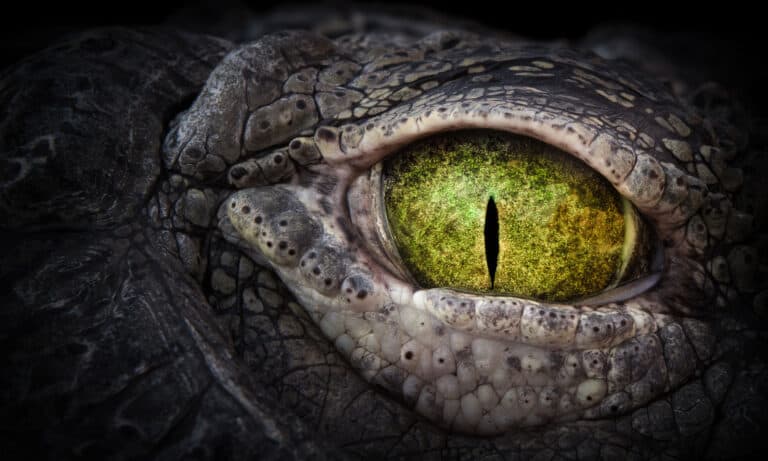
- Gharials have slit-like pupils that open wide during the darkness of night to allow them to see better. This night vision is also greatly improved by a special layer at the back of the eye, which reflects as much light as possible into their eyes.
- Due to the fact that their eyes are set so close together and face forward, gharials are able to see in three dimensions which helps them to judge distances more accurately.
- Gharials have a special, transparent third eyelid that they are able to cover each eye with to protect them when they fully submerge themselves in the water.
- They have external flaps that close over their ears and nostrils to protect them from the incoming water, and a flap that closes at the back of their mouths to prevent water from entering their lungs.
Scientific Name
The gharial’s scientific name is Gavialis gangeticus, with gangeticus meaning “of the Ganges” in reference to the Ganges River. The animal’s original scientific name was Lacerta gangetica, described by Johann Friedrich Gmelin in 1789. Subsequent taxonomic changes by naturalists led to the current name.
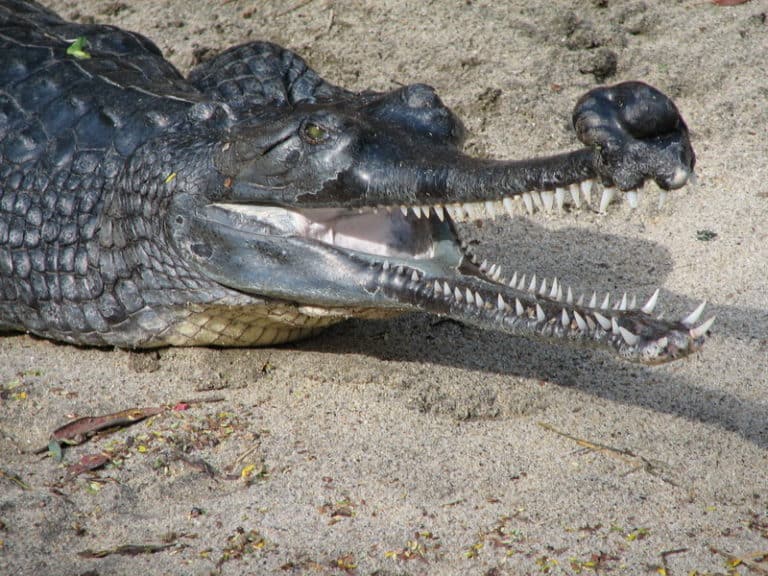
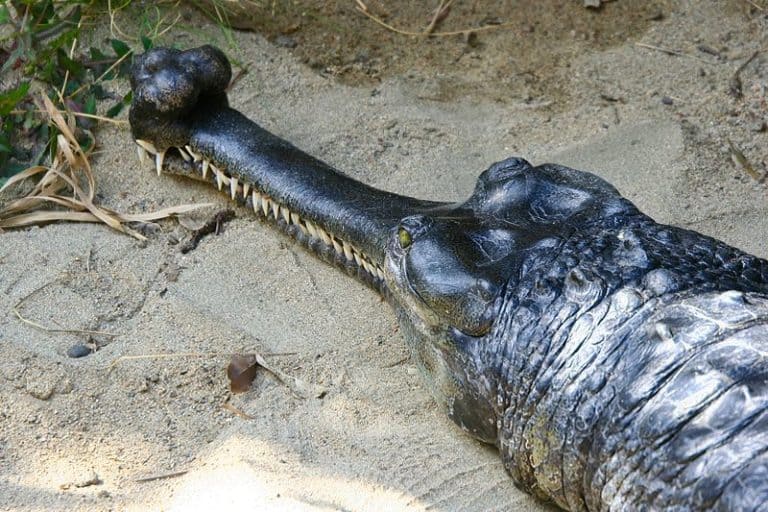
The common name gharial is in reference to the resemblance of the adult male’s snout to an Indian clay pot called a “ghara.” The ghara helps the gharial’s vocalizations by creating a loud buzzing and also assists them in attracting females.
It’s also known as the Indian gharial, gavial, fish-eating gharial, and long-nosed crocodile.
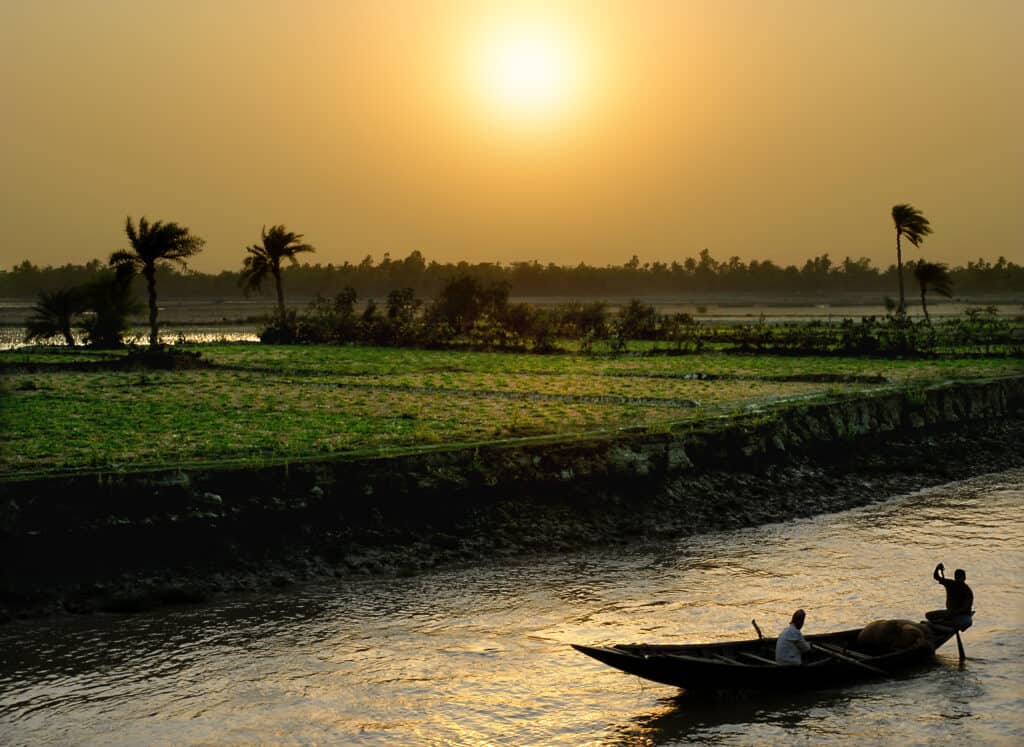
The gharial’s scientific name Gavialis gangeticus refers to the Ganges River.
©Jono Photography/Shutterstock.com
Evolution and Origins
Closely related to other crocodilians in the Crocodilia order that includes crocodiles, alligators, and caimans, gharials are animals that have existed on Earth for more than 200 million years and have changed little in their evolution since. Like the other members of Crocodilia, gharials are archosaurs, which is a group of reptiles that included the dinosaurs and are not closely related to other more modern reptile species that belong to a separate group completely.
However, unlike the dinosaurs which disappeared 65 million years ago, the adaptations that crocodilians possess mean that they are incredibly well adapted to their habitats and have therefore been able to continue to exist as a species.
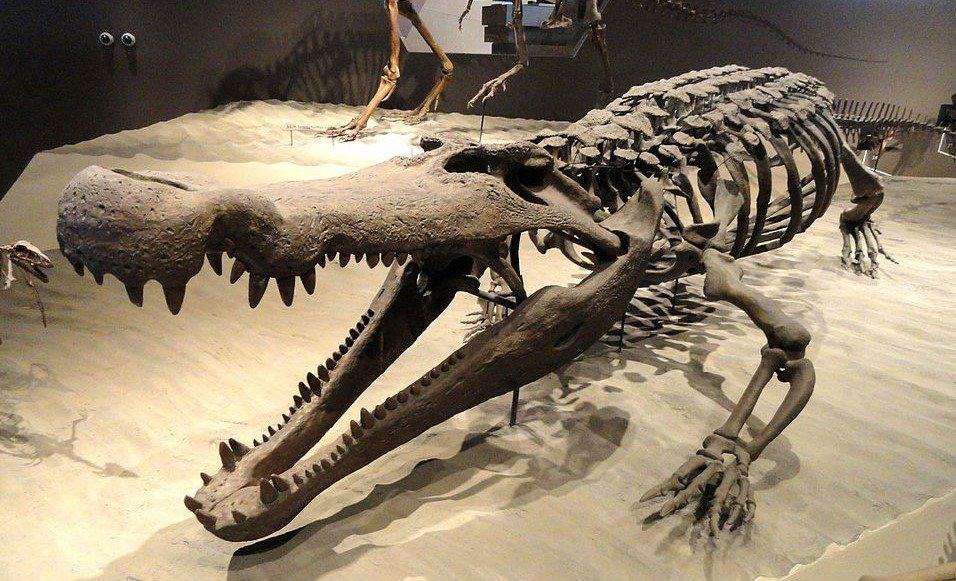
Gharials are part of the Crocodilia order, which includes the extinct genus Deinosuchus.
Appearance
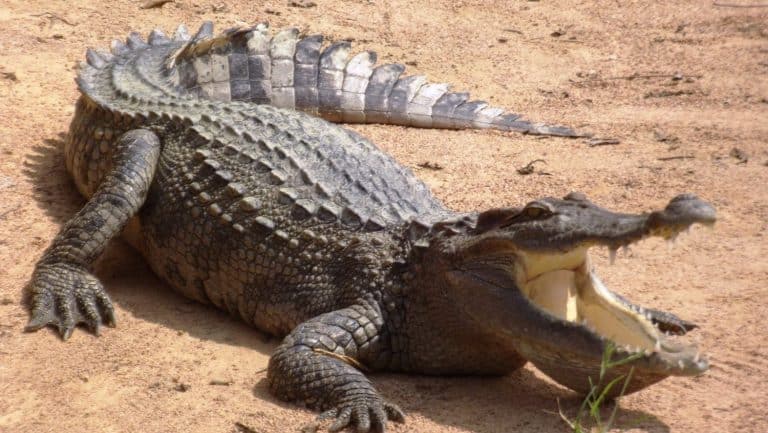
Gharials share a number of characteristics with other crocodilian species including the hard, plate-like scales that protect their bodies from both sunburn and attack from predators. These olive or grey-colored toughened scales are also waterproof and help to prevent their body from drying out.
It is one of the longest of living crocodilians capable of growing 11.8 to 21 feet long and typically weighs around 330 to 551 lbs.
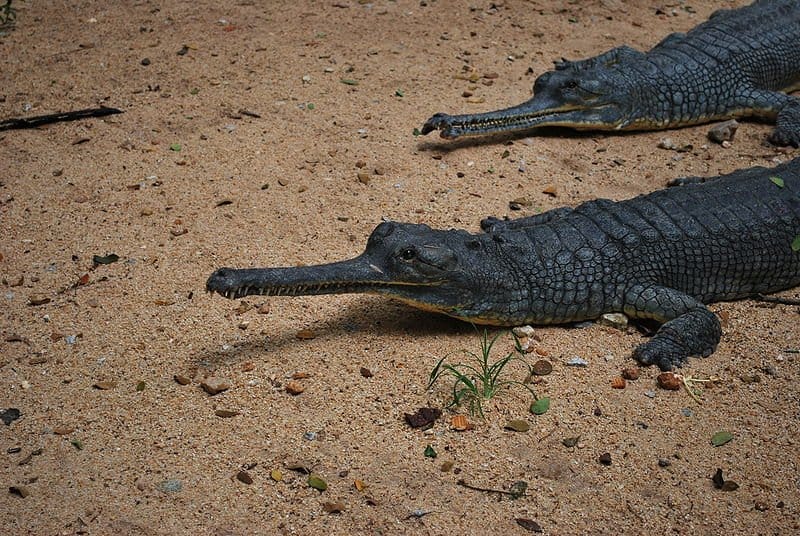
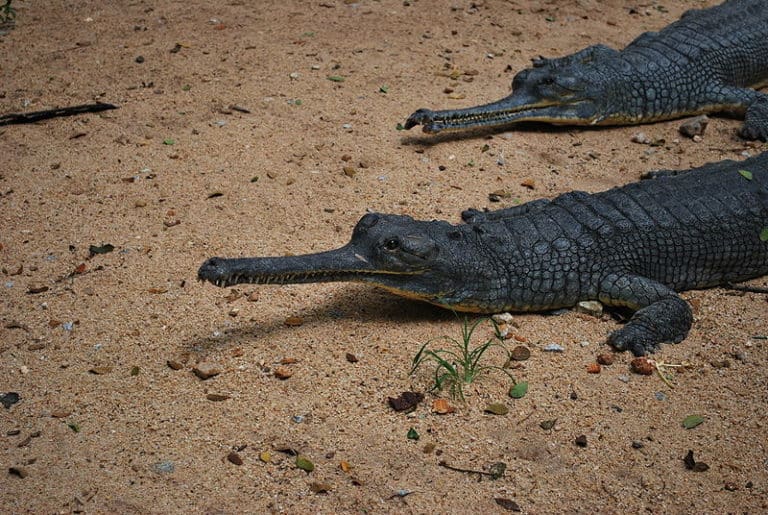
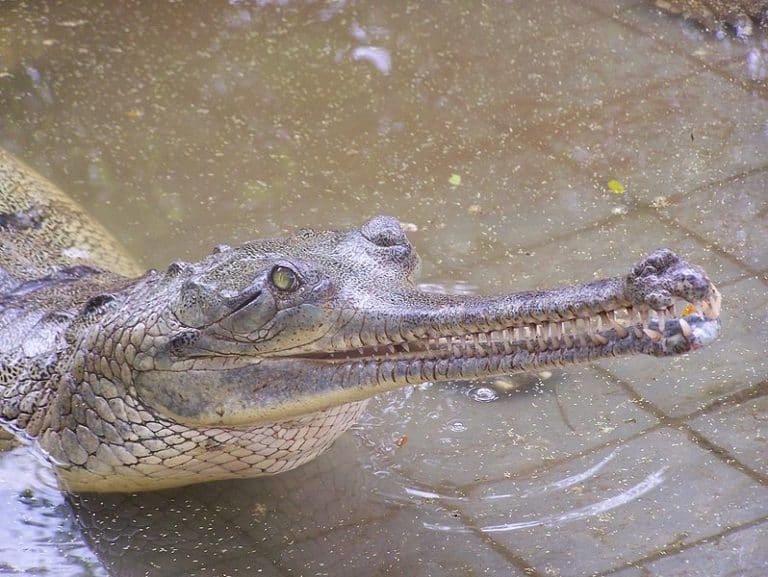
The gharial is easily recognizable among crocodilians due to its long, slender snout which is lined with small and incredibly sharp interlocking teeth. Male gharials have a bulbous growth on the end of their long snout which is used for making vocalizations and for blowing air bubbles in the water which are important in their mating displays.
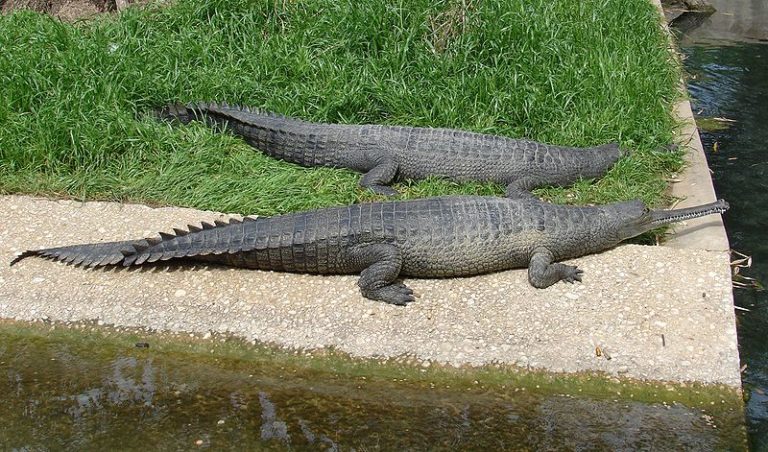
Unlike crocodiles and alligators that have strong hind legs and can move quickly on land, the legs of the gharial are comparatively weak and are not suitable for moving around on land. Gharials therefore spend most of their time in the water, only leaving to bask in the sun on the muddy banks and to lay their eggs.
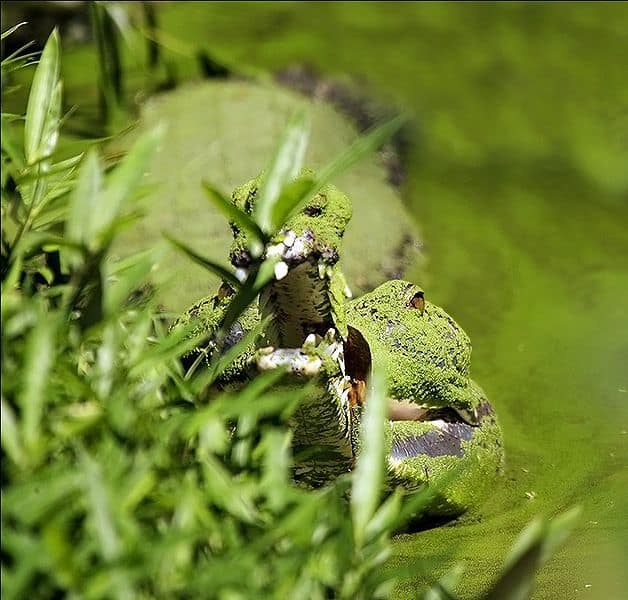
Gharials are animals that have eyes that are situated on the very top of their head which allows them to remain submerged and unseen by both prey species and potential predators whilst still allowing them to keep watch on their surroundings. The same applies to their nostrils at the end of their long snout, which means that they can still breathe but can stay hidden for long periods of time.
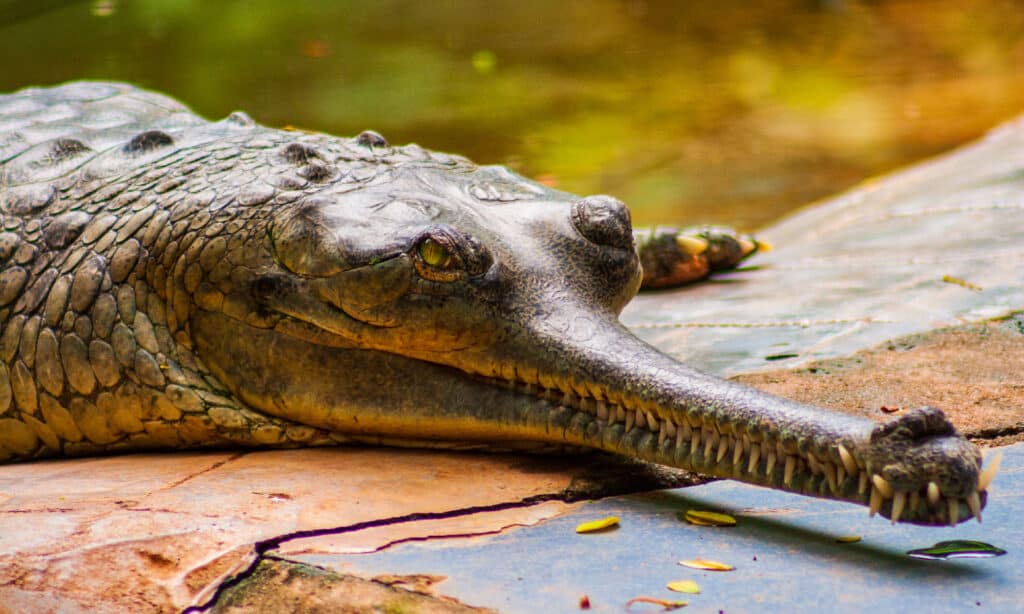
The gharial is easily recognizable among crocodilians due to its long, slender snout.
©iStock.com/palliki
Behavior
Unlike other crocodilian species that are semiaquatic and even hunt on land in some cases, gharials spend almost all of their time in the water and only leave to warm their bodies up by basking in the sun and to make nests.
In the same way as similar species, gharials are unable to regulate their body temperature internally and instead rely on their surroundings to do it for them. Their weak leg muscles mean that gharials have to drag themselves onto the river banks. By basking in the sun, they are able to warm their bodies up in order to gain the energy that they need for hunting and are then able to cool them down when they are submerged in the water.
When they enter the water, gharials sink their bodies down leaving just their eyes and nostrils exposed on the surface. Their bodies and tail hang down when they are floating and their hind feet act as brakes to stop them from sinking completely. Gharials use their webbed toes which are spread widely and allow them to descend slowly down without disturbing the water when they are trying to remain hidden from predators.
Unlike other members of the crocodilian family that can (and do) pose a threat to human life as they are able to hunt people, the narrow shape of the gharial’s snout means that they are unable to hunt people and therefore don’t.
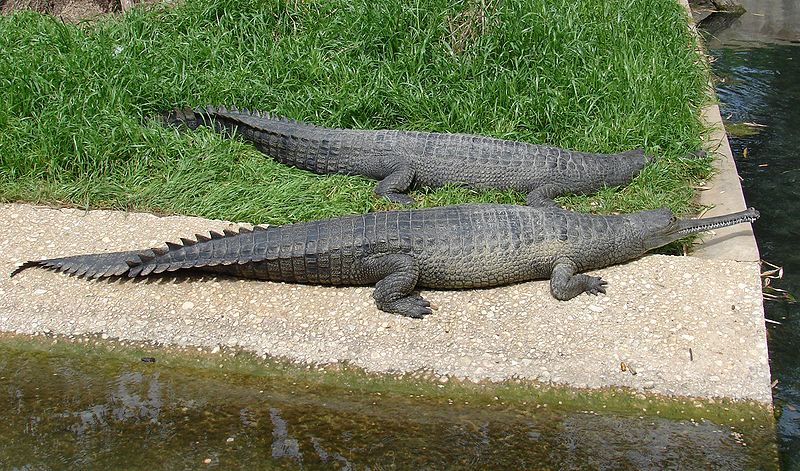
Gharials bask in the sun’s rays to warm up and gain energy.
Habitat
Historically, gharials had a wide distribution throughout the Indian subcontinent from Pakistan in the west, across to parts of Myanmar and south into India. Today however, they are confined to small and increasingly more isolated regions in Northern India and Nepal. They prefer the calmer, wide backwaters of slow-moving rivers where they are able to swim more easily using their flattened tails and webbed hind feet.
The degradation of their freshwater habitats has had enormous implications for gharials and has contributed to their severe population decline in modern times. Their almost solely aquatic lifestyle means that gharials are heavily dependent on healthy river systems, and when these decline so do the number of individuals that exist in them.
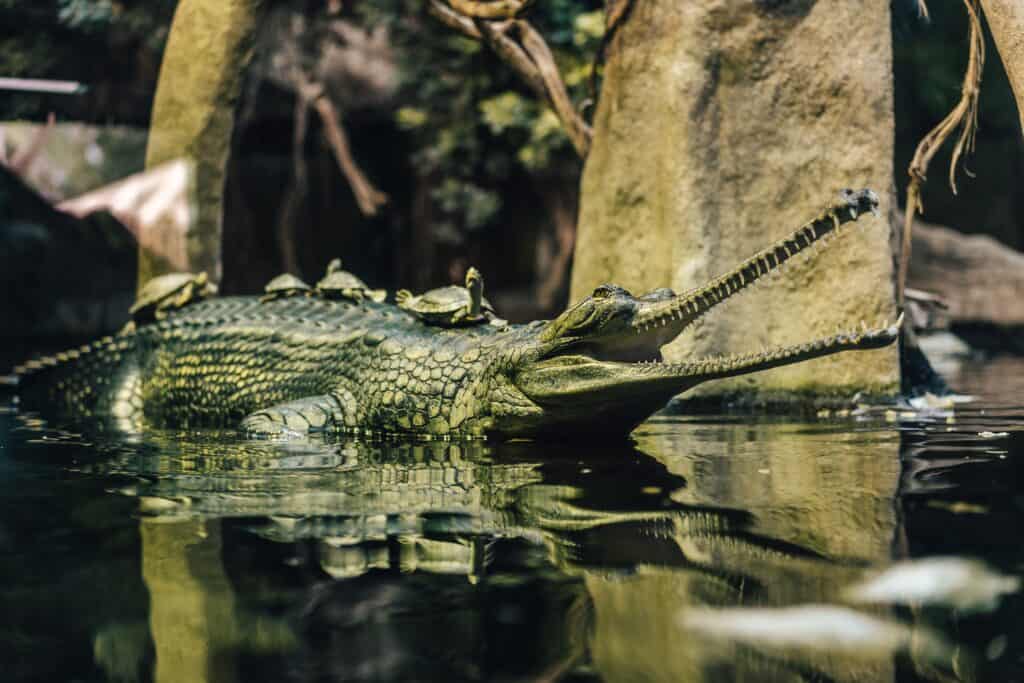
Gharials (and turtles) live in freshwater habitats.
©Ondra Vacek/Shutterstock.com
Diet
Gharials are carnivorous reptiles that primarily feed on fish in the water but will also sometimes take aquatic birds should the opportunity arise. Their specially adapted long, thin snouts contain over 100 small, razor-sharp teeth which are used to sink into their prey when they snap their powerful jaws shut. Gharials, are unable to chew their food and instead swallow it whole.
Gharials use sensors to detect vibrations in the water that signalizes approaching prey. They catch fish in the water by lying in wait before quickly snapping them side-on and flicking them back into their mouths and swallowing them headfirst.
Juvenile gharials that haven’t refined their techniques at successfully catching the slippery fish, will also often feed on small crustaceans and frogs that they find in the water. The delicate shape of their narrow jaws means that gharials are unable to catch larger prey species.
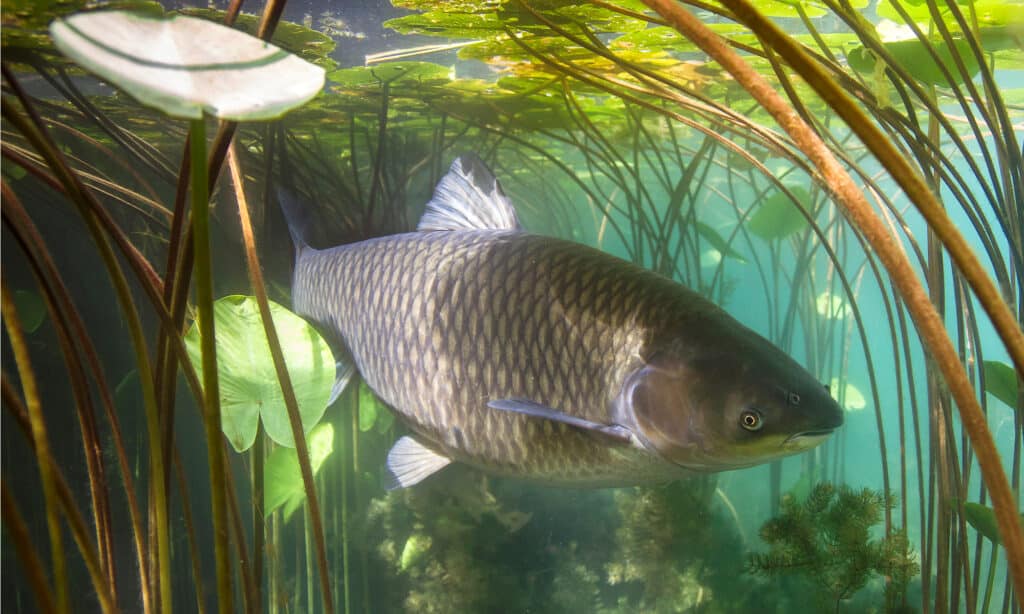
Gharials are carnivorous and mainly feed on fish such as grass carp.
©Rostislav Stefanek/Shutterstock.com
Predators and Threats
Due to their large size and aquatic nature, adult gharials have no real natural predators within their environments. The smaller and more vulnerable juveniles though are threatened by a number of animal species including birds of prey and large reptiles including snakes.
People are really the only threat to gharials in their natural environment. They have been excessively hunted for their skins and meat throughout their once wide range, and nests are often raided by people for their eggs. Gharials have also been hunted as their body parts are used in some traditional medicines.
Hunting aside, gharials are also heavily threatened by habitat loss which has played a major part in their demise as a species throughout much of their natural range. Not only have they been affected by the degradation in the quality of the water, but also human interferences such as mining, net fishing, and dams to create land for agriculture and grazing have had a severe impact on the abundance of these freshwater habitats and therefore, gharial population numbers. The increase in human activity in their native environments has pushed the remaining gharial populations into smaller and increasingly isolated regions and they are now therefore only found in two countries.
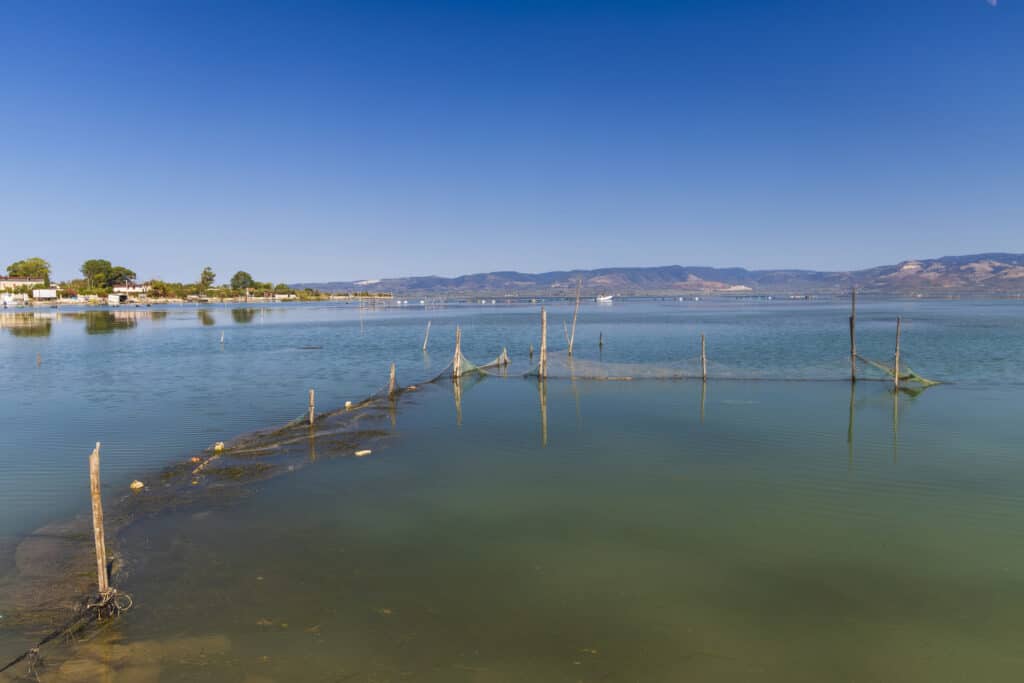
Human interferences such as net fishing create habitat loss.
©iStock.com/phbcz
Reproduction, Babies, and Lifespan
During the mating season, male gharials become fiercely territorial and use vocalizations and bubble displays created by the bulbous bump on the end of their snout to attract and assemble a harem of females which they mate with in the water. After mating, female gharials leave the water to lay their eggs in a nest that is a good distance away from the water to prevent it from becoming flooded. Between 30 and 50 hard, leathery eggs are laid between March and May that weigh around 150g each.
Female gharials protect their eggs and young when they emerge but unlike other crocodilian species that help their young into the water by carrying them in their mouths, female gharials are unable to do this because of the shape of their snouts. Juvenile gharials remain close to their mothers until they are large enough to defend themselves again predators, and are able to breed when they are around 10 years old.
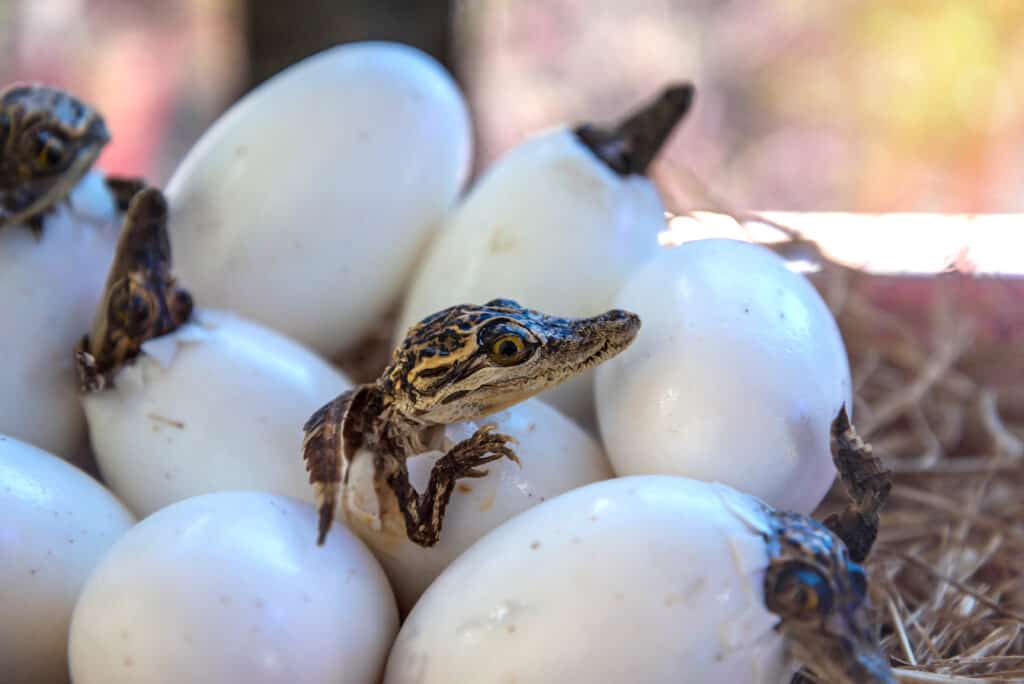
Like other crocodile species, the gharial leaves the water to lay eggs in a nest.
©WeStudio/Shutterstock.com
Population and Conservation
Today, the gharial is listed as Critically Endangered in its natural environment by the IUCN. It is estimated that their population numbers have declined by up to 98% over the past century, with gharials nearly becoming extinct in the 1970s due to the severity of hunting and habitat loss. It’s believed that around 1,500 gharials are existing in the wild in India and Nepal habitats.
Gharials are now a protected species and although hunting has certainly decreased, they are still heavily affected by the loss of their habitats and getting caught up in fishing nets, even in areas that are actually protected by law.

The IUCN’s Red List classifies the gharial as Critically Endangered.
©Tobias Arhelger/Shutterstock.com
Gharial Pictures
View all of our Gharial pictures in the gallery.

Sources
- David Burnie, Dorling Kindersley (2011) Animal, The Definitive Visual Guide To The World's Wildlife / Accessed May 9, 2018
- Tom Jackson, Lorenz Books (2007) The World Encyclopedia Of Animals / Accessed May 9, 2018
- David Burnie, Kingfisher (2011) The Kingfisher Animal Encyclopedia / Accessed May 9, 2018
- Richard Mackay, University of California Press (2009) The Atlas Of Endangered Species / Accessed May 9, 2018
- David Burnie, Dorling Kindersley (2008) Illustrated Encyclopedia Of Animals / Accessed May 9, 2018
- Dorling Kindersley (2006) Dorling Kindersley Encyclopedia Of Animals / Accessed May 9, 2018
- IUCN Red List / Published March 1, 2007 / Accessed May 9, 2018