
T
Species Profile

Tarsier

Tarsiidae

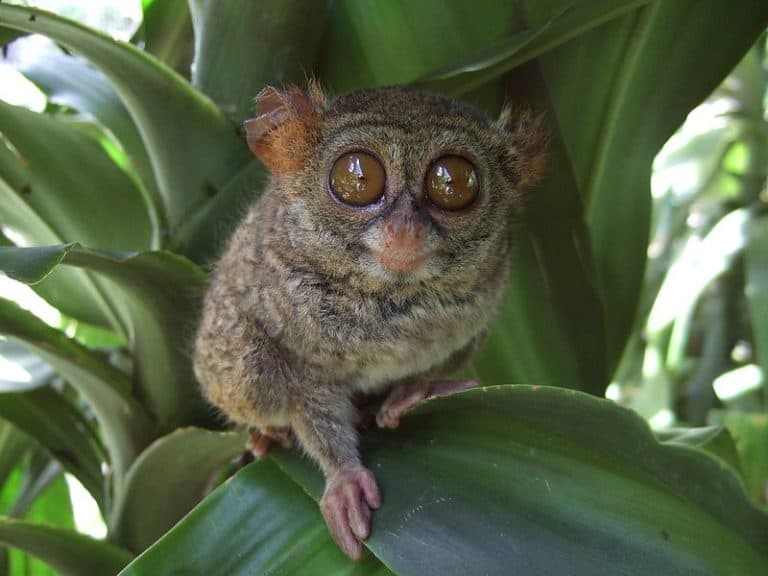
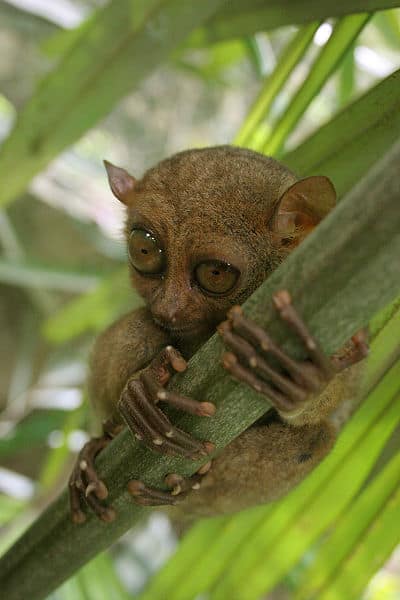
Big eyes. Bigger leaps.
Magalhaes - Public Domain

Tarsier Distribution

Click a location to explore more animals from that region

Endemic Species
Loading map...

At a Glance

Family Overview This page covers the Tarsier family as a group. Stats below are general traits shared across the family.
Activity Nocturnal+
Lifespan 12 years
Weight 0.17 lbs
Status Not Evaluated
Did You Know?

Tarsiers are among the very few primates that are obligate faunivores-living on insects and other small animals, not fruit.

Scientific Classification

Family Overview "Tarsier" is not a single species but represents an entire family containing multiple species.

Tarsiers are small, nocturnal haplorhine primates famous for extremely large eyes, elongated tarsal (ankle) bones adapted for leaping, and a predatory, primarily insectivorous diet (they are among the few obligate faunivorous primates).

Kingdom
Animalia
Phylum
Chordata
Class
Mammalia
Order
Primates
Family
Tarsiidae

Distinguishing Features

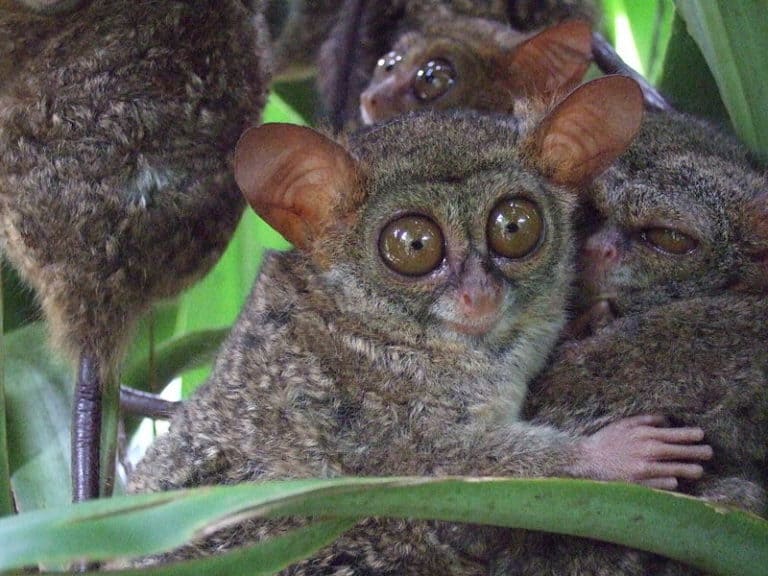
  • Enormous forward-facing eyes (nocturnal adaptation) and excellent low-light vision
  • Powerful hind limbs with elongated tarsal bones for vertical clinging and long-distance leaping
  • Long tail used for balance rather than grasping
  • Carnivorous/insectivorous feeding ecology compared to most other primates
  • Characteristic vocalizations and scent-marking used in territorial and social behavior

Did You Know?

Tarsiers are among the very few primates that are obligate faunivores-living on insects and other small animals, not fruit.

Across the family, adults are tiny: ~9-16 cm body length, but carry long tails ~13-27 cm for balance while leaping.

They're classic "vertical clingers and leapers," launching from trunks and landing on vertical supports with remarkable precision.

Their eyes are enormous for their size (about ~14-18 mm wide in many species) and cannot move much in their sockets.

Instead of eye movement, tarsiers pivot their heads dramatically-up to ~180° in each direction-to scan for prey.

Some tarsier species use very high-frequency (sometimes near-ultrasonic) calls, likely helping communication in dense forest at night.

Family range spans multiple island regions-Philippines, Borneo/Sundaland, and Sulawesi-where different species vary in calls, coat color, and social patterns.

Unique Adaptations

  • Elongated tarsal (ankle) bones (the trait behind the name "tarsier") act like biomechanical levers for powerful leaping.
  • Enormous forward-facing eyes adapted to low light; eyes are relatively fixed, trading eye movement for head rotation.
  • Extreme neck flexibility enabling head rotation up to ~180° each way, compensating for limited eye mobility.
  • Grasping hands/feet with enlarged fingertip/toe pads for strong purchase on vertical surfaces during clinging and landings.
  • Obligate predatory digestion/feeding ecology among primates: they routinely capture live animal prey rather than relying on fruit/leaf diets.
  • Long, often sparsely haired tail tip in many species functions mainly for balance and control during leaps and vertical landings.
  • High-frequency hearing and vocal signaling (including very high-pitched calls in some species) suited to nocturnal forest communication.

Interesting Behaviors

  • Nocturnal sit-and-wait hunting: many individuals perch upright on trunks/branches, then explode into a leap to seize prey.
  • Prey choice is broadly similar (arthropods plus small vertebrates), but varies by habitat and availability-some populations take more lizards/frogs, others mostly insects.
  • Vertical clinging and leaping locomotion is the shared template; exact leap distances and perch preferences vary with forest structure (secondary growth vs. mature forest).
  • Vocal communication is prominent, but differs among lineages: duet-like calling is well known in some Sulawesi tarsiers, while other species rely more on solo calls and contact notes.
  • Territoriality is common (scent-marking and calling), yet social organization varies-from more pair-associated systems in some species to more solitary spacing in others.
  • Daytime roosting occurs in dense vegetation, tangles, or tree hollows; roost choice differs with local predator pressure and habitat.
  • Grooming uses specialized grooming claws (especially on the second and third toes); grooming may be solitary or social depending on species and group structure.

Cultural Significance

Tarsiers are used to promote Southeast Asian forest conservation, especially on islands with many unique species (e.g., the Philippines and Sulawesi). They appear in ecotourism and education; because handling and bright light stress them, people are urged to view them respectfully and protect habitat.

Myths & Legends

Philippine (Bohol and other Visayan areas) local belief: harming or killing a tarsier can bring misfortune, a taboo that functions as an informal protection custom in some communities.

Historical travel-anecdote tradition: early European naturalists and travelers described tarsiers as "spectral" or "goblin-like" forest creatures because of their eyes and nocturnal habits-an association that fed later popular tales framing them as mysterious night spirits.

Naming origin as a cultural-historical story: "tarsier" comes from the animal's distinctive elongated tarsus (ankle/foot) bones-an anatomical feature so striking it became the basis of its common name in Western natural history.

Conservation Status

NE Not Evaluated

Has not yet been evaluated against the criteria.

Population Decreasing

Protected Under

  • CITES Appendix II (tarsiers trade controlled as primates)
  • Philippines: Wildlife Resources Conservation and Protection Act (RA 9147)
  • Indonesia: Conservation of Living Resources and Their Ecosystems (Law No. 5/1990)
  • Protected areas and national parks across Indonesia, Malaysia (Borneo), and the Philippines (site-dependent)

You might be looking for:

Philippine tarsier

35%

Carlito syrichta

A well-known tarsier species endemic to the Philippines; often featured in media and tourism.

Spectral tarsier

25%

Tarsius tarsier

A Sulawesi-region tarsier historically treated broadly; name still commonly encountered.

Pygmy tarsier

15%

Tarsius pumilus

A rarer, high-elevation Sulawesi tarsier; distinctive due to small size and montane habitat.

Horsfield’s tarsier

15%

Cephalopachus bancanus

A Sundaland (Borneo/Sumatra vicinity) tarsier, representing the western tarsier lineage.

Life Cycle

Birth 1 infant
Lifespan 12 years

Lifespan

In the Wild
6–20 years
In Captivity
8–26 years

Reproduction

Mating System Data Deficient
Social Structure Socially Monogamous
Breeding Pattern Serial
Fertilization Internal Fertilization
Birth Type Internal_fertilization

Tarsier social and mating systems vary by species. Many live in territorial pairs or small family groups, often sharing sleeping sites, while foraging may be solitary. Both monogamy and polygyny have been reported. Females usually rear a single infant and male care is limited.

Behavior & Ecology

Social Family group Group: 2
Activity Nocturnal, Crepuscular
Diet Insectivore Large, moving arthropods-especially crickets/katydids/grasshoppers and other sizable nocturnal insects (with preference varying by species, habitat, and local prey availability).

Temperament

Highly vigilant, cryptic, and wary; freeze-and-scan behavior common
Territorial; adults can be aggressive toward same-sex intruders
Predatory focus during foraging; rapid, reactive pursuit and capture
Tolerance varies by species and habitat; more affiliative at shared sleeping sites

Communication

species-specific calls; contact calls between neighbors or mates
alarm calls in response to predators or disturbance
mating-related calls; some populations perform coordinated male-female duets
infant distress calls prompting maternal retrieval or attention
scent marking with urine and glandular secretions; marking routes and sleeping sites
visual signals: staring, body postures, and tail movements during arousal
tactile contact: grooming and close huddling, mostly within pairs/family
spatial communication via spacing and repeated use of perches and travel paths

Habitat

Biomes:
Tropical Rainforest Tropical Dry Forest Wetland
Terrain:
Coastal Island Plains Valley Hilly Mountainous Riverine +1
Elevation: Up to 6561 ft 8 in

Ecological Role

Nocturnal mesopredators specializing on live arthropods, with variable inclusion of small vertebrates; important controllers of forest-edge and understory prey communities.

Regulation of nocturnal insect populations (including many herbivorous/defoliating insects) Potential suppression of pest insects in disturbed/edge habitats near forest mosaics Energy transfer from abundant invertebrate biomass to higher trophic levels (as prey for owls, snakes, and small carnivores)

Diet Details

Main Prey:
Large insects Beetles Moths and other nocturnal flying insects Cicadas and other true bugs Ants and termites Arachnids Small invertebrates Small vertebrates +2

Human Interaction

Domestication Status

Wild

Tarsiers (family Tarsiidae) are wild primates with no history of domestication. They are sometimes taken for short displays, tourist photos, or the illegal pet trade, but are not bred to be tame and usually do poorly in captivity. Zoos and rescue centers have tried care with mixed results; long-term, large breeding programs are rare.

Danger Level

Low
  • Defensive bites and scratches if handled (can break skin)
  • Potential zoonotic disease exposure common to handling wild primates (risk depends on setting and hygiene; not uniquely high compared with similar small mammals)
  • Human safety risks mainly arise from improper capture/handling at night (falls, stress-related incidents) rather than active aggression
  • Animal-welfare risk is high: tarsiers are easily stressed and may self-injure in captivity, creating indirect risks during rescue/transport

As a Pet

Not Suitable as Pet

Legality: Tarsiers (Tarsiidae) are illegal or heavily restricted in most of their home countries and under CITES. Permits are rare, welfare rules are hard to meet, and many places ban keeping them as pets.

Care Level: Expert Only

Purchase Cost: Up to $5,000
Lifetime Cost: $15,000 - $60,000

Economic Value

Uses:
Ecotourism Education and conservation outreach Scientific research (sensory biology, locomotion, primate evolution) Local cultural value Negative economic impacts from illegal wildlife trade (enforcement and welfare costs)
Products:
  • wildlife-viewing tourism experiences (guided night walks, sanctuaries/reserves)
  • conservation-program revenue and donations
  • research outputs (non-consumptive value; data and publications rather than physical goods)

Relationships

Related Species 5

Philippine tarsier Carlito syrichta Shared Family
Horsfield's tarsier Cephalopachus bancanus Shared Family
Spectral tarsier Tarsius tarsier Shared Family
Dian's tarsier Tarsius dentatus Shared Family
Pygmy tarsier Tarsius pumilus Shared Family

Ecological Equivalents 4

Animals that fill a similar ecological role in their ecosystem

Senegal bushbaby Galago senegalensis Small, nocturnal, arboreal primate that forages heavily on insects and uses powerful leaping. Occupies a similar nighttime niche, though galagos are strepsirrhines and are more omnivorous, often including gum and fruit in their diet.
Brown greater galago Otolemur crassicaudatus Nocturnal arboreal primate with vertical clinging and leaping tendencies and insect-heavy foraging. Differs in being larger and generally more omnivorous than tarsiers.
Gray mouse lemur Microcebus murinus Tiny nocturnal arboreal primate that hunts insects and small prey. Overlaps in size class and nocturnal hunting, but mouse lemurs are typically omnivorous rather than obligate faunivores.
Philippine scops-owl Otus megalotis Nocturnal, arboreal predator in overlapping habitats that targets large insects and small vertebrates; shares a similar feeding window and prey base, but occupies a bird-of-prey niche.

Types of Tarsier

12

Explore 12 recognized types of tarsier

Philippine tarsier Carlito syrichta
Horsfield's (Bornean) tarsier Cephalopachus bancanus
Spectral tarsier Tarsius tarsier
Dian's tarsier Tarsius dentatus
Makassar (western) tarsier Tarsius fuscus
Lariang tarsier Tarsius lariang
Peleng tarsier Tarsius pelengensis
Sangihe tarsier Tarsius sangirensis
Jatna's tarsier Tarsius supriatnai
Siau Island tarsier Tarsius tumpara
Wallace's tarsier Tarsius wallacei
Pygmy tarsier Tarsius pumilus

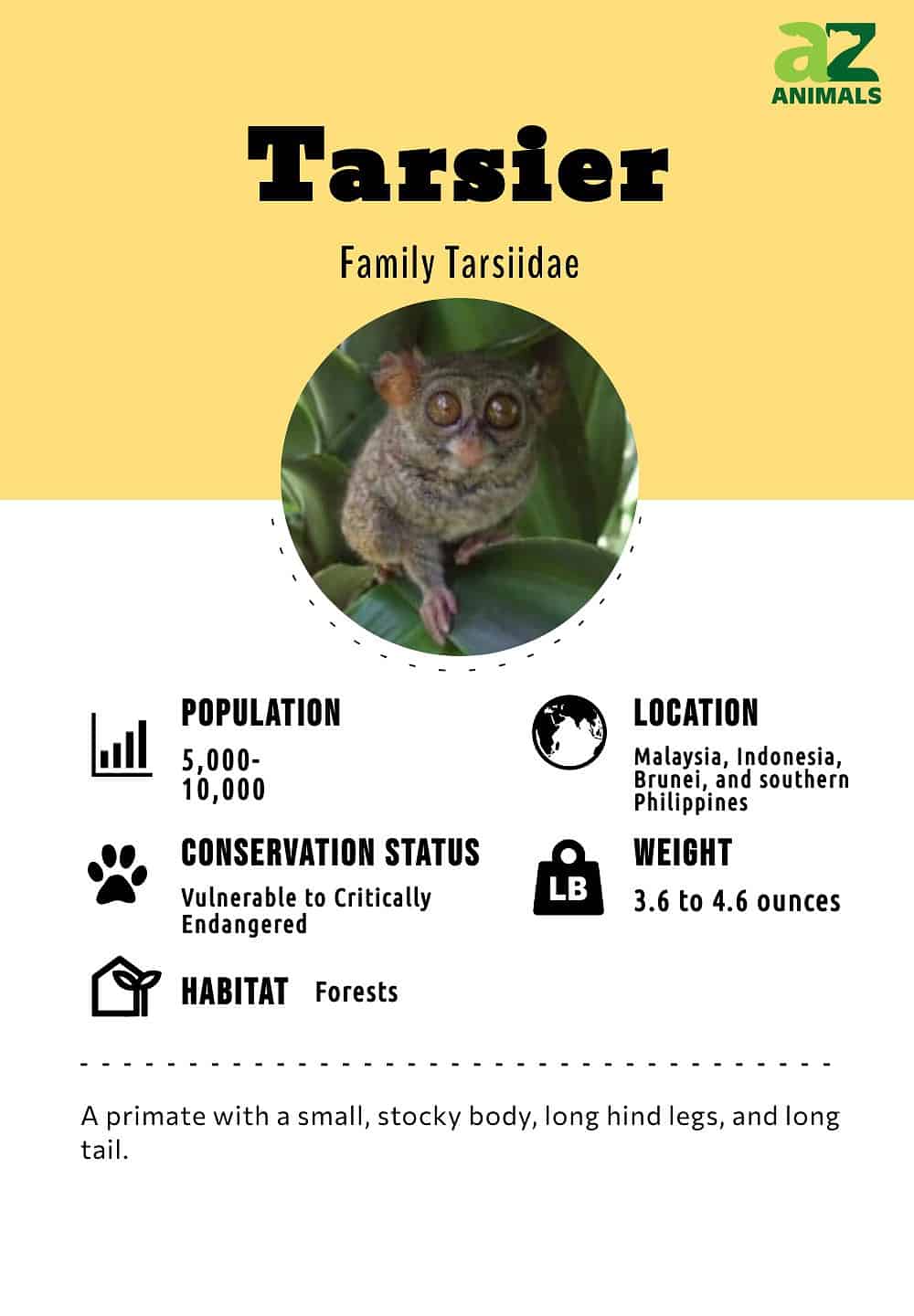
The Tarsier is one of the most unique primates on the planet. It is known to have the largest eyes of any mammal in relation to its body size. Each eye is actually heavier than its brain!
3 Interesting Facts:

  • The Tarsier has an unusually long anklebone that enables it to jump distances more than 40 times its own body length. The bones are known as the Tarsals, which is where the Tarsier gets its name.
  • Females are known to give birth to the largest babies in relation to their adult size.
  • The Tarsier is known to be quite unique geographically because of its distribution across Wallace’s Line, which runs south between Borneo and Sulawesi and separates the evolutionary centers of the animals found in Eurasia and Australia. Generally, animal species tend to be found on only one side of Wallace’s Line, but the Tarsier is found on both.

Classification and Evolution
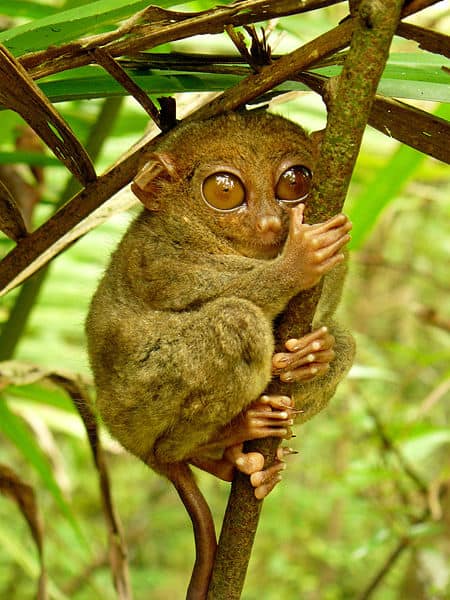
The Tarsier is a small species of primate that inhabits the well-vegetated forests of a number of islands in southeast Asia. Although fossil records show that Tarsiers once could have been found in mainland Asia, Europe, North America, and Africa, modern Tarsiers are today restricted to just a handful of islands in Malaysia, Indonesia, and the southern Philippines. These fossil records show that Tarsiers have existed for 55 million years, and have had very few developmental changes in the last 45 million years.

As a member of the Primate order, the Tarsier is in the Suborder Haplorhini (which means dry nose), the Infraorder Tarsiiformes, and the Family Tarsiidae, of which Tarsier is the only member. After that, there are three genus categories: Carlito, Cephalopachus, and Tarsius.

Otherwise, there has been constant debate amongst scientists over the naming and classification of the different Tarsier species. There appear to be from 13-19 different subspecies of Tarsier that are split into three groups generally depending on their geographic location: Western Tarsiers, Eastern Tarsiers, and Philippine Tarsiers.

Although science is slowly discovering more and more about Tarsiers in the wild, data can be hard to collect due to their shy and elusive nature. Add to that the constant confusion over the classification of separate species, and conservation efforts become difficult.

Anatomy and Appearance
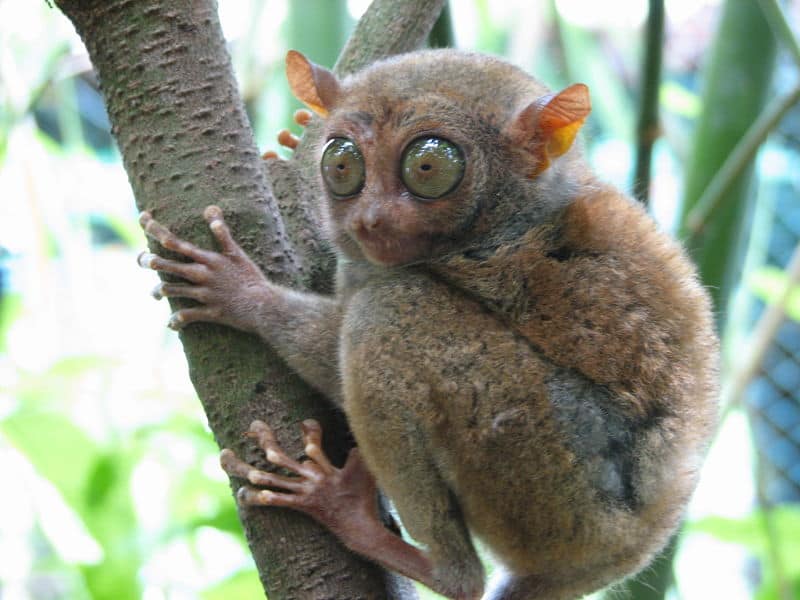
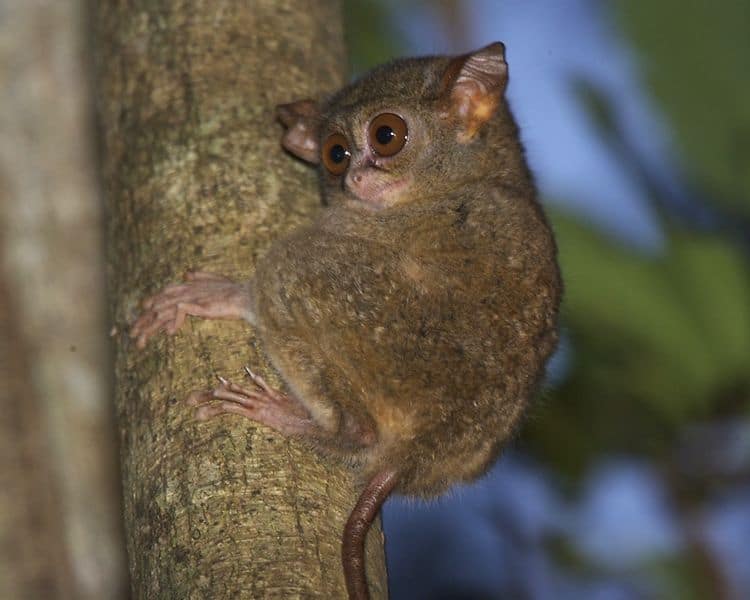
The Tarsier is a unique and distinctive looking animal that has a number of specific features to aid its nocturnal and arboreal lifestyle. Although the exact appearance of the Tarsier may vary slightly between species, all are relatively similar with a small, stocky body and long tail that is either sparsely covered in fur or has a tuft at the end.

Their very soft fur varies among grey, brown, and ochre in color, depending on the species, but all Tarsiers share the characteristic long hind legs that enable them to leap distances of up to 16.5 feet (5 meters) between branches. The long fingers and toes of the Tarsier are tipped with pads and have nails to help them grip onto branches and prey.

The most distinctive features of the Tarsier though can be found on its head that, thanks to specially adapted vertebrae, are able to turn 180 degrees in both directions. Therefore, this primate can see behind itself without moving its body.

The enormous eyes can be up almost two-thirds of an inch across. They enable the Tarsier to hunt for prey and watch out for predators in the dark. Tarsiers also have large bat-like ears that are incredibly sensitive and able to detect even the slightest sounds close by.

Distribution and Habitat
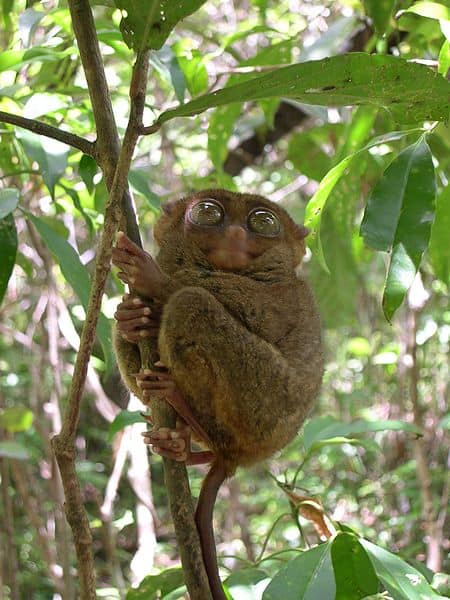
Although they were once found on four continents, today Tarsiers are restricted to a number of islands in southeast Asia.

  • Western Tarsiers animals are generally found in lowland primary forests or low mountain forests on the islands of Borneo, Sumatra, Bangka, Belitung, Kalimanta, and small surrounding islands.
  • Eastern Tarsiers can be found only on Sulawesi and the surrounding islands but seem to be more adaptable to habitats at different levels of forest. The exception is the Pygmy Tarsier which is restricted to very high mountainous forest.
  • Philippine Tarsiers tend to prefer lowland forests and are distributed across southern Philippines islands such as Bohol, Samar, Leyte, and Mindanao.

Despite there being limited information about the distribution of subspecies in particular, the general population trend is thought to be declining, primarily due to habitat loss and fragmentation of such small and unique island ecosystems.

Behavior and Lifestyle
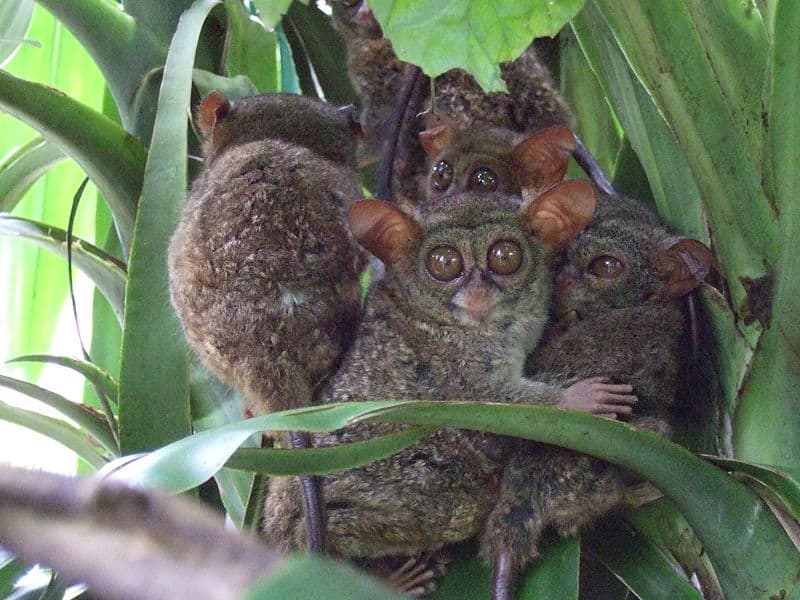
Until recently it was thought that all Tarsiers were solitary. However, recent research has shown that social behavior varies among the different species. Eastern Tarsiers are the most sociable and spend time in groups of two or three individuals. Western Tarsiers appear to be more solitary, only coming together to mate.

Tarsiers spend most of their lives clinging to tree branches where they rest during the day. However, Tarsiers are incredibly unique amongst primates because they do not climb or move about in search of food. Instead, they cling onto a tree branch where they can turn their heads dramatically to survey their surroundings. They then use their incredibly powerful, long hind legs to help them to leap to another branch or to pounce on prey with their padded fingertips and claws, providing them with essential grip when landing.

Tarsiers are also relatively vocal animals, and although the number and frequency of calls depend on the species, it is often the easiest way to identify one Tarsier subspecies from another, with different vocalizations being used for different situations.

Reproduction and Life Cycles
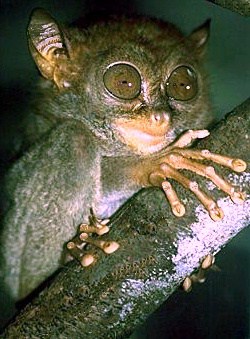
Tarsiers are able to breed all year round with females giving birth to a single baby after a gestation period that lasts for about six months. The exception is the Eastern Tarsier (the Spectral Tarsier) that has two breeding seasons between April and May, and then October and November.

Baby Tarsiers are very well developed and are born with a full coat of fur and open eyes They are able to climb at just a day old. The female Tarsier suckles her young for around two months; then the infant begins eating an adult diet. Some are able to hunt independently of their mother before they are even a month old.

Tarsier infants are carried around in their mother’s mouth or cling onto her fur. Once they can hunt on their own, young Tarsiers leave their mother to establish a territory of their own. They are usually able to reproduce between one and two years old. The lifespan of Tarsiers depends on the species, but the Philippine Tarsiers are thought to live 20 years, whereas the Western and Eastern Tarsiers can live 15 years and 12 years respectively.

Diet and Prey

The Tarsier is also unique in that it is the only completely carnivorous primate in the world. Under cover of night, Tarsiers cling to tree branches while waiting motionlessly but using their night vision and sensitive hearing to locate food. Then the Tarsier moves slightly closer to its prey before leaping onto it and catching it with its front hands. The long fingers and toes of the Tarsier enable it to also trap flying prey mid-air and provide an almost cage-like device to prevent it from escaping before the Tarsier has killed it. Insects make up the bulk of a Tarsier’s diet, along with small vertebrates such as frogs, lizards, and small birds. Some Tarsier species will even hunt poisonous snakes and can actually catch small bats in the air. Tarsiers hold their prey in their front hands to eat it with their strong jaws and teeth. Their mouths, which are wide for their small size, enable them to consume larger prey.

Predators and Threats
Since the Tarsier is small, it is preyed upon by numerous animal species in the surrounding forest including cats, birds of prey, large snakes, and small carnivores. Tarsiers can keenly sense the presence of a potential predator and often use their strong hind legs to leap to a safer branch.

However, the remaining Tarsier populations are at greater risk from people than anything else, primarily in the form of the degradation and fragmentation of their habitats. Forest clearance for agriculture and mining, and land clearance for livestock grazing has led to drastic declines in their population numbers. They are also often captured for the exotic pet trade but many die within a matter of days due to the lack of live food or suitable sleeping sites.

Relationship with Humans

The Tarsier is an incredibly elusive animal that is known to be particularly shy around humans. With increasing human activity in areas throughout much of their natural range, Tarsiers are being pushed into smaller and more isolated pockets of their once extensive and rich habitats. They are not particularly adaptable to areas of degraded forest because of a lack of food and trees where they can sleep and sit to watch for prey or predators.

A possible factor for the drastically declining populations of the Siau Island Tarsier is that local people hunt them for food, which along with their very restricted range on their island, has led to them being classed as one of the 25 most endangered primates in the world.

Conservation Status

Today, many of the different Tarsier species are either listed as being Endangered or Vulnerable by the IUCN with a number (including the Siau Island Tarsier) being listed as being Critically Endangered in the their natural habitats. Some species are listed as Data Deficient by the IUCN because of a lack of information about their status in the wild.

Although conservation work, particularly in the Philippines, is striving to protect these animals and their remaining pockets of primary forest, they remain threatened by loss of habitat throughout much of their natural range. Captive breeding programs are quite unsuccessful as only about 50% of Tarsiers captured are said to survive in their new homes. The reasons for this failure to thrive are a lack of live food, a high infant mortality rate, and a slow reproduction rate in zoos.

View all 606 animals that start with T
How to say Tarsier in ...
Czech
Nártoun
German
Koboldmakis
English
Tarsier
Spanish
Tarsius
Finnish
Kummituseläimet
French
Tarsier
Dutch
Spookdiertjes
Portuguese
Tarsius
Swedish
Spökdjur

Sources

  1. David Burnie, Dorling Kindersley (2011) Animal, The Definitive Visual Guide To The World's Wildlife / Accessed May 14, 2009
  2. Tom Jackson, Lorenz Books (2007) The World Encyclopedia Of Animals / Accessed May 14, 2009
  3. David Burnie, Kingfisher (2011) The Kingfisher Animal Encyclopedia / Accessed May 14, 2009
  4. Richard Mackay, University of California Press (2009) The Atlas Of Endangered Species / Accessed May 14, 2009
  5. David Burnie, Dorling Kindersley (2008) Illustrated Encyclopedia Of Animals / Accessed May 14, 2009
  6. Dorling Kindersley (2006) Dorling Kindersley Encyclopedia Of Animals / Accessed May 14, 2009
  7. David W. Macdonald, Oxford University Press (2010) The Encyclopedia Of Mammals / Accessed May 14, 2009
  8. Tarsier Information / Accessed May 14, 2009
  9. Tarsier Conservation / Accessed May 14, 2009

Thank you for reading! Have some feedback for us?


Tarsier FAQs (Frequently Asked Questions)

Tarsiers are Carnivores, meaning they eat other animals.