
Wisconsin is one of the best states in the country for whitetail deer hunting—some would argue it’s the best. With millions of acres of forested land, there’s no shortage of places for these deer to roam, eat, and rest.
There is also plenty of opportunity to hunt Wisconsin’s booming whitetail population. According to the Boone and Crockett Club, in the 99 deer seasons between when the hunt for the state’s typical whitetail record took place and 2013, Wisconsin hunters harvested 1,057 typical whitetails that were entered into the Boone and Crockett record book, which was 324 more than second-place Illinois.
In other words, a number of impressive whitetail deer have been harvested in Wisconsin, but the record-holding hunt for the state record occurred more than a century ago—and fate and luck are the only reasons we know about it.
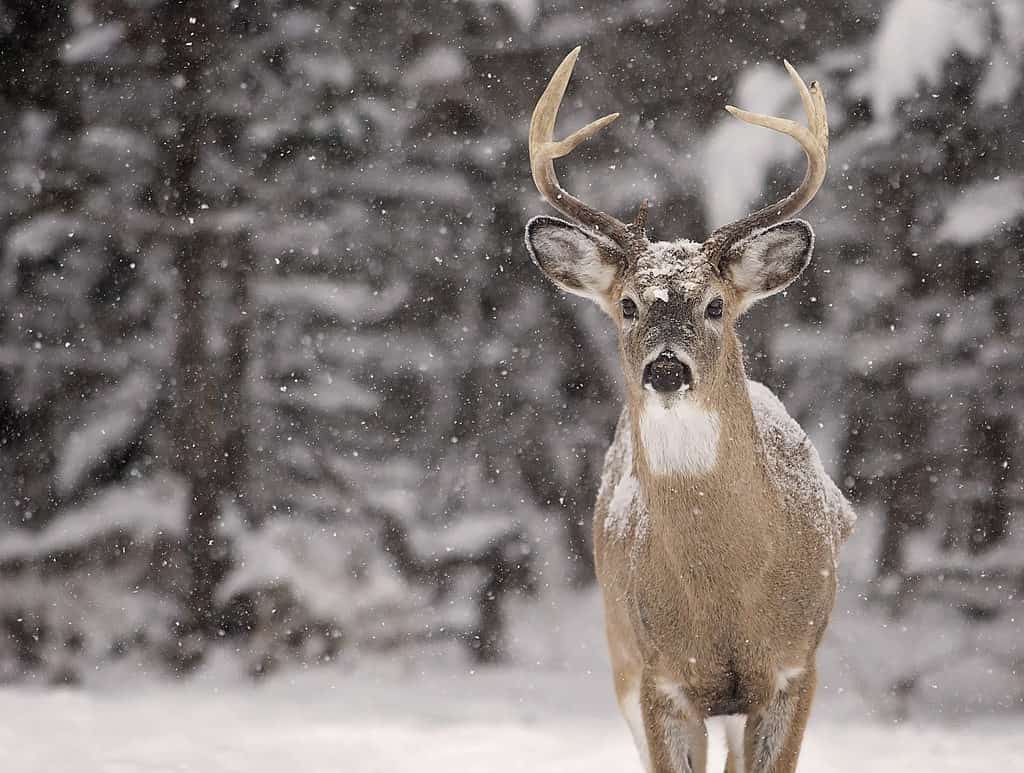
Fresh deer tracks in the snow led Jim Jordan to his world record–making typical whitetail in 1914.
©iStock.com/Lynn_Bystrom
Lost and Found
The quick and dirty of it is this: Twenty-two-year-old James (Jim) Jordan, using a .25-20 Winchester lever-action rifle, shoots a buck while hunting along the Yellow River near Danbury, Wisconsin, an unincorporated census-designated place in Burnett County with a 2010 U.S. Census population of 172 souls. Locals are impressed, even estimating the buck’s live weight around 400 pounds. Jordan pays a local taxidermist $5 to mount it. Shortly thereafter, the taxidermist disappears and so does the mount.
Tracking the Trophy
On November 20, 1914, Jordan and his friend, Egus Davis, went hunting not far from Jordan’s home. Snow was on the ground, meaning tracking was going to be easy. The account published in Legendary Whitetails says that Davis killed a doe, which Davis field-dressed using Jordan’s knife, loaded into a horse-pulled wagon, and transported back to the house. Jordan continued to hunt alone.
Jordan found fresh tracks in the snow of several deer and one set of what he believed belonged to a very large buck. He tracked the whitetail to nearby Soo Line railroad tracks, where his hopes of finding an enormous buck were realized. Startled by the train’s whistle, several deer emerged from the weeds, including his buck. He aimed his rifle and fired. The does scattered in one direction and Jordan’s buck in another. He continued to shoot at the buck as it ran for cover.
Convinced that he’d connected with one or more shots, Jordan pursued the buck, tracking him to the banks of the river, where he received confirmation of a successful shot—blood. He also realized that he his rifle was empty. By God’s grace, he found a single bullet in his pocket. If he found the buck, Jordan knew this shot would have to count.
Jordan eventually caught up to the buck and pursued it. Then, the buck crossed the shallow, icy waters of the Yellow River. From his side of the river, Jordan took careful aim and shot. The buck went down. As he crossed the river, he realized that his knife was still with Davis. Jordan then hiked home to retrieve his knife and friend. When they returned, the buck was gone.
The two friends deduced that the dying deer had slid into the river and walked downstream where they soon found his buck lodged against a rock midstream. Jordan waded into the freezing waters to retrieve the buck.

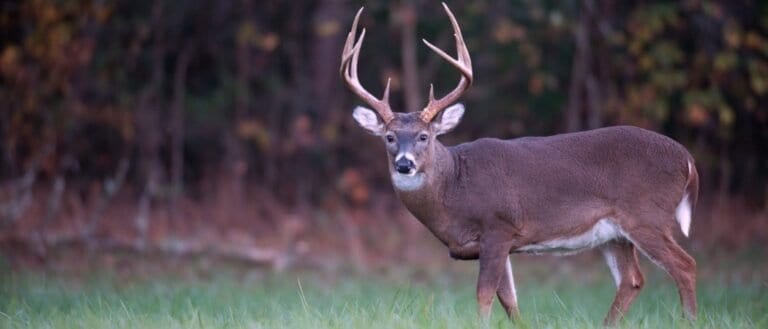
Wisconsin has millions of acres of forest land, perfect for whitetail deer hunting.
Tracking the Mount
The community agreed: This buck was special. Part-time taxidermist George VanCastle offered to mount it for $5. Jordan accepted, and VanCastle loaded the unskinned head onto the train and returned to his home in Webster, Wisconsin, about 10 miles from Danbury.
VanCastle’s wife died soon after he picked up the rack. After a few months, Jordan grew concerned since he hadn’t heard from VanCastle and traveled to Webster, where he learned that the taxidermist had moved to Hinckley, Minnesota, after his wife’s death. Only 25 miles separate Danbury from Hinckley, but at the time, there was a bridgeless stretch of the St. Croix River between the two towns. Jordan postponed his trip to Hinkley for so long that when he did make the trip, VanCastle had remarried and moved to Florida, presumably with the mount in tow.
In fact, the mount never left Hinckley. It continued to gather dust in the attic of VanCastle’s Hinckley home until it popped up at a rummage sale in Sandstone, Minnesota, about 10 miles from Hinckley, in 1958 where it was purchased by Robert Ludwig for $3.
In 1964, Ludwig informally measured the 5×5 antlers according to the Boone and Crockett scoring system. The score he got would make it a new world record for typical whitetail. Trophies are awarded based on antler size and complexity in two categories: typical and non-typical. He sent the score sheet to Bernie Fashingbauer, an official B&C measurer and director of the Science Museum of Minnesota’s Lee and Rose Warner Nature Center, who agreed.
However, also in 1964, Ludwig met his long-distant cousin, Jim Jordan, who informed Ludwig that Jordan, in fact, shot that buck in 1914. No one believed Jordan. Nevertheless, the buck entered the Boone and Crockett record books, and the hunter was listed as “unknown” and the location “Sandstone, Minnesota.”
The Sandstone Buck received an official score of 206-1/8 inches and became the world and Minnesota state record for typical whitetail deer.
Jordan continued to plead his case, and finally in 1977, Boone and Crockett opened an investigation and a year later, in 1978, two months after his death, Jordan was officially recognized as the hunter and Burnett County as the location where it was taken.
The Jordan Buck, as it’s now called, held the world record until 1993 when Milo Hanson’s buck, shot in Biggar, Saskatchewan, Canada, during the 1992 hunting season overtook Jordan’s trophy by more than 7 inches.

The Jordan Buck is a nearly perfectly symmetrical.
©Paul Tessier/Shutterstock.com
Jordan Buck Score Sheet
While Jordan’s buck no longer holds the world record, it remains the largest buck ever harvested in the United States. Its near perfect antlers continue to awe hunters and non-hunters alike.
According to the Boone and Crockett Club, these are some of the Jordan Buck’s key measurements:
- 53-7/8 inches of mass/circumference measurements
- 30-inch main beams, even on both sides
- G1s-G4s: 7, 13, 10 and 7 inches
The buck’s score received a 3-2/8-inch deduction from its gross score of 209-3/8, making its net score a full 98.4 percent of the gross typical score, “which is unmatched by any other whitetail in the upper tier of the record book,” writes Legendary Whitetails. “Perhaps the most unusual characteristic of the Wisconsin rack is that it’s so big and massive without having any abnormal points. This is the rarest of all traits in a truly world-class whitetail, for almost all of the great deer have at least one non-typical point.”
How Jim Jordan found and lost and found again this perfect behemoth is even more remarkable than the beautiful beast itself.