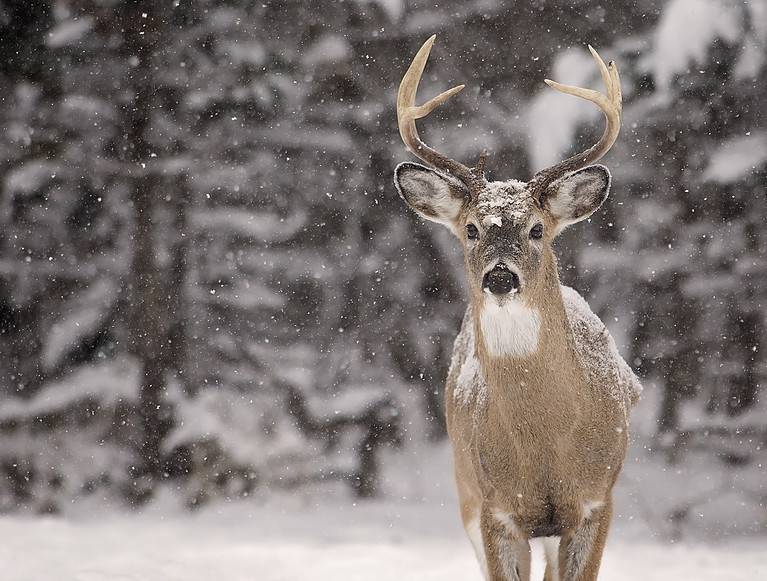

The whitetail deer (Odocoileus virginianus) is located on both American continents from Southern Canada down to Peru and Bolivia in the South America, where they inhabit hardwoods, croplands, brushlands, pasturelands, and even towns and cities. There is an especially large number of whitetail deer in Virginia—estimated between 850,000 and 1 million. In fact, another common name for them is the Virginia deer.
Because of their large numbers and as the most popular game animal in Virginia, there have been efforts over the years to properly manage impacts on vegetation and natural ecosystems as well as mitigate risks to both deer and people on highways and roadways. As a result, the state created the Virginia Deer Management Plan, 2015–2024. The plan stresses the importance of active deer management, with hunting as the preferred population management method. However, it also ensures these measures are ethical and sportsmanlike.
For the Boone and Crockett Club, the name of the big game hunt is ethical and sportsmanlike. This organization, founded in 1887 by Theodore Roosevelt and others for the purposes of conservation and wildlife management, sets guidelines for and maintains trophy hunting records for big game animals, including whitetail deer.
What garners a trophy record for whitetail deer, the focus is not on the body size or weight of the animal but rather on its antler size and complexity. Additionally, there are two categories recognized by Boone and Crockett. A typical set of antlers follows a standard pattern defined by symmetrical tines and evenly spaced points. Non-typical antlers deviate from the standard in quite unusual ways, creating stunning and strange shapes and designs and often racking up very high scores.
An official Boone and Crockett measurer takes measurements and counts of the individual elements on the antlers: the number of points on the antlers, the width of the main beam spread of the antlers from tip to tip, the inside spread, the length of the main beam, the length of the points, and the circumference between points.
The data are calculated according to a formula outlined on a score chart to provide a final score. Scores above 170 and 195 are in all-time record territory for the typical and non-typical categories, respectively.
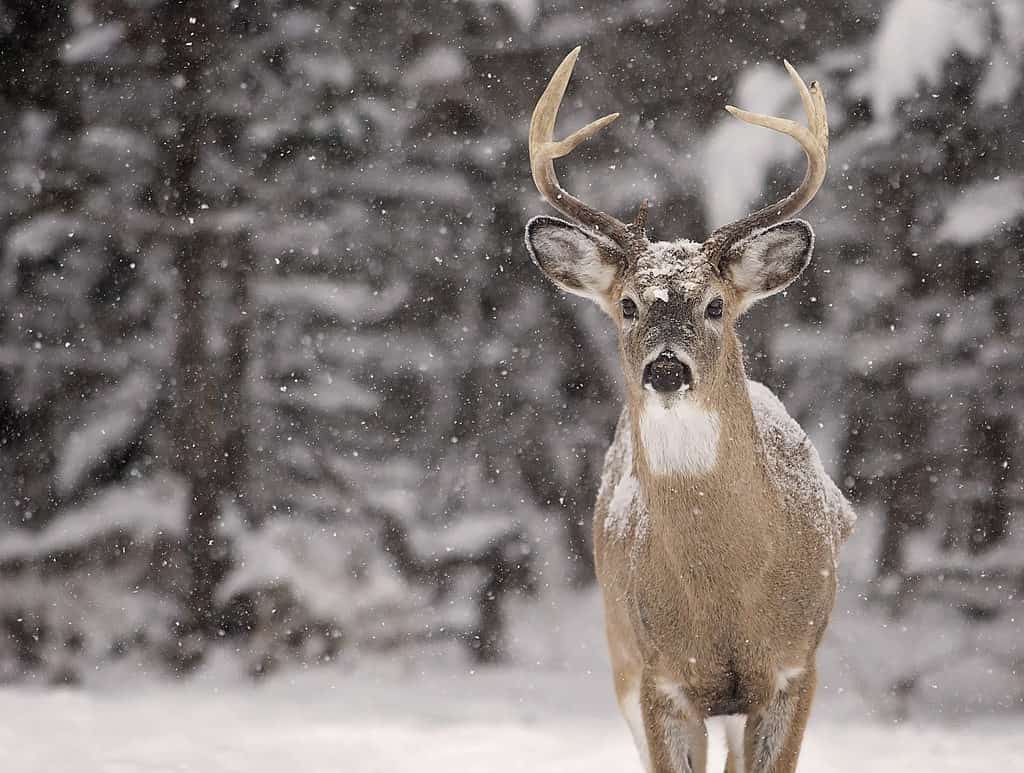
The whitetail deer is a medium-sized ungulate and the most popular game animal in the state of Virginia.
©iStock.com/Lynn_Bystrom
Virginia’s Record Bucks
Virginia’s Virginia deer population grew quite large in the 1990s, as both typical and non-typical records were set in that decade. While hunting in Buchanan County in 1999, Jerry L. James scored a typical buck with an antler score of 189-2/8. The 10-point rack features an inside spread of 18-4/8 inches and beam lengths of 27-1/8 and 28-5/8 inches.
Also harvested in the 1990s was the typical world record for whitetail deer, but the hunt took place in Biggar, Saskatchewan, Canada, where Milo N. Hanson, who was hunting his own property in November 1992, tracked and shot a monster buck, although Hanson never thought it’d set a world record that has stood for more than 30 years. That record-setting buck scored 213-5/8.
Seven years before James bagged his typical record, in 1992, James W. Smith harvested his non-typical buck in Warren County, a county in the northern part of the state in the Shenandoah Valley region. The deer’s unusual rack, which has 30 points (15 on left and right antlers), a 21-inch inside spread, and 28 2/8- and 29 1/8-inch main beams, scored 257-4/8 inches.
The non-typical whitetail deer record belongs to the “Missouri Monarch,” a buck whose rack was discovered along the side of the road in St. Louis County, Missouri, in 1981. It was scored 333-7/8.
In fact, the no. 2 largest non-typical rack—referred to as the Hole in the Horn Buck—also belongs to a buck whose antlers were found. Railroad workers found the deer’s carcass under a chain-link fence in Portage County, Ohio, in 1940. They thought it’d been hit by a train, didn’t think it was anything special, and gave it to a local taxidermist who mounted it. It hung in the Kent Canadian Club for decades before someone recognized its record potential. It was scored 328-2/8.