
Deer hunting opportunities in Michigan are as ubiquitous as mosquitoes in August. Although the Great Lakes State may be better known as an angler’s paradise, Michigan’s deer hunting scene offers plenty of chances to harvest trophy-worthy bucks. The stories behind the current bucks in the record books are pretty interesting. Let’s learn more!

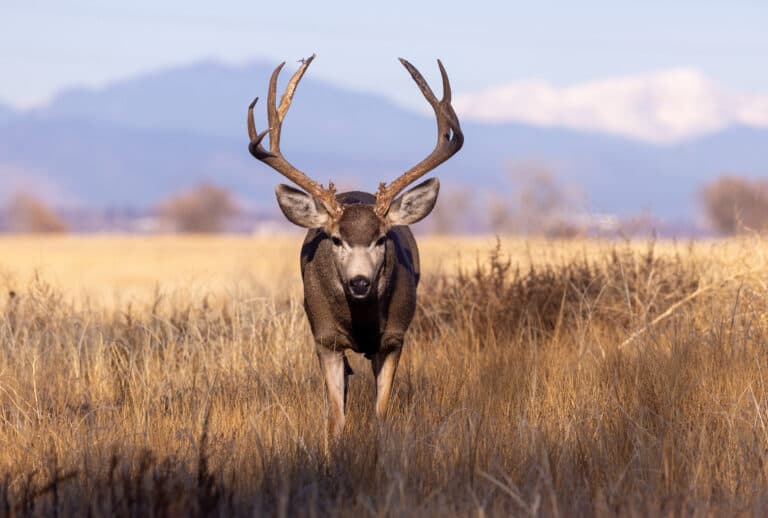
Male deer, called bucks, possess antlers that are shed from mid-January to mid-April and are regrown each spring.
©Tom Reichner/Shutterstock.com
A Tree on Its Head: Michigan’s Record Typical Whitetail
In an interview with Scott Clow of 99.1 WFMK-FM, Troy Stephens recounted the events that led to his record typical whitetail. That year, 1996, had been a tough one financially. To survive, Stephens sold all his hunting equipment, so when he was invited to hunt private land in Jackson County by a friend, he had to borrow a 12-gauge shotgun from his mother’s boyfriend.
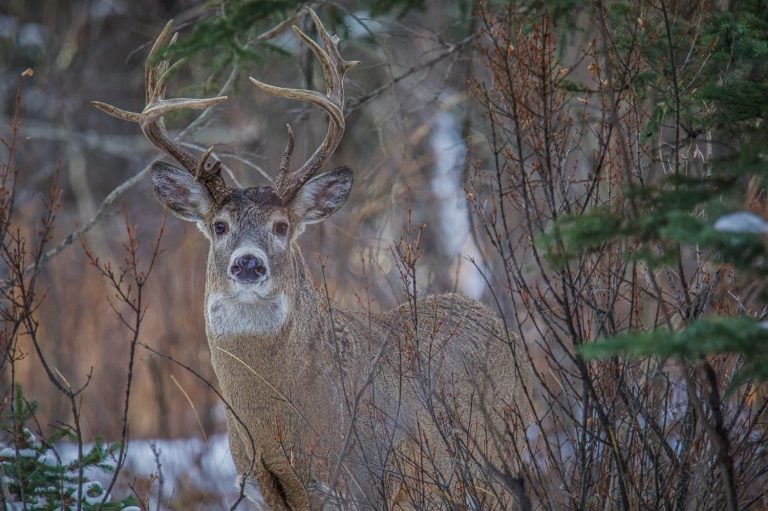
On the day of the hunt, November 26, there was snow on the ground from the night before. The early morning temperature was 14 degrees Fahrenheit. He sat unprotected from the elements in a folding wooden chair at the edge of a field with a swamp at his back when, from 200 yards away, “‘a doe began to cross the field and behind it was a buck that looked like he had a tree on its head.'”
He realized his glove couldn’t fit in the trigger guard, so he carefully and quietly removed it and raised the shotgun as they came to within 100 yards of Stephens. From his seat, he fired a buckshot round, and Stephens believes some hit the buck in the knee, slowing the buck’s retreat and allowing him to get up and move in to about 35 yards. He chambered a slug, aimed, and shot. The buck didn’t go down. He loaded a second slug, and this time, it connected, causing the buck to drop in place.
Stephens knew it was special, but the taxidermist, Jim Bass, was the one who told Stephens he had a state typical record. And Bass was right. Later, when it was scored, Stephens had the record.
Stephens’ buck scored an even 198. Today, it ranks 40th overall among deer from all states. The antlers feature 16 points, four of which are abnormal; main beams that both extend over 29 inches; an inside spread of 20-2/8; and brow tines that measure 10 and 11-3/8 inches, respectively. Both its G2 points measure more than 13 inches.
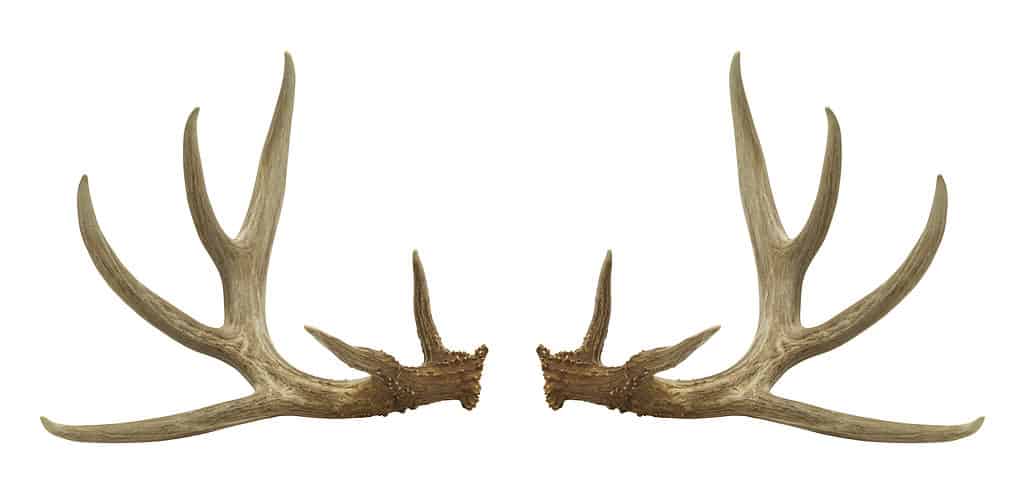
Deer antlers are prized for their symmetry, complexity, and size. Awards are given out in two categories—typical and non-typical—depending on how much they align with the standard.
©Mega Pixel/Shutterstock.com
Typical vs. Non-Typical Antlers
Typical antlers follow a standard pattern, defined by symmetrical tines and evenly spaced upward points on both beams. Conversely, non-typical refers to deviations from the standard, and these deviations can create quite strange, beautiful antler shapes. Typically, non-typical antlers have mismatched sides (e.g., 6 tines on the left beam and 4 on the right), points that grow not just upward but in all directions, and points that grow off other antler points.
Antler growth is influenced by genetics, age, and nutrition. In the case of non-typical antlers, injury plays a significant role. Deer antlers are 80% water, which makes them susceptible to injury. It’s not uncommon for deer to suffer a minor injury, causing the antlers to appear non-typical for a season. A significant injury, however, can cause a buck’s antlers to grow in a non-typical fashion permanently.
Antlers are scored using a formula developed by the Boone and Crockett Club. Measurements and counts are taken of the various elements of the antlers, including the number of points on the antlers, the length of the tip-to-tip spread, the length of the greatest spread, the inside spread of the main beams, the length of the main beams, and the lengths of the points (both normal and abnormal). A minimum score of 170 is required for a typical buck to make the Boone and Crockett all-time record book, while a score of 195 or greater is required for a non-typical buck.
Whether to have a rack scored as typical or non-typical boils down to the hunter’s preference and which option makes the most logical sense. Both methods—typical or non-typical—measure abnormalities in the antlers; the difference is that abnormal points add to the score of a non-typical, whereas they deduct from the gross score of a typical.
Antler symmetry is key for the net score, as the scoring system values this balance.

Deer hunting stretches over several months in Michigan, typically beginning in mid-September and concluding in some areas on January 31. Make sure to double check the state’s hunting regulations for details.
©Kit Carlson/Shutterstock.com
Picked Up: Michigan’s Record Typical Whitetail
Michigan’s largest non-typical whitetail deer shares a detail in its discovery with the non-typical world record. No one can take credit for harvesting them, as both bucks were found already dead. And there were plenty of hunters who would have gladly taken either had anyone known about them.
How this buck eluded trail cameras and hunters in 2010 is anyone’s guess. In fact, not even a hunter found the Michigan record buck. While walking her dog along a creek on property she owned, Sharon Weidmayer spotted antlers sticking up through brush on the property. Birds, animals, and insects had largely picked over the carcass, but its antlers looked big. Weidmayer called Ron Waldron, a friend and hunter who lived in the next county over in Ann Arbor, and offered the antlers to him.
The buck, which died of natural causes about one month after the 2009 hunting season ended in January 2010, was big, Waldron agreed, but he was downright flabbergasted when he learned the buck’s official Boone and Crockett score. With a net score of 246-2/8, this buck has main beams 31 inches long, an inside spread of 28-5/8 inches, and several tines between 12 and 13 inches in length.
Say, “Cheese”
A few people later reported seeing the record whitetail, but only one person provided proof that shehad seen the Weidmayer-Waldron buck. A 15-year-old girl photographed it on July 11, 2009, on property that bordered the parcel where it was later found dead.