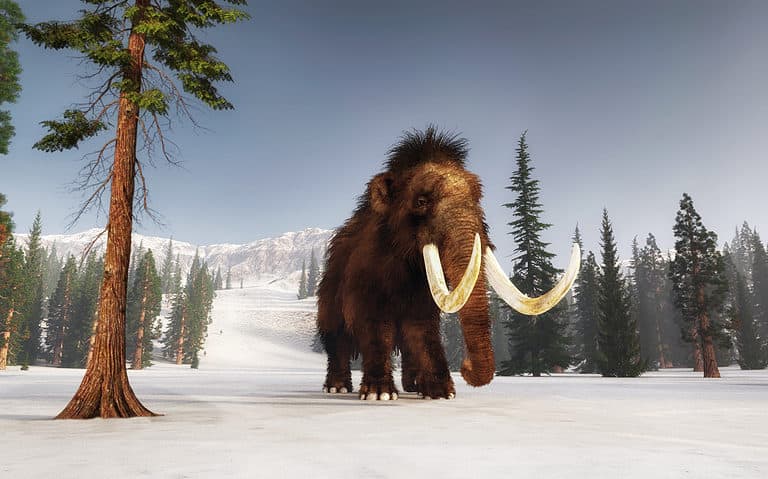

Woolly mammoths might seem ancient, but compared to other “prehistoric” creatures like dinosaurs, they died out fairly recently. While most mammoths went extinct around 12,000 years ago, some isolated groups were still around on islands as recently as 4,000 years ago. Today’s scientists are still finding plenty of preserved woolly mammoth remains to study. However, it is rare to find a full mammoth skeleton, let alone an entire frozen mammoth.
However, gold miners in Canada’s province of Yukon recently unearthed a complete baby mammoth that researchers estimate has been frozen there in the permafrost for around 30,000 years. It was found in the Trʼondëk Hwëchʼin First Nation’s territory. The baby has been given the name of Nun cho ga. In the Hän language, spoken by the Trʼondëk Hwëchʼin First Nation, the name means “big baby animal.”
Why Is This Tiny Mammoth Discovery Important?
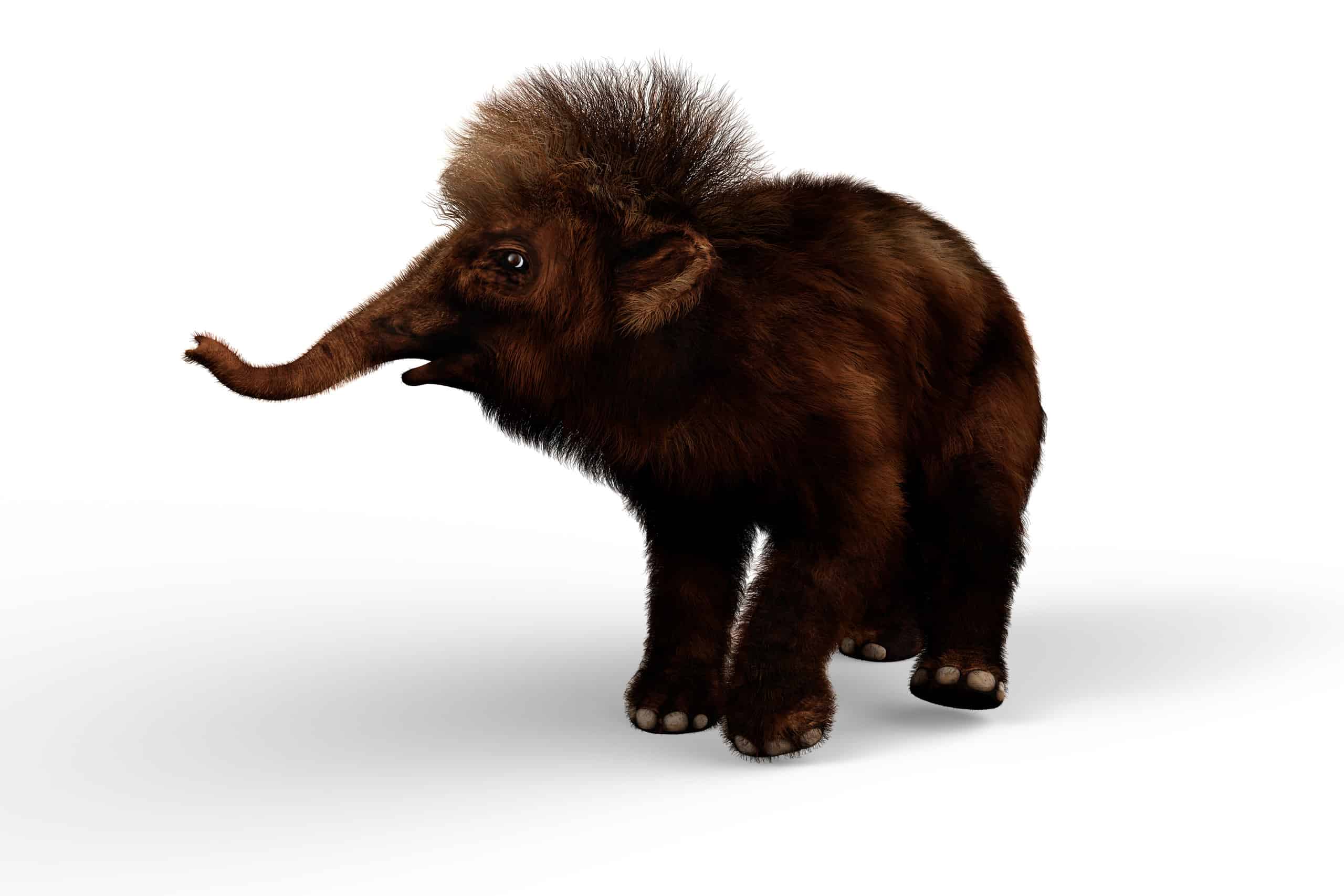
This little mammoth, which experts believe is a female calf, can mean big scientific insights. Only one other similarly complete mammoth has been found. That one, named Lyuba, was also a baby and was found in Siberia, Russia, in 2007. Nun cho ga is the most complete mammoth remains found in North America. It even has skin and hair, which can give researchers valuable information on how woolly mammoths lived and what they looked like. This specimen even still has toenails and intestines.
This is similar to Lyuba’s discovery. That mammoth even had eyes and all of her organs. She had some of her mother’s milk in her stomach. She also had some fecal matter in her stomach, which experts believe baby mammoths may have ingested to develop a healthy gut biome as they aged.
Even before doing much examination, experts have already learned a lot. For example, they learnt that Nun cho ga had a piece of grass in her stomach when she died. They believe that means she was grazing, perhaps with her mammoth family, shortly before her death. They think she may have gotten trapped in the mud there and died, perhaps only a few steps away from her family. Shortly after her death, she was buried in the mud, and permafrost formed, preserving her body until now. This is similar to how Lyuba also died. She got stuck in a muddy riverbed while crossing it with her family.
Experts believe that Nun cho ga was only between 30 and 35 days old when she died. She is just a bit longer than Lyuba, at around 55 inches long.
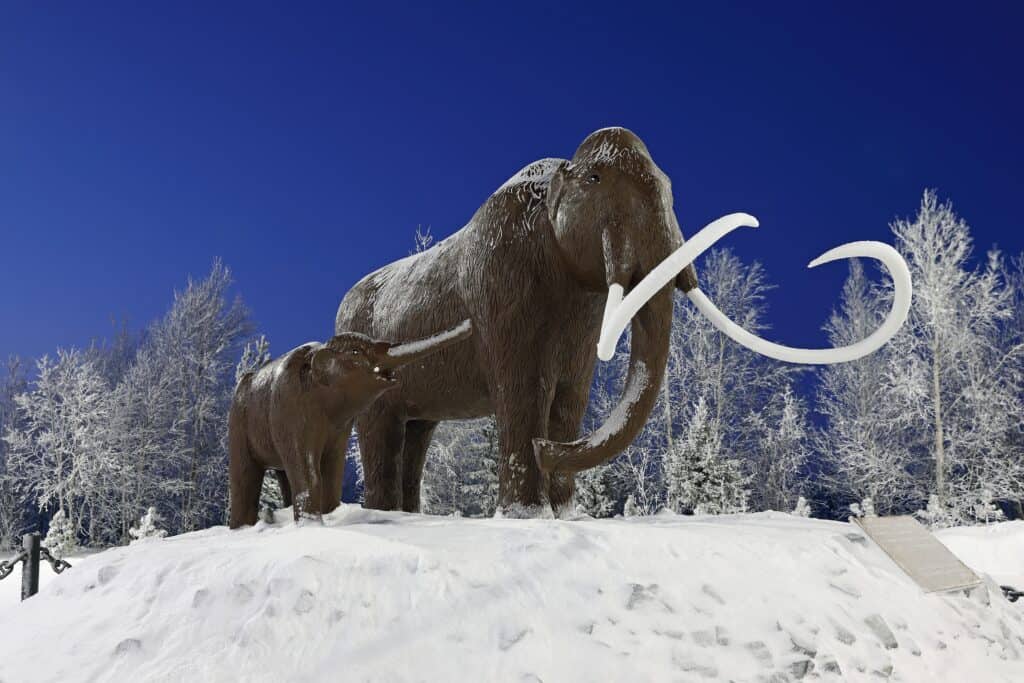
The tiny mammoth that was discovered is very important scientifically, as it is almost intact, and much can be learned from studying it.
©Grigorii Pisotsckii/Shutterstock.com
How Was Nun Cho Ga Found?
At Treadstone Mining, a gold mine, a bulldozer hit something. So, the worker went to get his boss, Brian McCaughan, to see what they should do. They examined it and then called the experts at the Beringia Centre. Grant Zazula, the province’s paleontologist, rushed over to the site with other geologists from the Yukon Geological Survey, Jeff Bond & Derek Cronmiller, along with University of Calgary Professor Dan Shugar, to fully unearth the mammoth before it could thaw.
When researchers arrived, they not only extracted the mammoth but also studied the permafrost area it had come out of. One of the paleontologists said that Nun cho ga is “one of the most incredible mummified Ice Age animals ever discovered in the world.”
The timing couldn’t have been better. About one hour after the researchers arrived, a torrential downpour with thunder started. The scientists at the site said that if they had arrived much later, Nun cho ga would have likely been lost in the storm.
Treating The Discovery With Respect
The timing of the discovery also had an important meaning. It was found on both the solstice and Indigenous Peoples’ Day in Canada.
Since it was found on Trʼondëk Hwëchʼin land, Nun cho ga was first brought to a ceremony with Trʼondëk Hwëchʼin elders along with the geologists, miners, and scientists who helped to unearth her. The elders blessed and named the mummified remains.
Nun cho ga is now at the Canadian Conservation Institute in Ottawa, where she is undergoing preservation work. Eventually, the mammoth will be returned to Trʼondëk Hwëchʼin in Yukon.