Quick Take
- Some pythons tried to survive the freeze by doing exactly the wrong thing. The article reveals what they did.
- Scientists hunting for cold-tolerance genes kept finding something unrelated. The explanation involves how these snakes eat.
- Some pythons may have a hidden shelter option underground. Who built it for them?
- Nearly 28,000 pythons have been pulled out since 2000, yet big questions remain. What do researchers still want to test?
From January 2 to 11, 2010, a record cold spell hit South Florida. Air temperatures stayed at or below 50 degrees for at least 48 hours and bottomed out between about 25 and 32 degrees, according to a 2023 U.S. Geological Survey (USGS) review in the journal NeoBiota.
Scientists were already tracking 10 Burmese pythons in the Everglades, each implanted with a radio transmitter and a temperature logger. Only one survived, a team from the University of Florida and USGS reported in Biological Invasions in 2011.
Temperature data from the loggers indicated the snakes had likely died, the 2011 team found. Body temperatures in eight snakes rose and fell normally before January 9, declined steeply from January 9 to 11, then showed no further sign the animals were warming themselves. Some tracked pythons had tried to bask in the open instead of retreating to shelter. Of 99 untagged pythons the team accounted for, 59 lived and 40 died.
The pythons caught in the years after carry a different genetic mix. University of Texas at Arlington biologists compared python DNA from before and after the freeze and found shifts in genes linked to sensing cold, behavior and organ growth.
Most cold-killed pythons had body temperatures stuck at 41 to 50 degrees
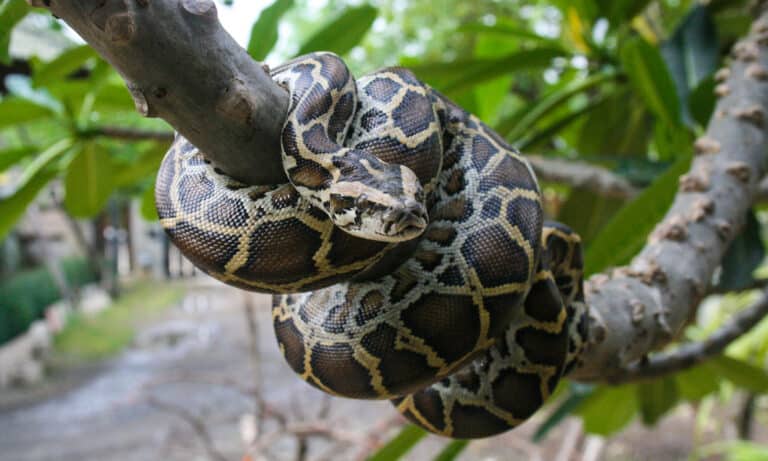
Burmese pythons are ectotherms that rely on outside heat, the 2023 USGS review explains, and they control body temperature by basking, seeking shade and coiling.
In an outdoor enclosure in South Carolina, the review notes, 10 pythons from Everglades National Park survived nights when their core temperature fell to about 39 degrees. All eventually died, most after body temperatures held between 41 and 50 degrees. A 2016 model suggests a cold python can’t generate energy, so its breathing slows and it runs short of oxygen.
To survive lethally cold air, a python has to get into shelter and stay there until temperatures rise, the 2023 review says. The 2011 team said basking during the freeze appeared to be maladaptive.
Scientists went looking for cold genes and kept finding organ-growth genes
The 2018 study in Molecular Ecology sequenced 97 South Florida pythons: 48 caught from May 2003 to June 2009 and 49 caught from October 2012 to December 2013. Gene variants had shifted more than random drift alone would explain. Twelve regions bearing marks of natural selection held 78 genes tied to sensory perception, responding to hypothermia, learning and behavior, and organ growth.
“We kept seeing evidence of adaptation in genes related to cell division, organ growth and tissue development, which admittedly puzzled us at first,” Daren Card, who had recently earned his doctorate at UT Arlington working on the project, said in the university’s October 2018 release.
A python shrinks its organs between meals, the 2018 study notes. Within 48 hours of eating, its heart, small intestine, liver and kidneys can grow 40 to 100 percent in mass and its metabolism can rise up to 40-fold. Florida pythons eat year-round: 94.3 percent of 455 snakes necropsied from 2003 to 2008 had a meal inside. Seven wild Florida pythons collected in January 2016 and held without food for at least eight days still had organ cells closer in size to those of digesting lab pythons than to those of fasted ones.
The authors propose that a python with a revved-up metabolism holds a higher body temperature and may resist a freeze. They caution that flexibility within a snake’s lifetime could explain some of the gene-activity results.
Nine nests sat in tortoise and armadillo burrows
Researchers from the Conservancy of Southwest Florida radio-tracked 29 pythons in southwest Florida for a 2024 study in the Journal of Herpetology. The snakes used gopher tortoise burrows, nine-banded armadillo burrows and other ground cavities for thermal refuge, breeding and brooding. Nine nests, 71 percent of those found, were in tortoise or armadillo burrows. In northern India, the 2023 USGS review notes, Burmese pythons appear to use porcupine burrows to escape winter cold.
Pythons have also been found north of the Everglades through sightings and captures, USGS’s python FAQ says. The Florida Fish and Wildlife Conservation Commission (FWC) considers them established from just south of Lake Okeechobee to Key Largo and treats pythons found outside its mapped range as likely escaped or released pets.
Almost 28,000 pythons removed since 2000
FWC’s August 5, 2026 release says almost 28,000 wild Burmese pythons have been removed and reported since 2000.
Card’s team wrote in 2018 that further experiments would be valuable to test whether behavior, cold tolerance and digestion are linked. The 2024 burrow study said underground refuges may affect python survival and dispersal and warrant further assessment.