
Quick Take
- Kākāpōs are the heaviest parrot on earth. They are also nocturnal, flightless, and feature forward-facing eyes like owls.
- They evolved to live on the ground, evading airbound predators like eagles.
- Settlers to New Zealand brought predators that Kākāpōs were not equipped to deal with, drastically reducing their numbers.
- Recent conservation initiatives have given these unique birds a second chance at survival.
When you think of birds, you might imagine wings flapping silently against a blue sky. The kākāpō, however, lacks these typical bird attributes. It’s a type of parrot found only in New Zealand that spends its entire life on the ground, unable to fly. It is also nocturnal and tends to get incredibly loud when communicating. Kākāpōs defy almost every typical bird stereotype. Once a common sight in New Zealand, kākāpōs are now one of the most endangered birds on Earth.
It’s hard to understate just how strange kākāpōs are in the grand scheme of birds. They almost seem human in their complicated rituals, extensive lifespans, and gravity-bound living. A classic case of island syndrome, kākāpōs once benefited from their isolated jungle ecosystem. Modernity made this paradise into something far more threatening, however, as fewer than a thousand kākāpōs are left in the wild. They are so endangered that each living individual kākāpō has been given a name and is intensely monitored. Let’s learn more about this fascinating flightless bird, why it is a biological oddity, and what steps people are taking to protect it from total extinction.
A Biological Oddball
Kākāpōs are a species of nocturnal, flightless, ground-dwelling parrots of the superfamily Strigopoidea. Also known as owl parrots or flightless parrots, kākāpōs are endemic to New Zealand, where they live in a variety of environments. Considered to be habitat generalists, these birds were once able to live in almost every climate that New Zealand offered. They can withstand hot, dry northern summers as well as chillier winter temperatures in the more southern Fiordland region. That said, these birds prefer regions with mild winters and abundant rainfall.

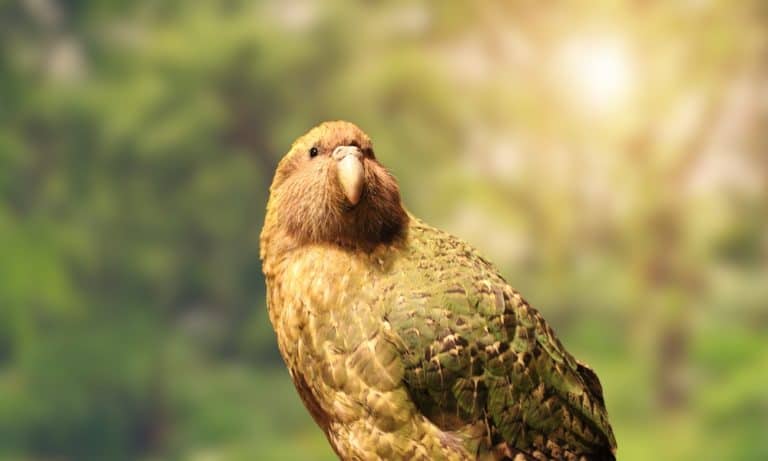
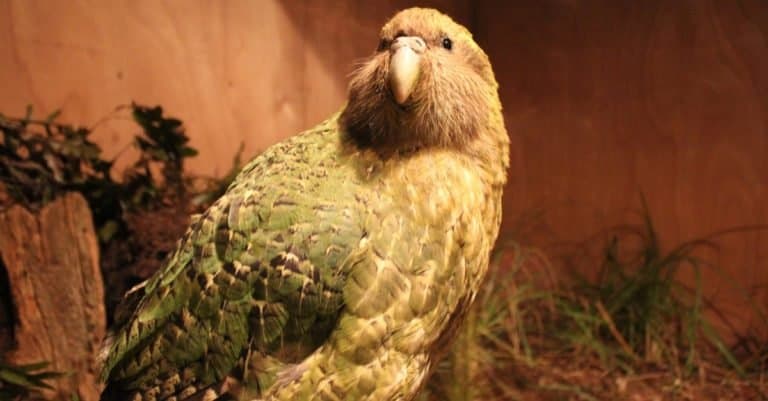
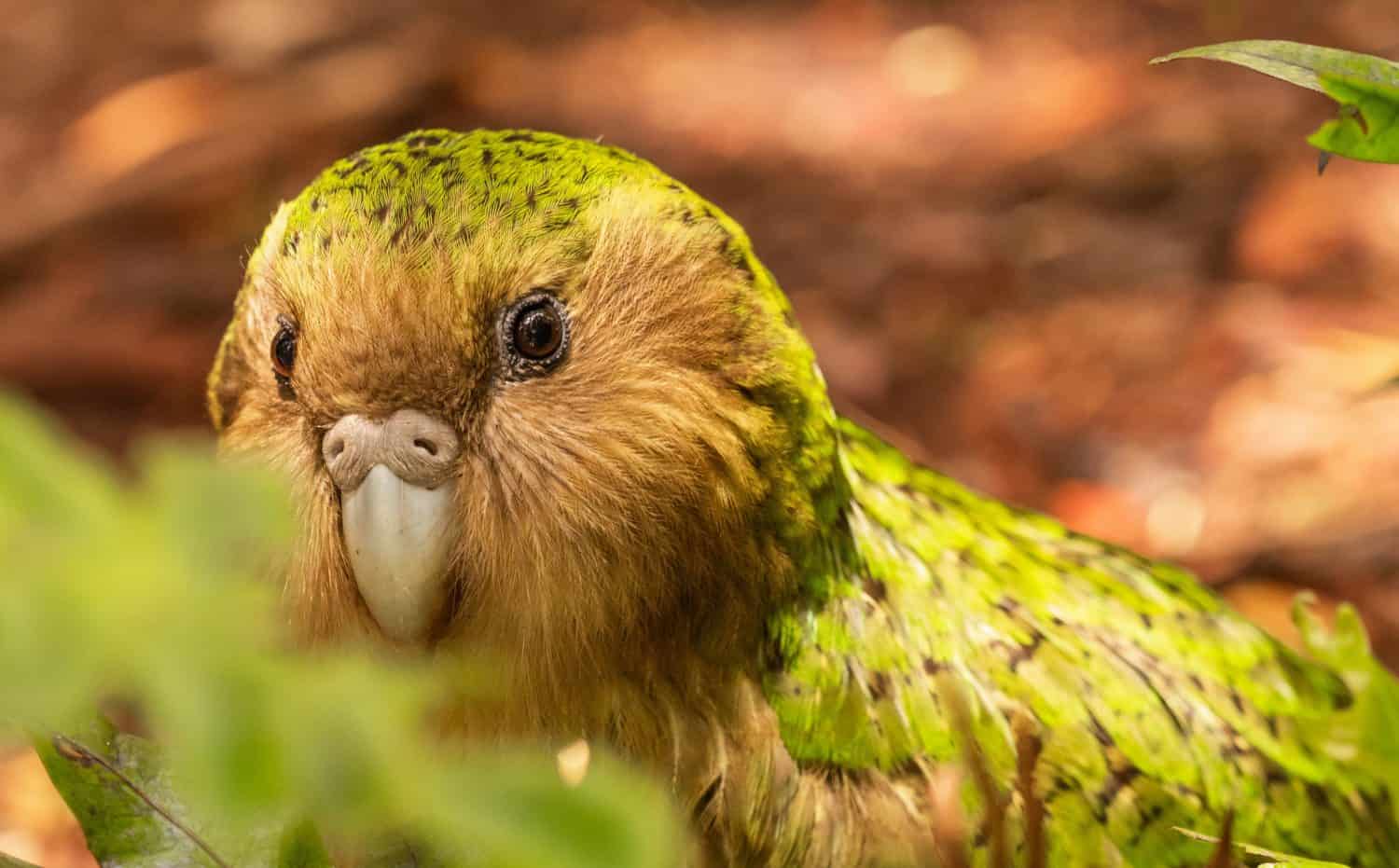
Unlike other parrots, kākāpōs have forward-facing eyes like owls.
They are large birds, growing up to 25 inches long. Among parrots, they have distinct traits and features. These include speckled yellow-green plumages, large grey beaks, short legs, big blue feet, short wings, and short tails. They also have distinct facial discs as well as owl-esque forward-facing eyes. While adult males weigh between three and six pounds, females are considerably lighter. They weigh between two and three pounds on average.
So much about these birds is hard to believe. Kākāpōs are the only flightless parrot on earth, but also the heaviest. They are herbivorous, active at night, and males and females look noticeably different. They might also be some of the longest-living birds on Earth, with lifespans up to a century. These attributes have made them potent symbols throughout New Zealand’s history. For centuries, kākāpōs have played an important role in Māori traditions. They were hunted for their meat and feathers and also held a significant place in Māori mythology.
Island Syndrome
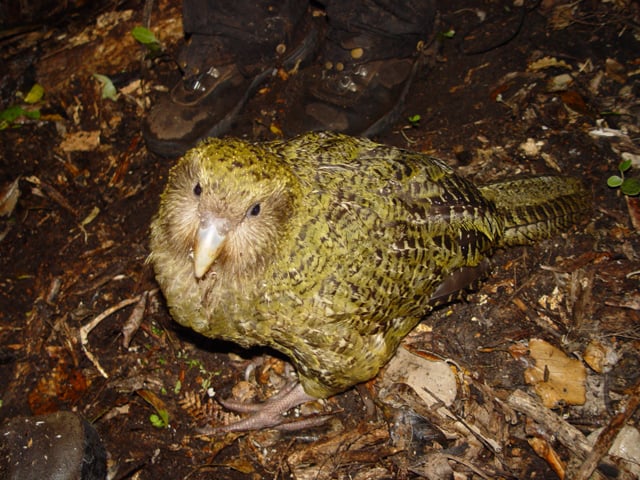
A classic example of island syndrome, kākāpōs lacked many ground predators, so they didn’t have much need to fly in the air like other birds.
The reason kākāpōs stand apart from other birds, even parrots, is their unique genetic history. Prehistoric New Zealand lacked ground-dwelling predators. This meant that kākāpōs didn’t need to adapt for flight. Over time, wings shrank, and they became flightless. To both compensate for this lack and to adapt to their environment, kākāpōs developed powerful legs. Though ancient New Zealand lacked ground predators, it made up for it with terrifying aerial options. The Haast’s eagle, for example, the largest eagle to ever live, used to rule the sky above the islands. They hunted by day, so kākāpōs transitioned to nighttime activity.
Living at night, however, required specific adaptations. For one, kākāpōs developed a type of motionless camouflage thanks to their green and brown feathers. In low light, these flightless birds blend seamlessly in with the forest floor. This also helped them fill an ecological niche. New Zealand lacked what other parts of the world had: small, nocturnal mammals that forage on the forest floor. Kākāpōs, in turn, filled a similar ecological role to small, nocturnal mammals, but with feathers. They wandered below the canopy, eating fruits and seeds without much feathered competition.
Owl Parrot, Night Parrot
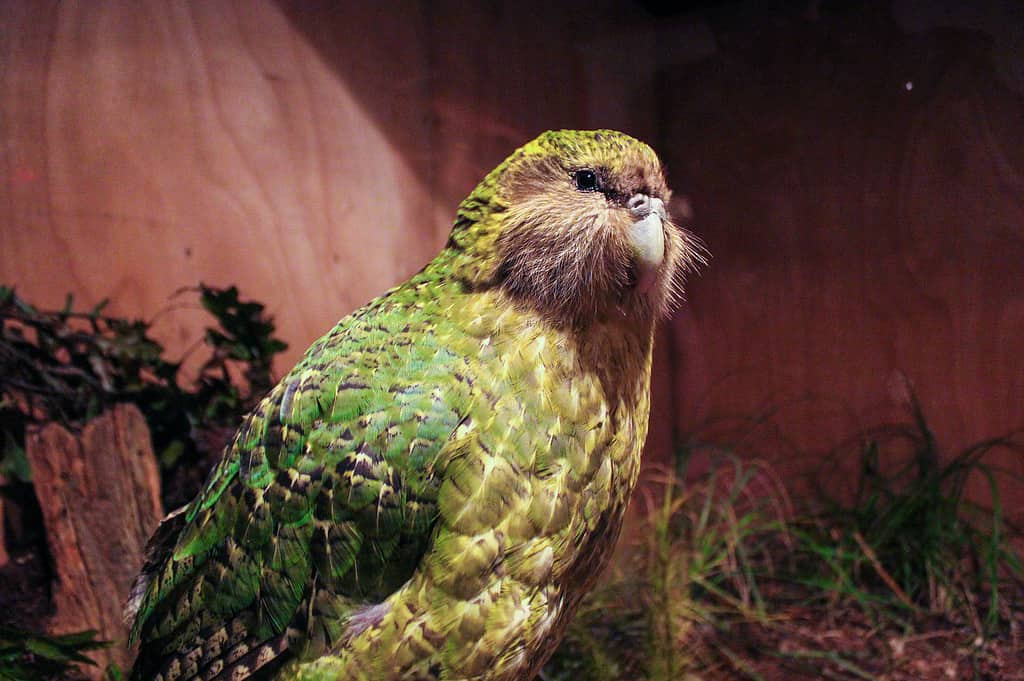
These parrots feature fine feathers on their face that function like cat whiskers, helping them to navigate forest floors at night.
©Imogen Warren/Shutterstock.com
The name kākāpō itself is a Māori word that translates to “night parrot.” Once European settlers arrived, they called it the “owl parrot.” That’s because this bird’s face is framed by a disc of feathers. Finer than normal feathers, this disc is sensory, functioning like a cat’s whiskers to help kākāpō navigate dark forests.
These sensory abilities extend to other arenas as well. Kākāpōs have an incredible sense of smell. Only one other parrot species can distinguish between odors while foraging. This is because kākāpōs have large olfactory bulb ratios. Interestingly, this potent sense of smell is extended to creatures that encounter these birds. These birds give off a distinctly musty-sweet odor. People say this smell is like a mixture of honey, flowers, and old violin cases. One wonders about the purpose of this adaptation. It helps kākāpōs find each other in the forest as much as it clues predators to their presence. Indeed, this adaptation quickly became a vulnerability once predators that hunted by smell were introduced to the New Zealand islands.
Beyond that, kākāpōs have other adaptations to the darkness. They have smaller optic tectums, nucleus rotundus, and entopalliums than daytime parrots. Kākāpōs also have retinas with qualities best suited for twilight, as they contain characteristics of the retinas of both daytime and nighttime birds. This means that kākāpōs have great light sensitivity but substandard visual acuity.
Lek Mating and the Sacred Rimu
Another strange and fascinating feature of kākāpōs is their mercurial and elaborate mating rituals. Their reproduction is intrinsically tied to the crop cycles of native trees like the rimu. These trees produce fruit rich in calcium and vitamin D, both essential nutrients for kākāpō chicks. However, rimu trees only produce fruit every two to four years. When fruit is lacking, kākāpōs do not breed. This makes their ability to propagate at the mercy of the ecosystem’s rhythm.

These flightless birds undertake elaborate, exhausting mating rituals.
©YouTube/The Proud Kiwi
Unlike other birds, kākāpōs must perform elaborate, almost maze-like mating rituals to reproduce. They are the only parrot in the world to use a lek breeding system, which involves a series of complicated moves and machinations. First, male kākāpōs leave their home ranges during breeding years and travel several miles to high ridges. There, they dig bowls in the earth. After that, the males begin calling in hopes of attracting females. They inflate distinct thoracic air sacs in their bodies like balloons to emit low-frequency boom sounds. These booms can travel miles through the forest unfettered. Once a boom has been sounded out, males begin emitting high-pitched metallic sounds to help females triangulate their position.
This call-and-response ritual can take a long time to succeed. Male kākāpōs can ‘boom’ for up to eight hours a night for nearly four months straight before a female responds. During this time, they may lose up to half their body weight.
Conservation Efforts
As previously mentioned, kākāpōs evolved in an environment that has since changed and become more dangerous for them. Successive waves of settlers brought with them plenty of animals that kākāpos were not equipped to deal with. First, Polynesian settlers brought rats. They also began hunting the relatively vulnerable ground birds. This vulnerability increased once Europeans arrived, bringing stoats, cats, and other animals like Norway rats with them. When threatened, kākāpōs stay perfectly still. This strategy works against eagles, but it makes them easy prey for cats and stoats.
By the 1970s, kākāpōs were believed to be extinct. Luckily, a desperate search yielded a handful of male kākāpōs in Fiordland. In 1977, however, a small population of about 200 individuals was found on Stewart Island.
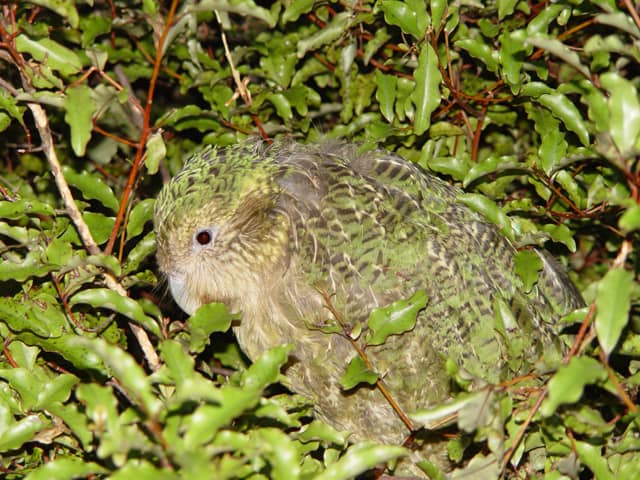
The Kākāpō Recovery Programme is one of the most ambitious conservation programs ever created.
Luckily, conservationists sprang into action. Since then, New Zealand’s Department of Conservation has initiated the Kākāpō Recovery Programme. It’s one of the most ambitious and sophisticated wildlife rescue efforts ever undertaken. It involved the relocation of every single living kākāpō to protected, predator-free islands. These islands (Whenua Hou, Pukenui, and Te Kākahu) are like fortresses. Every visitor is checked for seeds, rodents, and other biological stowaways.
Each kākāpō is fitted with a backpack transmitter that tells researchers where they are, how healthy they are, and whom they have mated with. Automatic feeding stations located around the islands only open for specific birds. This ensures that each individual reaches its ideal breeding weight. More recently, drones have even been used to fly sperm samples across islands for artificial insemination. This has increased the total kākāpō population from 51 individuals in the 1990s to over 230 in recent years.
The future for the kākāpō is uncertain and challenging, but there is hope. Inbreeding is a concern and so is disease, but conservationists remain optimistic. Currently, a massive rimu fruiting event is underway. Since kākāpō breeding is closely tied to this tree, a large crop may lead to a significant breeding season. This may be just what the kākāpō needs to get its population above 300 individuals.