
Quick Take
- The emperor penguin must access 1,800 feet of the water column to meet foraging requirements.
- The International Ornithologists’ Union recently increased the species count to 19, complicating legacy research.
- Crested penguins perform a selective clutch reduction to prioritize the survival of larger offspring.
The formally feathered, flightless aquatic birds known as penguins dominate the frigid waters surrounding the subantarctic and Antarctic islands. The Southern Hemisphere is penguin territory, although a single species makes its home north of the equator. The penguin family’s famous black-and-white coats camouflage them as they bound in and out of the water. Their rigid, paddle-like flippers maneuver them quickly and seamlessly through the water, and their pointed beaks feature Velcro-like structures and serrated edges to hold tight to slippery meals.

The International Ornithologists’ Union (IOU) recognizes six genera that comprise 19 extant species in the penguin family (Spheniscidae). Keep reading to learn more about these fascinating birds.
Great Penguins
The Aptenodytes genus includes the largest two penguin species, and the common name for this group—the Great Penguins—refers to their size, not their population, influence, or status. The smaller of the two Great Penguins, the king penguin (Aptenodytes patagonicus), resembles its larger cousin, the emperor penguin (Aptenodytes forsteri), but if you know what to look for, it can be quite easy to tell them apart.
King Penguins
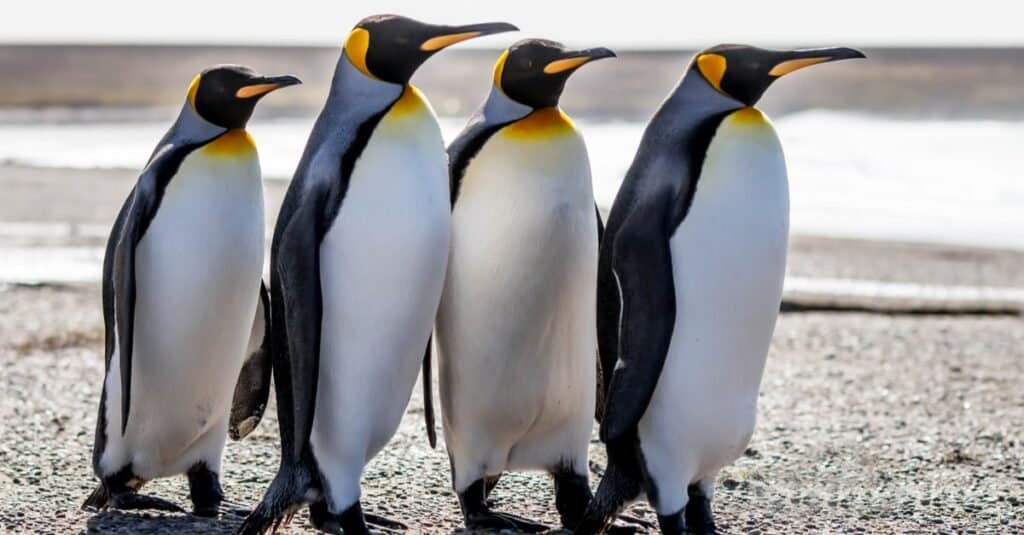
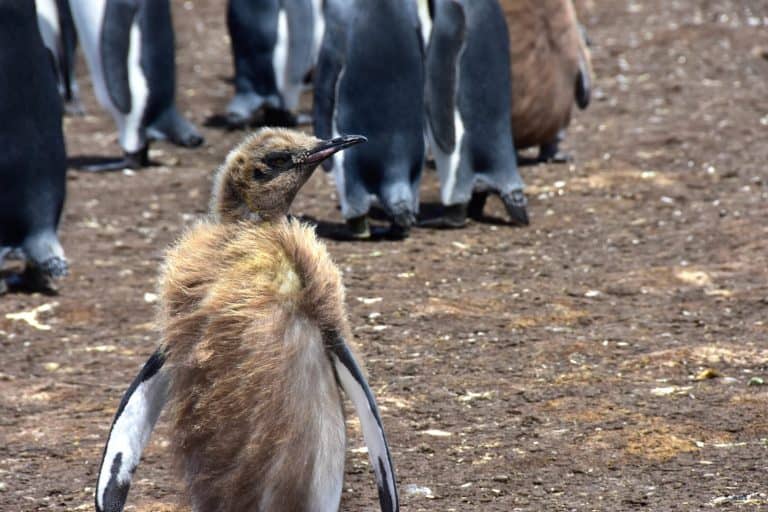
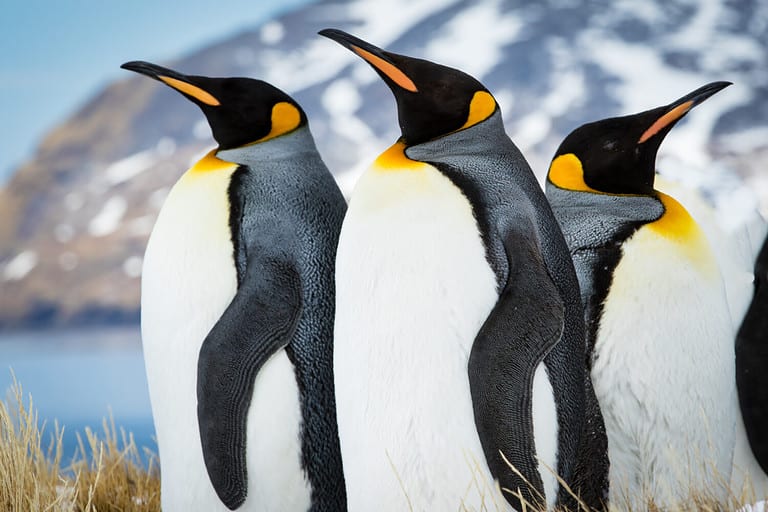
King penguins are the second-largest penguin species, very similar in appearance and size to the emperor penguin, the largest Great Penguin.
©fieldwork/Shutterstock.com
Both king and emperor penguins feature the distinctive tuxedo-like appearance that is most commonly associated with penguins: black feathers on their backs, white feathers on their underside and chest, and orange or yellowish feathers on their ear patches and just below their throats. In fact, the two species are often confused. They shouldn’t be, though. For one, there is little overlap between king and emperor penguins in their natural range. King penguins live on the subantarctic islands surrounding Antarctica, while emperor penguins live in the harshest environment of all penguin species: Antarctica itself.
The patches on king penguins are a vibrant orange, and the kings appear to be wearing a coat that wraps around and nearly snaps just above the bright orange patch on their necks. Their beaks are longer than those of emperor penguins and feature an orange teardrop-shaped patch on the bill’s lower part.
Adult king penguins are about the size of a 3-year-old human toddler, reaching 33-37 inches in length and weighing 31-37 pounds. These penguins feed mostly on lantern fish, but squid and crustaceans will suffice, and they will dive up to 300 feet deep to hunt for food. While they prey on other sea creatures, king penguins aren’t at the top of the food chain. They are preferred meals for leopard seals, orcas, and giant petrels.
In 2020, king penguins were assessed and determined to be of Least Concern by the IUCN Red List of Threatened Species.
Emperor Penguins
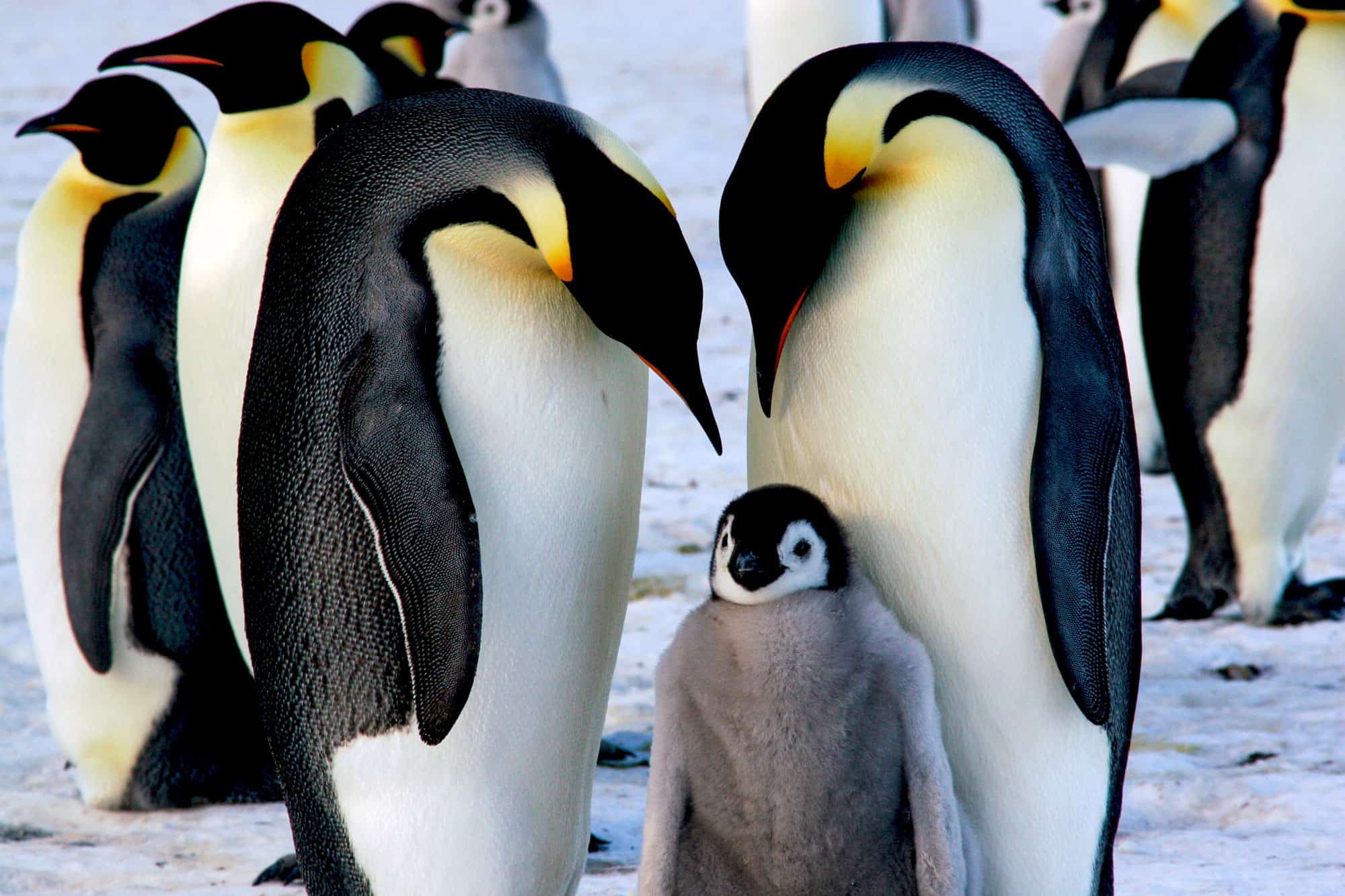
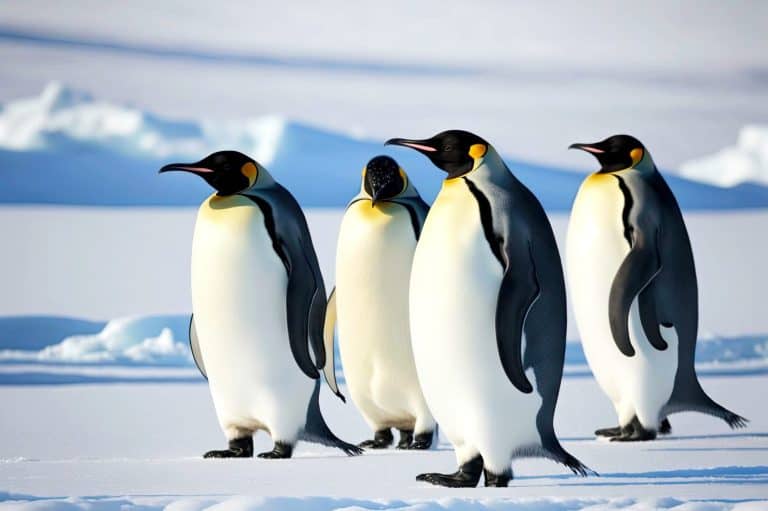
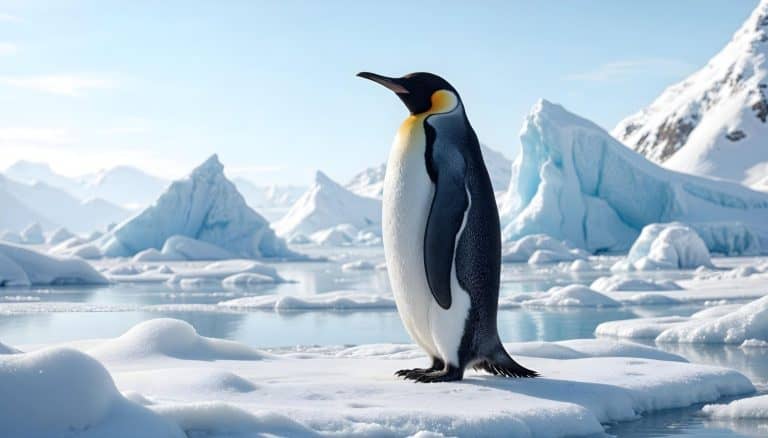
Male and female emperor penguins are about the same size, and both have yellow markings on their chest and ear.
©iStock.com/BernardBreton
As the largest penguin species and the deepest-diving bird capable of reaching depths of 1,800 feet in search of food, emperor penguins grow to be 50 inches tall and weigh 60-100 pounds. Like king penguins, emperors feature markings on their ears and chest, although the color tends to be more yellow and less vibrant.
Emperor penguins are the only penguin species to breed during winter. They form breeding colonies with several thousand members. Females lay one egg each year. The egg is incubated for two months by the male. Once the chick hatches, parents take turns caring for it, foraging, and feeding it. Emperor penguins eat fish, crustaceans, and krill.
The IUCN Red List of Threatened Species assessed emperor penguins as Near Threatened in 2019. Their population is decreasing.
Brush-Tailed Penguins
The three species of brush-tailed penguins (Pygoscelis) are listed as Least Concern by the IUCN Red List of Threatened Species. The populations of Adelie, chinstrap, and gentoo penguins are increasing, moderately depleted, and stable, according to the IUCN.
Adelie Penguins
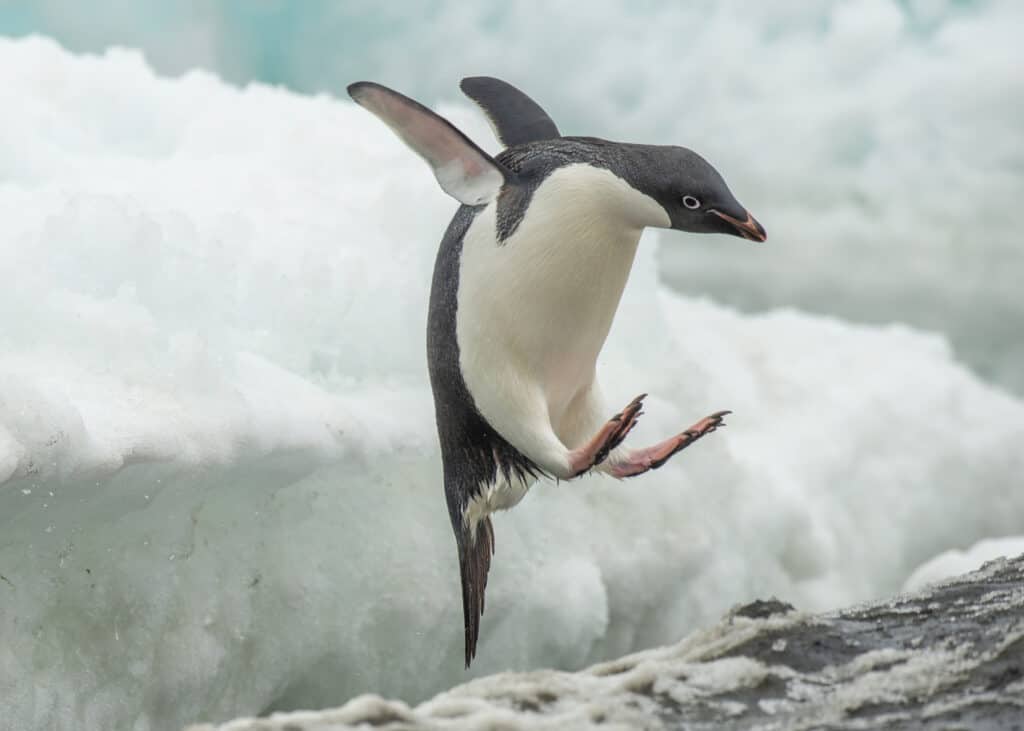
Adelie penguins are named for the wife of a French explorer.
©Benny Cottele/Shutterstock.com
Adelie penguins live along the coastline of Antarctica and on Bouvet Island. French explorer Jules Dumont d’Urville discovered these penguins in 1840 and named them after his wife, Adélie. They are a bit smaller than gentoo penguins and a bit larger than chinstrap penguins, growing 28-29 inches in length and weighing 8-18 pounds. While males and females have the same coloring and pattern, females are significantly smaller. These penguins are distinguishable from other mid-size penguins by a small white circle around their eyes.
One of four penguin species to nest on the continent of Antarctica, Adelie penguins prefer a diet of silverfish, lantern fish, krill, and squid. Their breeding season begins in October and goes through February. Two eggs are produced in each clutch, and both parents, taking turns, incubate the eggs for a little over one month. Adelie penguins fall prey to leopard seals and south polar skuas, a predatory seabird that nests on the edges of the continent.
Chinstrap Penguins
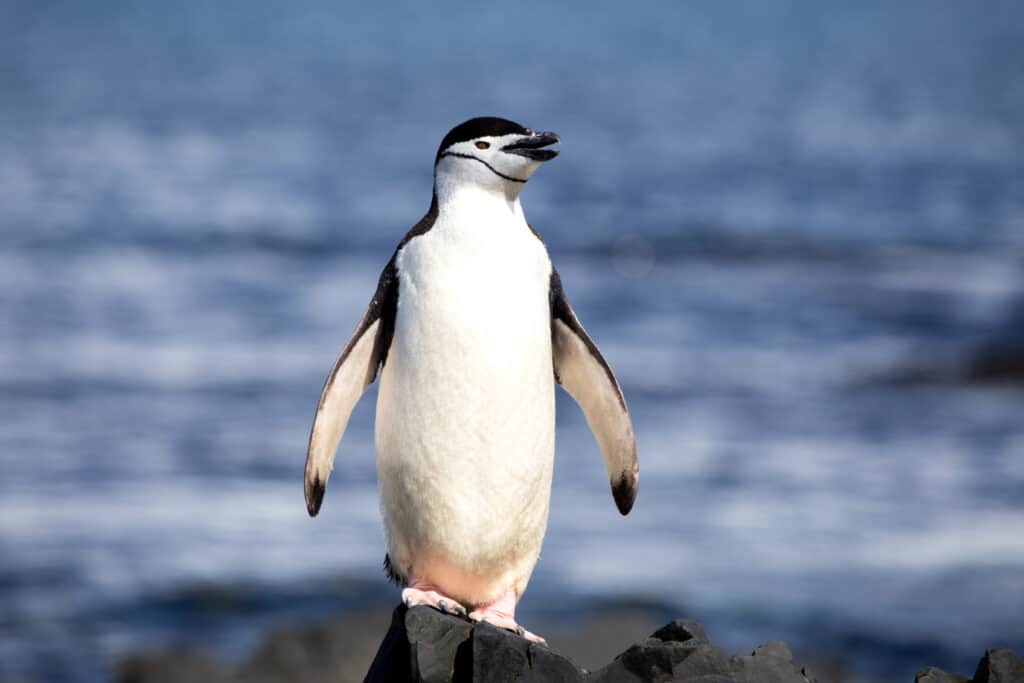
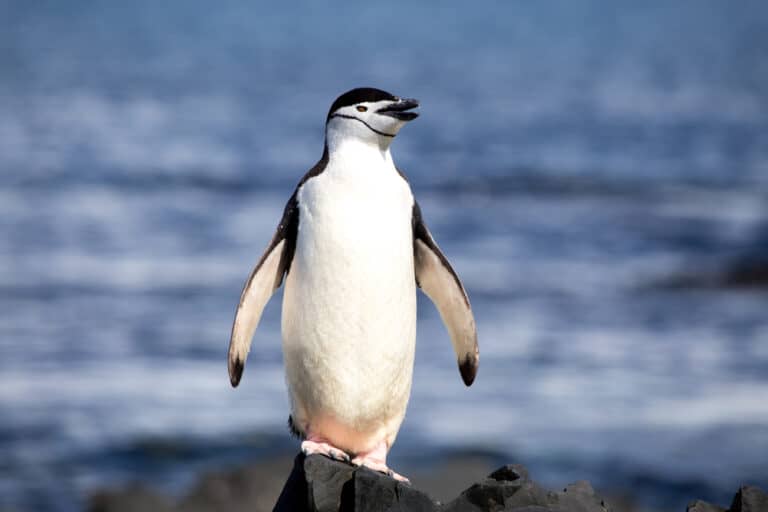
Chinstrap penguins are named for the black band at their necks that makes them appear to be wearing a helmet with a chinstrap.
©robert mcgillivray/Shutterstock.com
The many islands in the southern Pacific and Antarctic oceans are home to the aptly named chinstrap penguins. Named for the narrow band of black feathers on their white necks that stretches from ear to ear under the chin, giving the appearance that they are wearing a helmet with a chinstrap, chinstrap penguins divide their time 50-50 between land and sea. This chin marking has also helped them earn other monikers including ringed penguins and bearded penguins.
These mid-size penguins are typically 27-30 inches in length and 7-11.5 pounds. They are quite vocal birds, as well. Their braying call, “ah, kauk, kauk, kauk,” is accompanied by extended flippers and side-to-side head sways. Using rocks, chinstrap penguins build round nests where they lay their clutch of two eggs. Both males and females are involved with incubating the eggs, which hatch after about 37 days. The colonies where these birds breed are huge, in the hundreds of thousands. As such, these penguins have developed a reputation for being the most aggressive species. Researchers attribute this to intensive competition for essential resources.
Gentoo Penguins
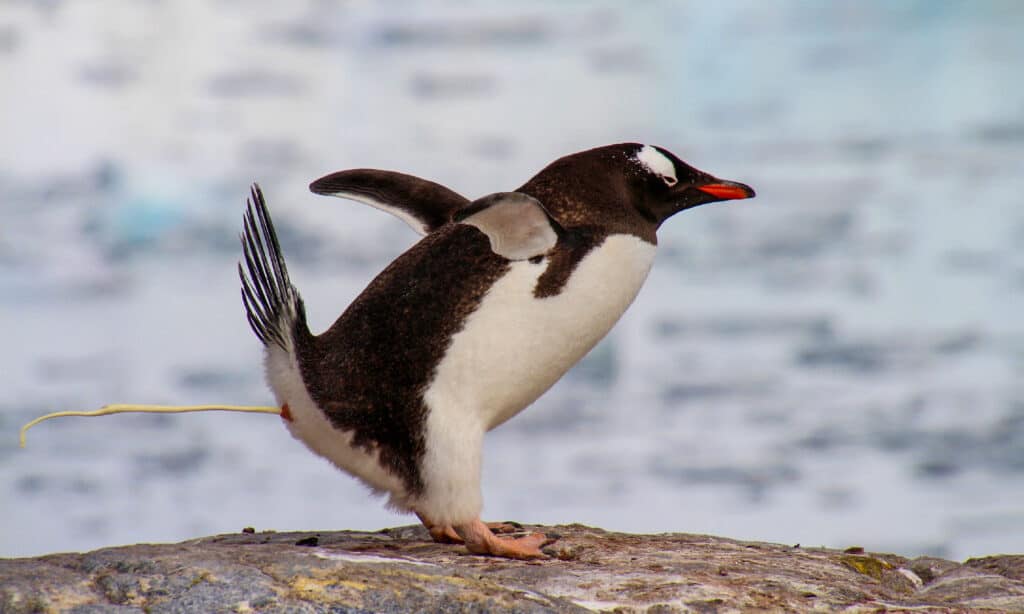
Gentoo penguins have the longest tail feathers of any penguin species.
©Kamla S/Shutterstock.com
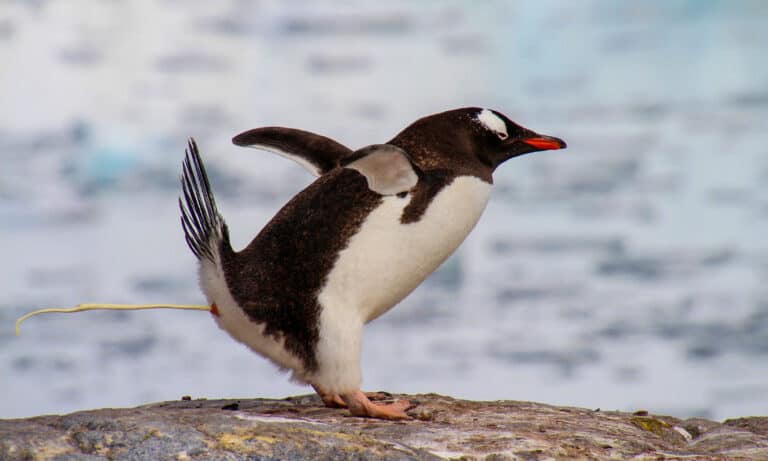
Like the other two mid-sized penguins in this genus, gentoo penguins have a unique feature on their head. A broad, white stripe, which narrows as it wraps over their black heads, gives the impression they are wearing headphones or perhaps a bonnet. Their lipstick-orange bill is one of the most unique features among all penguins. They also have the longest tail feathers of any penguin species. Gentoo penguins grow 28-35 inches in length and weigh 9.5-18.5 pounds. These penguins form breeding colonies in ice-free zones and make nests from stones placed in grass. Their range includes a number of subantarctic islands, such as the Falkland Islands, South Georgia, the South Sandwich Islands, and the Kerguelen Islands.
Their mating ritual involves male penguins offering rocks or stones to females in order to construct a nest. Females lay two eggs, and both parents share in incubating them. Gentoos eat fish, crustaceans, and cephalopods. Their diet varies depending on availability. Leopard seals and orcas prey on them, but it’s sure to be an exercise for these animals as gentoos are the fastest-swimming penguin. Gentoo chicks are easy prey for petrels and skuas.
This species has four recognized subspecies, according to the IOU. They are the eastern gentoo penguin (P. p. taeniata), the northern gentoo penguin (P. p. papua), the southern gentoo penguin (P. p. ellsworthi), and the South Georgia gentoo penguin (P. p. poncetii).
Little Penguins
The only penguin species in the Eudyptula genus are little penguins (Eudyptula minor), but the IOU recognizes six subspecies: E. minor novaehollandiae, E. minor minor, E. minor iredelai, E. minor variabilis, E. minor albosignata, and E. minor chathamensis. These penguins and their subspecies can be found living in Australia, Tasmania, and New Zealand.
Little Penguins
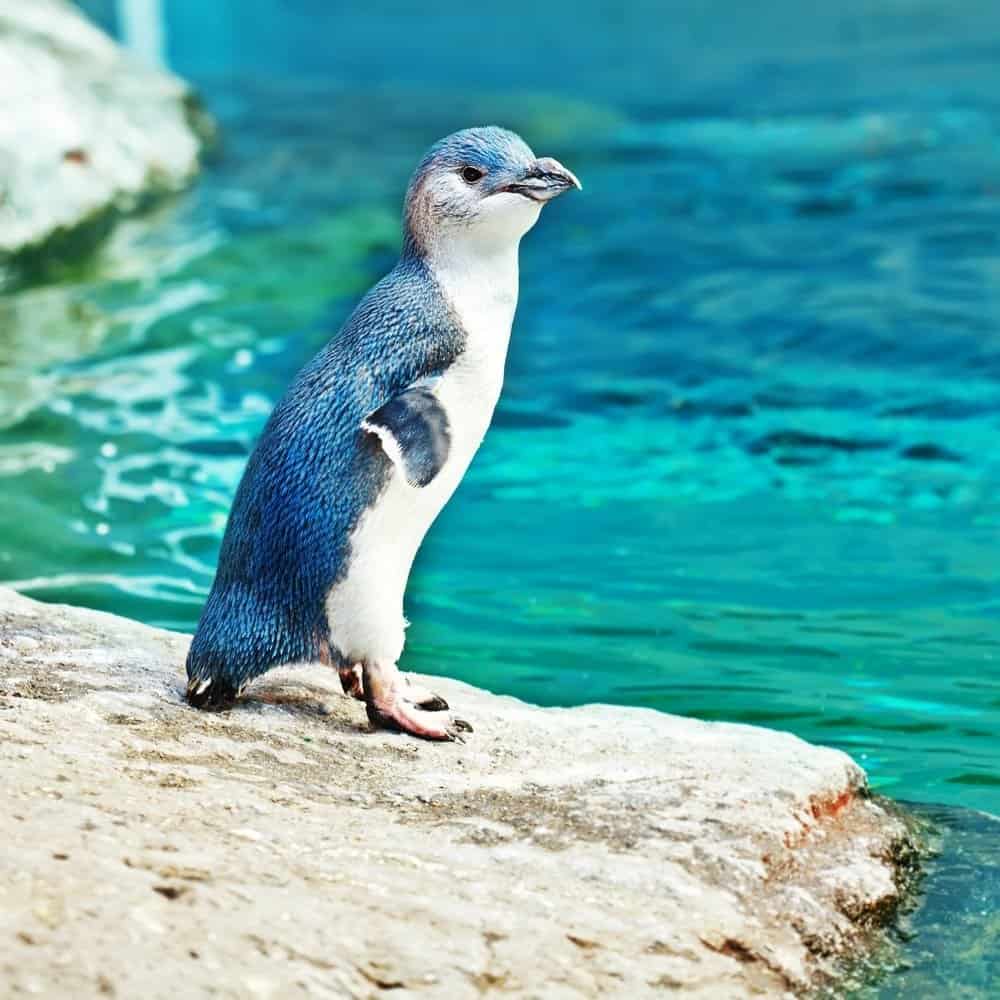
Little or fairy penguins got their common name thanks to their small stature.
©Khoroshunova Olga/Shutterstock.com
These penguins are, in fact, little—the smallest penguin species. Little penguins are also called blue penguins and fairy penguins. Adults reach 10-12 inches in length and weigh 2-3.5 pounds, and males are larger and heavier than females. The name blue penguin refers to this species’ coloring. Instead of the black and white so often associated with penguins, little or blue penguins are grey to indigo where one would expect to see black. Their chest and underside are white.
Little penguins feed on a diet of small fish such as herring, shad, anchovy, and sardines, as well as crustaceans and cephalopods like squid. Once the sun rises, these penguins head to sea to forage. They do not return to their burrows or nests until the end of the day. In fact, their presence on land is strictly nocturnal. Males and females incubate the two eggs, taking turns to forage at sea. Fur seals, sharks, and sea lions find little penguins particularly appealing.
The IUCN Red List of Threatened Species lists this species of Least Concern.
Banded Penguins
Four species of penguins comprise the Spheniscus genus. These penguins feature similar banded feather patterns, a locator call that resembles the sound of a donkey braying, a wedge-shaped flipper, black beaks, and a presence in warmer climates.
Galapagos Penguins
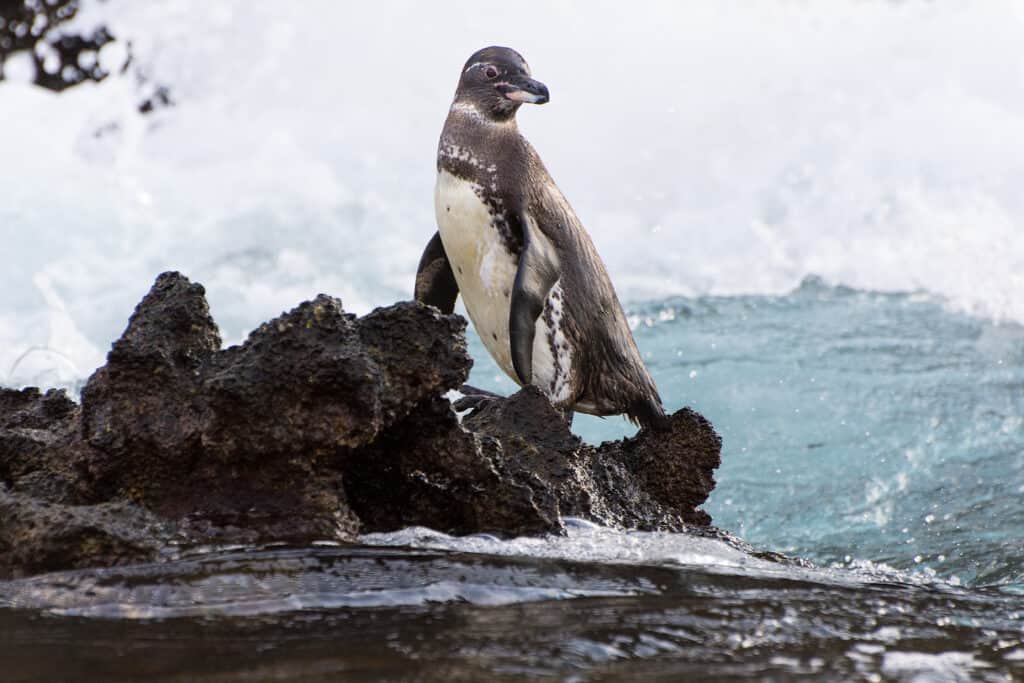
Galapagos penguins are the only penguin species to live north of the equator.
©iStock.com/Kirk Hewlett
Standing 19-20 inches tall and weighing 4.5-9 pounds, Galapagos penguins are the second-smallest penguin species and the only penguin species that lives north of the equator on the mostly west side of the Galapagos Islands of Ecuador. The Humboldt and Cromwell currents bring cool waters to the archipelago, one way these penguins can stay cool as they spend a lot of time in the water. They shade their feet with their flippers and pant like dogs—adaptations that keep them cool at the tropical latitude.
These penguins are black on their head, back, and flippers. Their white belly is cut across by a single band of black feathers, and their black head has a thin, white-feathered C-shaped band that extends from above the front of the eye on either side up and around the ear-coverts where it then connects to the chin. Galapagos penguins mate with the same partner for life. The breeding season is year-round. Their mating rituals include flipper patting, mutual grooming, and bill touching. They lay one or two eggs in a protected, cool area and incubate them for 40 days. Both parents incubate, feed, and groom their young. Galapagos penguin’s diet consists primarily of mullet and sardines.
Galapagos penguins’ population is trending down with an estimated 1,200 mature individuals in the wild. Most recently assessed in 2020, the species remains Endangered according to the IUCN Red List of Threatened Species.
Humboldt Penguins
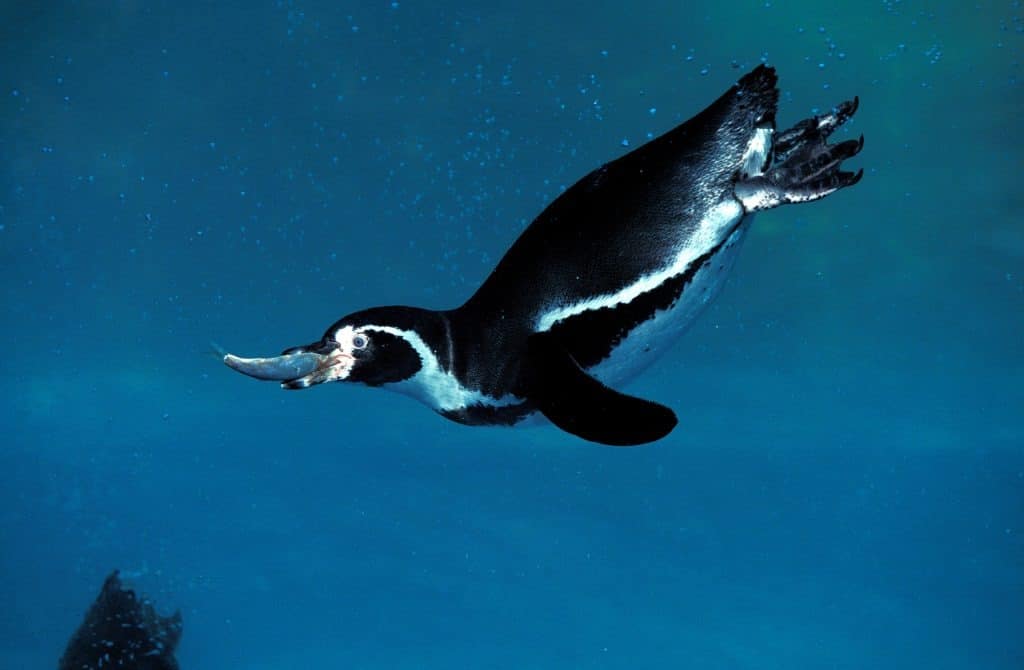
The Humboldt Current provides a steady, reliable source of food to Humboldt penguins.
©slowmotiongli/Shutterstock.com
The medium-size Humboldt penguins live along the Pacific coast of Peru and Chile in South America. There is overlap in range between these penguins and the Magellanic penguins on the central Chilean coast. These penguins and the current near their breeding grounds are named for German naturalist Alexander von Humboldt. The Humboldt Current brings a steady stream of nutrients and food to these penguins, which subsists on a diet of fish and cephalopods, like squid and octopus. They are shallow divers and prefer to hunt close to home, rarely traveling farther than 20-40 miles in search of prey.
Humboldt penguins grow to be 22-28 inches in length and to weigh 6.5-13.2 pounds. They are the heaviest of the banded penguins. Like the Magellanic penguins, Humboldts are black on their head, back, and flippers and white on their underside with a white C-shaped band that extends from above the front of the eye on either side up and around the ear-coverts where it then joins at the chin. That band is wider and more defined than the band on the Galapagos penguins. The black-breast band on their belly stretches down the flanks to the thigh. Males and females court each other with a series of head nods, dances, wing flaps, and one-eyed glances. Female Humboldt penguins lay two eggs that incubate for 41 days, with both parents providing warmth for the eggs and food for the chicks.
As of 2020, this species is listed as Vulnerable on the IUCN Red List of Threatened Species with a decreasing population trend and an estimated wild population of 23,800.
Magellanic Penguins
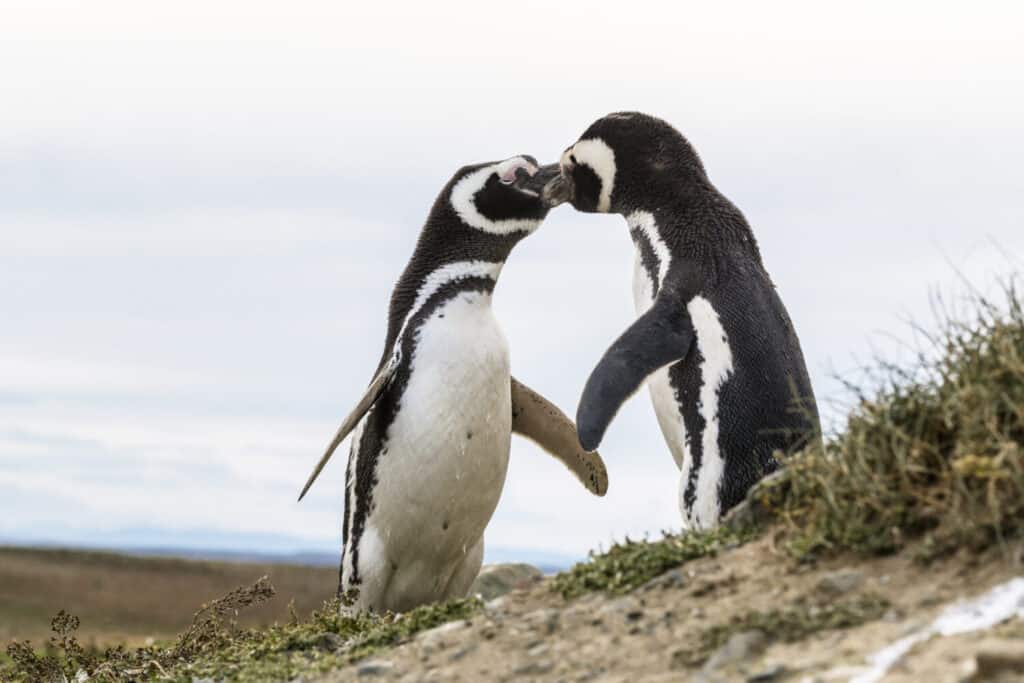
Penguins take their mating seriously, and many Magellanic penguins are monogamous.
©Sergey Didenko/Shutterstock.com
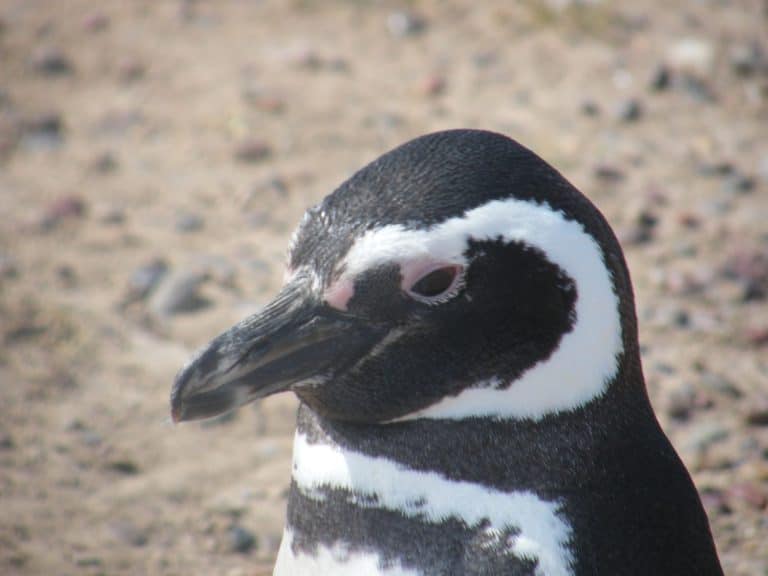
Magellanic penguins bear the common and scientific name of the famous explorer who first spotted them in 1520, Ferdinand Magellan. Their breeding grounds are in coastal Patagonia—Argentina and Chile—and the Falkland Islands. These penguins are characterized by a broad crescent-shaped band of white feathers that extends from above each eye to their chin, an inverted horseshoe-shaped band on their underside, and a pink bit of flesh on their face. Their bills and feet are black. Magellanic penguins are the largest of the banded penguins, standing about 28 inches tall and weighing 9-10 pounds. They are sexually dimorphic.
Favorite foods include cuttlefish, squid, and krill. Magellanic penguins travel in large groups when they hunt, breed, and nest. They lay two eggs at once in places where temperatures exceed and remain above 68 degrees Fahrenheit. Both parents contribute to incubating (about 42 days), feeding, and caring for their young. Many Magellanic penguins are monogamous, and the male’s call alone is enough for the female to recognize him.
The estimated population of this species is 2.2-3.2 million, and the population trend is decreasing. Nevertheless, in 2020, the IUCN Red List of Threatened Species lists Magellanic penguins as of Least Concern.
African Penguins
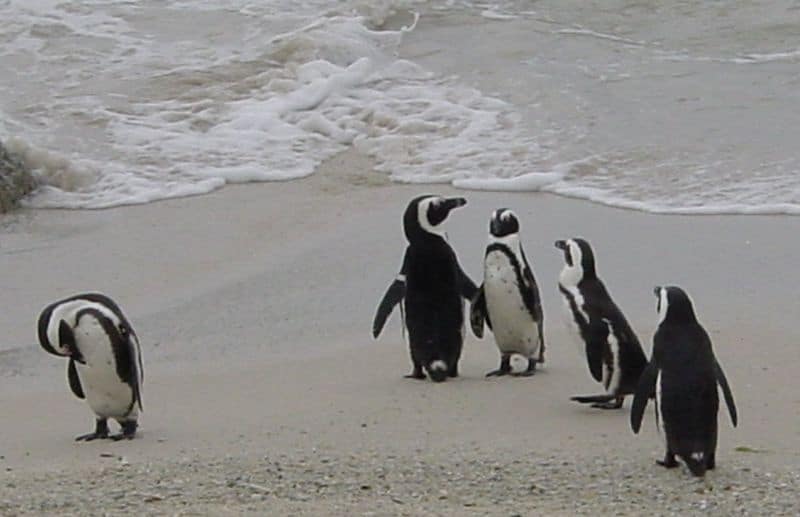
African penguins have an unfortunate nickname, courtesy of their donkey-like braying.
©tato grasso, CC BY-SA 2.5, via Wikimedia Commons – Original / License
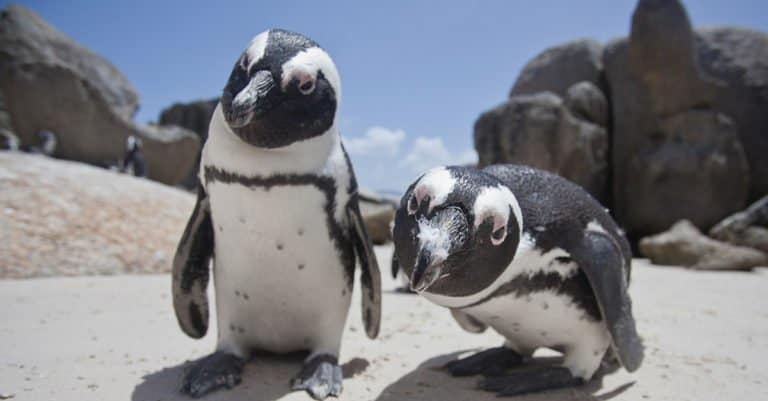
Also called Cape penguins and South African penguins, African penguins are the only penguin species to live in the Old World. They live on the southern and southwestern coasts of Namibia and South Africa and a number of islands between the two countries. These penguins stand 24-27 inches in length and weigh about 8-9 pounds. They are characterized by one black band on their white underside and a circle of pink skin around each eye. They also have a thick C-shaped band around the eyes, ears, and chin, similar to the ones found on the other banded penguins.
Like the other penguins in this genus, African penguins mate for life. Males and females both contribute to incubating, feeding, and caring for their young, and their mating ritual has both sexes using a loud donkey-like braying—a behavior that earned them another name, “jackass penguins.” African penguins eat squid, sardines, pilchards, horse mackerel, and anchovies, and they serve as food for seals and sharks at sea and leopards and mongooses on land.
Last assessed in July 2024 by the IUCN Red List of Threatened Species, African penguins are Critically Endangered. The estimated number of mature individuals is 19,800 and decreasing.
Yellow-Eyed Penguins
The sole species in the Megadyptes genus are yellow-eyed penguins, which live along New Zealand’s eastern and southeastern coasts and a few of the country’s smaller islands, including Stewart Island, the Auckland Islands, and the Campbell Islands.
Yellow-Eyed Penguins
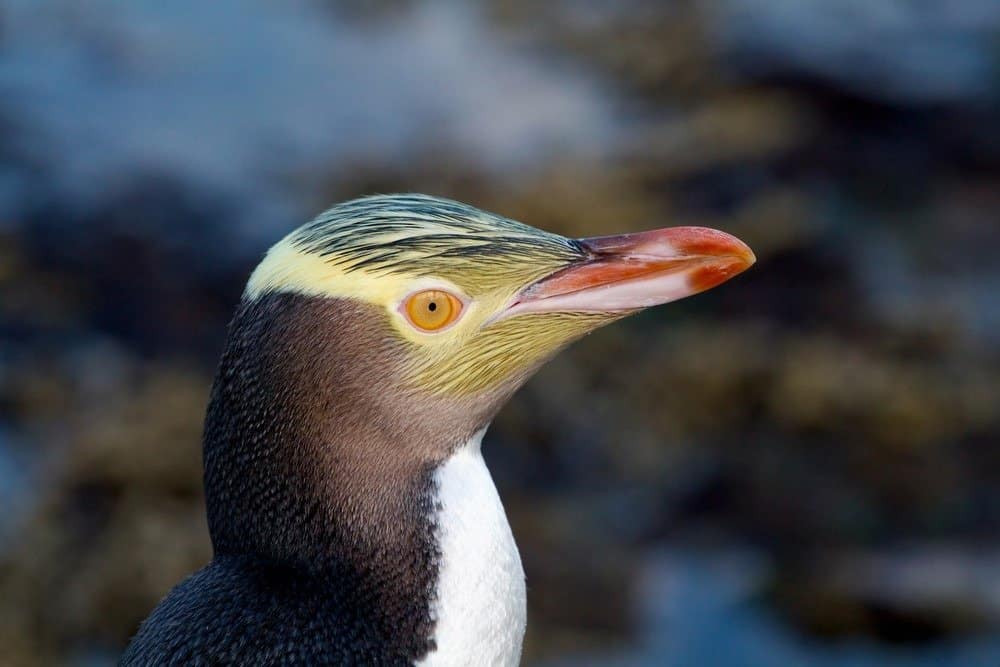
The yellow-eyed penguin population is in sharp decline.
©Anders Peter Photography/Shutterstock.com
Yellow-eyed penguins are easily picked out of a crowd thanks to their pale-yellow eyes, yellow eye bands, and yellow feathers on their head. Adults average 24 inches in length and weigh 11-13 pounds, with females slightly shorter and slimmer. These penguins build nests of grass and twigs away from the prying eyes of other breeding pairs. Males and females share responsibility for incubating their two eggs, which hatch after 39-51 days, as well as foraging and feeding.
Their diet consists of fish such as red and blue cod, opal fish, and bristling, and squid. Yellow-eyed penguins can and do dive as deep as 425 feet beneath the surface to forage. In their pursuit of food, they can become meals for sharks and Hooker’s sea lions. These penguins’ predators on land are usually introduced species: short-tailed weasels or ermines, ferrets, dogs, and cats.
Populations of both mainland and island yellow-eyed penguins are in sharp decline, and this is attributed to rising ocean temperatures, fisheries, and human pollution. In 2020, the IUCN Red List of Threatened Species assessed and listed this penguin as Endangered. It is estimated that fewer than 3,500 live in the wild, and their numbers decline yearly.
Crested Penguins
The genus Eudyptes contains the largest number of penguin species. All eight species are black and white and feature yellow-orange crests, orange bills, and red eyes. These penguins also produce two-egg clutches, where the first of the two is usually smaller in size and gets discarded or pushed out of the nest sometime during the incubation period.
Macaroni Penguins
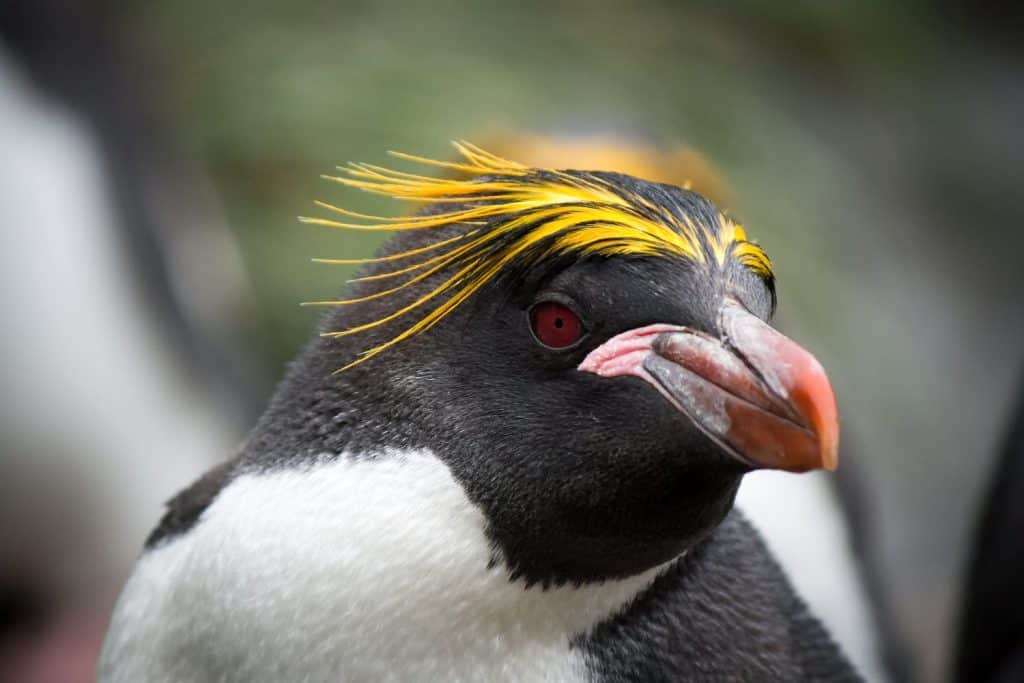
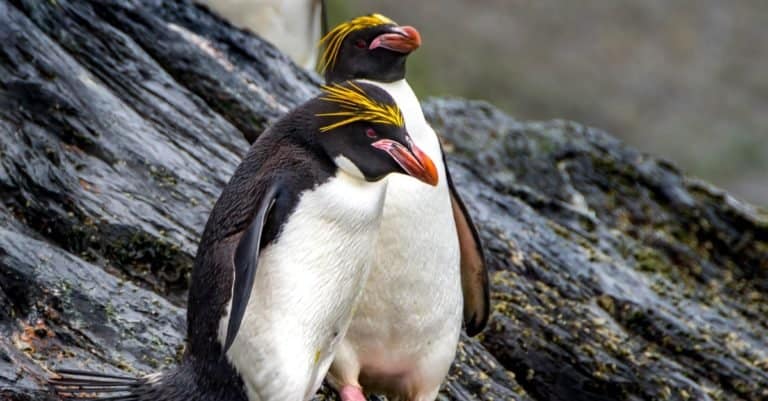
Macaroni penguins have a yellow crest on their head, a black face, and a white underbelly.
©james_stone76/Shutterstock.com
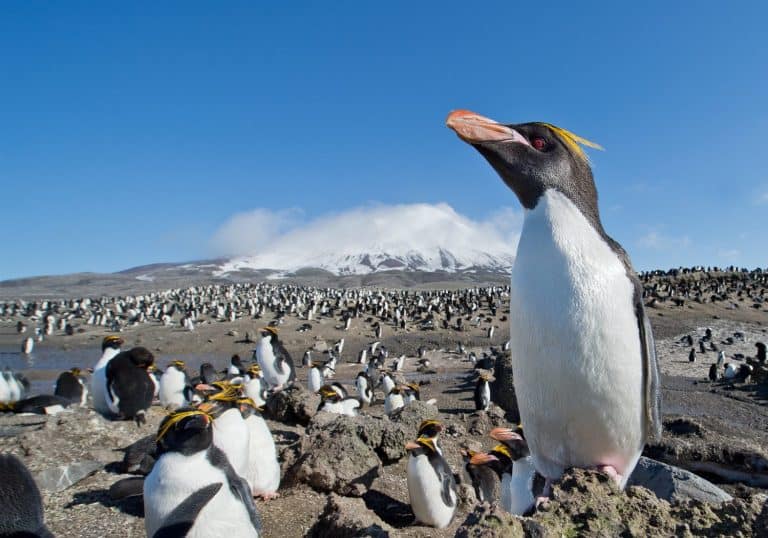
Over-the-top would be the adjective to describe macaroni penguins. When sailors first spotted them, they linked their exaggerated appearance and behavior with the macaroni fashion of the 18th century. Macaroni penguins grow to be 28 inches in length and weigh, on average, 12 pounds. They are the largest crested penguins. On their black heads is their most distinctive feature: a yellow-orange crest of feathers that extends from the middle of their forehead over both eyes to the back of the head.
Males put on quite a display when attempting to attract a mate—dancing, preening, braying, bowing forward, making undulating sounds, and extending their neck to the sky, moving their head side-to-side as they trumpet loudly. Tough to resist, right? Their breeding colonies are large, containing over 100,000 individual penguins. Both parents take turns incubating the egg(s), and males care for the young after hatching while females bring food back to the nest.
Estimates today put the global population of breeding pairs at around nine million, down from “a minimum breeding population of 11.8 million pairs on the Subantarctic islands in the Indian and South Atlantic Oceans and the Antarctic Peninsula,” as compiled in Eric J. Woehler’s “The Distribution and Abundance of Antarctic and Subantarctic Penguins,” which was published in 1993. (52) Their IUCN Red List status is Vulnerable, despite this species having the largest population of all penguins, numerically speaking.
Macaroni penguins primarily subsist on krill, while fur seals, leopard seals, and orcas prey on the fashionable penguins. Their eggs and chicks are preyed on by skuas, petrels, sheathbills, and gulls.
Royal Penguins
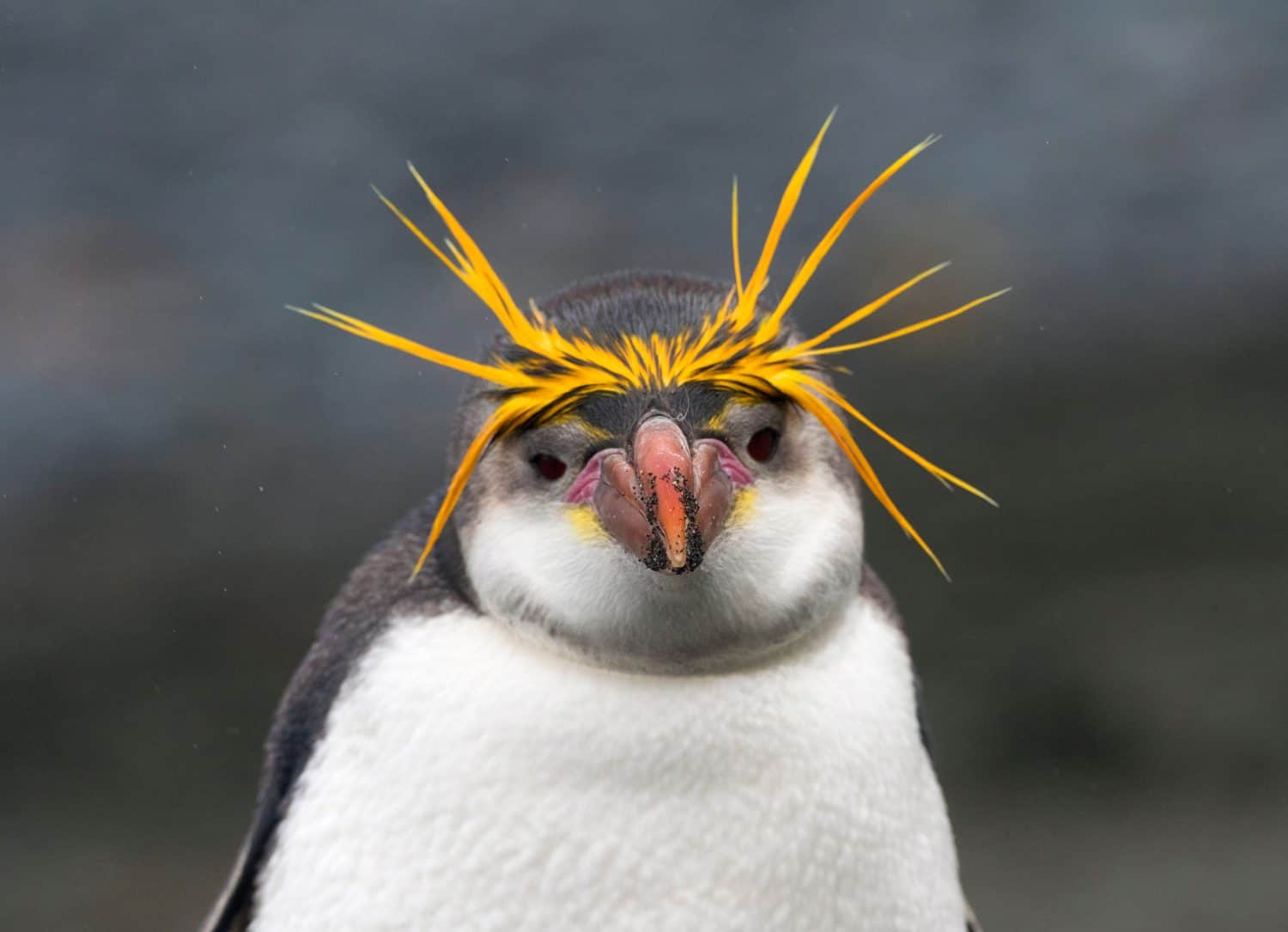
Royal penguins are native to Macquarie Island in the Southwestern Pacific Ocean.
©Agami Photo Agency/Shutterstock.com
Native to Macquarie Island, a subantarctic island in the southwestern Pacific Ocean about halfway between New Zealand and Antarctica, royal penguins are closely related to macaroni penguins. In fact, some ornithologists treat the latter as a subspecies of the macaroni penguin. The IOU recognizes royal penguins as a distinct species. Visually, however, the two species look different. While macaronis have a black head and neck, royals have a white face and neck. Royal penguins grow 26-30 inches in length and weigh 9-13 pounds. As is the case with most penguin species, males are taller and heavier than females. Males contribute heavily to the responsibilities of incubating and raising young.
The IUCN Red List of Threatened Species assessed this species in 2021 and lists it as of Least Concern.
Rockhopper Penguins
The 21st century has seen a shake-up in rockhopper penguin taxonomy. Until 2006, southern rockhopper penguins (Eudyptes chrysocome) were recognized as the sole species with two subspecies: northern (E. c. moseleyi) and eastern (E. c. filholi). Research published in 2006 presented evidence that the northern subspecies populations (i.e., E. moseleyi) should be its own species. For a time, rockhopper penguins were taxonomically divided into northern rockhoppers that live in the Southern Hemisphere’s temperate coastal regions and southern rockhoppers living in its subantarctic regions.
A 2021 molecular phylogenetic study recommended splitting the subantarctic (or southern) rockhopper penguins into two separate species: the western and eastern rockhopper penguins. Western rockhopper penguins have retained the scientific name for southern rockhopper penguins (E. chrysocome). The study concluded, “Species delimitation analyses based on molecular data…provide strong support for the taxonomic distinction of three species of rockhopper penguins.” The IOU updated its species list in February 2025 to reflect the study’s conclusions.
Northern Rockhopper Penguins
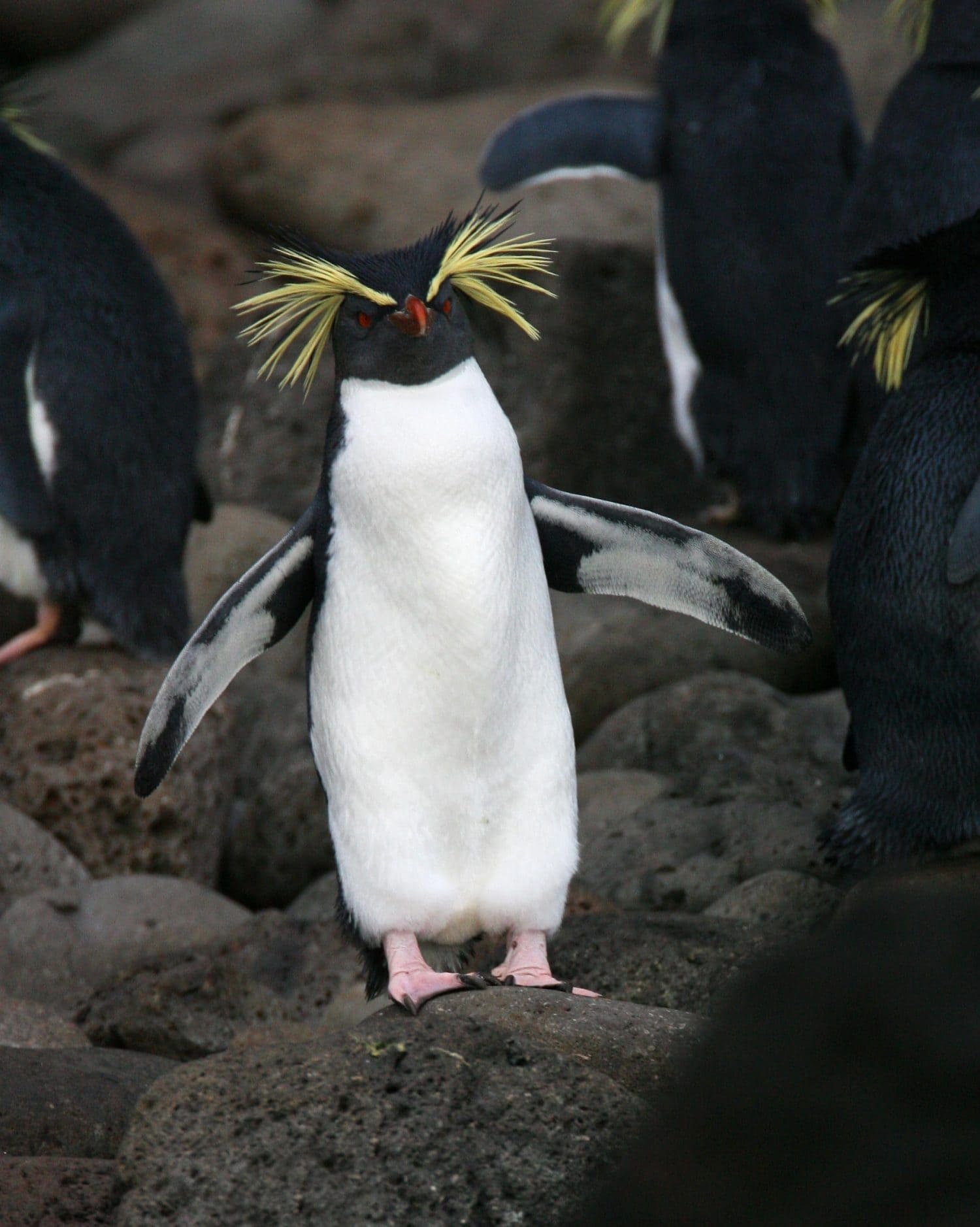
The main protagonist in the 2007 film “Surf’s Up” features a Moseley’s or northern rockhopper penguin.
©Traveller MG/Shutterstock.com
The breeding grounds of northern or Moseley’s rockhopper penguins are on the Tristan da Cunha islands and Gough Island in the South Atlantic Ocean and on the Amsterdam and St. Paul islands in the Indian Ocean. The name rockhoppers stems from their unique way of getting around obstacles: They hop over them, using their flippers to help them jump. Northern rockhopper penguins are the larger of the three rockhopper penguin species, standing 21-25.5 inches tall and weighing 3.5-9 pounds.
These rockhoppers have the longest and most flamboyant pale-yellow crests of the three rockhopper species. A thin, yellow stripe of feathers extends over their bright red eyes, and the feathers gradually increase in length and number. They eat a diet primarily of krill, squid, octopus, and some small fish. Northern rockhopper penguins breed in colonies built cliffside or at sea level. They sing songs to each other during the mating season, and their colonies have thousands of pairs of penguins.
This species’ most recent assessment by the IUCN Red List of Threatened Species was in 2020. The northern rockhopper penguin is listed as Endangered with a declining population estimated at 413,700 mature individuals.
Eastern Rockhopper Penguins
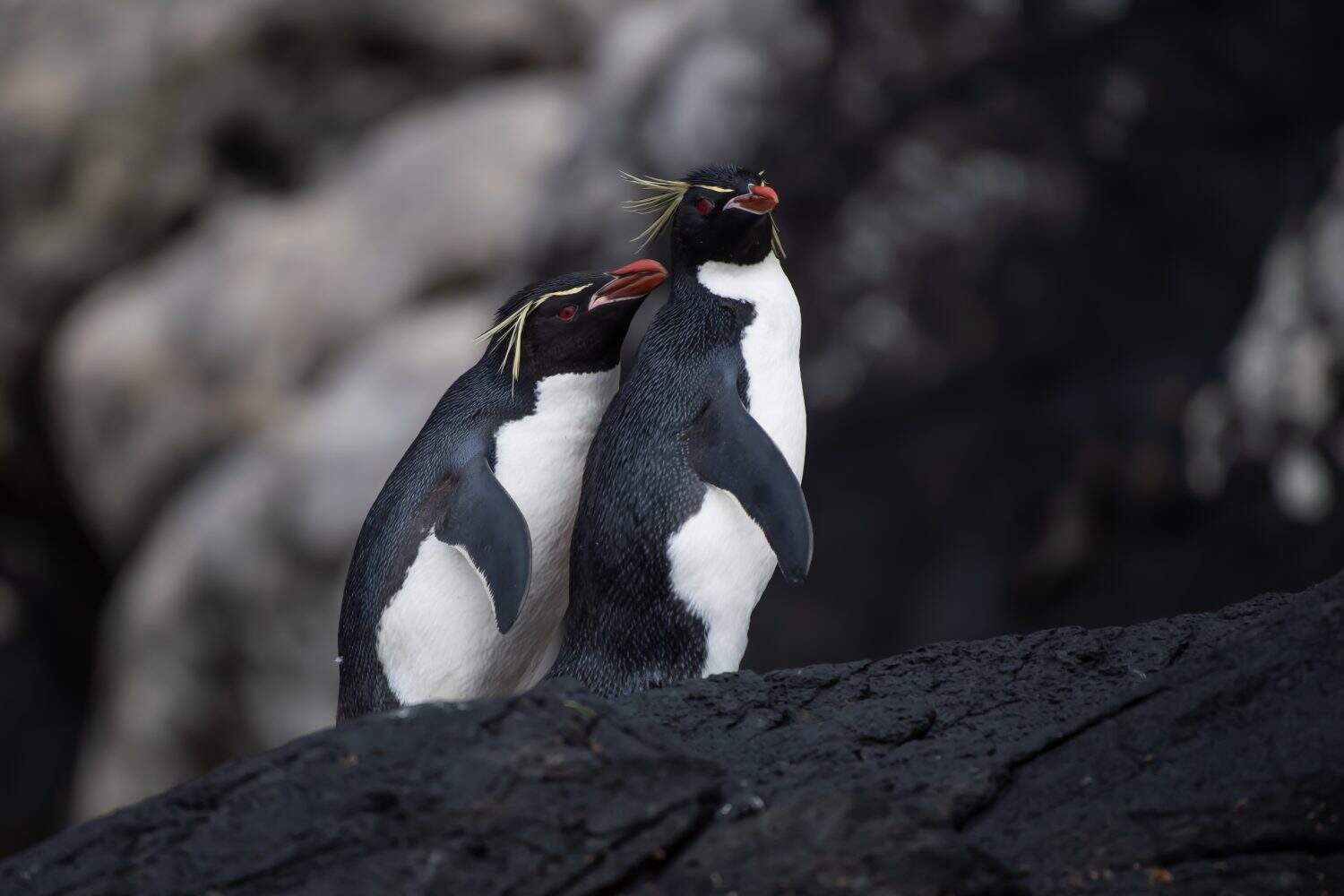
Geography may be the easiest way to identify the three rockhopper penguin species from each other, but eastern rockhopper penguins have pink margins around their bill, a feature the other two do not have.
©Charles Bergman/Shutterstock.com
Eastern rockhopper penguins look remarkably similar to their western cousins. Key to distinguishing between them is the pink margins around their bill. Neither northerns nor westerns have this feature. Eastern rockhoppers are 17.5-21.5 inches in length and 4.5-9.5 pounds.
Home for eastern rockhopper penguins are the subantarctic islands in New Zealand and in the Indian Ocean. They typical forage for food near their nesting sites, but they will travel as far away as 75 miles away. They eat fish, crustaceans, and cephalopods. Males and females share in the duties of incubating, feeding, and caring for their young. Late spring and summer are the breeding season, and adults spend their winters at sea. Their mating ritual involves their making loud pulsing braying calls accompanied by various displays.
Eastern rockhopper penguins have not been assessed by the IUCN Red List of Threatened Species, but their populations are believed to be declining.
Western Rockhopper Penguins
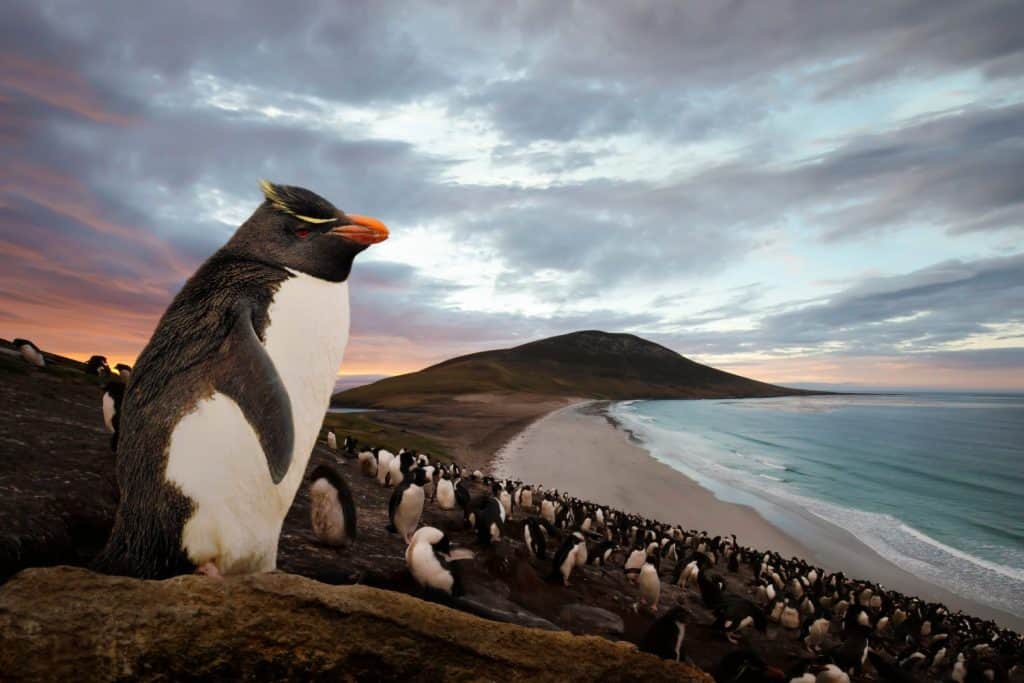
The crests of western rockhopper penguins are less dramatic than those of northern rockhoppers.
©Giedriius/Shutterstock.com
Western (traditionally known as southern) rockhopper penguins can be found on their breeding grounds on the southern coast of South America and the Falkland Islands of Argentina. They stand 18-23 inches tall and typically weigh 4-7.5 pounds. Because the three different rockhopper penguin species look so similar to each other, geography will likely determine which species you’re looking at as all rockhoppers feature black upperparts, white underparts, a black head, throat, and neck, a reddish bill, and red eyes. Even their crests are quite similar, although western rockhopper penguins’ crests are significantly less dramatic than those of their northern cousins.
The Western rockhopper penguin’s estimated population is 2.5 million, with decreasing trend. In 2020, the species was assessed and listed as Vulnerable by the IUCN Red List of Threatened Species.
Snares Penguins
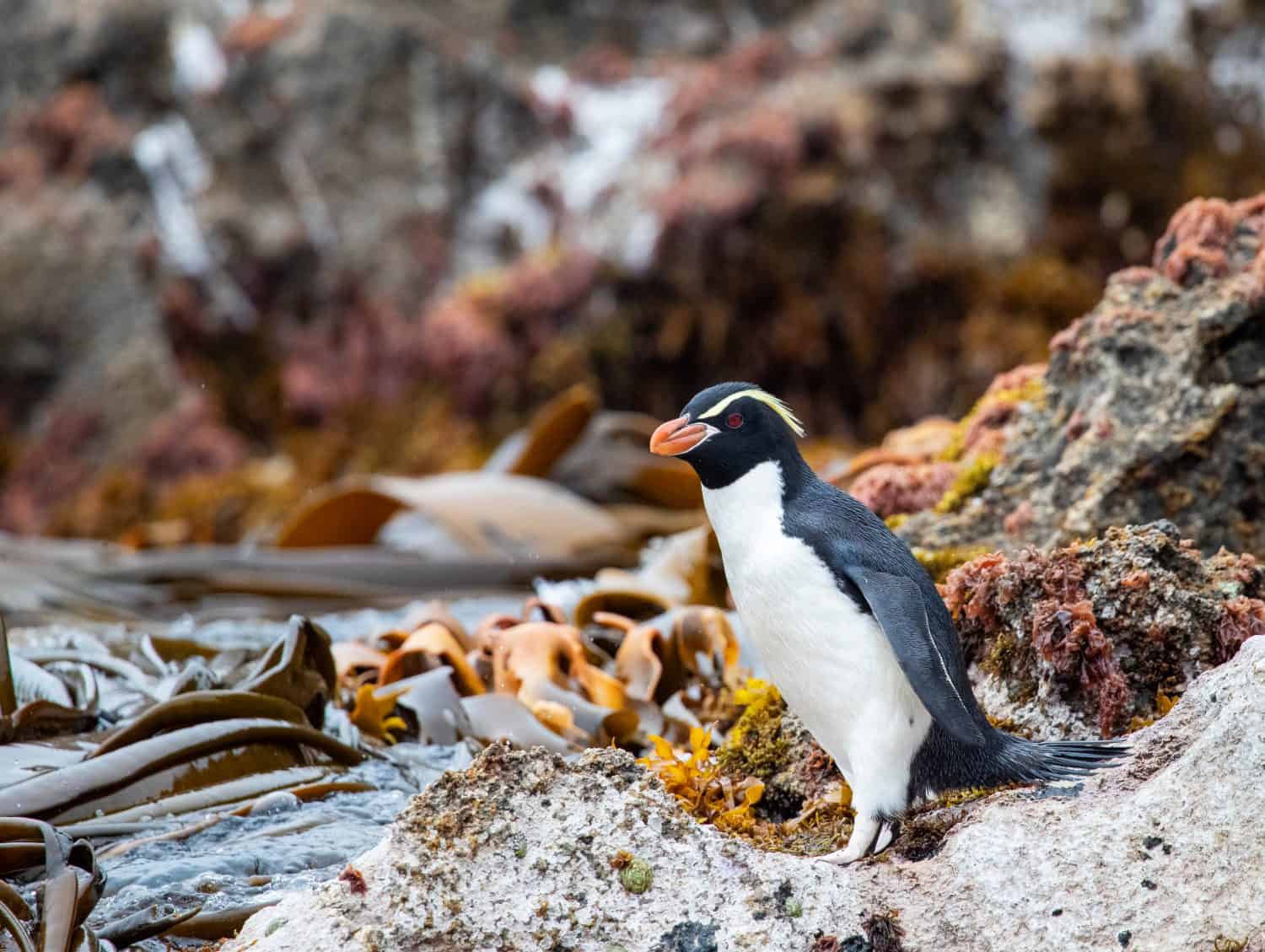
During the courtship ritual, male snares penguins attempt to attract a female by pounding their chest with their wings.
©Agami Photo Agency/Shutterstock.com
Snares penguins are the first of three penguin species on this list endemic to New Zealand. They breed on the Snares Islands, and little is known about where and how far they migrate during winter, but it is believed they do not go far. Snares penguins grow to be 19.5-27 inches tall and to weigh 5.5-9 pounds. Their pale-yellow crests begin at the base of the exposed skin on their beak and then extend over the eyes and down to the neck.
During the courtship ritual, males attract a mate by thumping their chest with their wings. Once coupled, they build a nest and the female lays two eggs five days apart. As is the case with all crested penguins, the second egg is much larger than the first, and the latter often doesn’t survive. It is believed that this egg-laying behavior is an adaptive response to environmental conditions meant to reduce brood size. This species forms colonies of up to 1,200 birds. Snares penguins primarily eat a diet rich in krill, but small fish and squid make regular appearances on their diet. Adult snares are meals for sea lions and leopard seals, but this has had no effect on their Vulnerable status on the IUCN Red List of Threatened Species. It is estimated that 63,000 remain in the wild.
Fiordland Penguins
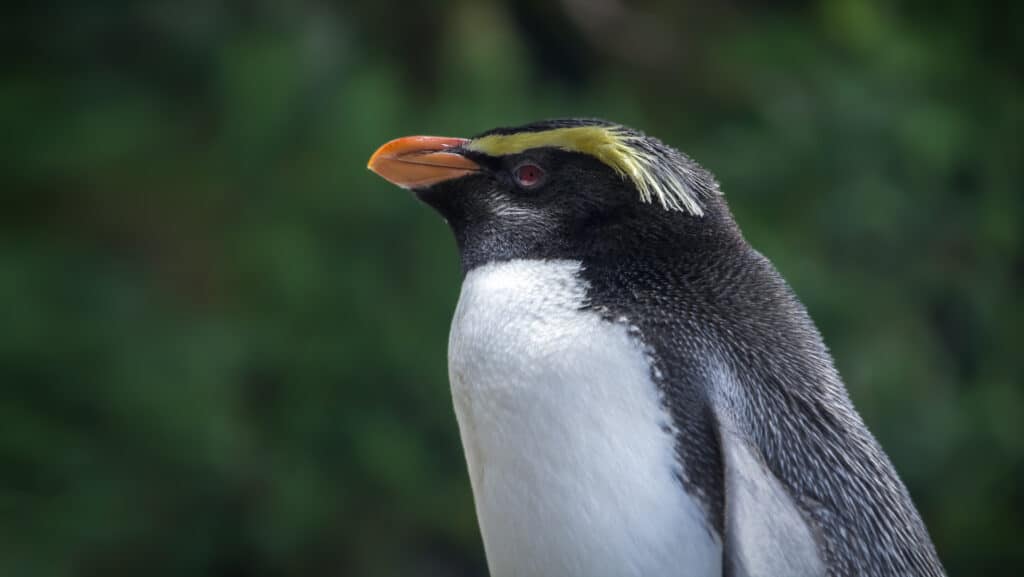
Fiordland penguins are one of three penguin species endemic to New Zealand.
©iStock.com/Darren Creighton
Fiordland penguins are the second endemic penguin species to New Zealand. These birds nest in colonies and build their nests in tree roots and rocky outcroppings along the western and southern coasts of the South Island in New Zealand as well as on Stewart Island. Eighty-five percent of their diet consists of arrow squid, and the rest is crustaceans. These penguins spend about 75% of the winter in the water and sometimes end up with barnacles on their tail feathers.
The medium-sized Fiordland penguin stands about 22 inches tall and weighs 4.5-11 pounds, on average weighing about 7.5 pounds. They can be distinguished from the other crested penguins endemic to New Zealand by the white markings on their face, the yellow crest that begins at the base of their beak and extends back over the eye before dropping down toward their neck. They also do not have any bare skin exposed around the base of their bill, which the other two species have.
Fiordland penguins numbers are decreasing, threatened by predators such as dogs, cats, rats, and stoats, and they will flee their nest and never return if disturbed while incubating an egg. Fiordland penguins are listed as Near Threatened by the IUCN Red List of Threatened Species, which assessed the species in 2020. It estimates that 12,500-50,000 individuals are in the wild.
Erect-Crested Penguins
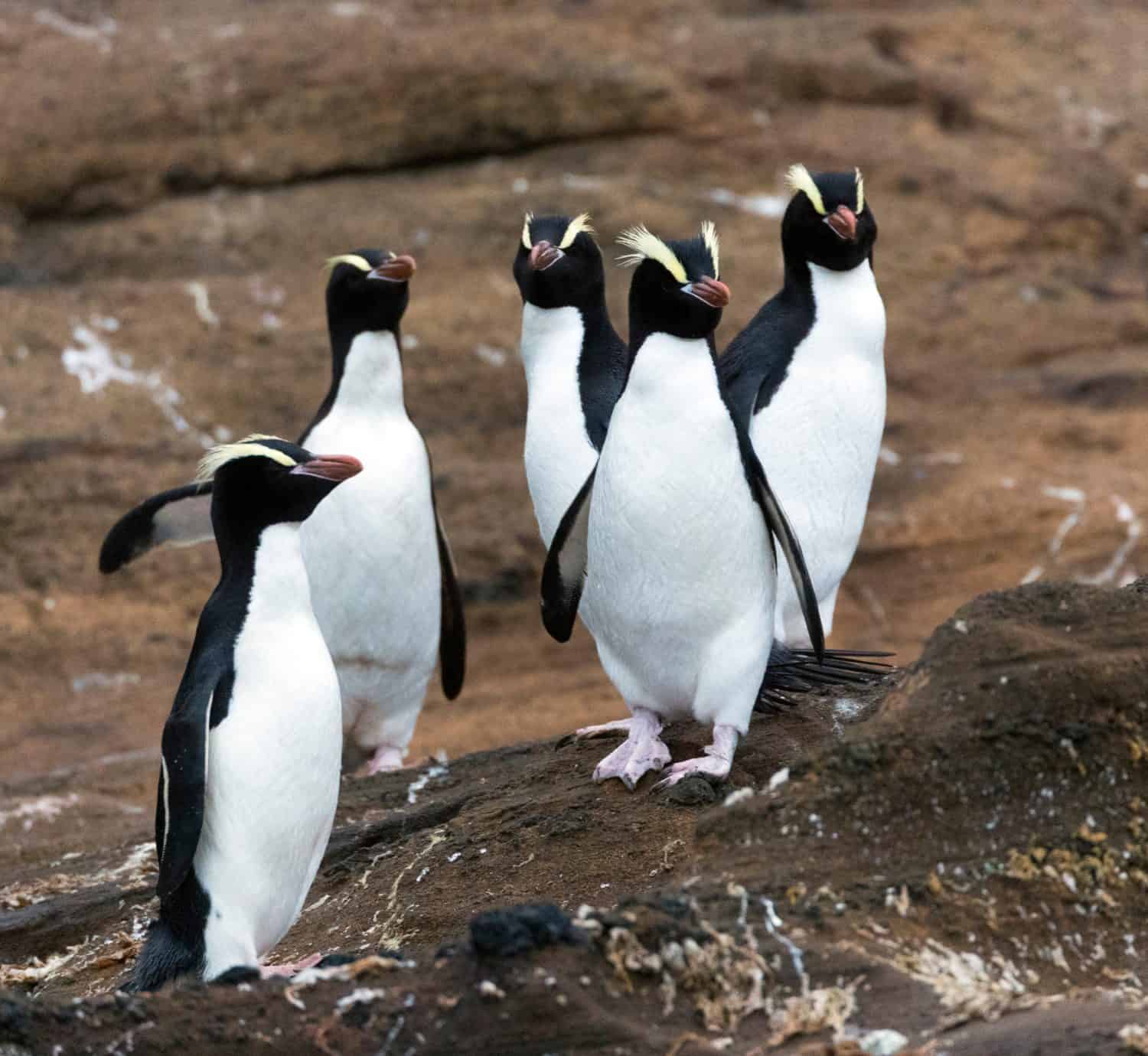
Few opportunities exist to study the erect-crested penguin’s breeding habits.
©Agami Photo Agency/Shutterstock.com
The least researched of all penguin species, erect-crested penguins are endemic to New Zealand. Little is known about their breeding systems, which is due, in part, to their remote and inhospitable (to people) breeding locations on the Bounty and Antipodes islands and to the fact that they spend their winters in the sea. Much is assumed about where they feed (far offshore) and where they migrate to between breeding seasons. Like other crested penguins, females lay two eggs in a clutch, the first of which is significantly smaller than the second, and males and females take turns incubating and raising their young.
Erect-crested penguins are often confused with New Zealand’s other two endemic species, the snares and Fiordland penguins. They are larger, however, than both species, on average, standing 20-28 inches tall and weighing 5.5-13 pounds. The species is sexually dimorphic, meaning males are larger and heavier than females. This is the only crested penguin that can raise and lower their crests. When upright, their crests resemble large yellow lashes. Their heads, necks, and backs are black, and the underside white. The only black on their underside is a black tip on the flippers.
The population of the erect-crested penguins is decreasing and has been since the 1940s, according to the IUCN Red List of Threatened Species. Estimates are that there are 150,000 individuals in the wild. The species was assessed in 2020 and listed as Endangered.
CORRECTION: This article was updated on January 23, 2026, to reflect changes to penguin taxonomy. Previously, 18 species were widely recognized. The International Ornithologists’ Union now recognizes 19 distinct penguin species.