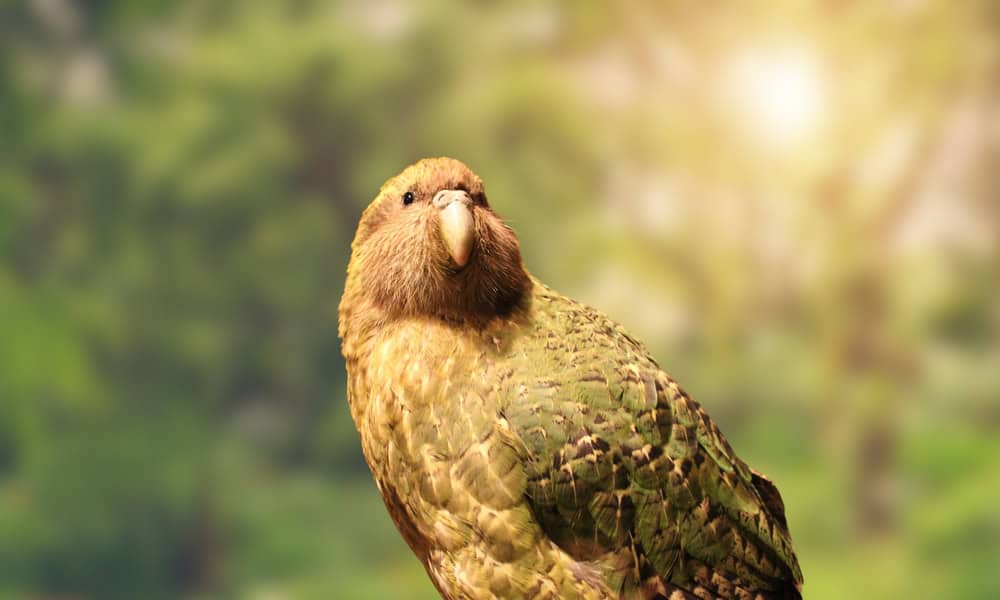

Have you ever heard of a flightless parrot? Meet the kakapo, the world’s heaviest parrot, in this incredible YouTube video. This unique parrot was once extinct in its native habitat on mainland New Zealand, but a small number have recently been reintroduced to a mainland sanctuary. The remaining populations are managed by the Kakapo Recovery Programme and are still critically endangered, with most living on predator-free offshore islands and a small number recently reintroduced to a mainland sanctuary. Find out why kakapos can’t fly, and learn more about their unusual behaviors, their rescue from total extinction, and their hopeful future.
Why Can’t the Kakapo Fly?
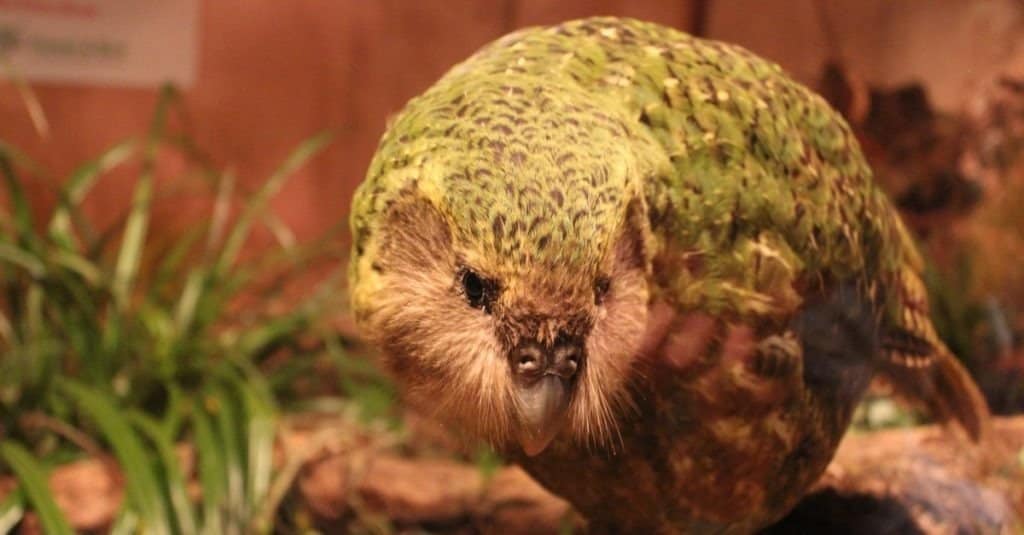
Although they cannot fly, kakapos have strong, sturdy legs that allow them to climb trees and walk long distances.
©Imogen Warren/Shutterstock.com
The kakapo (Strigops habroptila) is the heaviest parrot species, growing as long as 25 inches in length and weighing up to 8.8 pounds. The females are much smaller in stature, but they can still reach weights upwards of 4.4 pounds. To put the kakapo’s weight into perspective, the largest flying parrot, the hyacinth macaw (Anodorhynchus hyacinthinus), only weighs up to 3.7 pounds.
Although the kakapo has wings, its wings are too small and weak to lift its large body off the ground. It has reduced wing muscles, and its sternum, or breastbone, also lacks a keel, which is a ridge of bone that the flight muscles attach to. Researchers believe kakapos exhibit tendencies of island gigantism, where few predators and plentiful food predispose animals to grow larger than those on the mainland. The kakapo sacrificed flight for increased thermodynamic efficiency, which is the ability to convert food into usable energy effectively.
To compensate for the loss of flight, kakapos have powerful legs that allow them to walk over 3 miles and climb trees. Their wings also help them maintain balance while walking and running. When jumping from the canopy to the ground, their wings act as parachutes to slow their descent.
Kakapo Characteristics
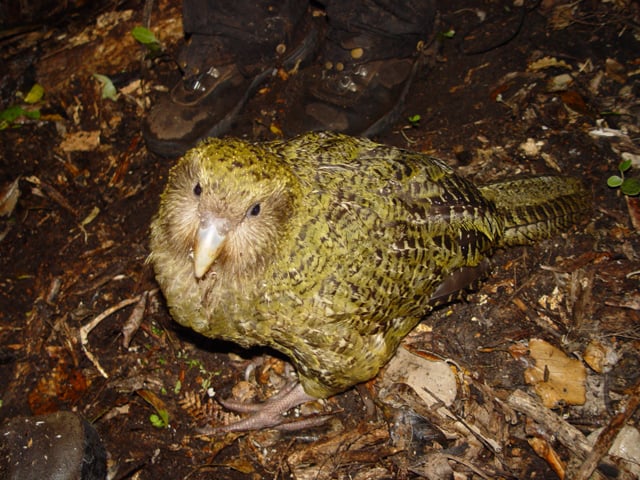
Kakapos are sometimes called owl parrots because of the owl-like circle of feathers on their faces.
The kakapo has mossy or olive-green colored feathers with black and brown markings on its upper parts. Its throat, breast, and the area under its tail have feathers of a mottled, yellow-green hue. Kakapos are sometimes called the owl-parrot, and their scientific name means “owl-like,” referring to the circle of light brown feathers on their faces. They have dark brown eyes surrounded by gray rings of bare skin. Their beaks, legs, and feet are a pale blue-grey. They have large nostrils, with the females’ nostrils being smaller. Female kakapos have similar but subtler coloring, with less yellow and less mottling, and their legs and feet are a pinkish gray.
Male kakapos have short, sturdy legs with large feet, while females have more slender legs and feet. Like most parrots, kakapos’ feet are zygodactyl, which means two of their toes face forward while the other two face backward. This is believed to be an adaptation for climbing, perching, moving from branch to branch, and handling food. Male kakapos have short, rounded wings and relatively short, straight tails. Females have noticeably longer wings and tails, as well as flatter, narrower heads with thinner, longer beaks.
Kakapo Behavior
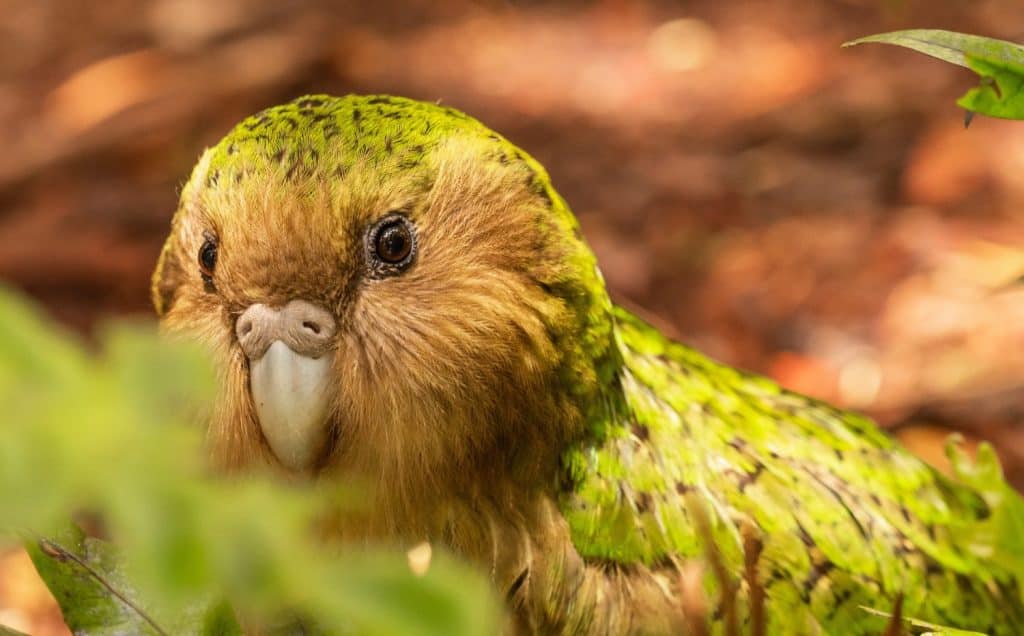
Kakapos are the only nocturnal parrot species.
©FeatherStalker Don/Shutterstock.com
Unlike other parrots, kakapos are nocturnal. Their name means “night parrot” in Māori. Scientists believe this is an adaptation to avoid diurnal birds of prey that depend on sight. During the day, they sleep under rocky ledges or in caves or burrows, emerging at night to forage on the ground and occasionally in the canopy for food.
Kakapos are strict herbivores, and their diet varies by season. They primarily eat leaves, fruit, nectar, seeds, roots, shrubs, twigs, and fungi. Unlike other birds, they have an underdeveloped gizzard and instead grind their food with specialized tongues and palates. When their preferred foods are plentiful, kakapo feed on them almost exclusively. Kakapos only breed every 2-4 years, specifically when rimu fruit crops are abundant.
Lekking and Booming
Kakapos are also the only lek-breeding parrot species. They are solitary birds except during the mating season. At that time, males travel to an arena, or lek, where they perform their courtship displays. The males dig bowl-shaped depressions in the ground, which are linked by tracks that can be up to 650 feet long. The males fight for the best bowls, and once the bowls have been claimed, the males begin to make loud “booming” sounds. Kakapos are the only parrots with an inflatable thoracic air sac that allows them to make these noises. In optimal conditions, these sounds can be heard over 3 miles away. Males may boom continuously for eight hours a night, every night, for up to five months. If a male attracts a female to his bowl, he performs a courtship dance, and then they mate.
After mating, that is the end of the male’s involvement with his offspring. The mother builds a nest in a sheltered area such as a cave or hollow log. Females typically lay 1-4 eggs during the breeding season. Incubation takes around 30 days. Like most birds, the hatchlings are altricial, so they require significant parental care. The chicks generally fledge after about 10 weeks, but the mother may continue to feed them for up to four more months.
A Conservation Success Story
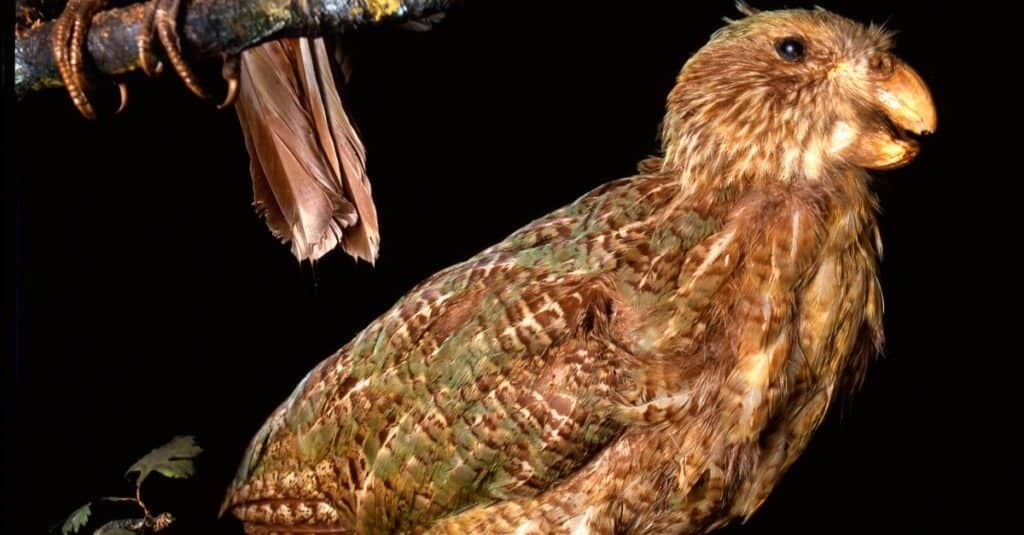
Kakapos now live on five predator-free islands that are protected against invasive species.
©COULANGES/Shutterstock.com
The kakapo once flourished across mainland New Zealand. Although the birds were important to the Māori and featured in their folklore, kakapos were hunted for their meat and feathers. Their eggs and chicks also fell prey to the rats that came over on the settlers’ boats. The kakapo’s habitat range was reduced when the settlers cleared the land for housing and agriculture.
When Europeans arrived in the 19th century, the birds were already extinct in some parts of New Zealand. Introduced species, including dogs, cats, stoats, and ferrets, further decimated the population. The kakapo’s tricks of freezing in place or camouflaging itself were successful when their only predators were birds of prey that hunted primarily by sight. However, these strategies were unsuccessful against predatory mammals that hunted by smell. When Europeans came across the kakapo, they hunted the birds for their meat and captured or killed them for wealthy collectors, museums, and zoos. They also cleared more of the birds’ habitat for housing, agriculture, and grazing.
By the mid-1990s, only 51 kakapos were left in the world. The New Zealand Department of Conservation launched the Kakapo Recovery Programme to bring these birds back from the edge of extinction. The remaining birds were captured and relocated to five predator-free islands protected against invasive species. According to the Department of Conservation, there are now 241 kakapos living in the wild. In an effort to save more of their native species that cannot survive on the mainland, the government of New Zealand is currently working toward the eradication of all mammalian predators from uninhabited offshore islands by 2050.