
Quick Take
- A cassowary following you down a beach might look curious, but looks can be deceiving. There is a specific behavior that turns these birds dangerous in a hurry. See the encounter →
- Its dagger-like claw isn't even the strangest thing about this bird. That bizarre helmet on its head has scientists still debating what it actually does. Explore the casque mystery →
- Cassowaries are called 'the world's most dangerous bird,' but the real story behind that label is more complicated than it sounds. Unpack the danger label →
- Wildlife officials have a specific warning about what makes cassowaries bolder around humans, and most beachgoers would never guess the cause. See the wildlife warning →
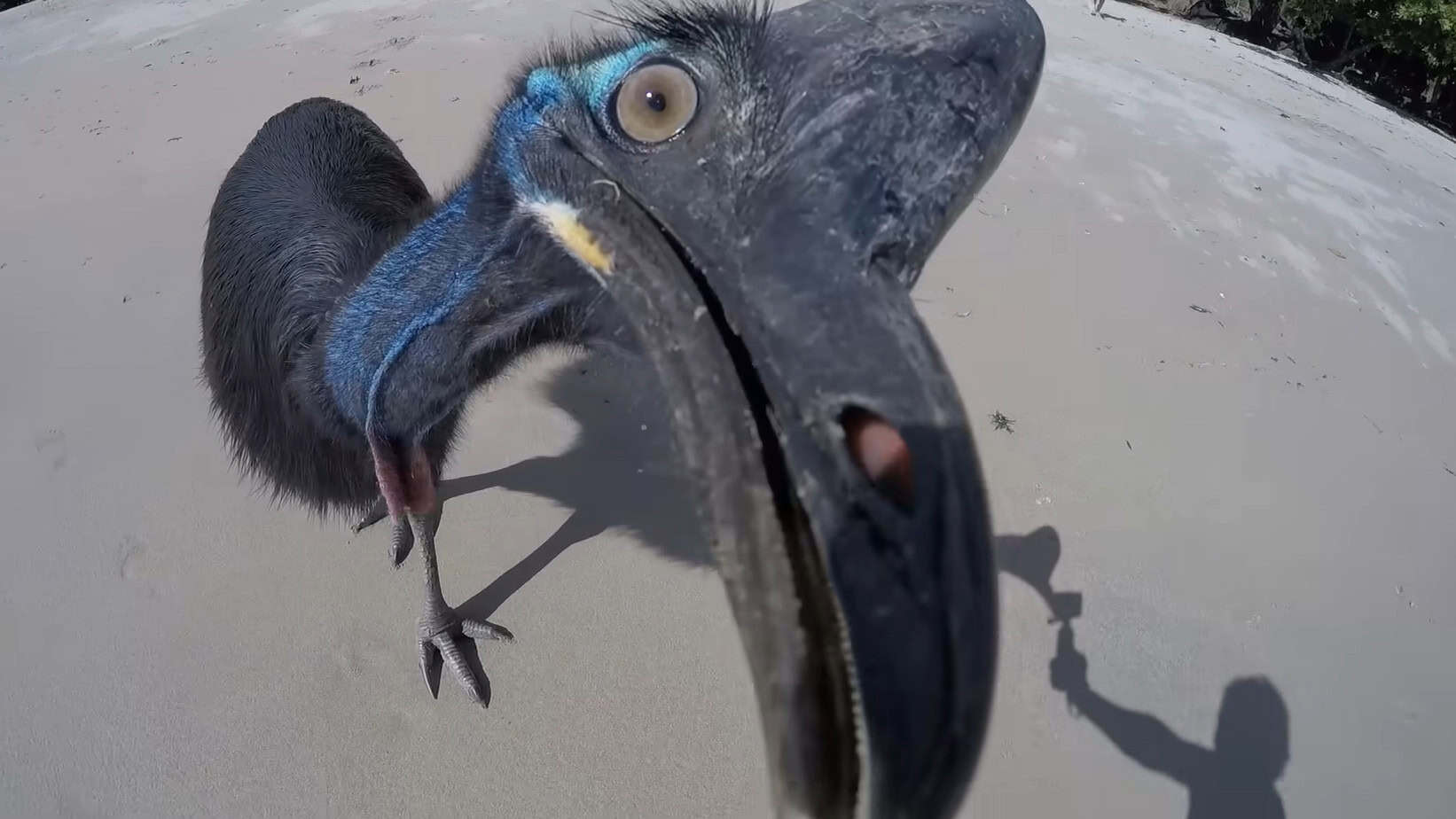
There are some wild animals you would love to stumble across on vacation. A massive cassowary following you down the beach might not make that list. In the video below, two beachgoers suddenly find themselves sharing the shoreline with one of the world’s largest and most intimidating flightless birds.
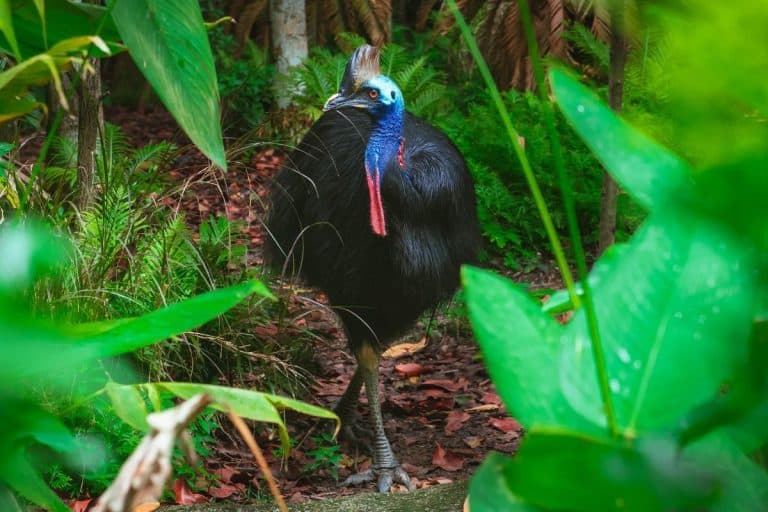
The encounter appears more curious than aggressive, but that probably would not make it feel any less unsettling in person. Cassowaries can stand nearly as tall as a human, have powerful legs, and carry a dagger-like claw on each foot. Having one casually decide to follow you is the sort of wildlife encounter best appreciated from a very respectful distance.
Watch the Cassowary Follow Them Down the Beach
At first, the cassowary is partly hidden among the vegetation bordering the beach. Then it notices the people nearby and begins walking toward them. The person filming understandably starts putting some distance between herself and a bird that looks like it wandered straight out of the dinosaur exhibit.
Another beachgoer briefly gets the bird’s attention, but the cassowary soon turns back toward the camera and continues following. It’s tempting to call this a charge, but the footage looks more like a persistent approach than an all-out attack. Eventually, the people move away and the bird remains behind.
Exactly what caught the cassowary’s attention is impossible to know from the video alone. Wildlife officials warn that cassowaries that become accustomed to people, particularly through feeding, can become bolder around humans. The safest response is not to investigate the investigation. Give the bird plenty of room and slowly back away.
Are Cassowaries Dangerous?
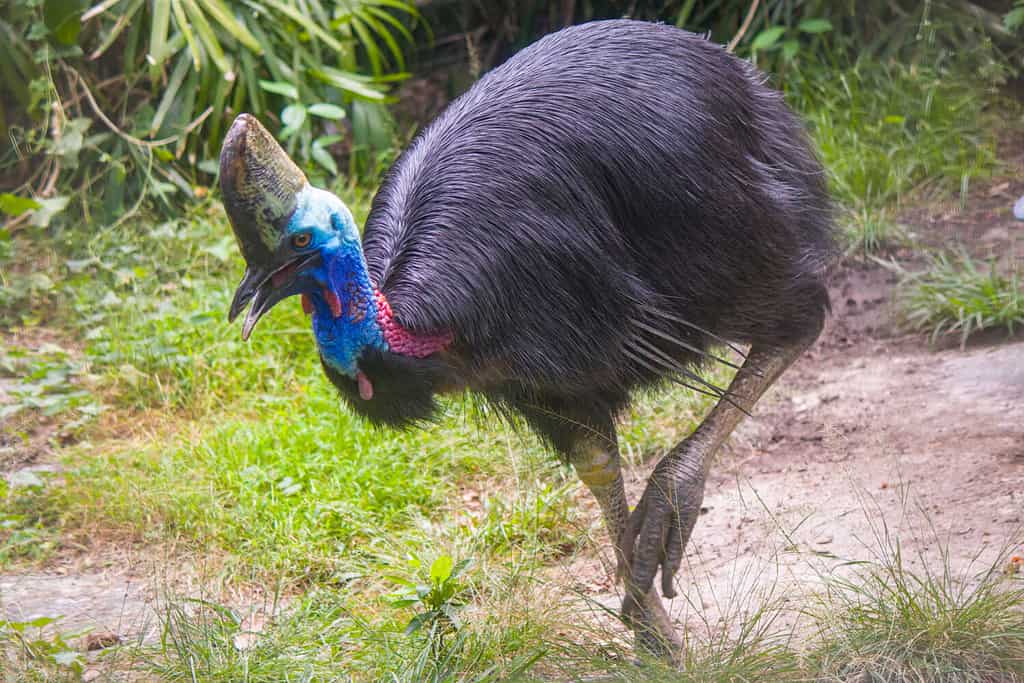
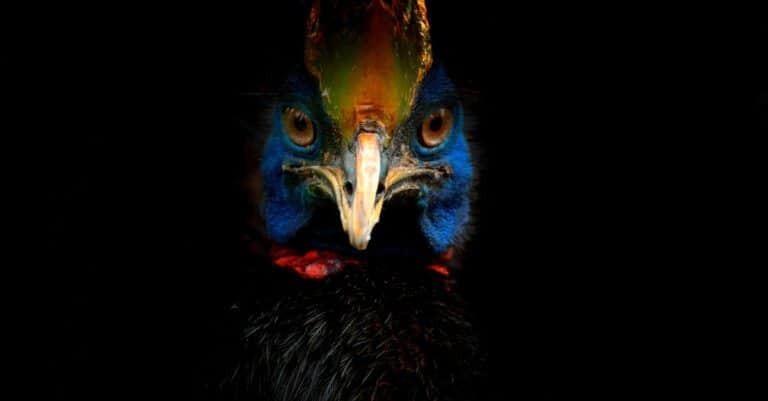
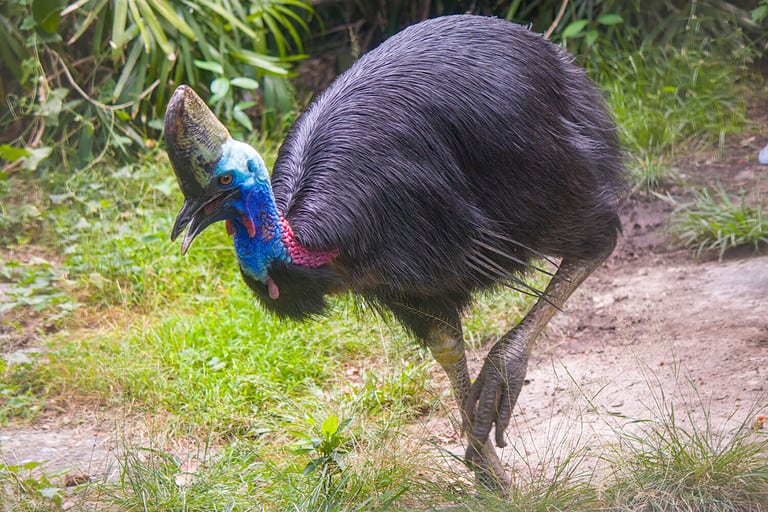
Southern cassowaries have vivid blue necks, red wattles, powerful legs, and a tall casque on top of the head.
©Danny Ye/Shutterstock.com
Cassowaries are not constantly looking for a fight, but they are large, powerful wild animals that can be dangerous when threatened, cornered, defending chicks, or accustomed to receiving food from people. Queensland wildlife officials describe their behavior as unpredictable and recommend never approaching or feeding one.
Fruit makes up most of a southern cassowary’s diet, although the birds also eat fungi, insects, snails, and occasional small vertebrates or carrion. Being mostly a fruit eater does not make one harmless. Cassowaries have heavily muscled legs and a long, dagger-shaped inner claw that can reach about 120 millimeters, or 4.7 inches. A defensive kick can cause serious injuries.
Fatal encounters are extremely rare, but they have happened. One documented death occurred in Australia in 1926 after a teenager and his brother attempted to attack a cassowary. A second widely reported fatality occurred in Florida in 2019 when a captive cassowary attacked its owner after he fell. Those incidents help explain the bird’s fearsome reputation, although simply calling it “the world’s most dangerous bird” makes the risk sound far more routine than it actually is.
What Is on the Cassowary’s Head?
That helmet-like structure on top of a cassowary’s head is called a casque. Researchers have debated its purpose for generations, and it may perform more than one job. The casque has a keratin covering over a complex bony structure rather than being a simple solid horn.
One of the strongest supported explanations is temperature control. Researchers using thermal imaging found that cassowaries can release more heat through the casque in hot conditions while reducing heat loss when temperatures are cooler. In other words, the strange-looking helmet appears to work at least partly like a built-in thermal radiator.
Scientists have also investigated whether the casque plays a role in visual communication or social display, and recent research has found differences in casque shape among cassowary species. Other older ideas, including that the casque primarily protects the bird’s head while crashing through vegetation or acts as a resonating chamber for its calls, have much less support. Like the bird carrying it, the casque is still keeping a few secrets.