A
Species Profile

African Bush Elephant

Loxodonta africana

Big ears, big impact.
Gorgo, Public domain, via Wikimedia Commons

African Bush Elephant Distribution

Click a location to explore more animals from that region

Loading map...

Size Comparison

Human 5'8"
African Bush Elephant 10 ft 6 in

African Bush Elephant is 1.9x the height of an average human.

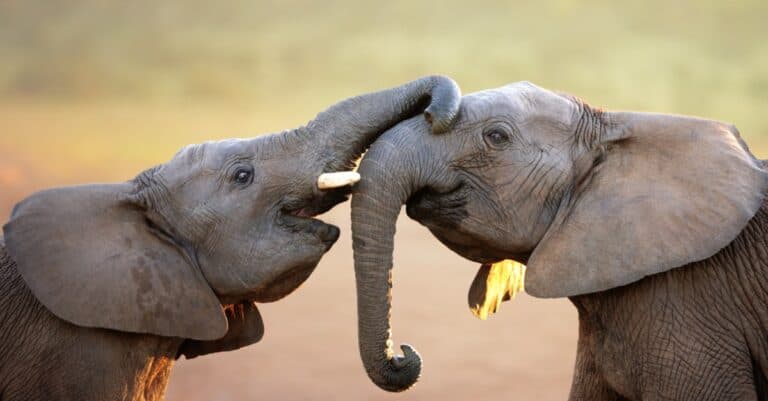
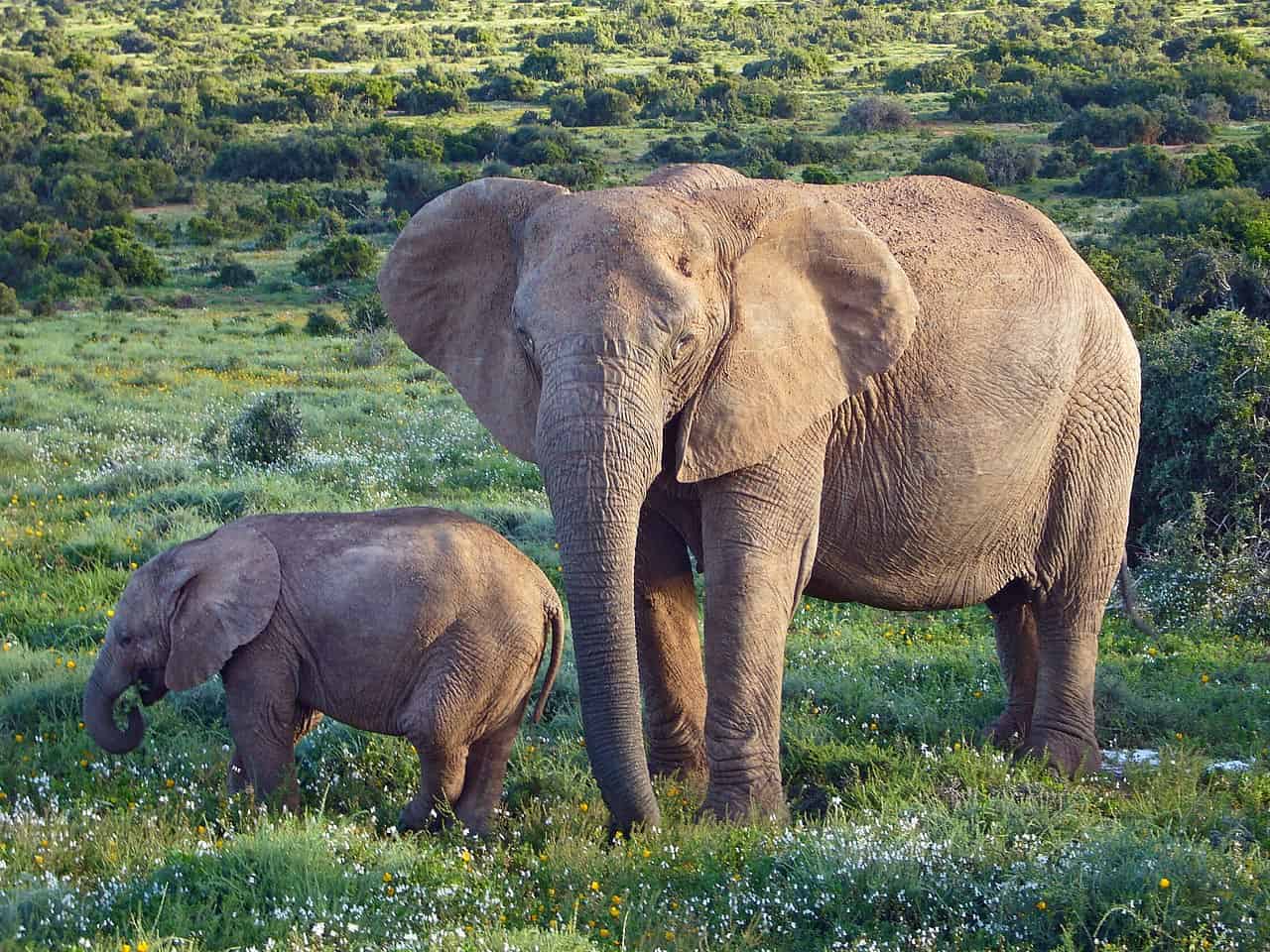
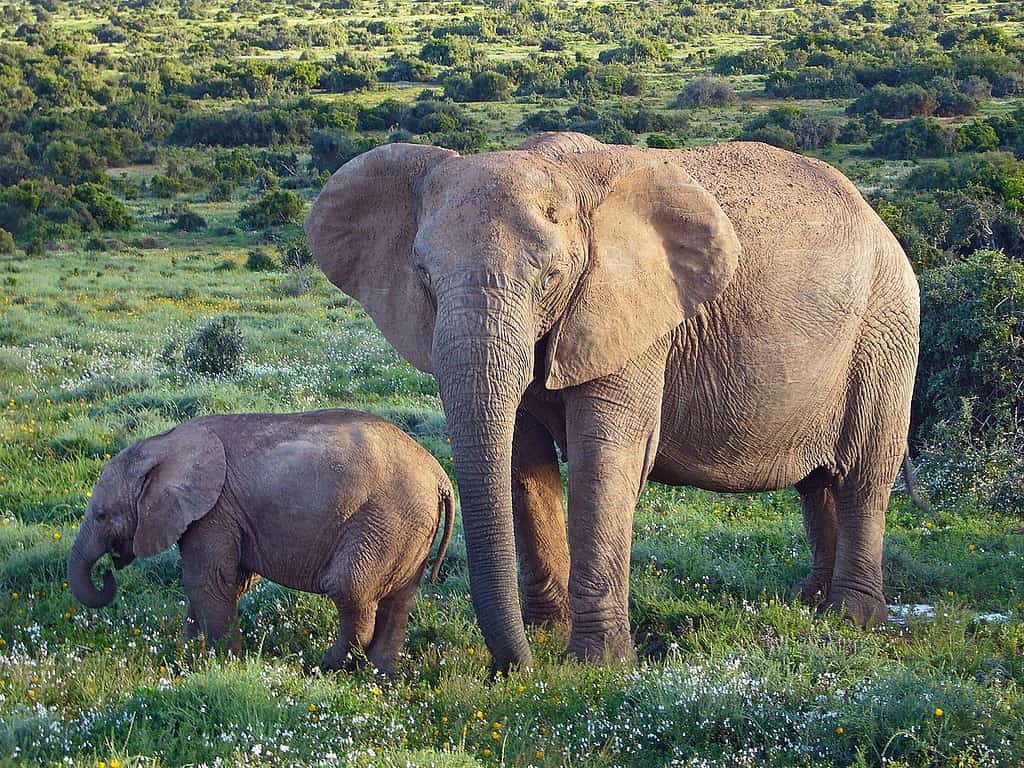
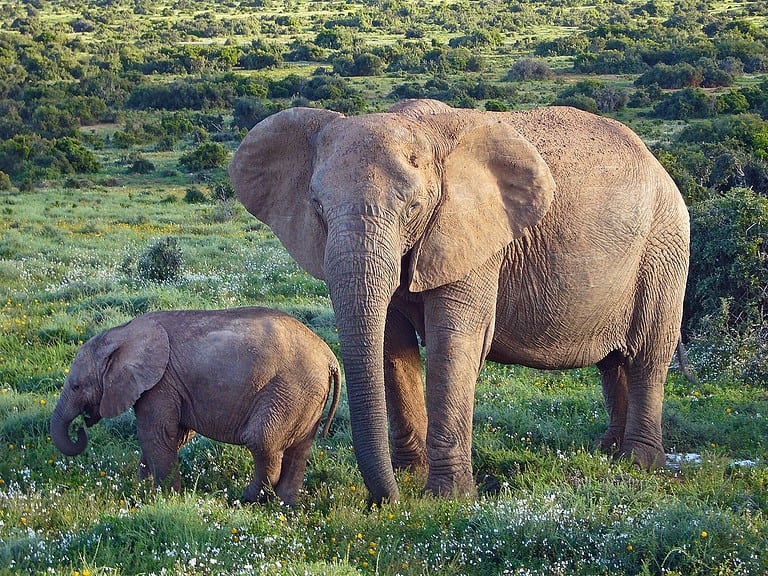
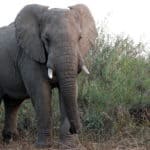
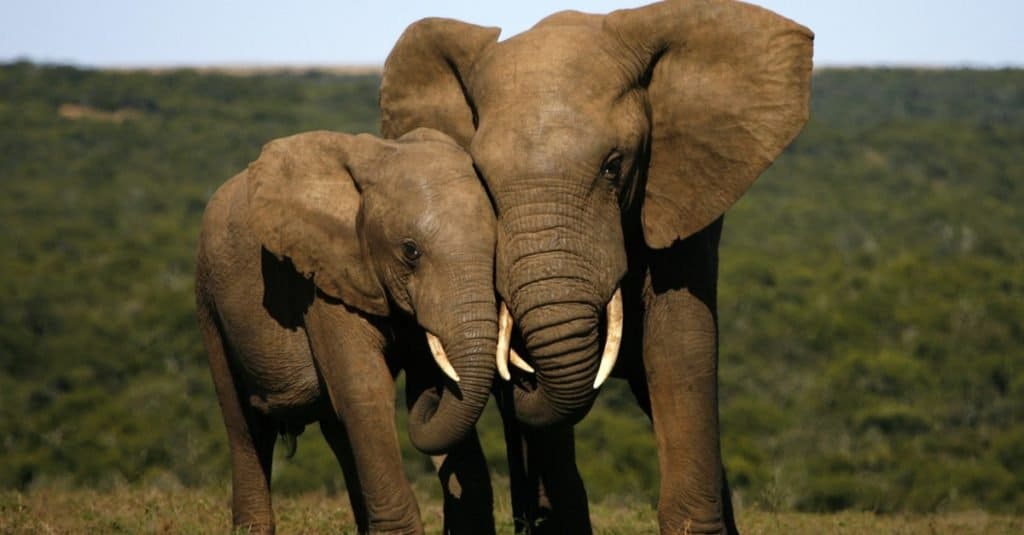
African Elephant in Addo National Park, South Africa

At a Glance

Wild Species
Also Known As African elephant, savanna elephant, African savannah elephant, elefante africano, éléphant d'Afrique, tembo, ndovu
Diet Herbivore
Activity Cathemeral+
Lifespan 60 years
Weight 10400 lbs
Status Endangered
Did You Know?

Adult males typically stand ~3.2-4.0 m at the shoulder and weigh ~4,700-6,048 kg; adult females ~2.4-3.0 m and ~2,160-3,232 kg (standard mammalogy references such as Nowak; Shoshani).

Scientific Classification

The African bush elephant (Loxodonta africana) is a highly social, wide-ranging elephant of sub-Saharan Africa, known for its very large ears, massive body size, and prominent tusks. It lives in matriarch-led family groups and plays a major ecological role as an ecosystem engineer (e.g., altering vegetation structure and dispersing seeds).

Kingdom
Animalia
Phylum
Chordata
Class
Mammalia
Order
Proboscidea
Family
Elephantidae
Genus
Loxodonta
Species
Loxodonta africana

Distinguishing Features

  • Largest living terrestrial animal; very robust build
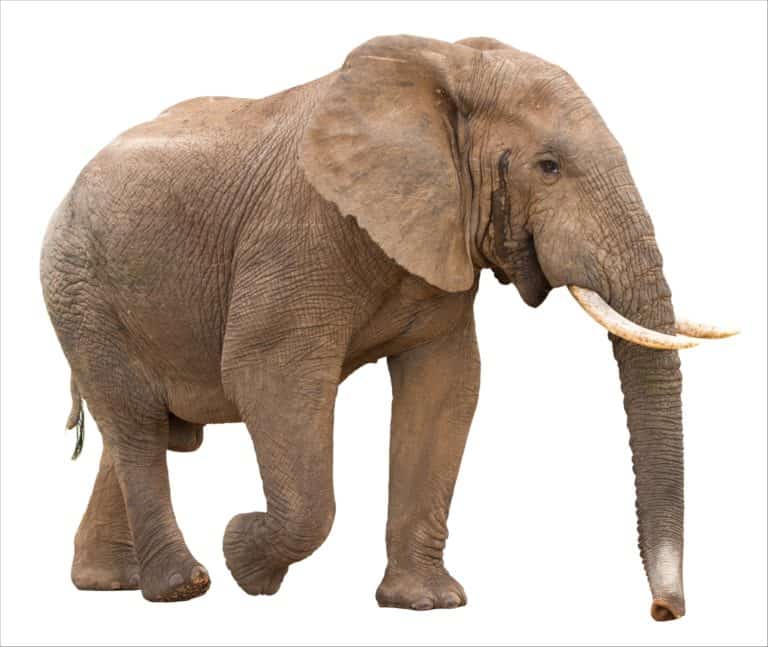
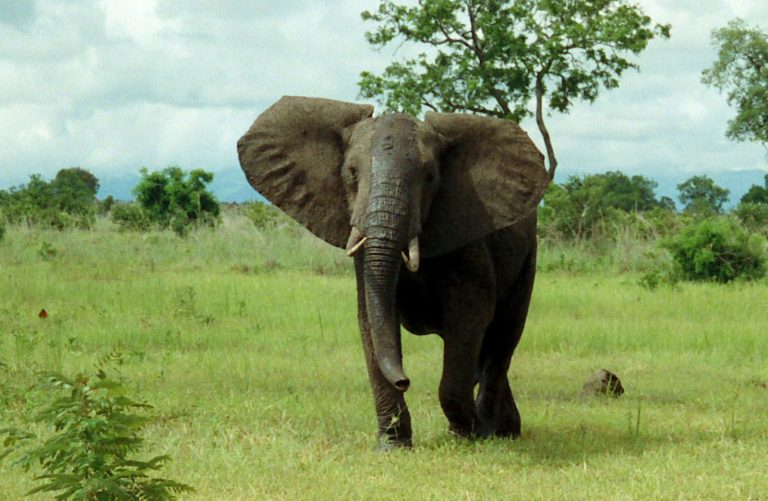
  • Large, fan-shaped ears (larger than in Asian elephants), aiding heat dissipation
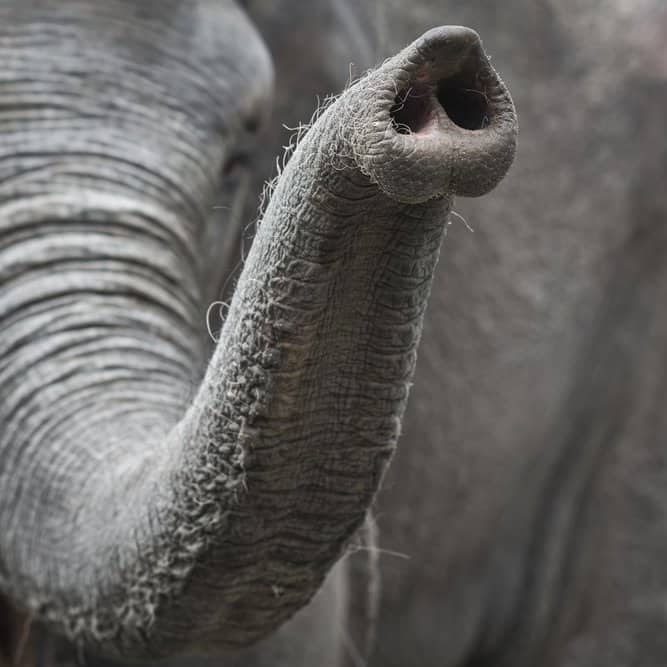
  • Two ‘finger-like’ projections at the tip of the trunk
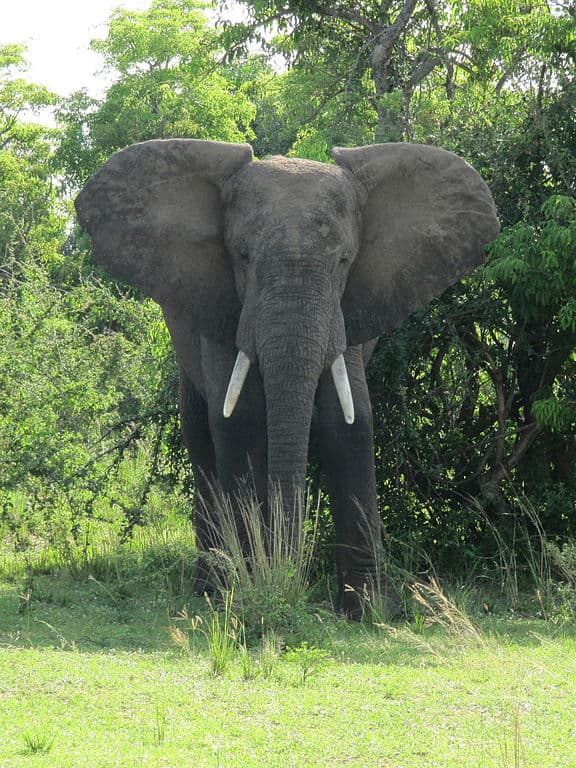
  • Both sexes typically have tusks (size varies widely)
  • Back often somewhat concave/saddle-shaped compared with Asian elephants
  • Adapted to more open habitats than the African forest elephant

Physical Measurements

Males and females differ in size

Height
10 ft 10 in (9 ft 10 in – 13 ft 1 in)
8 ft 6 in (7 ft 10 in – 9 ft 2 in)
Length
22 ft 4 in (19 ft 8 in – 24 ft 7 in)
Weight
6.6 tons (4.4 tons – 7.7 tons)
3.3 tons (3.0 tons – 4.0 tons)
Tail Length
3 ft 7 in (3 ft 3 in – 4 ft 3 in)
3 ft 9 in (3 ft 3 in – 4 ft 3 in)
Top Speed
25 mph
African bush elephant: 40 km/h

Appearance

Primary Colors
Secondary Colors
Skin Type African bush elephant (Loxodonta africana) has very thick, tough, deeply wrinkled skin with sparse bristly hair. After wallowing or dusting it shows a mud-cracked look. Skin is often about 2–3 cm thick.
Distinctive Features
  • African bush elephant (Loxodonta africana) is very large and lives in open areas. Adult males reach about 3.2–4.0 m at the shoulder; adult females about 2.4–3.0 m.
  • Large, triangular ears characteristic of Loxodonta africana (larger and more open-habitat-adapted than the African forest elephant, L. cyclotis); ears are highly vascular for heat dissipation and are visually prominent in savanna populations.
  • Long muscular trunk (elongated nose/upper lip) with two 'finger' projections at the tip (diagnostic for African elephants), enabling fine manipulation and browsing.
  • Tusks (enlarged upper teeth) occur in both sexes but vary widely across individuals and populations; males usually have larger, heavier tusks, while genetics and poaching can produce tuskless or reduced-tusk elephants.
  • Columnar limbs with large, round feet and thick keratinized foot pads suited to long-distance walking; forefoot typically has 4 toenails and hindfoot 3 (commonly cited for Loxodonta africana in comparative anatomy references).
  • Tail ending in a coarse hair tuft; sparse bristles also occur on head and body, more noticeable in calves.
  • Temporal glands between eye and ear can secrete during heightened arousal; in adult males this is especially associated with musth (a key sex-linked condition/behavior with visible secretions and staining).
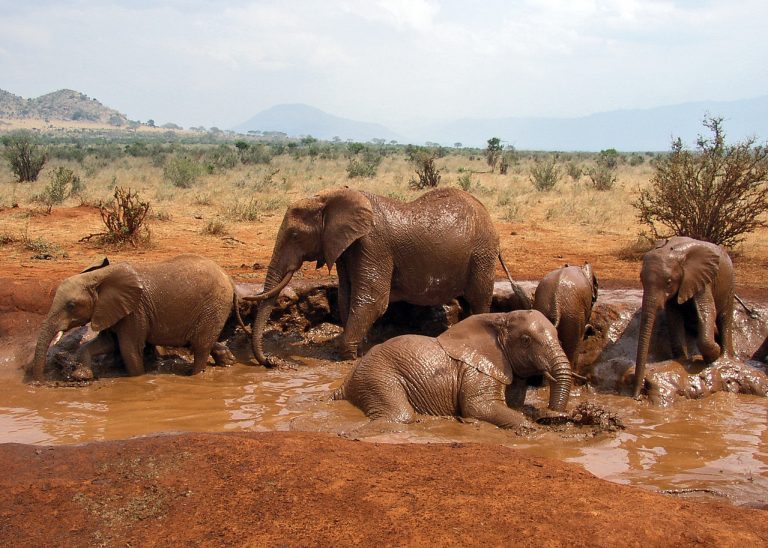
  • External appearance is frequently modified by ecosystem-engineer behaviors: mud wallowing/dusting (thermoregulation/UV and insect protection), bark rubbing, and vegetation pushing-often leaving skin dusty, mud-caked, or scuffed, especially on shoulders/flanks.
  • Older African bush elephants (Loxodonta africana) show more ear-edge tears or notches, worn or broken tusks, and deeper skin folds. Wild lifespan is commonly about 60–70 years.

Sexual Dimorphism

Strong sexual dimorphism typical of Loxodonta africana: adult males are substantially taller and heavier than adult females and generally carry larger tusks; mature males also show musth-associated temporal gland secretion and urine dribbling that can stain the inner hind legs (IUCN/field biology syntheses; Nowak 1999).

  • Larger overall size: adult males commonly ~3.2-4.0 m at the shoulder (Nowak 1999; Kingdon, Mammals of Africa).
  • Heavier, more muscular head/neck profile; thicker appearance through shoulders and forequarters.
  • Tusks generally longer/thicker on average (but highly variable; some males have broken/shortened tusks or may be reduced/tuskless in rare cases).
  • More frequent/obvious temporal gland secretion and staining during musth; can produce a darker, wet-streaked look on the cheeks and along the face.
  • Smaller overall size: adult females commonly ~2.4-3.0 m at the shoulder (Nowak 1999; Kingdon, Mammals of Africa).
  • Tusks typically present but smaller on average; tusklessness can be more common in some populations and is an important source of individual variation (not uniform across the species).
  • More gracile head/shoulder profile compared with adult males; in social groups, adult females are usually seen in matriarch-led family units with calves, affecting typical observed 'group appearance' in the field.

Did You Know?

Adult males typically stand ~3.2-4.0 m at the shoulder and weigh ~4,700-6,048 kg; adult females ~2.4-3.0 m and ~2,160-3,232 kg (standard mammalogy references such as Nowak; Shoshani).

Pregnancy lasts ~22 months (~660 days), one of the longest gestations of any mammal; calves are ~90-120 kg at birth (field syntheses incl. Moss/Estes).

A trunk contains ~40,000 individual muscles, enabling delicate grasping and powerful lifting (classic anatomical estimates cited by Shoshani).

Elephants replace their cheek teeth in a conveyor-belt sequence-up to 6 sets over a lifetime-matching a life built on grinding tough vegetation (elephant dental biology literature).

Family groups are led by an older matriarch whose social knowledge (routes, risks, water) improves group survival during droughts (long-term Amboseli research; Moss).

Their very low-frequency calls (infrasound) can travel kilometers and also couple into the ground as vibrations (bioacoustics work by Payne and colleagues).

Some populations undertake large seasonal movements; for example, Mali's Gourma elephants historically completed an annual circuit on the order of ~600 km to track water and forage (Sahel movement studies by conservation researchers).

Unique Adaptations

  • Very large, highly vascular ears function as "radiators," dumping heat in open, hot habitats; ear-flapping increases convective cooling-an adaptation especially prominent in savanna elephants.
  • Trunk versatility: a muscular hydrostat with tens of thousands of muscle fascicles enables suction drinking, precise plucking, and powerful pushing-key to a generalist feeding strategy.
  • Tusks are continuously growing upper incisors used for digging, stripping bark, moving logs/rocks, and social display; selective poaching has driven increased tusklessness in some populations (documented evolutionary response).
  • Specialized feet: a thick, elastic fat pad under each foot spreads weight and dampens sound/vibration; helps support multi-ton bodies while walking long distances.
  • Tooth progression: sequential molar replacement (rather than many teeth at once) supports decades of abrasive grazing/browsing; worn final molars can limit feeding late in life.
  • Low-frequency communication: production and detection of infrasound and vibration supports coordination across open landscapes where groups may be widely spaced.
  • Digestive "seed dispersal engine": hindgut fermentation and large daily intake/defecation move viable seeds long distances, often enhancing germination after gut passage (numerous seed-dispersal studies in African savannas).

Interesting Behaviors

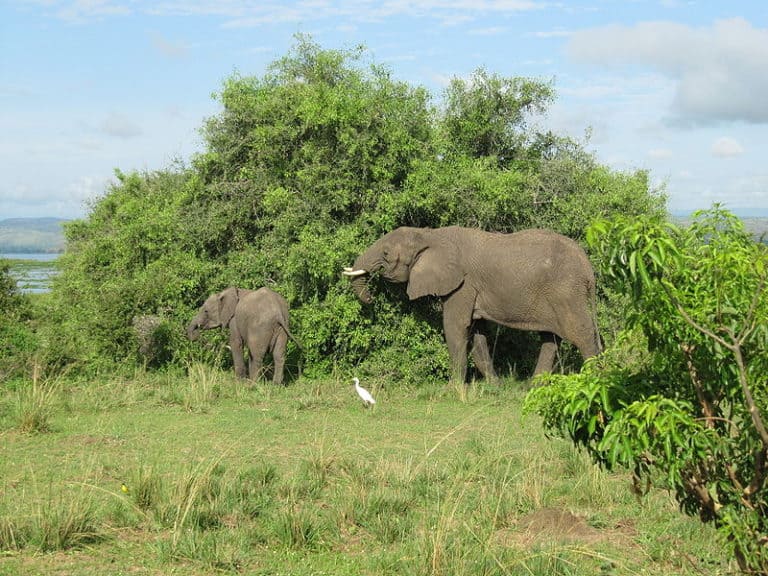
  • Matriarchal society: related females and young form stable family units; families may fuse into larger bond groups or clans during favorable conditions (fission-fusion dynamics).
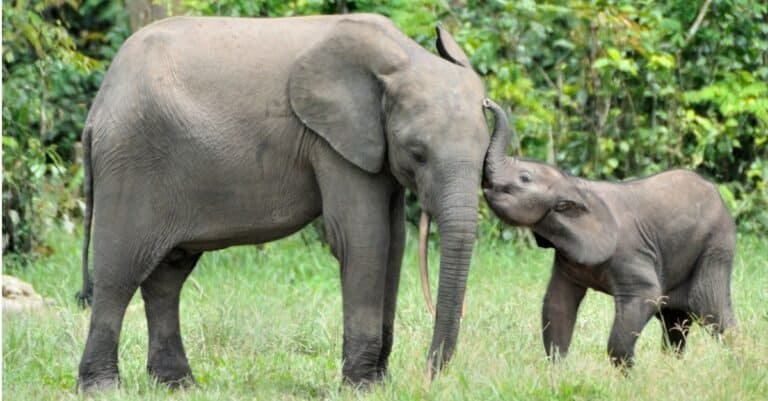
  • Allomothering: juveniles and adult females often guard, escort, and "babysit" calves, increasing calf safety and social learning opportunities.
  • Male life-history split: as bulls mature they spend increasing time alone or in loose bachelor groups; adult males periodically enter musth (weeks to months) with heightened roaming and mating effort.
  • Cooperative defense: adults form a protective ring around calves when threatened; matriarchs often take the front position while others flank and rear-guard.
  • Ecosystem engineering: pushing over or stripping trees, opening woodland into savanna patches; this reshapes habitat structure for grazers, birds, and smaller browsers.
  • Water and mineral seeking: digging in dry riverbeds for subsurface water, enlarging wallows, and visiting mineral licks; these sites then serve many other species.
  • Tool use and object manipulation: using branches as fly-switches or back-scratchers; dust-bathing and mud-wallowing for skin care and parasite control.
  • Long-distance navigation: repeated use of traditional routes between wet- and dry-season ranges, guided by memory of water points and forage phenology.

Cultural Significance

The African bush elephant (Loxodonta africana) is a symbol of power, memory, and leadership in royal symbols, totems, proverbs, songs, masks, and national park identity. It supports ecotourism, causes crop-raiding conflicts, and shapes ivory and anti-poaching debates.

Myths & Legends

West African trickster traditions (e.g., Akan/Anansi cycles) often portray the Elephant as the strongest "chief" of animals who can still be outwitted by a smaller, clever rival-using Elephant to teach that wisdom can beat force.

Southern African Khoisan and Bantu storytellers often show the African bush elephant (Loxodonta africana) as an ancient, powerful bush being whose size and memory explain old routes, clearings, and waterholes.

In many East and Southern African folktales, Hare (or Tortoise) challenges Elephant in contests of wit-races, tug-of-war, or judgment disputes-ending with a moral about pride, patience, and leadership.

A widespread African narrative motif treats Elephant as a dignified but sometimes blunt judge among animals, called upon to settle disputes because of age and authority-reflecting real-world associations with matriarchal elders and social knowledge.

Historical cultural association: in several African societies, ivory and elephant symbolism became tied to kingship, wealth, and sacred authority; court histories and praise-names recount rulers compared to elephants for strength and protective power.

Conservation Status

EN Endangered

Facing a very high risk of extinction in the wild.

Population Decreasing

Protected Under

  • IUCN Red List: Loxodonta africana assessed as Endangered (EN; 2021 assessment).
  • CITES: African elephant is generally listed on Appendix I; certain southern African populations have been listed on Appendix II with annotations (trade controls remain strict and ivory trade is tightly regulated/prohibited under most circumstances).
  • National legislation: Protected under wildlife laws in most range states (legal status and enforcement strength vary).
  • Protected areas: Occurs in numerous national parks, reserves, and transboundary conservation areas across its range; effectiveness varies with resourcing, connectivity, and surrounding land-use pressure.
  • CMS (Convention on Migratory Species): Loxodonta africana is listed on Appendix II (promoting international cooperation for migratory/transboundary populations).

Life Cycle

Birth 1 calf
Lifespan 60 years

Lifespan

In the Wild
0–70 years
In Captivity
0–60 years

Reproduction

Mating System Polygynandry
Social Structure Transient
Breeding Pattern Transient
Fertilization Internal Fertilization
Birth Type Internal_fertilization

Behavior & Ecology

Social Herd Group: 10
Activity Cathemeral, Crepuscular
Diet Herbivore Fresh grasses (Poaceae), particularly during the wet season when they are abundant and high in moisture.

Temperament

Highly social and affiliative within family units; frequent tactile contact and coordinated movement led by the matriarch (Moss 2001).
Protective/defensive of calves; adults may show rapid escalation to threat displays when approached (ear spreading, head high, trunk curled) and can charge if harassment continues (behavior described widely in field studies; e.g., Moss 2001).
Adult males show heightened aggression and increased ranging during musth, with dominance contests and increased mating attempts (Poole 1989; Poole & Moss 1989).
Behavioral plasticity: increased nocturnality and reduced daytime movement documented in areas of high human disturbance/poaching pressure (species-level pattern across populations; e.g., studies summarized in Goldenberg et al. 2017 for elephant behavioral shifts under risk).

Communication

Low-frequency rumbles, including infrasonic components commonly reported ~14-35 Hz that can propagate over kilometers E.g., Garstang et al. 1995; Poole et al. 1988
Trumpets (higher-amplitude, higher-frequency calls) associated with excitement, alarm, and social arousal.
Roars/screams during intense aggression or distress.
Snorts and barks used as short-range alarm or agitation signals.
Seismic signaling: production and detection of ground-borne vibrations Often coupled with low-frequency rumbles); receivers detect via mechanoreception in feet/trunk and can respond at distance (O'Connell-Rodwell et al. 2007
Chemical/olfactory signaling: urine/feces and temporal gland secretions; males assess female reproductive state and male musth status via scent, with trunk-to-mouth 'flehmen-like' sampling Poole 1989
Tactile communication: trunk touches, mouth/trunk contact, leaning, and reassurance contact; calves maintained via frequent physical contact and guiding.
Visual signals: ear spreading, head shaking, trunk posture, and body orientation used in dominance/defense; coordinated group movement cues led by matriarch Moss 2001

Habitat

Biomes:
Savanna Tropical Dry Forest Desert Hot Wetland Freshwater
Terrain:
Plains Plateau Valley Riverine Hilly Mountainous Rocky Sandy Muddy Coastal +4
Elevation: Up to 9842 ft 6 in

Ecological Role

Ecosystem engineer and keystone megaherbivore that strongly structures savanna and woodland vegetation and landscape heterogeneity.

Vegetation modification (toppling trees, browsing, debarking) that can maintain/open savannas and create habitat mosaics Seed dispersal (endozoochory of many large-fruited trees; long-distance dispersal via wide-ranging movements) Nutrient redistribution and cycling through dung deposition and movement between habitats Creation/maintenance of water access points (digging/excavation) and trails used by other animals Provision of resources for other species (dung supporting invertebrates; carcasses supporting scavengers; opened canopy/clearings benefiting grazers and certain plants)

Diet Details

Other Foods:
Grasses Woody browse Bark and cambium Forbs Roots, bulbs and rhizomes Fruits and seeds Salt lick +1

Human Interaction

Domestication Status

Wild

Loxodonta africana is not domesticated. Unlike Asian elephants, African bush elephants were rarely bred; mostly captured for zoos, tourism, or management. Historic war elephants were North African, an extinct form, not modern sub‑Saharan L. africana. Their huge size, long life/gestation, and matriarch groups make domestication impractical. Human interactions: crop raids, conflict control, ecotourism, ivory poaching, community conservation, research.

Danger Level

High
  • Human-elephant conflict near farms and settlements (charging, trampling, goring with tusks), especially during crop-raiding or when surprised at close range
  • Vehicle encounters (road crossings; collisions or aggressive responses to harassment)
  • Aggression associated with musth in adult males (heightened testosterone, increased roaming and risk-taking)
  • Maternal defense in family groups when calves are present
  • Occupational risk to rangers, researchers, and tourism staff during tracking, immobilization, translocation, or close-proximity viewing

As a Pet

Not Suitable as Pet

Legality: African bush elephant (Loxodonta africana) cannot be kept as a pet in most places. CITES controls trade. Many countries ban private ownership or require zoo-level licenses for approved zoos, conservation, or research groups.

Care Level: Expert Only

Purchase Cost: Up to $250,000
Lifetime Cost: $3,000,000 - $15,000,000

Economic Value

Uses:
Ecotourism and recreation Cultural and symbolic value Ecosystem services (ecosystem engineering, seed dispersal) Costs from human-elephant conflict (crop loss, infrastructure damage) Illegal wildlife trade (ivory) and enforcement costs
Products:
  • wildlife tourism revenue (safaris, park fees, guiding, lodging supply chains)
  • conservation employment and research funding tied to elephant presence
  • ecosystem-function benefits supporting biodiversity and habitat heterogeneity
  • negative economic impacts: crop damage, water infrastructure damage, vehicle collisions, fence damage
  • ivory (illegal in most markets; major driver of poaching pressure)

Classification and Evolution

The African Bush Elephant is the largest of all living creatures on land today, with some individuals growing to weigh more than 6 tons. The elephant is thought to have been named after the Greek word for ivory, meaning that elephants were named for their uniquely long tusks.
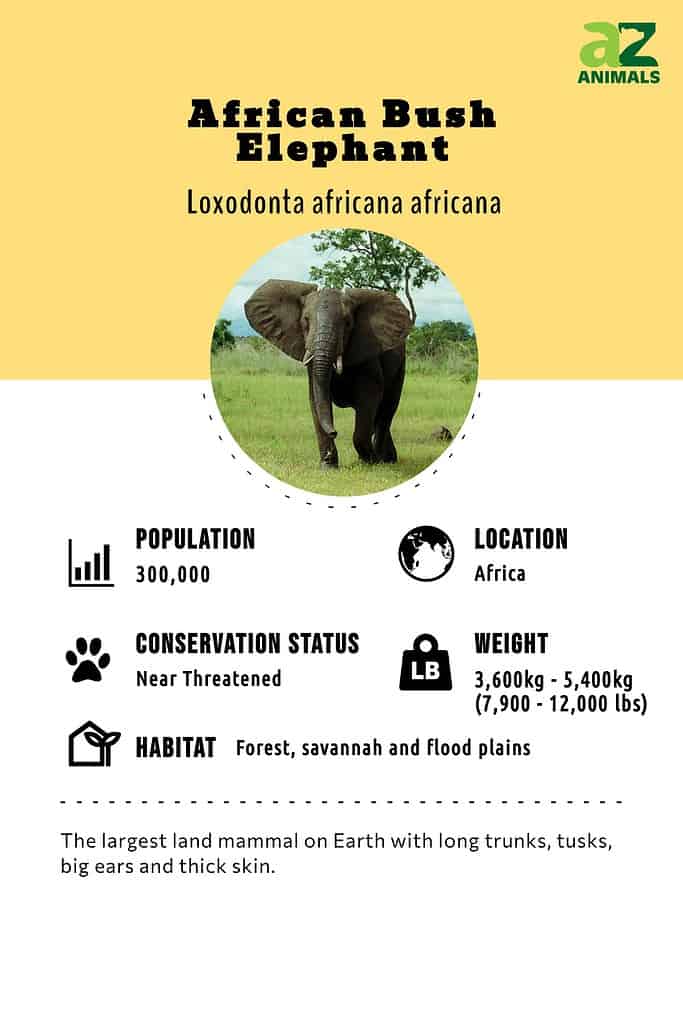
Although many of the ancestors of the African bush elephant became extinct during the last ice age (including the Woolly Mammoth), there are three distinct species of Elephant remaining today which are the Asian elephant (of which there are a number of sub-species), the African bush elephant and the African forest elephant.

Although these two elephant species are very similar, the African bush elephant is considered to be larger than the African forest elephant, which has rounder ears and straighter tusks.

Evolution
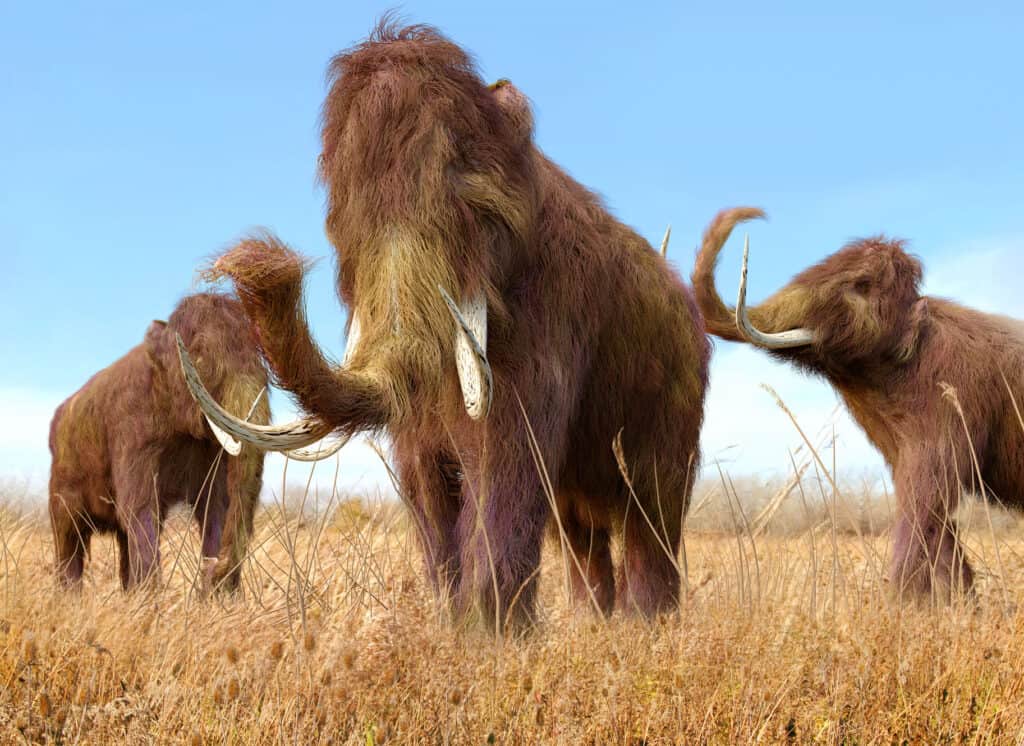
Woolly Mammoth (Mammuthus primigenius)

Woolly Mammoths are prehistoric ancestors of modern elephants.

Fossil records show that extinct proboscideans, large mammals with trunks and tusks, have been identified on every continent except Australia and Antarctica. The ancestor of these animals originated in Africa around 40 million years ago – and was trunkless. Moeritherium, about the size of modern pigs, is believed to be the animal that led to modern elephants – and is also an ancestor of manatees and dugongs.

Gomphotheres, tusked but with no trunks, were herbivores that roamed Africa, Eurasia, and the Americas during the Miocene, Pliocene, and Pleistocene epochs. These animals had given rise to the elephantids by the time of their extinction. Around the beginning of the Pleistocene, 5 million years ago, the Loxodonta arrived to be followed by the Elephas and Mammuthus. Loxodonta remained in Africa while Mammuthus ranged to Eurasia.

The ancestor of the Asian elephant, Elephas platycephus, arrived during the Pleistocene, as did the Mammuthus primigenious, the woolly mammoth. The African elephant, Loxodonta, appeared 1.5 million years ago and is the newest elephant species in evolutionary terms. It is larger than the Asian elephant in size and both males and females have tusks.

Anatomy and Appearance
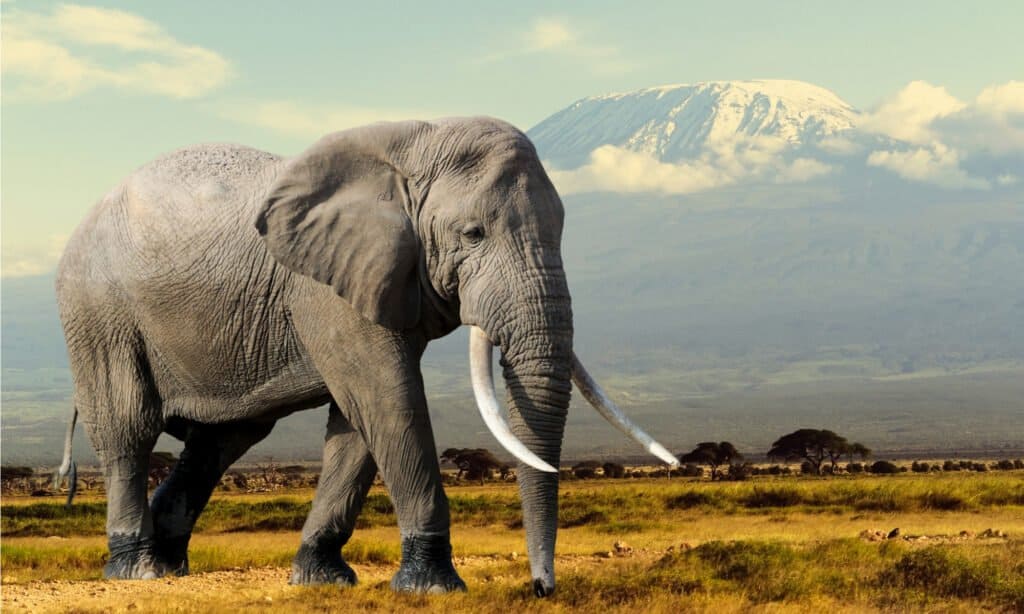
Elephant

African elephants are the largest animals that walk the earth.

The African bush elephant is the largest known land mammal on Earth, with male African bush elephants reaching up to 3.5 meters in height and the females being slightly smaller at around 3 meters tall. The body of the African bush elephants can also grow to between 6 and 7 meters long.

The tusks of an African bush elephant can be nearly 2.5 meters in length and generally weigh between 50 and 100 pounds, which is about the same as a small adult Human. African bush elephants have four molar teeth each weighing about 5.0 kg and measuring about 12 inches long. As the front pair of molars wear down and drop out in pieces, the back pair shifts forward, and two new molars emerge in the back of the African bush elephant’s mouth.

African bush elephants replace their teeth six times during their lives but when the animal is between 40 to 60 years old, it no longer has teeth and will likely die of starvation, which is sadly a common cause of death of elephants in the African wilderness.

Distribution and Habitat
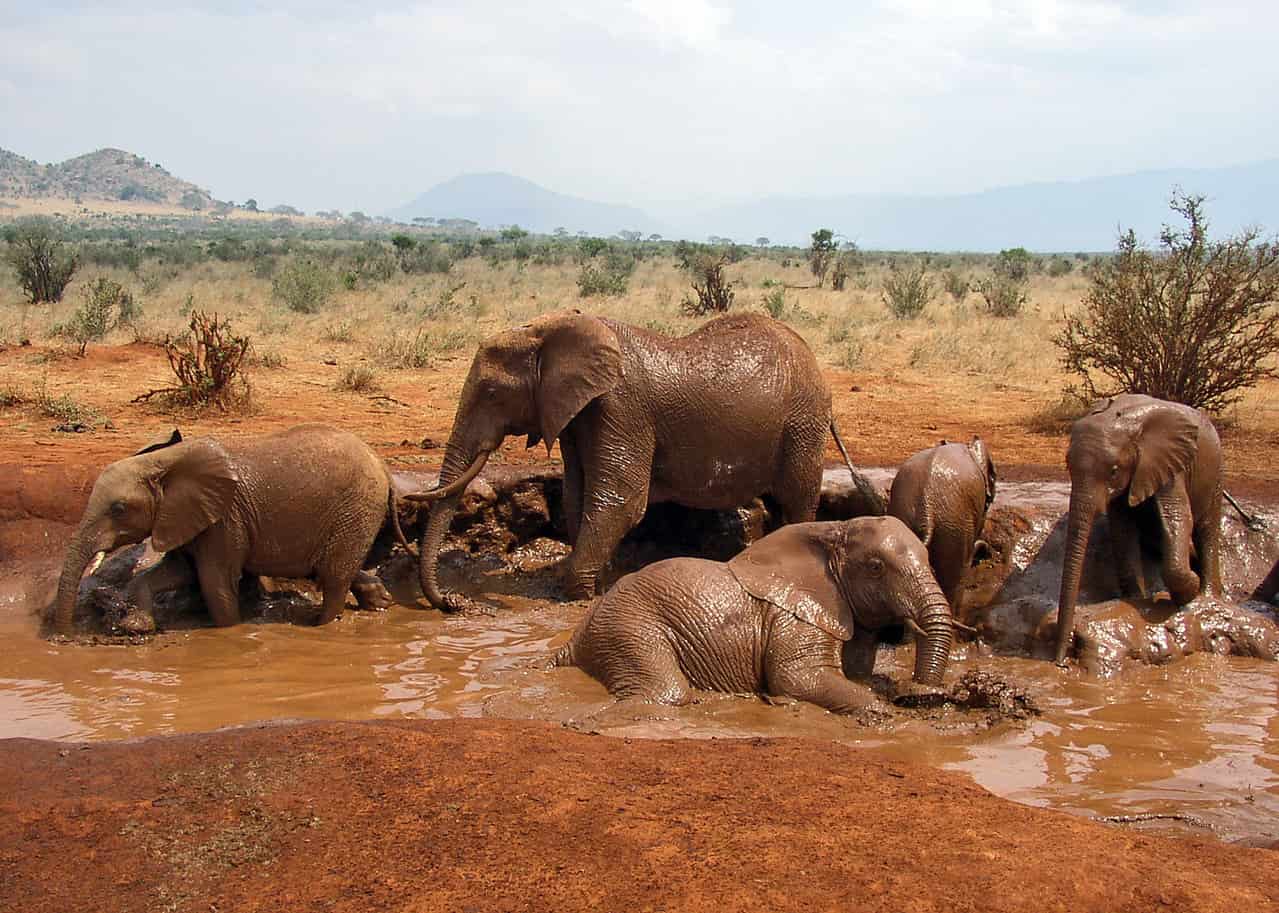
Herds of African bush elephants wander the plains and grasslands of Africa searching for food and waterholes.

Although the historical range of its ancestors ranged right into the Arctic Circle, today the African bush elephant is mainly found in central and southern Africa in nomadic herds that wander the plains and grasslands of Africa grazing for food and searching for waterholes. Unlike the slightly smaller African forest elephant, the African bush elephant inhabits the grassy savanna plains and shrubland of the African continent in groups that contain mothers and their calves. Generally, these herds contain around 10 individuals but it is not uncommon for family groups to join together, forming a clan that can contain over 1,000 elephants. This very social lifestyle means that the African bush elephants are less vulnerable on the open African plains.

Behavior and Lifestyle
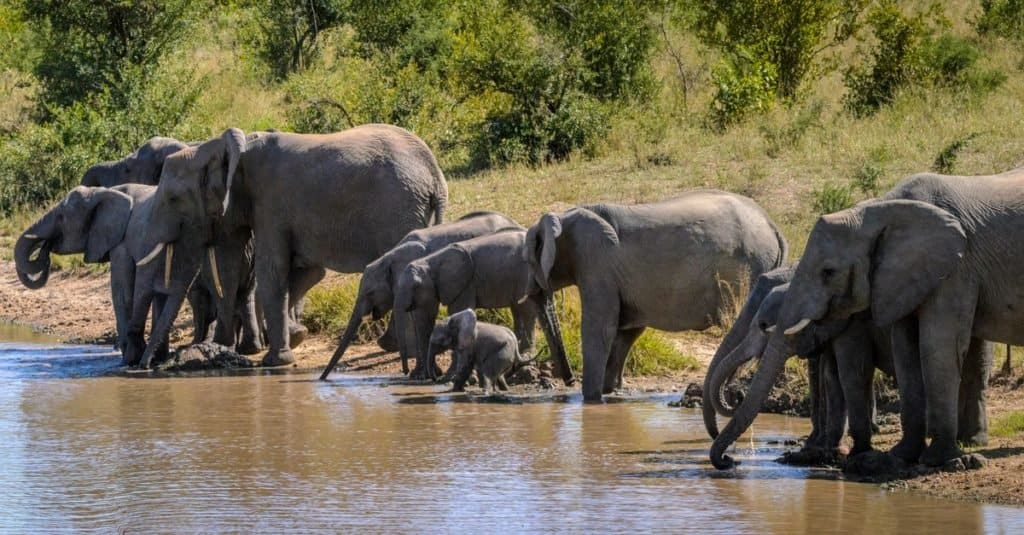
Animal Facts: Elephants

African bush elephants travel in family herds for protection from predators.

Not only is the African bush elephant an incredibly sociable mammal but it is also a very active one. Elephants are nomadic animals meaning that they are constantly on the move in search of food, so moving within these family herds allows them to have greater protection both from predators and from the elements.

The trunk of the African bush elephant is one of its most distinguishing features and this extra-long nose is not only flexible enough to gather and handle food but can also collect water. Its trunk, along with its tusks can also be used to defend itself from predators such as Lions, and to fight with other male elephants during the mating season.

African bush elephants are highly intelligent and emotional animals displaying behaviors that include giving and receiving love, caring deeply for the young, and grieving for dead relatives.

Reproduction and Life Cycles
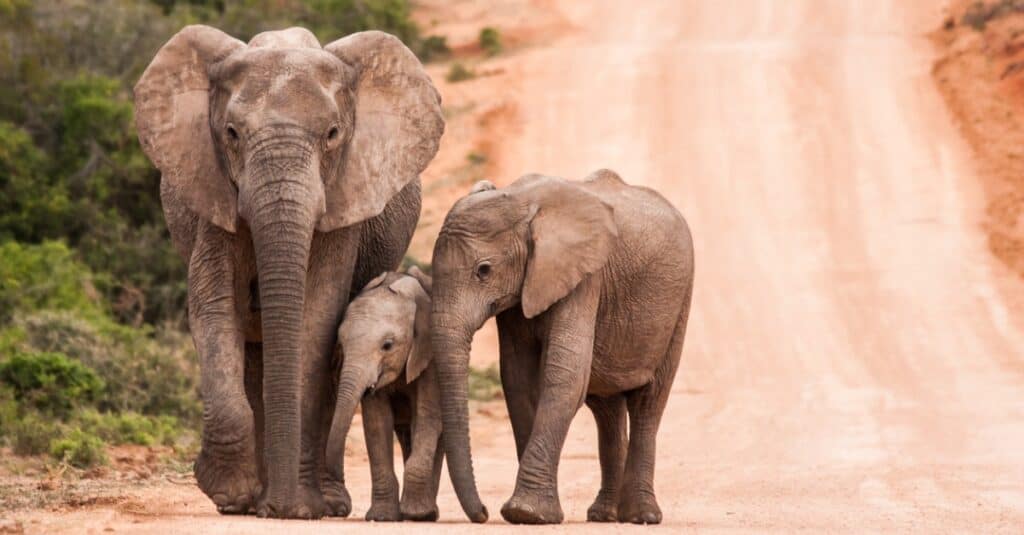
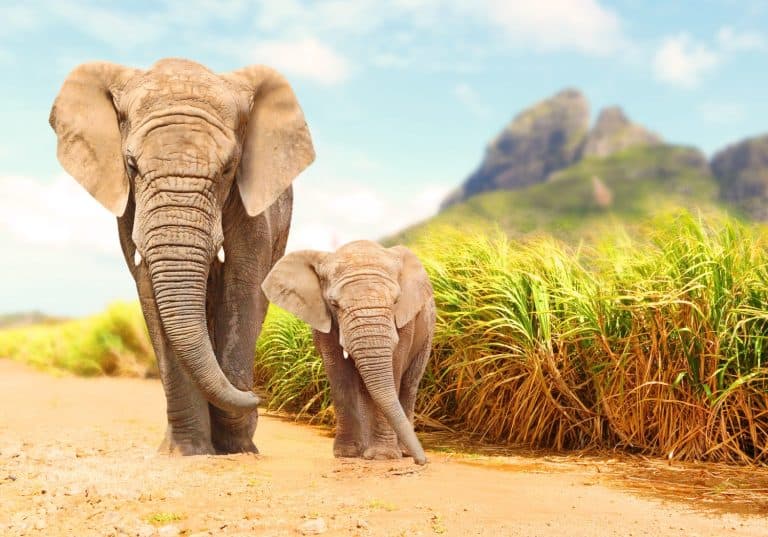
African elephants walking down dirt road

Female African bush elephants nurse their young for two years.

African bush elephants tend to live relatively long lives, with their average life span lasting between 60 and 70 years, on average. Females reach sexual maturity (are able to reproduce) after 10 or 11 years but are thought to be most fertile between the ages of 25 and 45.

Male African bush elephants, however, often don’t reach sexual maturity until they are nearly 20 years old. After mating and a gestation period of up to 2 years, the female gives birth to a single calf (twins have been known but are extremely rare).

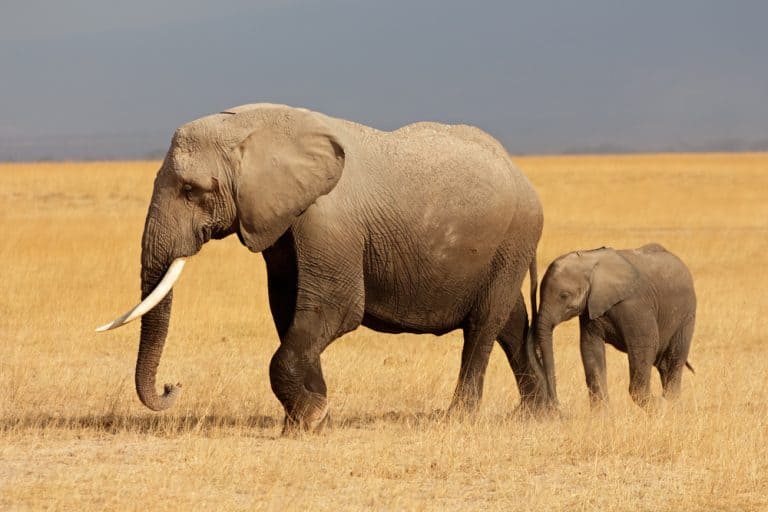
The calf is nursed for 2 years but will remain under the guidance and protection of the herd until it is old enough to support itself (around 6 years old). It is at this point that the tusks of the African bush elephant calf start to grow.

Diet
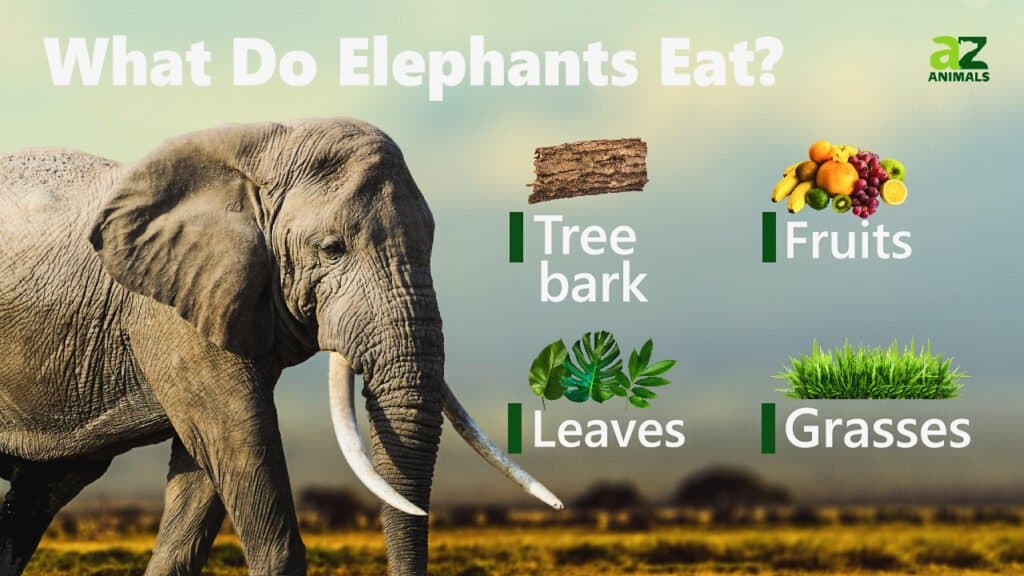
What Do Elephants Eat

Despite its immense size, the African bush elephant is a herbivorous mammal meaning that it survives on a diet that solely consists of plants and plant matter. The bulk of the elephant’s diet is comprised of leaves and branches that are stripped off the trees and bushes using its trunk. The African bush elephant also grazes on fruits and grasses and uses its immense tusks for digging for roots in the ground and to strip the bark of trees. Food is fed into its mouth using the trunk, and the large, flat teeth of the elephant are then the perfect tool for grinding the vegetation and course plants down so that they can then be more easily digested.

African bush elephants are capable of tucking away 350 pounds of food each day – they’re also capable of gulping down 200 liters of water daily. As a matter of fact, the better part of their time is dedicated to finding the perfect spots of lush vegetation to enjoy a meal.

Their presence also spells good tidings for other species such as birds, honey badgers, meerkats, mongooses, and monkeys which love to sift through the dung left behind by elephants. In it, these mammals and avians get to eat the seeds and grains which have made it through the pachyderms’ digestive system in one piece.

Predators and Threats
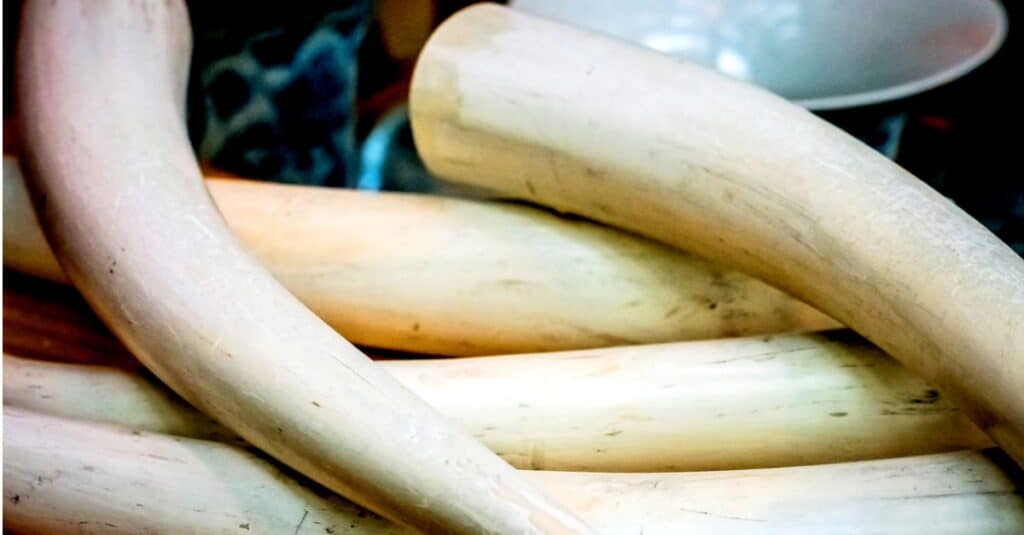
ivory in a basket

Humans that poach elephants for their tusks are the biggest threat to their survival.

The African bush elephant has no real natural predators to threaten its survival, mainly due to its sheer size and the fact that they often remain within the safety of the herd.

African bush elephants are peaceful giants and can be seen cohabiting in their habitat with other large mammals and birds. Lions and Hyenas may occasionally be able to pick off a young elephant that has been separated from its mother; they have also been known to attack adults that are old and sick and therefore more vulnerable.

Humans that poach the elephants for their ivory tusks, classifying them as one of the “African Big Five,” are the biggest threat to their survival along with habitat loss across the continent.

Interesting Facts and Features
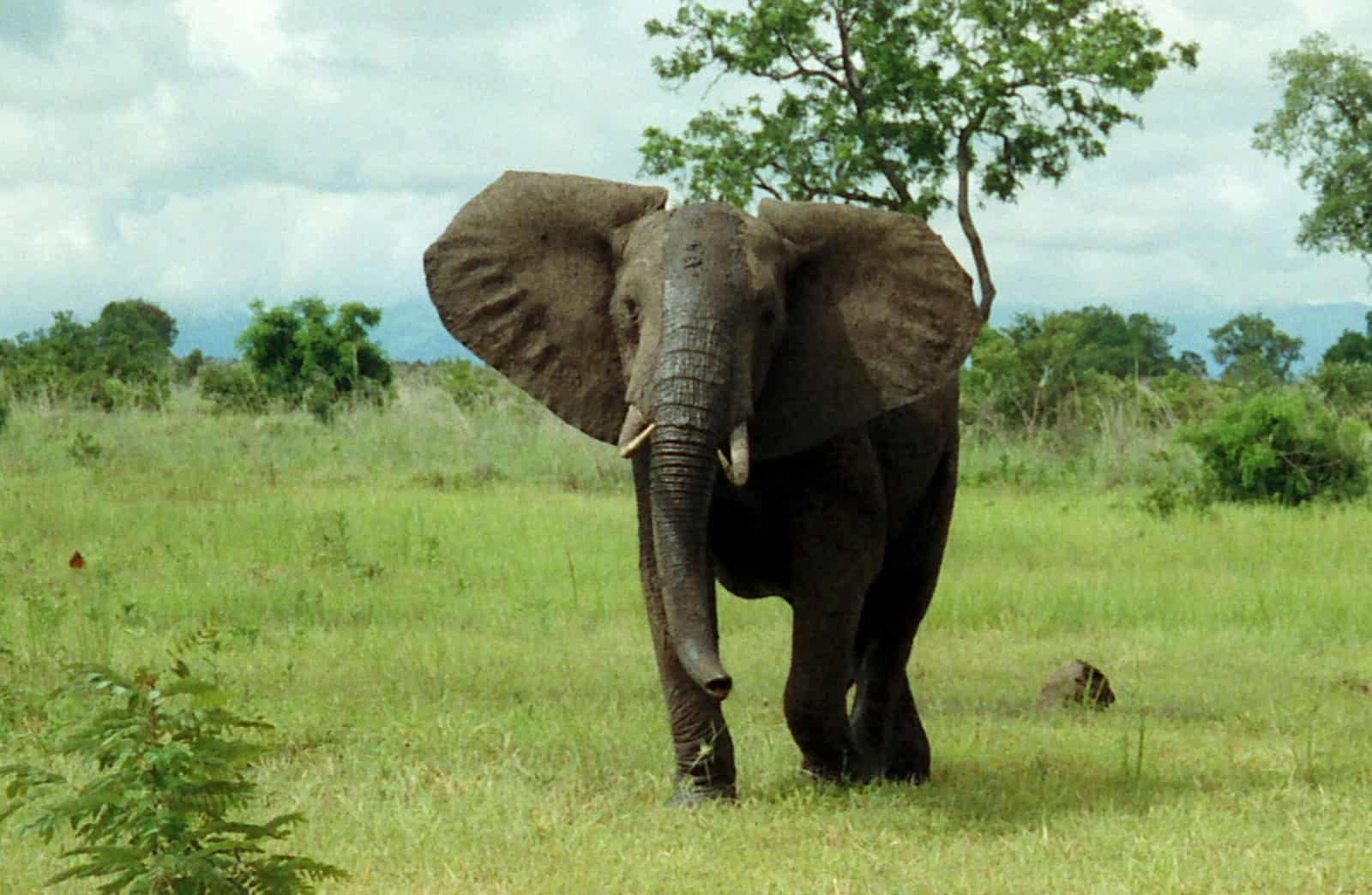
The ears of the African bush elephant are shaped like the African continent.

In the early 19th century, the story of the African bush elephant was very different with there being up to 5 million individuals thought to have been roaming the African continent. However, due to the increased demand for ivory, Africa’s elephant population is thought to have fallen as much as 85% in some areas.

The large ears of the African bush elephant are said by some to be shaped somewhat like Africa, but these large flaps of skin are not just for hearing, they are a vital tool in keeping the elephant cool in the African heat. Like many of the herbivores found throughout Africa, the calves can walk at birth to maximize their chances of survival. An adult African bush elephant can drink up to 50 gallons of water every day and is able to take 1.5 gallons of water into their trunks at a time.

Relationship with Humans
How Long Do Elephants Live?

Protected status is helping elephant numbers to remain stable.

Sadly, due to an increase of outside interest in Africa and its exotic wonders (particularly towards the mid-20th century), the African bush elephant population took a devastating decline toward extinction. After having been brutally killed by poachers for years for their ivory, elephants had vanished from much of their native habitat. In 1989 a worldwide elephant ivory hunting ban fell into place after the populations had dropped so dramatically across the continent. In northern and central parts of Africa, the African bush elephant is now rare and confined to protected areas, and although the story is similar in the south, South African elephant populations are thought to be doing better with an estimated 300,000 individuals in the region.

Conservation Status and Life Today

Today, although recovering, African bush elephant populations are still threatened by increasing levels of illegal poaching and habitat destruction. Deforestation in the elephant’s territory means that the animals lose both their food and shelter making them more vulnerable in the wild. Despite the ban, African bush elephants are also constantly threatened by poachers hunting the elephants for their ivory tusks.

View all 326 animals that start with A
How to say African Bush Elephant in ...
Bulgarian
Африканският саванен слон
Czech
Slon africký
Danish
Afrikansk savanneelefant
German
Afrikanischer Elefant
English
Savannah Elephant, Bush Elephant
Spanish
Elefante africano de sabana
French
Éléphant d'Afrique
Finnish
Savanninorsu
Croatian
Afrički slon
Hungarian
Afrikai telefánt
Japanese
アフリカゾウ
Dutch
Afrikaanse olifant
Polish
Słoń afrykański
Portuguese
Elefante, Elefante-africano
Swedish
Afrikansk elefant
Turkish
Afrika fili

Sources

  1. David Burnie, Dorling Kindersley (2011) Animal, The Definitive Visual Guide To The World's Wildlife / Accessed July 6, 2010
  2. Tom Jackson, Lorenz Books (2007) The World Encyclopedia Of Animals / Accessed July 6, 2010
  3. David Burnie, Kingfisher (2011) The Kingfisher Animal Encyclopedia / Accessed July 6, 2010
  4. Richard Mackay, University of California Press (2009) The Atlas Of Endangered Species / Accessed July 6, 2010
  5. David Burnie, Dorling Kindersley (2008) Illustrated Encyclopedia Of Animals / Accessed July 6, 2010
  6. Dorling Kindersley (2006) Dorling Kindersley Encyclopedia Of Animals / Accessed July 6, 2010
  7. David W. Macdonald, Oxford University Press (2010) The Encyclopedia Of Mammals / Accessed July 6, 2010
  8. African Bush Elephant Classification / Accessed July 6, 2010
  9. Evolution Of Elephants / Accessed July 6, 2010
  10. Elephant Intelligence / Accessed July 6, 2010
  11. African Elephant Information / Accessed July 6, 2010
  12. About African Bush Elephants / Accessed July 6, 2010
Lisha Pace

About the Author

Lisha Pace

After a career of working to provide opportunities for local communities to experience and create art, I am enjoying having time to write about two of my favorite things - nature and animals. Half of my life is spent outdoors, usually with my husband and sweet little fourteen year old dog. We love to take walks by the lake and take photos of the animals we meet including: otters, ospreys, Canadian geese, ducks and nesting bald eagles. I also enjoy reading, discovering books to add to my library, collecting and playing vinyl, and listening to my son's music.

Thank you for reading! Have some feedback for us?


African Bush Elephant FAQs (Frequently Asked Questions)

African Bush Elephants are Herbivores, meaning they eat plants.