Bumblebee
Bombus
 Verified by: AZ Animals Staff
The most common species of bee!
Advertisement
Bumblebee Scientific Classification
- Kingdom
- Animalia
- Phylum
- Arthropoda
- Class
- Insecta
- Order
- Hymenoptera
- Family
- Apidae
- Genus
- Bombus
- Scientific Name
- Bombus
Read our Complete Guide to Classification of Animals.
Bumblebee Conservation Status
Bumblebee Facts
- Main Prey
- Nectar, Pollen, Honey
- Habitat
- Quiet forests and pastures
- Predators
- Bats, Frogs, Skunks
- Diet
- Herbivore
- Average Litter Size
- 200
- Favorite Food
- Nectar
- Common Name
- Bumble Bee
- Number Of Species
- 250
- Location
- Mostly Northern Hemisphere
- Slogan
- The most common species of bee!

 © Ernie - Public Domain
View all of the Bumblebee images!



How to Add Us to Google News


The common bumblebee insect is one of the most social species on Earth. They congregate in vast colonies of fellow workers.
Led by a queen, bumblebees are almost a model of order and discipline. They cooperate, raise the young together, and divide up labor. Each bee has a specific role to promote the overall health and survival of the colony. Not all bees are like this, for example, the carpenter bee looks like a bumblebee insect, but is more of a solitary bee.
However, due to complex reasons, bumblebee numbers appear to be in decline throughout the world. This may have severe long-term effects on the rest of the Earth’s ecosystems.
Bumblebee Facts
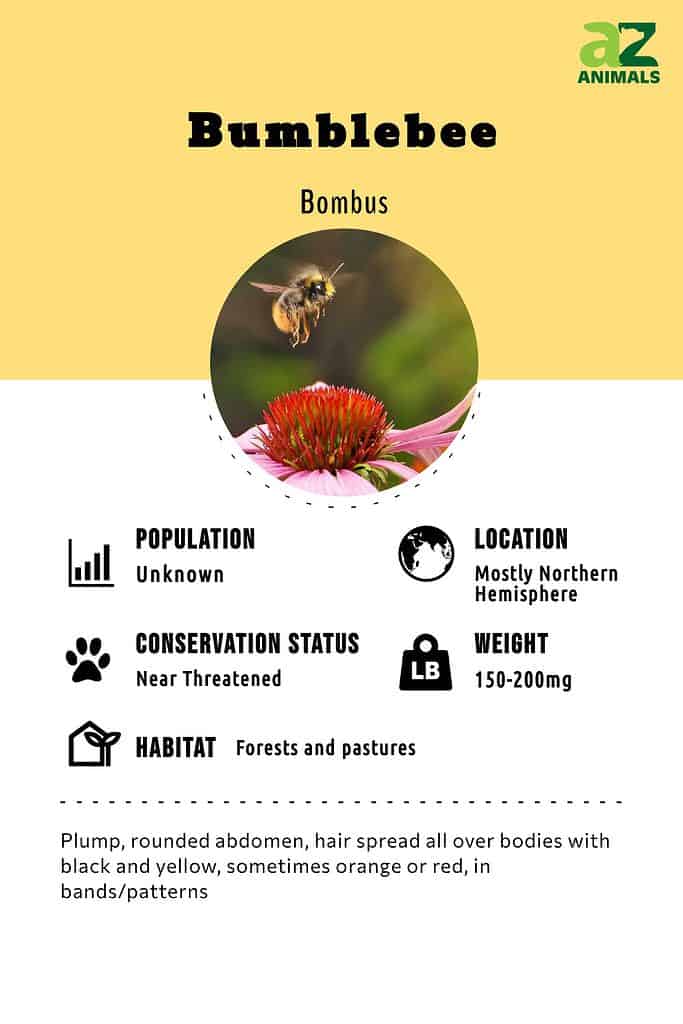
- Bumblebees are insects covered in a layer of oil that makes them more resistant to water.
- The bumblebee’s wings can only function in the appropriate temperatures. If the bee cannot take off, then it may shiver for several minutes to raise its internal temperature.
- A bumblebee is capable of producing a waxy substance to build nests and protect the eggs.
- In order to communicate with the colony, bumblebees have a remarkable intellectual ability compared to many insects. They can convey basic information to fellow workers and even remember complex patterns.
Make sure to give ‘10 Incredible Bumblebee Facts‘ a read if you’re looking for more facts on these amazing creatures.
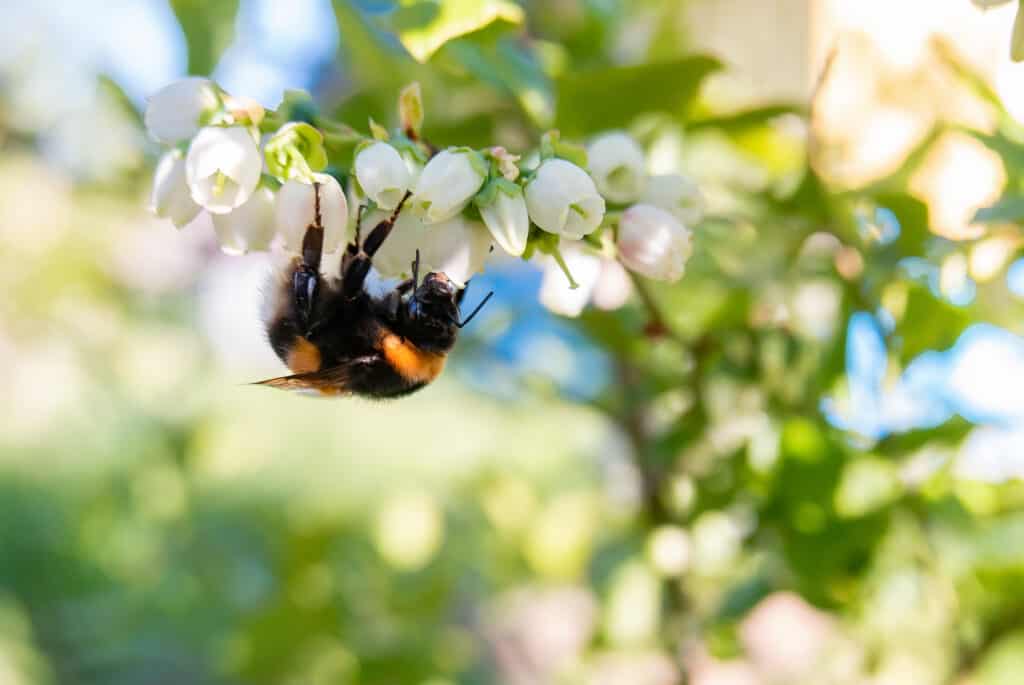
Bumblebees can convey basic information to fellow workers and even remember complex patterns.
©iStock.com/skiden
Scientific Name, History, and Evolution
The bumblebee insect is the common name for an entire genus of organisms called Bombus. According to the Merriam-Webster dictionary, the term Bombus comes from a Latin word meaning booming, buzzing, or humming. It is closely related to the Greek word bombos.
The bumblebee belongs to the family of Apidae, which compromises all types of bee species. It is closely related to the genus Meliponin, or the stingless bee. Altogether, there are more than 250 known species within the genus of Bombus, and several extinct species are also recognized in the fossil record. The genus may have evolved some 25 to 40 million years ago.
They also evolved from wasps over 100 million years ago. While these other insects are predators, most bumblebees today are food gathers, but they still build and defend nests.
There is an interesting parasitic group within the subspecies of bumblebees. They infiltrate other non-parasitic bumblebee nests and colonies by laying eggs within them and then allowing the hosts to feed their young. In fact, females will overthrow the presiding host queen and have the host worker bees feed her!
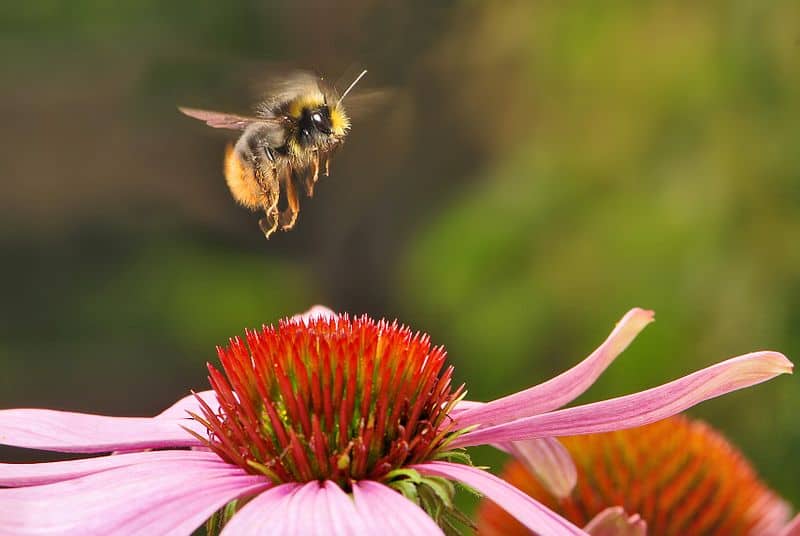
The bumblebee insect is the common name for an entire genus of organisms called
Bombus, which comes from a Latin word meaning booming, buzzing, or humming.
©Ernie – Public Domain
Appearance
The bumblebee can be identified by its rather large, plump appearance, its rounded abdomen, and the hair spread all over its body. They sport black and yellow colors — and sometimes even orange or red — in specific bands or patterns. These bright colors serve as a warning to other animals of the potential danger of threatening the bee.
In most species of bumblebees, there is a pollen basket located on the hind legs. This basket area features bare skin surrounded by small hairs to transport pollen around. Because of this, they can carry around a significant amount of their body weight in pollen.
The bumblebee has four wings to achieve flight. All of them are relatively small compared to its total body size. This has led to a common misconception that the bumblebee should be physically incapable of flight. However, this is based on a faulty idea of bumblebee flight. Many people assume that bumblebee wings are fixed. Instead, the bees can actually swivel or sweep their wings like a helicopter, so they flap their wings back and forth, rather than up and down.
This creates eddies of air to help them remain aloft. They beat their wings approximately 100 to 200 times every second. They can sometimes remove pollen from a flower just by the vibration of flapping their wings near it.
The typical bumblebee is somewhere around half an inch to an inch long, which is about the size of a dime. The bee’s weight is likewise minuscule. However, this is not uniformly true across the entire genus. The largest bee species in the world is Bombus dahibomii from Chile. It can reach up to 1.6 inches in length.
One of the bee’s most important characteristics is the long tongue-like proboscis that has adapted specifically to lap up nectar from a flower. The proboscis comes in a variety of different sizes, from short to long. Each species tends to be specialized for a specific flower (though bumblebees with a short proboscis can sometimes “steal” food from a longer flower by poking a hole near the place where the food is located).
The bees may end up traveling more than a mile to find an appropriate source of food.
Behavior
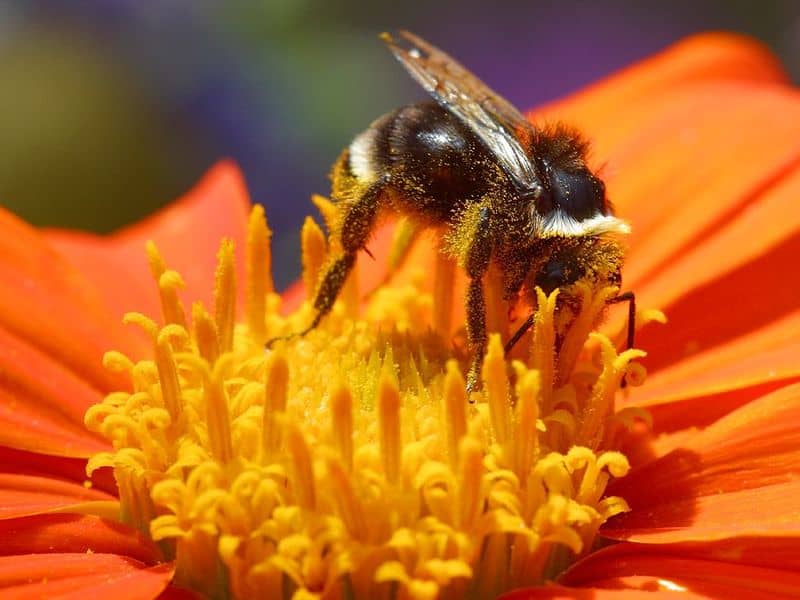
The bumblebee relies on its wits and senses to search for favorable flowers, including color and the presence of electric fields. Bumblebees tend to return to the same area to find food, but not necessarily the same flower. Once a flower is depleted, the bees will move on to a new one. They leave behind scent marks to tell fellow workers which flowers are bereft of nectar.
The bumblebee is an integral part of the natural ecosystem, transporting pollen between male and female flower parts. Berries, tomatoes, and squash in particular are highly dependent on bumblebee pollination.
Studies have revealed that bumblebees may be more intelligent than first suspected. Upon finding a new source of food, they can communicate the location to fellow members of the colony. Consequently, bumblebees are highly social creatures that rely on the work of the entire colony to survive.
A single colony usually contains up to 500 individuals at a time and occasionally even exceeds more than a thousand individuals. Although this may sound like a lot, it actually falls well short of the maximum number of honeybees in a colony.
At the center of the colony is a single dominant queen (though some species may have multiple). She is simultaneously the founder, leader, and matriarch of the colony. Each year around spring she establishes a hive at a suitable location close to a source of bumblebee foods.
She builds the colony almost completely from scratch and produces most of the offspring herself. It is at her beck and calls that the workers serve. This type of arrangement, which divides up workers into different castes, is known as eusocial behavior. It is fairly common in insects.
Both the queen and the female workers have a sharp stinger to defend against threats and predators. These stingers do not detach after use, so a bumblebee can strike a target repeatedly without injuring itself. Bumblebees will usually not bother people during their normal daily routine, but they can be quite aggressive about defending their colony. This may be a problem if the colony resides in a heavy population area.
Although most species of Bombus adhere to this basic eusocial behavior, the cuckoo bumblebee has a unique lifestyle altogether. As the name implies, it is a kind of brood parasite that relies on other species to raise its young. The cuckoo bees will infiltrate another colony, kill the leader, and replace it with their own female in order to force the workers to feed their larvae. In this way, it is essentially hijacking the work of another bumblebee species.
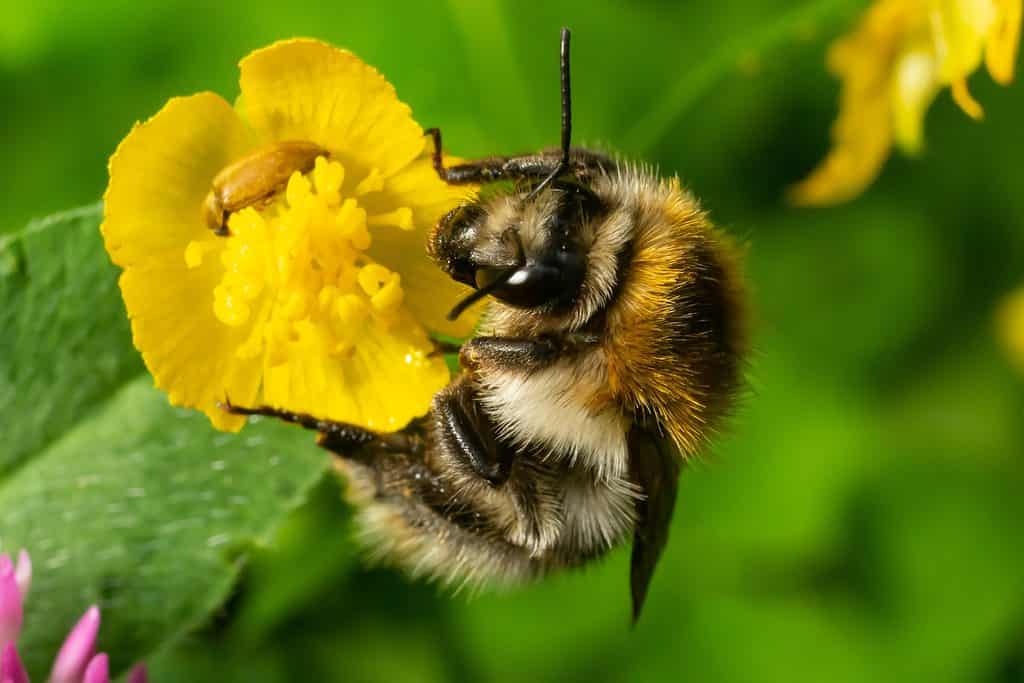
Once a flower is depleted, the bees will move on to a new one. They leave behind scent marks to tell fellow workers which flowers are bereft of nectar.
©olko1975/Shutterstock.com
Habitat
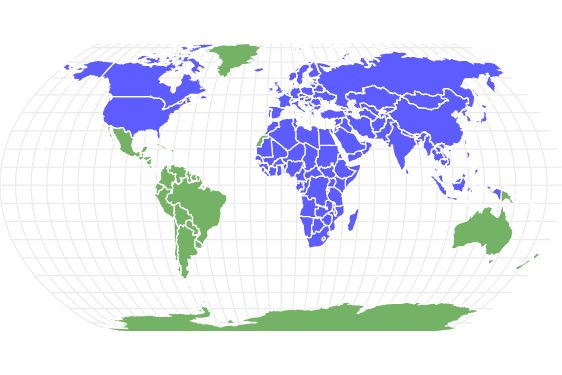
The bumblebee has an extensive range across North America, South America, Europe, Asia (minus parts of India and the Middle East), and Northern Africa. However, they are almost completely absent from Australia, sub-Saharan Africa, and Antarctica. The bumblebees can span all types of climates and geographical regions, including the tropics, but most species prefer temperate climates in high-altitude ranges.
Bumblebees will build nests somewhere close to the ground or below the ground. They can appropriate all kinds of environments into suitable nests, including human buildings, abandoned animal nests, and even old furniture. The nest must be relatively cool and receive little direct sunlight.
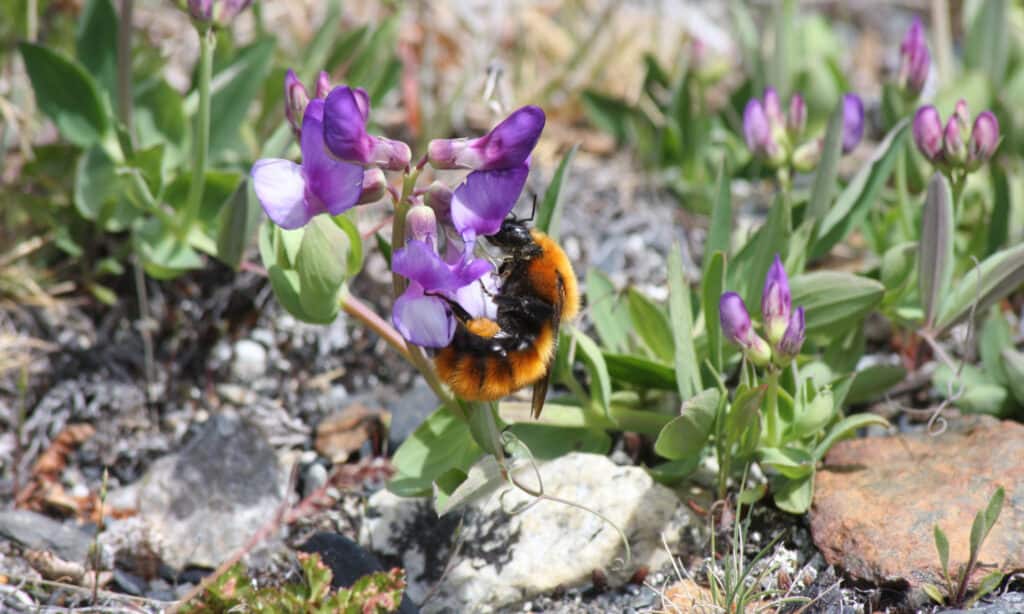
The bumblebees can span all types of climates and geographical regions, including the tropics, but most species prefer temperate climates in high-altitude ranges.
©Jody./Shutterstock.com
Diet
Bumblebees have a rather simple diet of nectar and pollen, which they gather from flowers. They do not make honey in a traditional sense. Honey is produced from the long-term storage of nectar, and the bumblebees do not survive over the winter. However, they are capable of storing their food in small quantities for a few days at a time in the wax-like cells of the colony. For this reason, bumblebees are sometimes used by humans as pollinators, but not honey producers as many think.
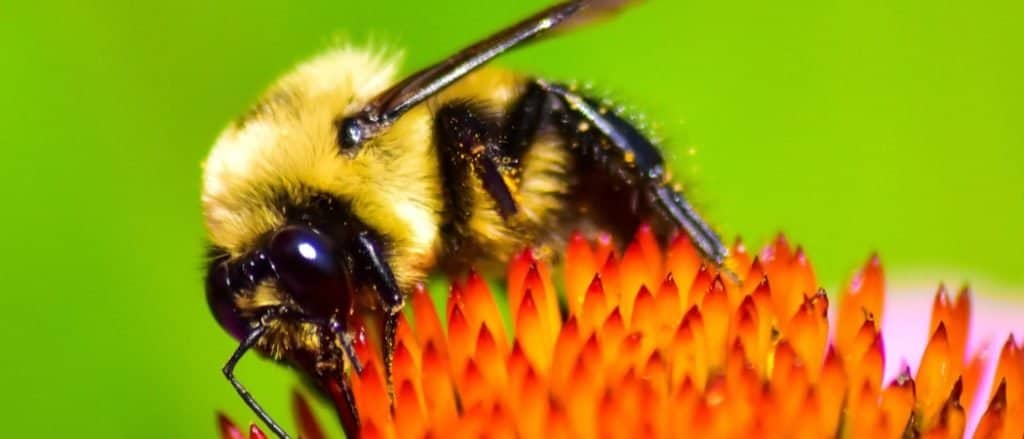
Bumblebees have a diet of nectar and pollen, which they gather from flowers.
©amypat45/Shutterstock.com
Predators and Threats
Due to their relatively small size, bumblebees are prone to predation from a number of animals. Birds, spiders, wasps, and flies will prey on individual bumblebees when they are out foraging, while large predators like the badger can dig up and consume an entire colony in a matter of moments.
The stinger can be a formidable defense for the bee, especially when they are present in large numbers. This has enabled them to thrive for millions of years. However, bumblebees also face significant long-term problems from human activity and climate change.
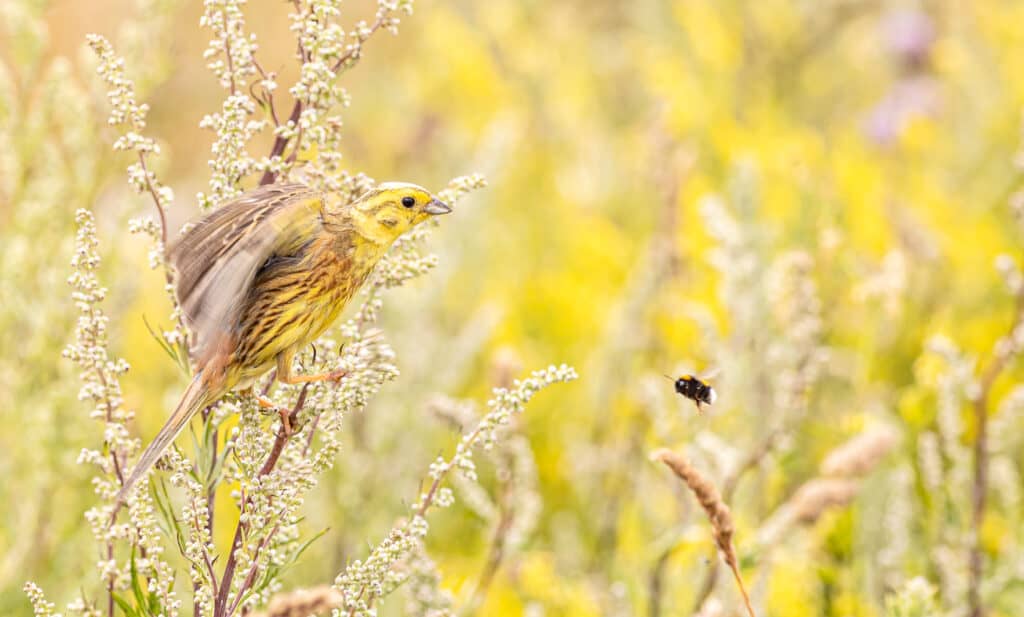
Birds, spiders, wasps, and flies will prey on individual bumblebees when they are out foraging.
©Michael Schnetz/Shutterstock.com
Reproduction, Babies, and Lifespan
The bumblebee has a complex annual reproduction and life cycle that revolves around the health of the colony. The annual cycle begins in the winter when the queen starts to build up enough fat to hibernate for the colder months. Upon emerging in the spring, she will then proceed to start a new colony and produce her first yearly offspring from the larvae. Learn more about other animal species that hibernate here.
The matriarch will produce a cluster of several eggs at one time. She fertilizes each egg individually from sperm stored in the spermatheca. She also has the ability to choose exactly which eggs to fertilize based on the needs of the colony. The fertilized eggs can become either regular females or more queens. The unfertilized eggs will become males, which go out into the world and attempt to mate. The matriarch will try to suppress the reproductive abilities of the females, so she will have exclusive reproductive rights with the males.
A typical bumblebee egg hatches into a larva after about two weeks of careful attention. The initial larva goes through several stages in its development. Each stage is known as an instar. When they are a week old, the larvae will produce cocoons for themselves so they can develop into mature adults. This cocoon stage is known as a pupa.
If successful, the colony will thrive throughout much of the summer months. The matriarch will continue to create new eggs, while the worker bees feed and take care of the subsequent offspring. During the fall, however, most of the existing colony dies off from natural causes. Since they do not survive the winter, bumblebees tend to have very short life cycles. Most of them live only for a month or two.
Read here to know more about the bumblebee’s lifespan.
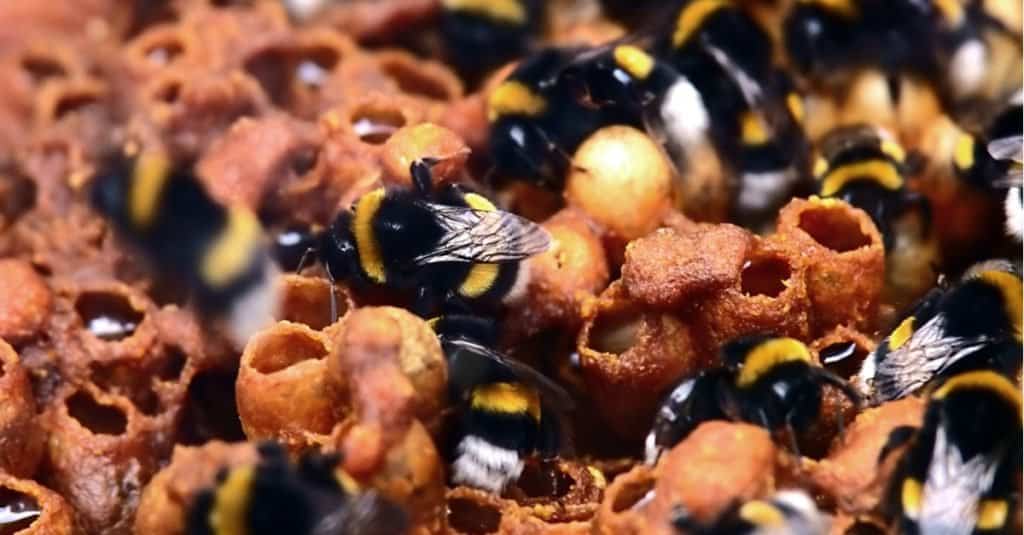
Bumblebees live together in family groups in a nest ruled by a queen who is helped by her daughters (called worker bees). There can be up to 400 bees in a single bumblebee nest.
©dwphotos/Shutterstock.com
Types of Bumblebees
Bumblebees can be found all over the world, and there are over 250 species of them. Here are just a few!
Found in North America:
- American Bumblebee – The Bombus pensylvanicus, although technically a threatened subspecies, can be found from Mexico, up the eastern side of the U.S., and also in the eastern side of Canada. These bees pollinate and prefer to be in open fields looking for clovers and sunflowers.
- Western Bumblebee – Bombus occidentalis
- Black-tailed Bumblebee – The Bombus melanopygus has a large area that it can be found throughout the western half of North America, from southern California to Alaska and from the heart of the Rocky Mountains all the way west to the Pacific Coast. They enjoy many types of plants for food and dwell in nests that can be located in buildings or other structures and also in the ground. This makes them bumble bees that can be seen in urban and rural scenes. They come in two varieties: one with a darker color and one with a “red butt”.
- Franklin’s Bumblebee – Bombus franklini
- Colorado Black Bumblebee – Bombus bifarius
- Yellowhead Bumblebee – Bombus flavifrons
- Hunt’s Bumblebee – Bombus huntii
- Great Yellow Bumblebee – Bombus distinguendus
- Golden-belted Bumblebee – Bombus balteatus
- Rusty Patched Bumblebee – Bombus affinis
- Black and Gold Bumblebee – Bombus auricomus
- Nevada Bumblebee – Bombus nevadensis
- Yellow-banded Bumblebee – Bombus terricola
- Heath Bumblebee – Bombus jonellus
- Half-black Bumblebee– Bombus Vagans
- Confusing Bumblebee – Bombus perplexus
- Sanderson Bumblebee– Bombus sandersoni
- Common Eastern Bumblebee– Bombus impatiens
- Golden Northern Bumblebee – The Bombus fervidus comes from North America and has a golden coloration to its underside and thorax. It can be found commonly in urban and rural areas throughout the U.S. (except for the southern states and Alaska) and the lower regions of Canada. These bees work masterfully together as a group to protect their nests.
- Yellow-faced Bumblebee – Bombus vosnesenskii
- Vancouver Bumblebee – Bombus vancouverensis
- Sitka Bumblebee – Bombus sitkensis
- Lemon Cuckoo Bumblebee – Bombus citrinus
- White-shouldered Bumblebee – Bombus appositus
- California Bumblebee – Bombus californicus
Found in Britain:
- Buff-tailed Bumblebee – The Bombus terrestris is a bumble bee that often shows up commonly in many countries in Europe and on the British Isles. Because they perform so well in greenhouses for pollinating, they can be also found around the world. The queen of the buff-tail hive only mates with one male. As a group, they have a division of labor and work together for caring of their young.
- Red-tailed Bumblebee – The Bombus lapidarius is located mostly in the central region of Europe and in Great Britain and has a striking red and black body. They have a special ability to create a good deal of warmth as they contract muscles that they use for flying. The heat that comes off this motion is used to keep nests at a warm temperature for their brood.
- Early Bumblebee – The Bombus pratorum is one of the bumble bees in the smaller size of their species. While they are common in Great Britain, they also can be found in areas of Asia and Europe. The name “early” comes from their tendency to start their colonies earlier in the year than other bumble bees. These bees have very aggressive queens that use their behavior to rule over their workers.
- Tree Bumblebee – The Bombus hypnorum is called the tree bumble bee and also the “new garden” bumble bee. While they seem to have originated in Europe and Asia, they moved to England in the 1900s. The tree bumble bee has a light brown thorax, a white tail, and a black abdomen. They pick habitats that are a little secluded and not overly competitive with other animals.
- Garden Bumblebee – The Bombus hortorum is a bumble bee that roams through Europe and Asia south of the Arctic circle. They have a specialized tongue to access pollen in plants that have deep flowers. The memory of garden bumble bees is used to help them remember how to find food in their territories.
- Common Carder Bumblebee – Bombus pascuorum
- White-tailed Bumblebee – Bombus lucorum
Found Around the World
- Red-shanked Carder Bumblebee – Bombus ruderarius
- Arctic Bumblebee – The Bombus polaris, as its name implies, has its habitat actually above the Arctic Circle, and it and the tundra bumble bee are the only two bumble bees that live in those regions. Several adaptations of this bumble bee have allowed them to thrive in super cold environments, such as insulated nests, thick coats of hair, and the ability to regulate its body temperature.
- Large Garden Bumblebee – Bombus ruderatus
- Shrill Carder Bumblebee – Bombus sylvarum
- Moss Carder Bumblebee – Bombus muscorum
- Brown-banded Carder Bumblebee – Bombus humilis
- Short-haired Bumblebee – Bombus subterraneus
- Gypsy Cuckoo Bumblebee – Bombus bohemicus
- Hill Bumblebee – Bombus rupestris
- Broken-belted Bumblebee – Bombus Soroeensis
- Southern/Vestal Cuckoo Bumblebee – Bombus vestalis
- Tundra Bumblebee – Bombus hyperboreus
- Forest Cuckoo Bumblebee – Bombus sylvestris
- Field Cuckoo Bumblebee – Bombus campestris
- Orange-belted Bumblebee – Bombus ternarius
- Cryptic Bumblebee – Bombus cryptarum
- Barbut’s Cuckoo Bumblebee – Bombus barbutellus
- Bilberry Bumblebee – Bombus monticola
- Wurflen’s Bumblebee – Bombus wurflenii
- Two-spotted Bumblebee – Bombus bimaculatus
- Southern Plains Bumblebee – Bombus fraternus
- Confusing Bumblebee – Bombus confusus
- Armenian Bumblebee – Bombus armeniacus
- Cousinly Bumblebee – Bombus armeniacus
- Suckley’s Cuckoo Bumblebee – Bombus suckleyi
- Variable Bumblebee – Bombus variabilis
- Active Bumblebee – Bombus neoboreus
- Indiscriminate Cuckoo Bumblebee – Bombus insularis
- Lapland Bumblebee – Bombus lapponicus
- Norwegian Bumblebee – Bombus norvegicus
Population
Since the late 20th century, scientists have noted a curious and alarming phenomenon: bumblebee populations appear to be in precipitous decline throughout the world. Although exact population figures are hard to come by, it’s been estimated that bumblebee numbers have dropped by as much as 50 percent in some regions of the world.
Some species are in worse shape than others. For example, the variable cuckoo bumblebee and the rusty patched bumblebee are considered to be critically endangered by the International Union for the Conservation of Nature (IUCN)‘s Red List. However, most are still vulnerable or least concern.
It is not entirely clear why numbers have dropped off. Pesticide use, habitat loss, and diseases have all been cited as potential causes. However, climate change may be greatly amplifying these underlying issues. One study noted that the largest declines in bumblebee populations occurred in the regions with the biggest changes in the climate. Besides addressing climate change, the elimination of pesticides and restoration of habitat might partially arrest the bumblebee’s decline.
How to Add Us to Google News

Bumblebee FAQs (Frequently Asked Questions)
What is the difference between a bumblebee and a carpenter bee?
While both of these insects look strikingly similar, they are very different and in a vast variety of ways. For example, carpenter bees are members of the Xylocopa family, while bumble bees are members of the Bombus family.
What is the difference between a bumblebee and honeybee?
The bumblebee and the honeybee are closely related, but they are actually different genera. As mentioned previously, the bumblebee is part of the genus Bombus, while the honeybee is part of a genus called Apis. Although they are part of the same family, there are numerous differences in appearance, behavior, and reproduction. Honeybees also tend to die when they sting.
How do bumblebees die?
Most bumblebees die naturally when a colony is replaced every year. The rest are killed by predators or human activities. Unlike some other bees, bumblebees do not die after they pierce something with their stinger.
What do bumblebees eat - are they carnivores, herbivores, or omnivores?
Bumblebees consume nectar and pollen from flowers almost exclusively, making them herbivores. The nectar is useful as a quick source of carbohydrates.
What eats bumblebees?
Spiders, birds, wasps, and some flies are all sources of potential danger for the bumblebee. Small and medium-sized mammals also sometimes feed on them.
What Kingdom do Bumblebees belong to?
Bumblebees belong to the Kingdom Animalia.
What phylum do Bumblebees belong to?
Bumblebees belong to the phylum Arthropoda.
What class do Bumblebees belong to?
Bumblebees belong to the class Insecta.
What family do Bumblebees belong to?
Bumblebees belong to the family Apidae.
What order do Bumblebees belong to?
Bumblebees belong to the order Hymenoptera.
What genus do Bumblebees belong to?
Bumblebees belong to the genus Bombus.
Where do Bumblebees live?
Bumblebees live in the Northern Hemisphere.
In what type of habitat do Bumblebees live?
Bumblebees live in quiet forests and pastures.
What is the average litter size for a Bumblebee?
The average litter size for a Bumblebee is 200.
What is an interesting fact about Bumblebees?
The Bumblebee is the most common species of bee!
What is the scientific name for the Bumblebee?
The scientific name for the Bumblebee is Bombus.
How many species of Bumblebee are there?
There are 250 species of Bumblebee.
How to say Bumblebee in ...
Thank you for reading! Have some feedback for us? Contact the AZ Animals editorial team.
Sources
- David Burnie, Dorling Kindersley (2011) Animal, The Definitive Visual Guide To The World's Wildlife
- Tom Jackson, Lorenz Books (2007) The World Encyclopedia Of Animals
- David Burnie, Kingfisher (2011) The Kingfisher Animal Encyclopedia
- Richard Mackay, University of California Press (2009) The Atlas Of Endangered Species
- David Burnie, Dorling Kindersley (2008) Illustrated Encyclopedia Of Animals
- Dorling Kindersley (2006) Dorling Kindersley Encyclopedia Of Animals