
Quick Take
- Blue is one of nature's rarest colors, and surprisingly, the reason most blue fish are blue has nothing to do with pigment. See iridescent color science →
- One iconic blue fish, which millions would recognize from a Pixar film, turns out to be ethically off-limits for home aquariums. Why Dory can't be kept →
- Only two fish on the planet produce actual blue pigment, and both of them are on this list. True blue pigment explained →
- Some of the most visually stunning blue fish are the hardest to keep alive, and knowing which ones before you buy could save you a costly mistake. Advanced species to avoid →
Blue is one of the rarest colors found in nature because true blue chemical pigments are not present in the majority of living organisms. Most blue animals do not have blue pigment. Instead, they have tiny physical structures — such as iridophores and nanostructures — that reflect or scatter light, making them appear blue. This is true of all kinds of animals, including fish. Although there are two fish that are known to produce blue pigment, the majority of fish species rely on iridophores to appear blue.
Mandarinfish
The Mandarinfish (Synchiropus splendidus), also known as the Mandarin dragonet, is a small, vibrantly colored fish native to the tropical Pacific Ocean, with an average length of 3 inches. Due to their striking color patterns, Mandarinfish are highly sought after, although they are considered expert-only aquarium fish.
Mandarinfish are challenging because they feed almost exclusively on live copepods and amphipods and will starve in captivity unless introduced into a well-established, mature reef tank with a thriving, sustainable micro-invertebrate population.
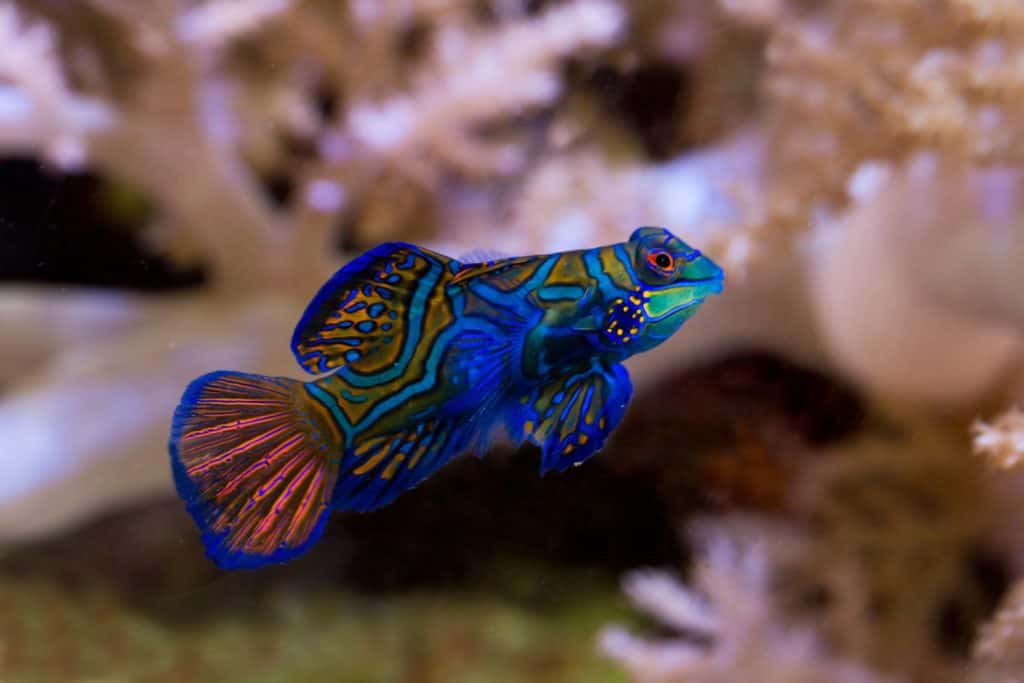
The mandarinfish produces a true blue pigment. This makes it an absolute anomaly in the natural world, in which only an infinitesimal fraction of the estimated 1.5 million animal species on the planet produce blue pigment.
©Podolnaya Elena/Shutterstock.com
Picturesque Dragonet
The picturesque dragonet (Synchiropus picturatus), also known as the target or psychedelic Mandarin, is a marine fish native to the Indo-West Pacific, including the Philippines, eastern Indonesia, and northwest Australia. These colorful fish reach a maximum length of about 3 inches. Like the Mandarinfish, the picturesque dragonet produces true blue coloring through pigment rather than structural light reflection. While occasionally sold in the marine aquarium trade, the picturesque dragonet is considered a difficult aquarium fish for beginners.
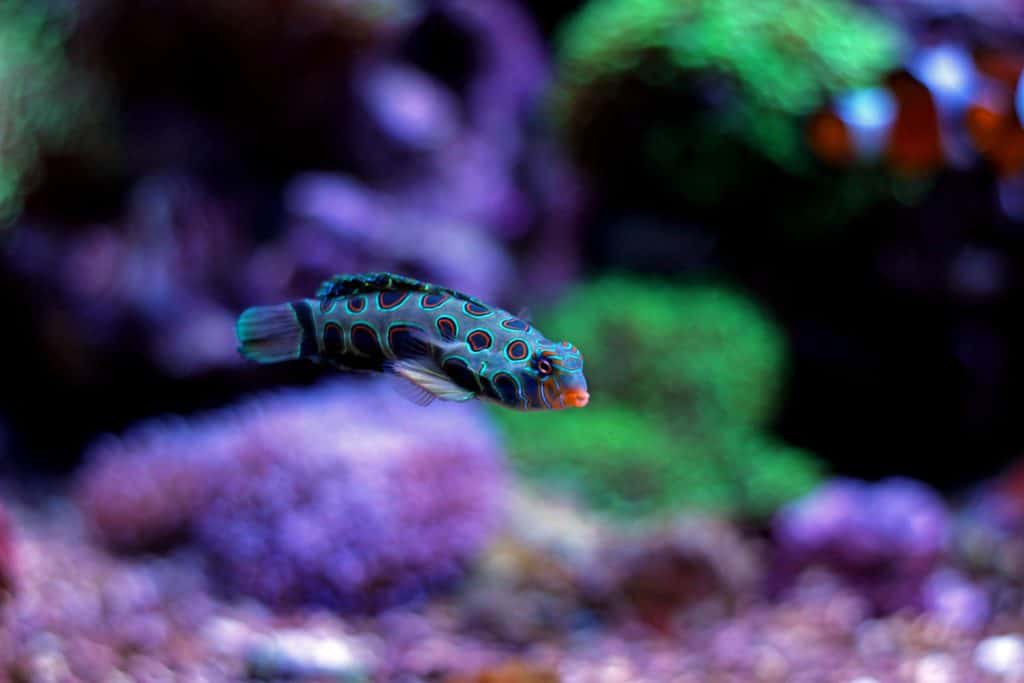
The picturesque dragonet is closely related to the Mandarinfish.
©Vojce/Shutterstock.com
Because it feeds almost exclusively on tiny copepods and live microcrustaceans rather than standard commercial flakes, it requires a well-established, mature live-rock saltwater tank with a self-sustaining pod population.
Betta
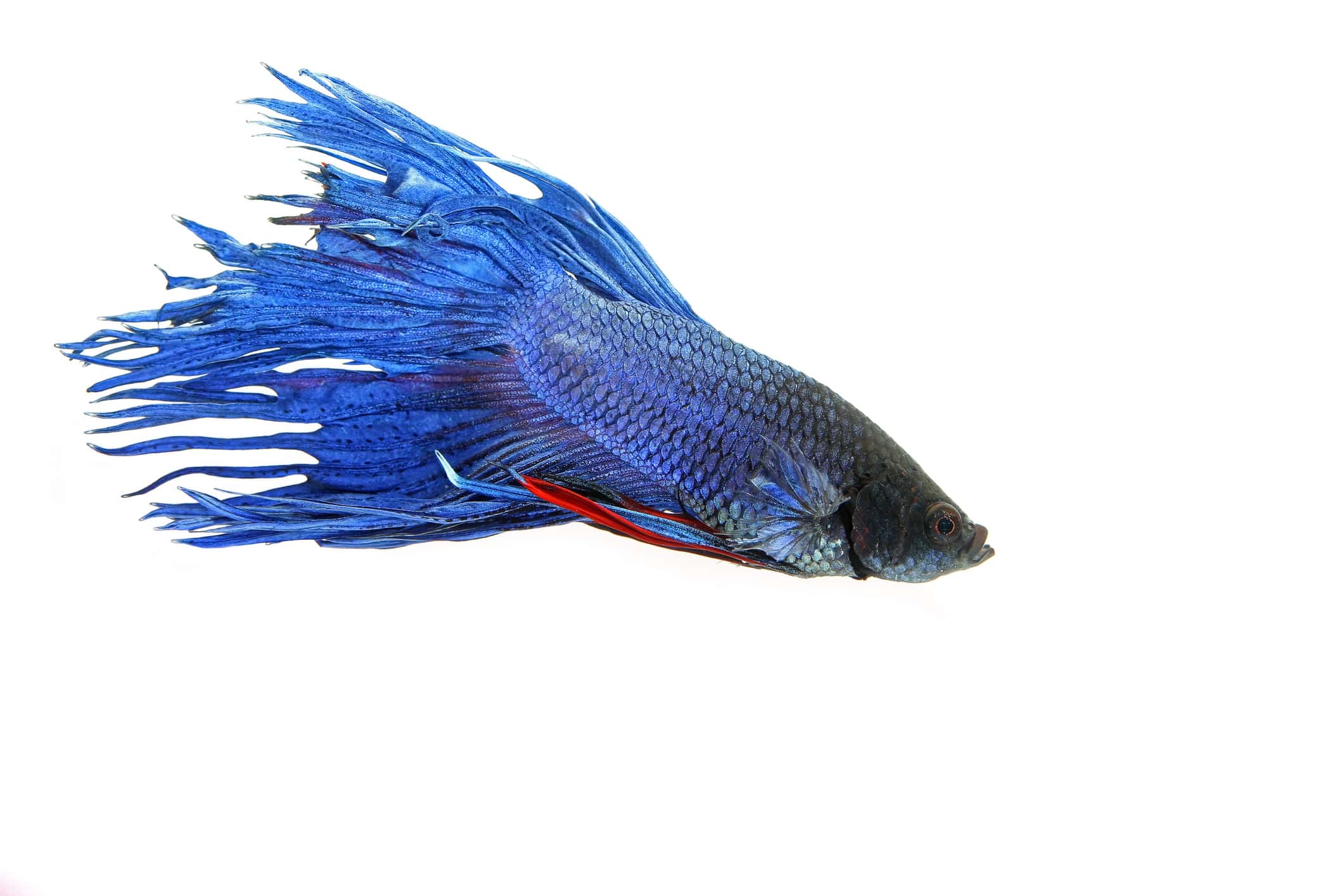
The betta fish (Betta splendens), commonly called the Siamese fighting fish, is a popular freshwater pet native to the warm, shallow rice paddies and slow streams of Southeast Asia. Bettas average 2.5 to 3 inches in length, including their elaborate, flowing fins. There are many distinct varieties of blue betta fish, which hobbyists generally categorize by their specific shade, pattern layout, and fin shape.
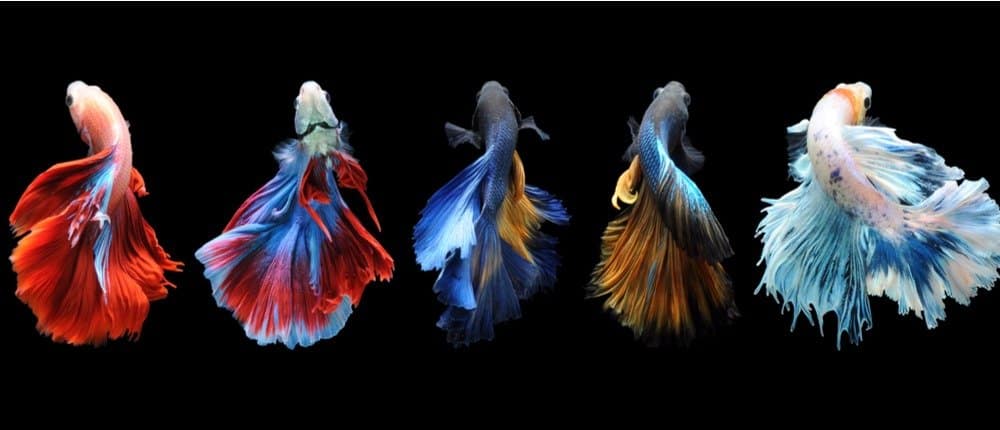
Betta fish come in many different blue varieties.
©Arif Supriyadi/Shutterstock.com
Blue is highly iridescent in betta fish, and selective breeding has produced an incredible range of blue varieties. These vibrant creatures make wonderful aquarium pets for owners willing to provide proper upkeep. While they are relatively low-maintenance and stunning to watch, they thrive in a filtered tank of at least 5 gallons with warm water (76 to 82°F). Male bettas must always be housed alone because of their fiercely territorial and aggressive nature.
Blue Cichlid
Cichlids are a vibrant group of freshwater aquarium fish primarily originating from Africa, Central and South America, and South Asia. Blue cichlid is a general term for many different fish in the Cichlidae family, such as the electric blue hap (Sciaenochromis fryeri), the blue peacock cichlid (Aulonocara nyassae), and the blue dolphin cichlid (Cyrtocara moorii). These fish display a striking blue coloration. Although cichlids are relatively hardy, many varieties require alkaline water and rocky areas to thrive in a home aquarium.
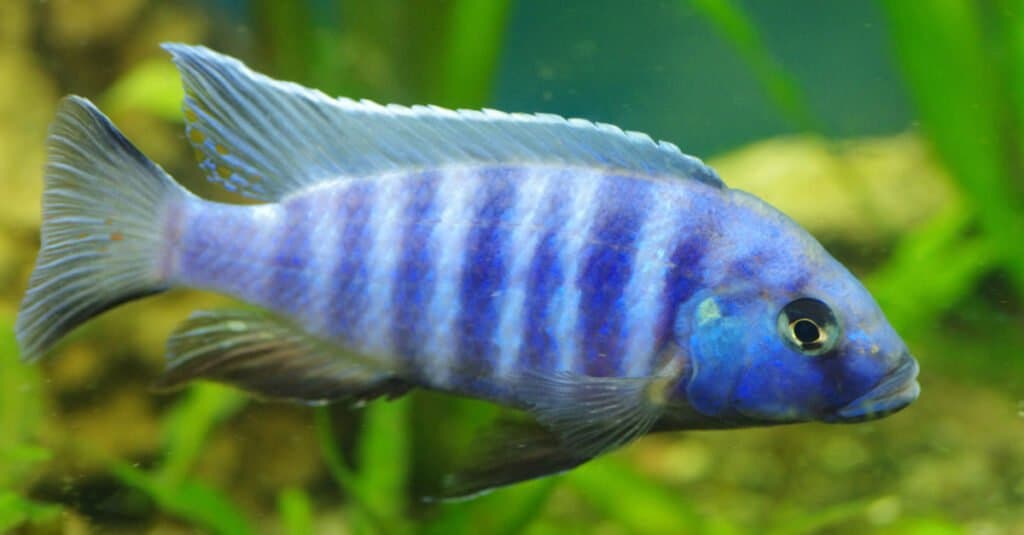
Larger aquariums are better for cichlids, like this blue zebra cichlid, which need plenty of space to thrive.
©Natalia Sidorova/Shutterstock.com
Lake Kutubu Rainbowfish
The Lake Kutubu rainbowfish (Melanotaenia lacustris) is endemic to Lake Kutubu and the Soro River in the Southern Highlands of Papua New Guinea. The rainbowfish has an average size of approximately 4 inches, with stunning iridescent turquoise, blue, and green scales that can shift rapidly depending on the lighting. Rainbowfish are a splendid addition to larger home aquariums because they are active, hardy schoolers.
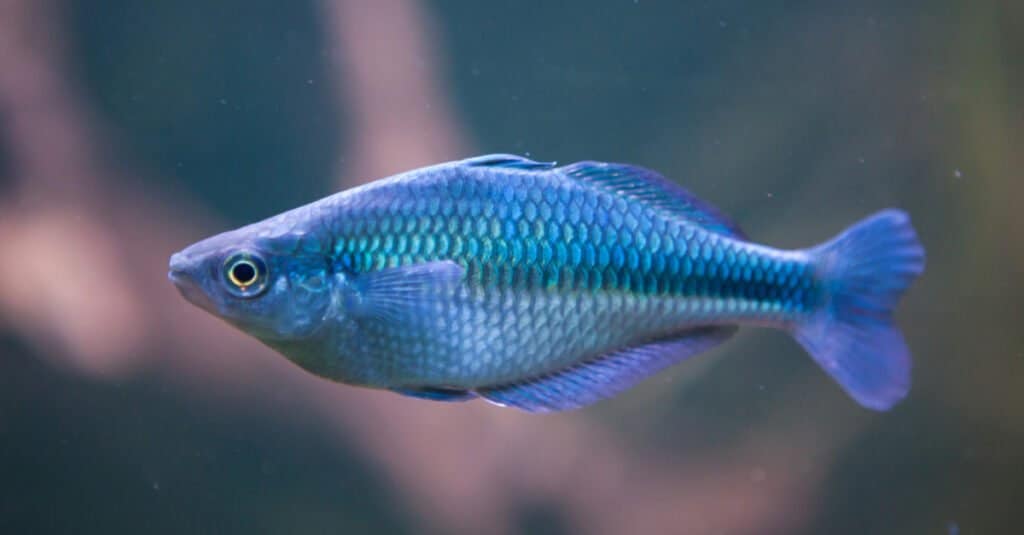
Lake Kutubu rainbowfish might not be as popular as other fish on the list, but they’re a brilliant shade of blue.
©Vladimir Wrangel/Shutterstock.com
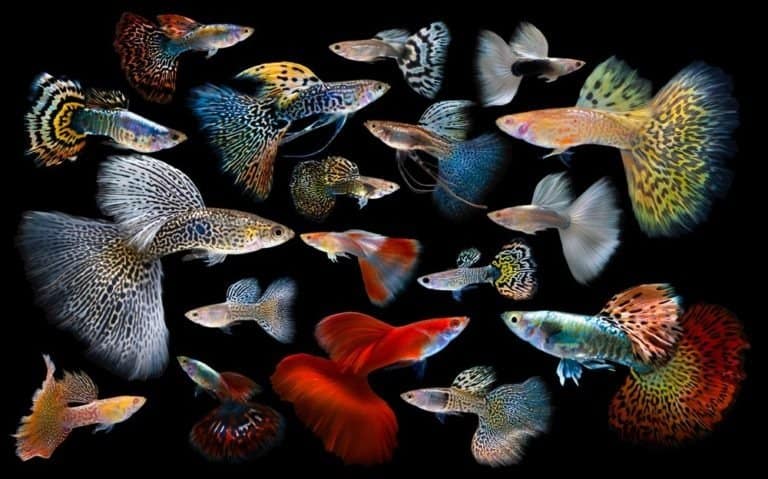
Blue Guppy
Guppies (Poecilia reticulata) are live-bearing, freshwater fish that are native to Northeast South America and the Caribbean. They are selectively bred in a variety of colors, including blue.
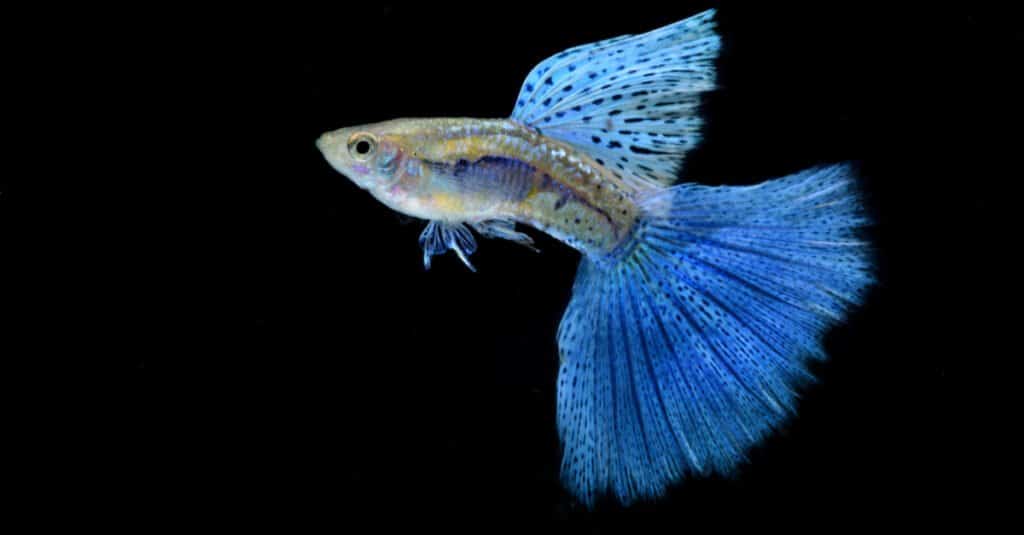
Blue guppies have differently colored bodies but their fins are an incredible blue.
©Nantawat Chotsuwan/Shutterstock.com
Guppies exhibit pronounced sexual dimorphism: adult males typically reach 0.6 to 1.2 inches with flowing fins, while females grow larger, reaching up to 2.4 inches and lacking flowing fins.
Guppies thrive in community tanks of 10 gallons or more, and they are considered a fabulous choice for the novice aquarist.
Dwarf Gourami
Dwarf Gouramis (Trichogaster lalius) can be bright blue or turquoise with red-orange vertical stripes, red or orange with contrasting blue stripes, or a plain, beautiful blue.
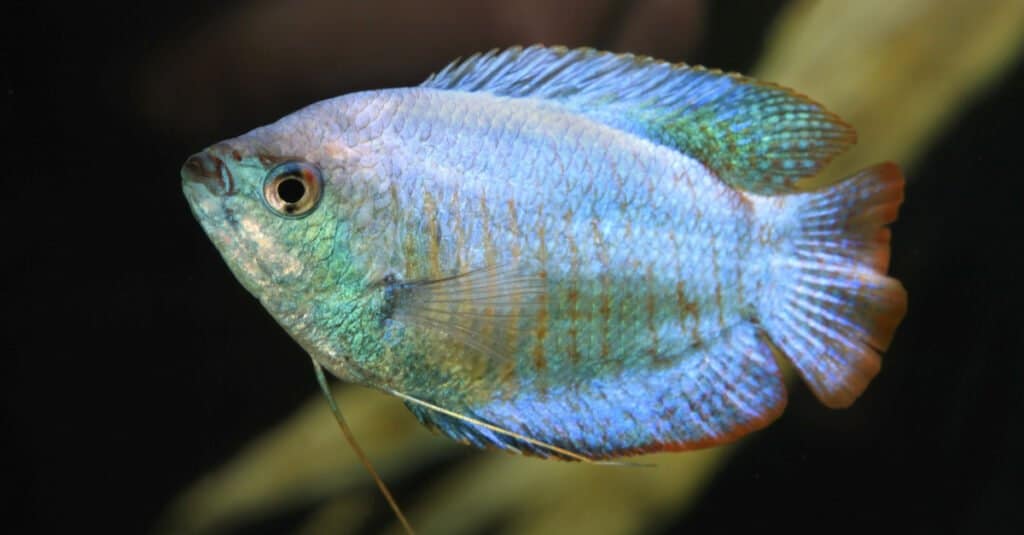
If you’re looking for a powder blue fish, some dwarf gouramis fit that color scheme.
©Steve Bower/Shutterstock.com
Dwarf gouramis are social schooling fish, so you’ll need at least six per tank. They average 3.5 inches in length, and a tank size of at least 29 gallons is needed to give them room to be active and school.
Royal Blue Tang
Royal Blue Tangs (Paracanthurus hepatus) are most recognized as Dory, the forgetful fish from the Pixar film Finding Nemo. They are blue with black markings and yellow tails and fins.
The royal blue tang is native to the coral reefs of the Indo-Pacific, with a wide distribution stretching from East Africa and the Red Sea all the way to Japan, Australia, and Samoa. While they can reach a maximum length of about 12 inches in the wild, captive royal blue tangs typically average between 8 and 10 inches in length.
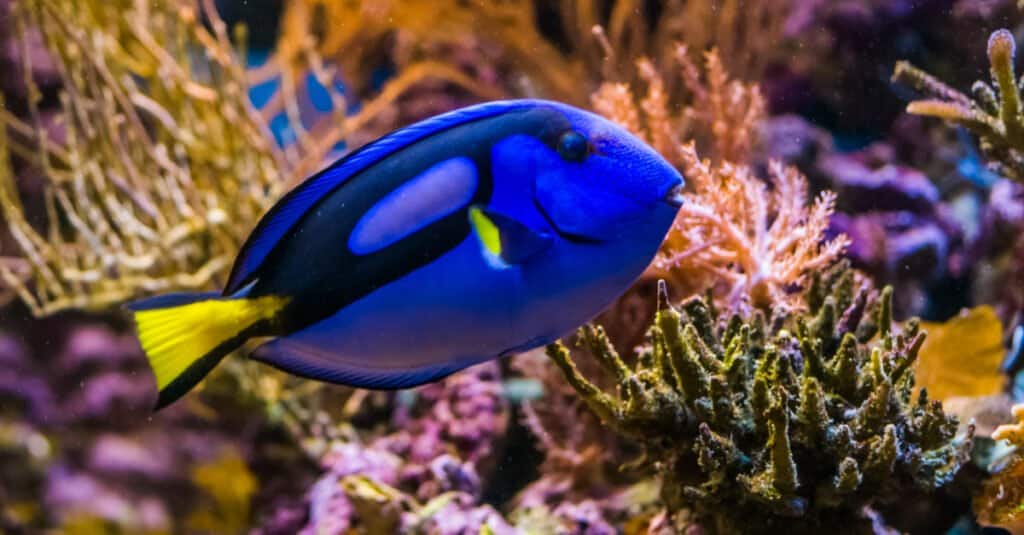
Blue tangs are an intense shade of blue.
©Charlotte Bleijenberg/Shutterstock.com
Unfortunately, these fish are not suitable for home aquariums because they cannot be ethically sourced. They only breed in the wild, never in captivity, meaning that any royal blue tang fish you purchase will have been wild-caught.
Yellowtail Damselfish
The yellowtail damselfish (Chrysiptera parasema) has a cobalt body and a bright yellow tail. It is a small marine fish native to the coral reefs of the Western Pacific, around Indonesia, the Philippines, New Guinea, and the Solomon Islands.
In a home aquarium, yellowtail damselfish have an average adult length of 2 to 3 inches. They make excellent aquarium fish, particularly for beginners, due to their extreme hardiness, active swimming behavior, and striking color.
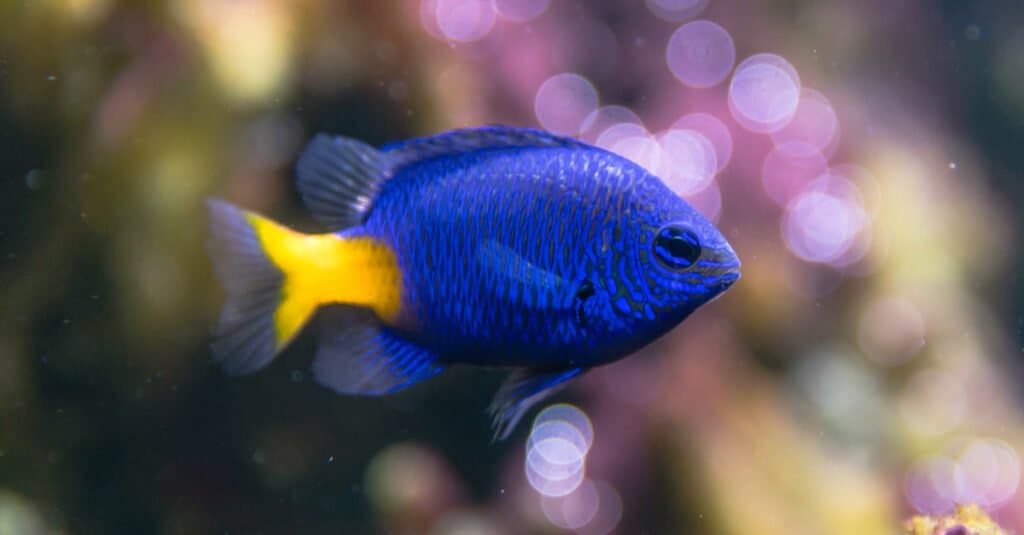
Yellowtail damselfish are saltwater fish that can be quite aggressive
©IanRedding/Shutterstock.com
Considered one of the least aggressive damselfish species, yellowtail damselfish can be successfully housed with other semi-aggressive community fish if given plenty of rockwork hiding spaces.
Cherub Pygmy Angelfish
The cherub pygmy angelfish (Centropyge argi), also commonly known as the cherubfish or Atlantic pygmy angelfish, is a small marine fish native to the Western Atlantic Ocean. Its natural distribution spans from the coastlines of North Carolina and Bermuda, southward through the Gulf of Mexico and the Caribbean Sea, all the way to French Guiana in South America. The cherub pygmy angelfish has a brilliant metallic sapphire-blue body contrasted by a vivid orange-yellow head, face, and chest. Cherubfish reach an adult size of between 2 and 3 inches, making them a popular choice for smaller saltwater aquariums.
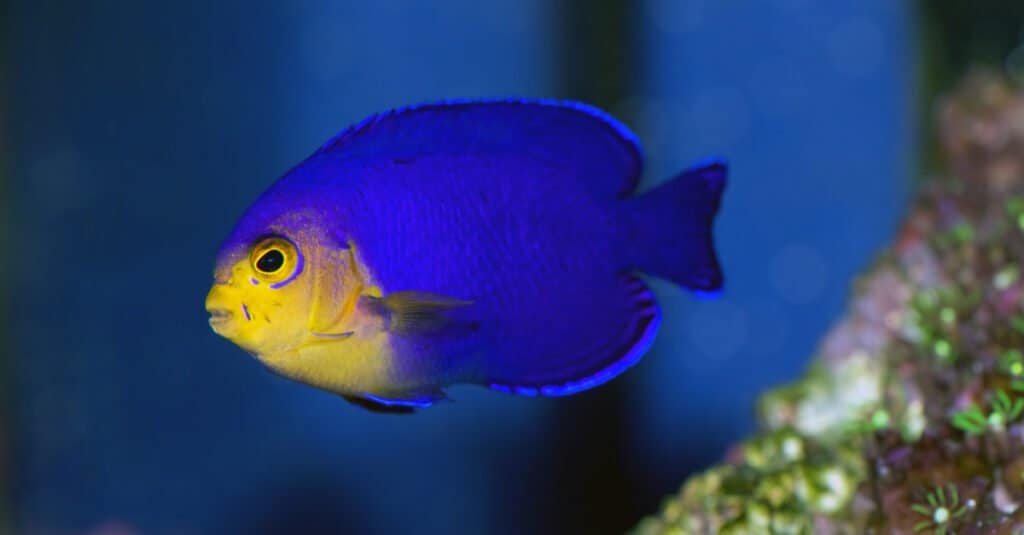
Cherub angelfish are oval-shaped with blue bodies and yellow faces.
©PAUL ATKINSON/Shutterstock.com
Cherub pygmy angelfish must be kept in schools of six or more in at least an 80-gallon tank. They may show aggression toward other species and should only be kept with similar-sized or larger fish to prevent them from eating smaller fish.
Blue Discus
The blue discus (Symphysodon aequifasciatus) is native to the Central and Eastern Amazon River Basin in South America. As its name suggests, the blue discus is a disc-shaped fish, covered with iridescent blue-green horizontal stripes or vertical bars. Captive-bred varieties may have solid, vibrant metallic blue bodies.
In the wild, discus fish reach an average size between 5 and 6 inches in diameter, while well-cared-for aquarium specimens can grow to between 8 and 9 inches. Blue discus make excellent aquarium fish, although they are not recommended for beginners, as they have strict water parameters and large space requirements. Because discus fish are schooling fish, it is recommended to keep a minimum of six.
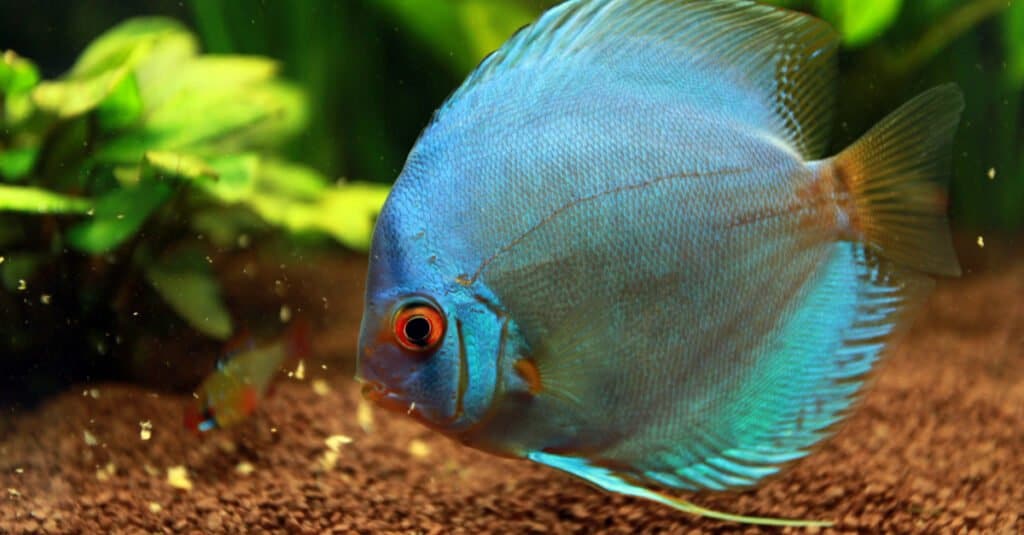
The blue discus can have incredible blue-turquoise coloring.
©Ivan Roth/Shutterstock.com