
Quick Take
- One fish on this list doesn't have scales at all, and its secret defense mechanism is stranger than you'd expect. See the scaleless wonder →
- Some of these fish start life as one color and one sex, then transform into something almost unrecognizable. Explore the color transformation →
- One species here is so rare that collectors pay tens of thousands of dollars just to own it, and the whole thing fits in the palm of your hand. Meet the rare peppermint angelfish →
- Bright colors aren't always about standing out. For several fish here, vivid patterns are actually a survival tool hiding in plain sight. See color as camouflage →
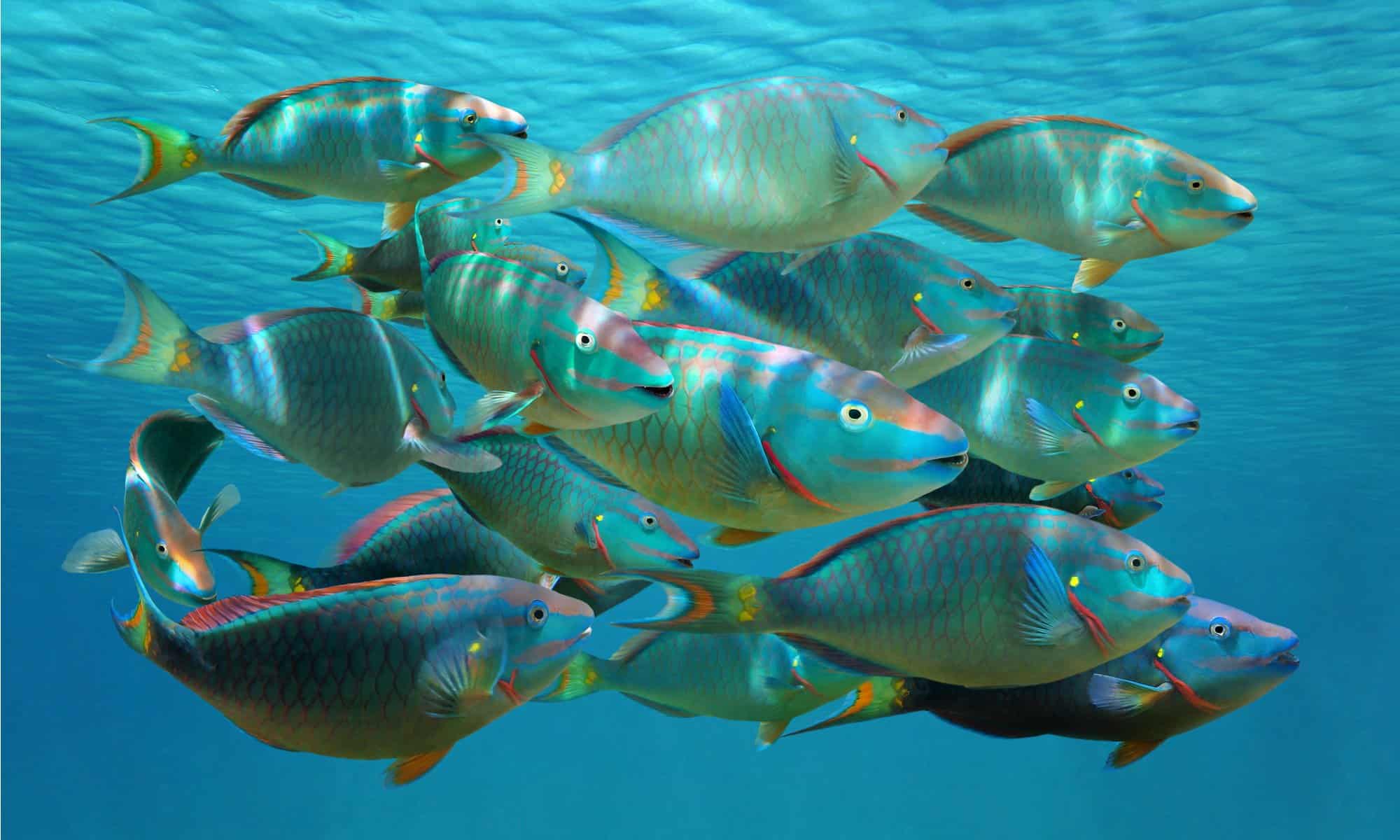
The oceans of the world are home to an estimated 20,000 species of saltwater fish. Some fish are like the flounder, a uniform brown or dark grey so they can blend into their surroundings in the open ocean or the on the sea floor. However, even vibrantly colored fish like the stoplight parrotfish rely on their vivid color patterns to blend in with the brightly pigmented corals in reef habitats. Continue reading to learn about 15 of the most colorful saltwater fish, including where you can find them in the world.
1. Flame Angelfish
The flame angelfish (Centropyge loricula) has several other names that you may be more familiar with, such as the flame angel, flaming angelfish, or Japanese pygmy angelfish. They are named for their bright orange and yellow bodies. They have vertical black bars on their sides, and their tail fins are edged in violet-blue. These fish typically reach 4-6 inches in length, with males being larger.
Flame angelfish are native to the tropical regions of the Pacific Ocean. Most commonly, they can be found around the reefs of Australia and the surrounding islands. Flame angelfish may also be found around the Hawaiian Islands, although this is a less common occurrence. These colorful saltwater fish can also live in aquariums and tanks.
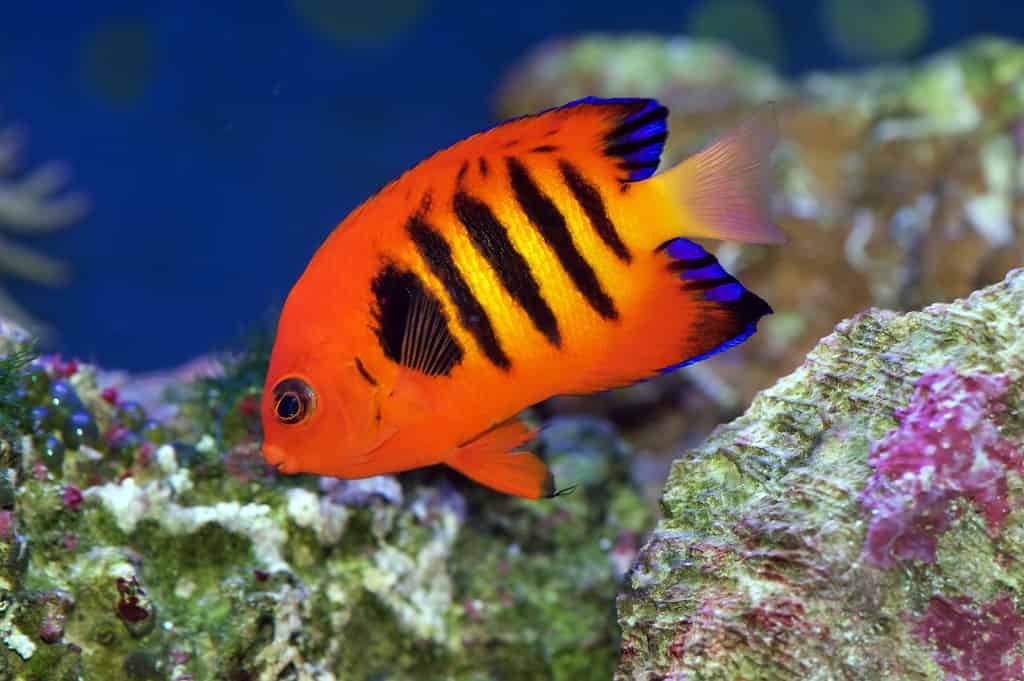
Flame angelfish get their name from their fiery orange and yellow bodies.
©PAUL ATKINSON/Shutterstock.com
2. Queen Angelfish
Another member of the family Pomacanthidae, the queen angelfish (Holacanthus ciliaris) is located in the western Atlantic Ocean. This species is also known as the blue angelfish, golden angelfish, and yellow angelfish. The queen angelfish lives just above the bottom, staying close to the substrate in the warm waters of coral reefs. These fish measure up to 18 inches long, with males being larger.
The scales of this species are a blue-green color with yellow tips. Their fins are bright yellow, with orange tips and blue bases in some areas. Queen angelfish also have brightly colored markings. They have a cobalt blue “crown” above their eyes, which is where they get their name. This crown also distinguishes them from other closely related species. As juveniles, they have brightly colored blue vertical stripes that fade as they mature.
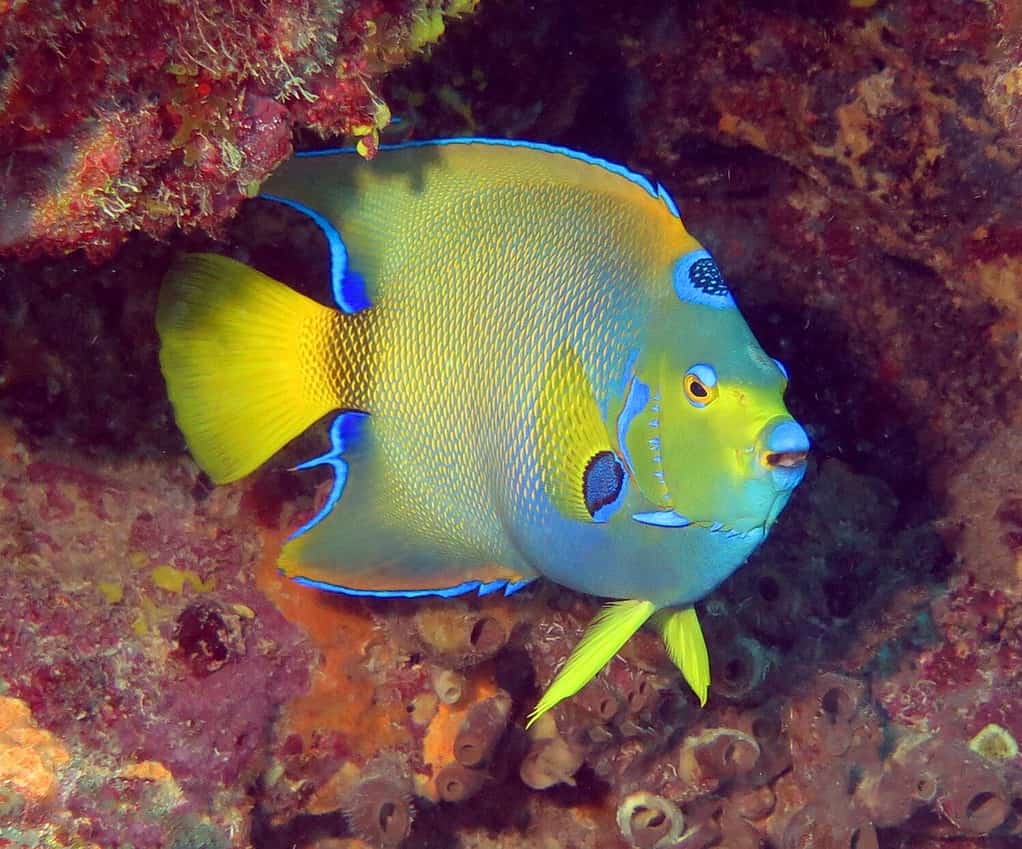
The queen angelfish lives just above the ocean floor.
©Daryl Duda/Shutterstock.com
3. Mandarin Dragonet
The Mandarin dragonet (Synchiropus splendidus) is a popular saltwater aquarium fish. Their brightly colored bodies can light up a tank. The Mandarin dragonet is native to the warm waters of the Pacific Ocean. This includes the waters surrounding the Japanese Ryukyu Islands south to the islands surrounding Australia. Their specific name, splendidus, comes from the Latin for “glittering” and “bright,” which is a proper name for this colorful saltwater fish. These fish measure up to around 3 inches long.
This fish is one of few vertebrates that have natural bright blue coloring, which comes from light-reflecting cells called cyanophores. Their blue bodies are adorned with a swirling, psychedelic orange, yellow, and green pattern. Research has unveiled that the Mandarin dragonet does not have scales, but instead, it has a slime coat that protects it from parasites and deters predators. It is hypothesized that they are aposematic, and their bright colors act as a warning like the coloration of a poison dart frog.
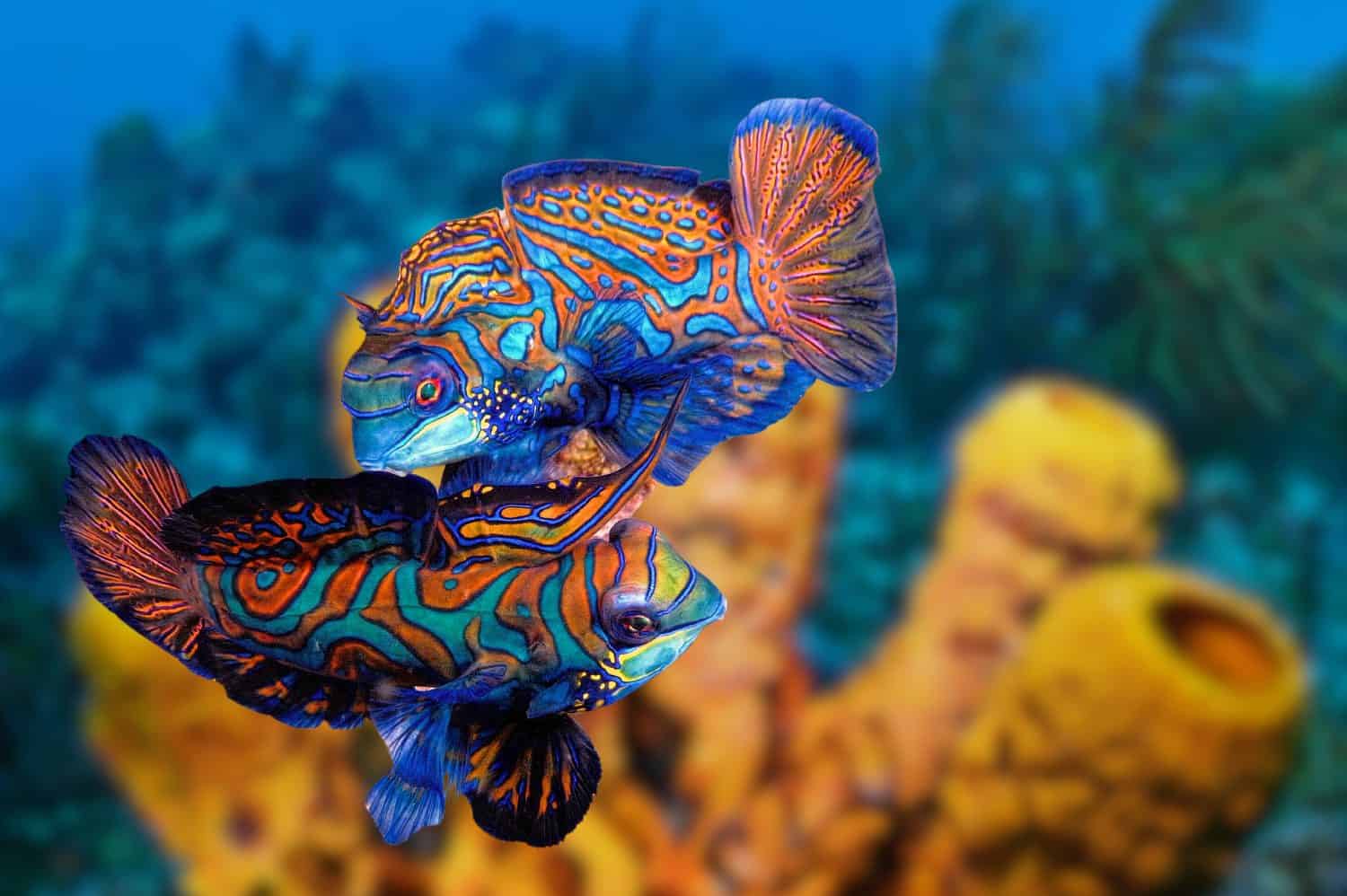
Mandarin dragonets have a beautiful blue, orange, green, and yellow color pattern.
©Makabas/Shutterstock.com
4. Emperor Angelfish
The emperor angelfish (Pomacanthus imperator) is another reef-associated fish. This species is widely distributed throughout the Indo-Pacific region from East Africa to the Hawaiian Islands. They are a relatively large species, reaching a maximum length of around 15 inches. This fish is popular for both its juvenile and adult coloration.
As a juvenile, the emperor angelfish has a dark blue body with concentric curving lines. These lines alternate between blue and white, creating an eye-catching pattern. The adults have a much different, but equally stunning, coloration. Adults have pale blue faces, with a dark blue mask around the eyes. Their bodies have yellow and blue stripes. The bottom of their bodies, near the pelvic and anal fins, is dark blue. In contrast, the dorsal region is a striking bright yellow color.
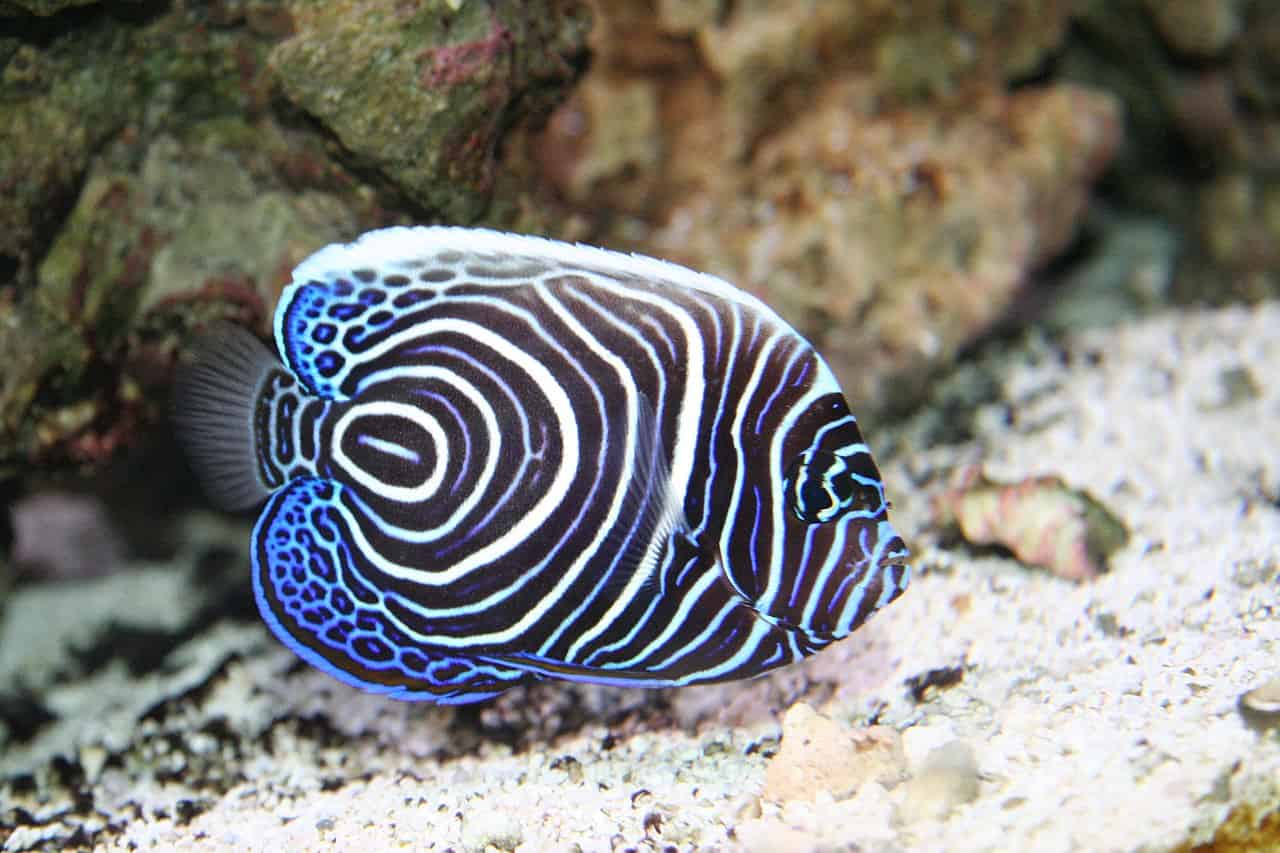
Juvenile emperor angelfish have an eye-catching curved pattern that changes as they mature.
©Vic Brincat (cadmanof50s) from Keswick, Ontario, Canada, CC BY 2.0, via Wikimedia Commons – Original / License
5. Royal Dottyback
The royal dottyback (Pictichromis paccagnellae) is also known as the bicolor dottyback, gramma dotty, and false gramma. These fish are often kept in marine aquariums for their striking coloring. The front part of these fish is vivid purple, while the back half is bright yellow. They also have a blue circle around their eyes. They only reach up to 3 inches in length.
Like the emperor angelfish, most royal dottybacks are native to the Indo-Pacific Ocean. Populations are concentrated around coral reefs in Indonesia, where they hide among the rocks and in crevices. These small fish are feisty and territorial. They do not tolerate members of their own species and will defend their areas against much larger fish.
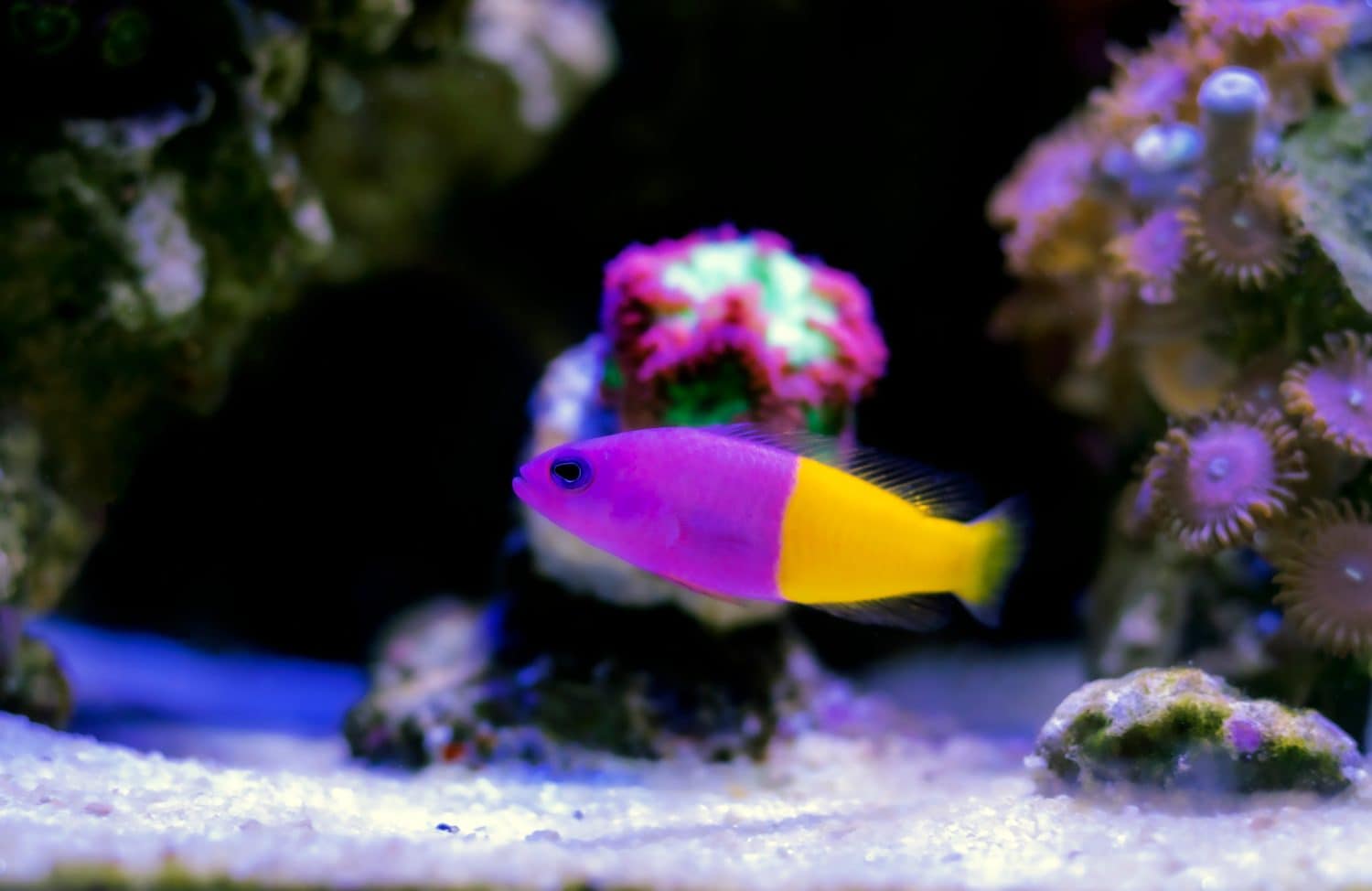
Royal dottybacks are also known as bicolor dottybacks due to their purple and yellow coloring.
©Vojce/Shutterstock.com
6. Stoplight Parrotfish
Although most species of parrotfish boast beautiful colorations, the scales of the stoplight parrotfish (Sparisoma viride) are especially striking. They get their name for the striking yellow patch at the base of the pelvic fins that looks like a traffic light. They inhabit the coral reefs in the tropical waters of the western Atlantic Ocean, including the Gulf of Mexico and the Caribbean Sea. These fish typically measure between 12 and 18 inches, although some may grow larger.
The stoplight parrotfish is a protogynous hermaphrodite, which means that it changes from female to male during its life. The terminal phase is the final stage, during which they are male. In the juvenile phase, the stoplight parrotfish starts out reddish-brown with black scales, horizontal rows of white spots, and a pale red stomach. In the initial phase, they become a more mottled reddish-brown color with a bright red belly. During the terminal phase, they develop a bright aqua green coloration with vibrant pink and yellow markings on their tails, gill slits, heads, and fins.
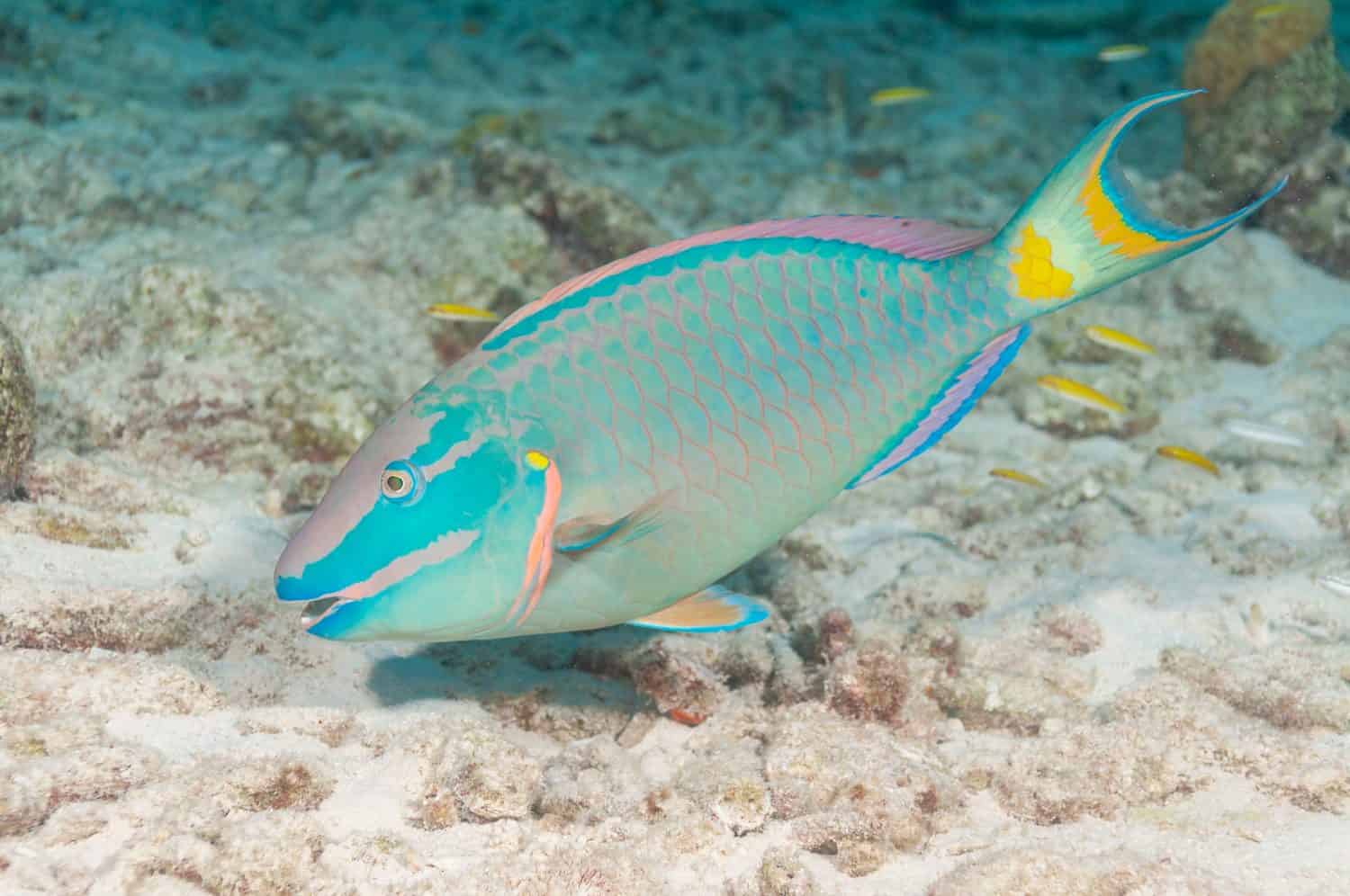
The stoplight parrotfish is one of the most colorful saltwater fish with its aqua, pink, and yellow pattern.
©Jesus Cobaleda/Shutterstock.com
7. Scrawled Cowfish
The scrawled cowfish (Acanthostracion quadricornis) has a beigey-yellow body with bright blue scrawled markings across their bodies. They also get their name, cowfish, from the horn-like projections that grow above their eyes. Along with their blue markings, scrawled cowfish have several dark blotches along their bodies. These fish can measure up to 22 inches in length.
Scrawled cowfish can be found throughout the Western Atlantic Ocean. However, their range is not as extensive as that of the hogfish. They live in the waters off the coast of Massachusetts to Brazil. These fish live in shallow water, typically among grass beds. When threatened, rather than fleeing or fighting, the scrawled cowfish will attempt to remain motionless, relying on its camouflage for protection.
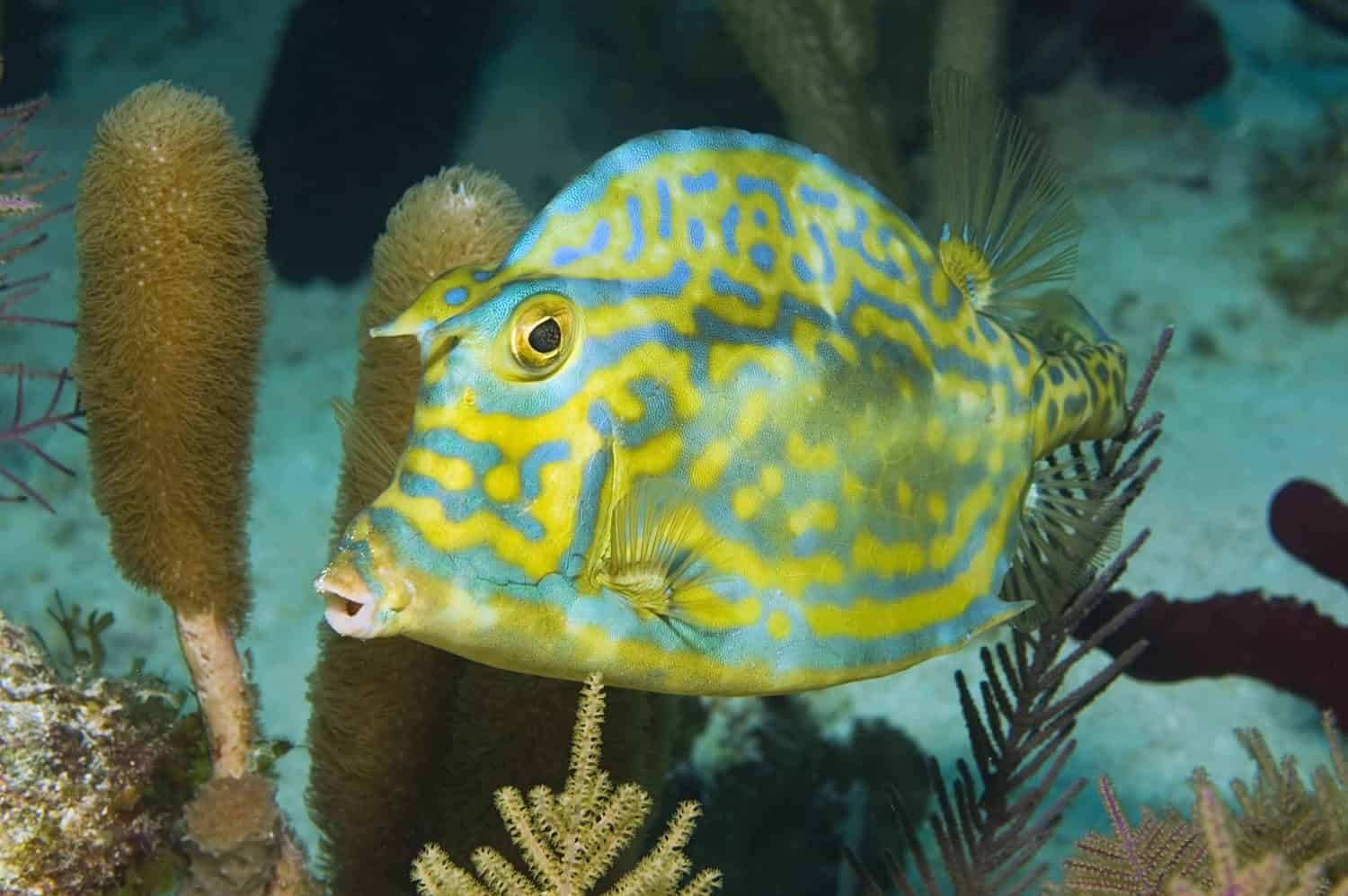
Scrawled cowfish can be found in shallow waters in the Western Atlantic.
©Durden Images/Shutterstock.com
8. Regal Blue Tang
You may recognize this colorful saltwater fish from the movie “Finding Nemo.” The regal blue tang (Paracanthurus hepatus), also known as the blue tang, is a species of surgeonfish popular in marine aquariums. Large adults can reach a maximum of approximately 12 inches in length.
The regal blue tang inhabits the warm coral reefs of the Indo-Pacific, from East Africa across to Japan, and down to the Great Barrier Reef in Australia. This flat, oval fish has a royal blue body with a darker blue marking across its upper body. Its fins are also edged in darker blue. It also has a bright yellow tail and pectoral fins. The blue coloring does not come from pigmentation, but from structures in skin cells called iridophores.
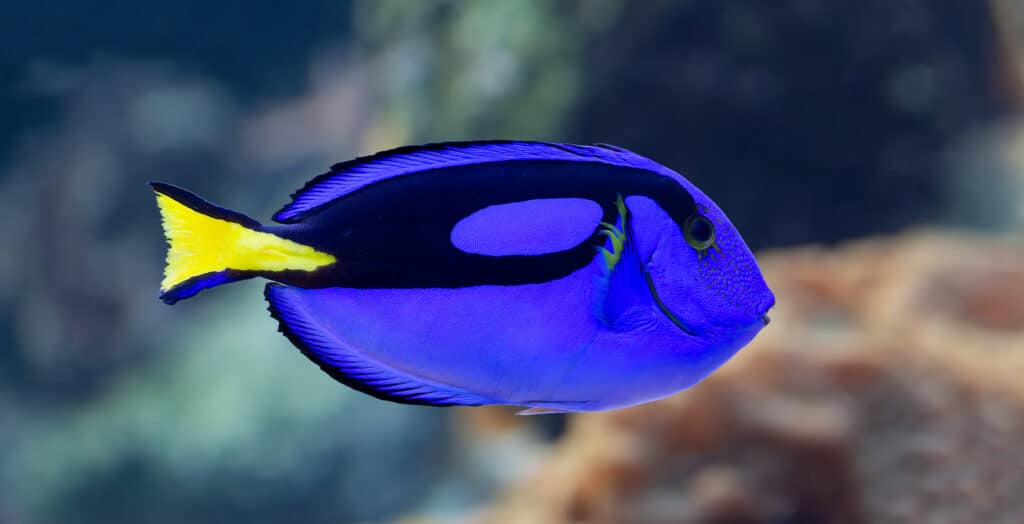
Dory in “Finding Nemo” is a regal blue tang.
©Henner Damke/Shutterstock.com
9. Pajama Cardinalfish
The pajama cardinalfish (Sphaeramia nematoptera) is a popular aquarium species that goes by many other names, including spotted cardinalfish, coral cardinalfish, and polkadot cardinalfish. They are named for their colorful polka dots on the back half of their bodies. Along with these brownish-orange dots, they have dark edged scales in the middle of their bodies, greenish-yellow faces, and bright orange eyes. The fins on the front half of their body are greenish-yellow, while the fins on their back half are transparent.
While they may be bold in color and appearance, the pajama cardinalfish has a mild personality. These fish easily assimilate into marine aquariums. However, they are a schooling species with a social hierarchy. Pajama cardinalfish are native to the Western Pacific Ocean. You can find them as far south as the Great Barrier Reef. These small fish generally grow up to 3.3 inches in length.
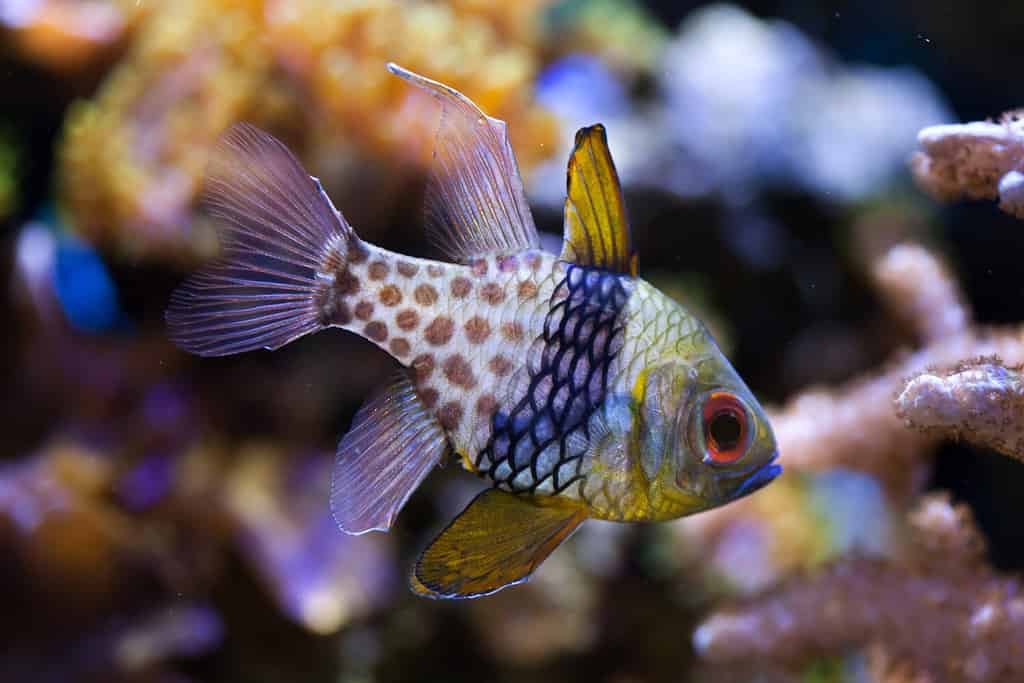
Pajama cardinalfish have a unique polka-dotted appearance.
©Vladimir Wrangel/Shutterstock.com
10. Cinnamon Clownfish
The cinnamon clownfish (Amphiprion melanopus) is another species that may transition from female to male during their lifetime. Like other species of clownfish, the cinnamon clownfish has a symbiotic relationship with sea anemone. Cinnamon clownfish are native to the Western Pacific Ocean. They range from Indonesia to Micronesia and French Polynesia.
Cinnamon clownfish have reddish-orange bodies with dark sides and the clownfish’s characteristic white head stripe. Their pectoral, pelvic, and anal fins are often black or dark brown, but their faces, dorsal fins, and tail fins are generally a brighter orange shade. These fish typically reach between 3.5 and 5 inches in length.
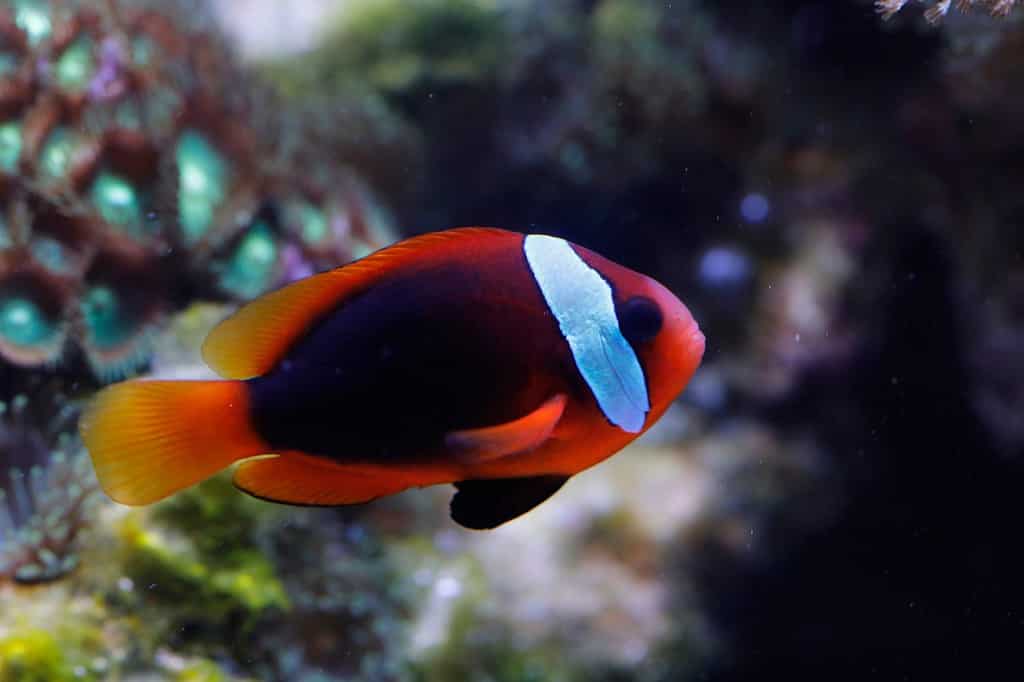
Cinnamon clownfish are native to the Western Pacific Ocean.
©R. Maximiliane/Shutterstock.com
11. Blue Triggerfish
When it comes to appearances, there’s no doubt that the blue triggerfish (Odonus niger) is one of the most colorful saltwater fish in the world. These fish are blue, purple, or dark teal with light blue head markings and fin margins. It also has small, red teeth that are visible even when its mouth is closed. Because of its teeth, other names for this fish species include redfang triggerfish, redtoothed filefish, and redtoothed triggerfish.
The blue triggerfish has the ability to change its color as a response to food, water quality, environment, stress, and other factors. These fish are native to the Indo-Pacific Ocean and Red Sea. Like many other species considered to be the most colorful saltwater fish, they can be found in the Great Barrier Reef. Blue triggerfish typically measure up to around 12 inches.
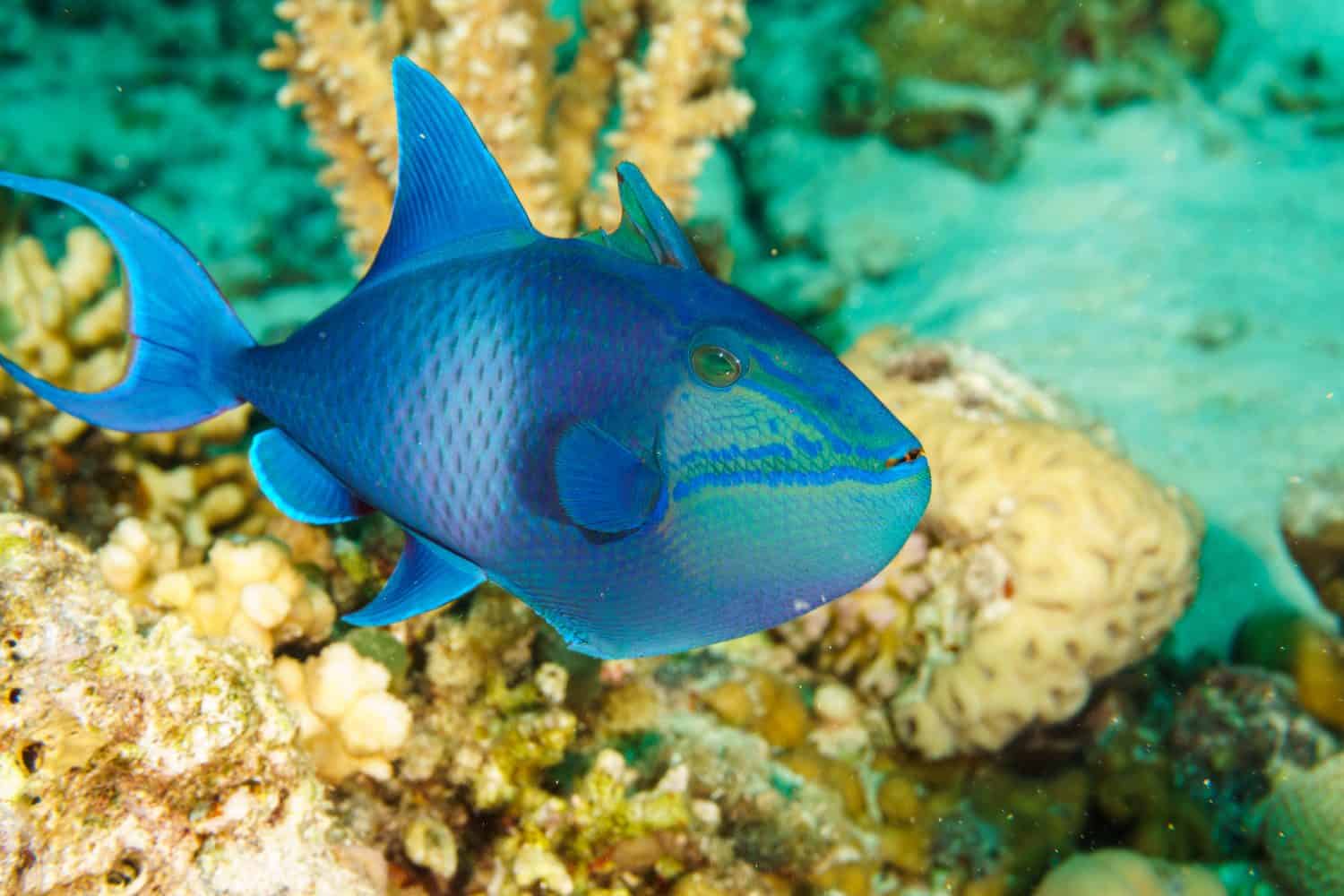
Blue triggerfish are a vibrant purple, blue, and green, along with fierce red teeth.
©Artur_Sarkisyan/Shutterstock.com
12. Peppermint Angelfish
The peppermint angelfish (Centropyge boylei) is a small, orange-red fish with several white vertical bands on its sides. This fish can also have yellow highlights on its face and fins. Peppermint angelfish measure less than 3 inches when fully grown.
These angelfish are native to the eastern-central Pacific Ocean, including the waters off the Cook Islands. They inhabit deep, tropical coral reefs, sheltering in caves and crevices or under rocky overhangs and ledges. Due to the challenges of collecting and transporting them, these rare fish are highly sought after by saltwater aquarium enthusiasts, often commanding tens of thousands of dollars.
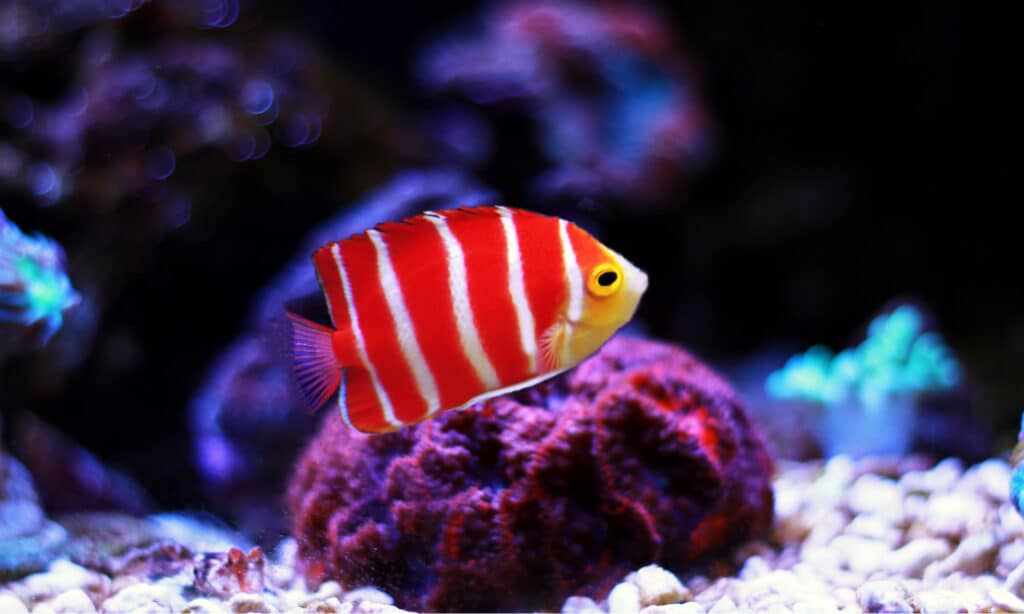
The peppermint angelfish’s unique colors make them look like the candy that they are named for.
©Vojce/Shutterstock.com
13. Surge Wrasse
The surge wrasse (Thalassoma purpureum) is often found in the surge zone on reef flats and margins This colorful fish is also called the purple wrasse, green-blocked wrasse, or the red and green wrasse. There is sexual dimorphism when it comes to color. Males are a bright, greenish-blue color with two reddish-pink horizontal stripes on the sides. They have large heads with pinkish-purple markings. Females are greener and less bright, with a dark red V-shaped marking on their snouts.
Like the stoplight parrotfish discussed above, surge wrasse are also protogynous hermaphrodites, with the ability to change from female to male. These fish are primarily found in the Indo-Pacific, from East Africa to the Eastern Pacific, including northern New Zealand. They also inhabit the southeastern corner of the Atlantic near South Africa. Surge wrasse measure a maximum of about 18 inches in length.
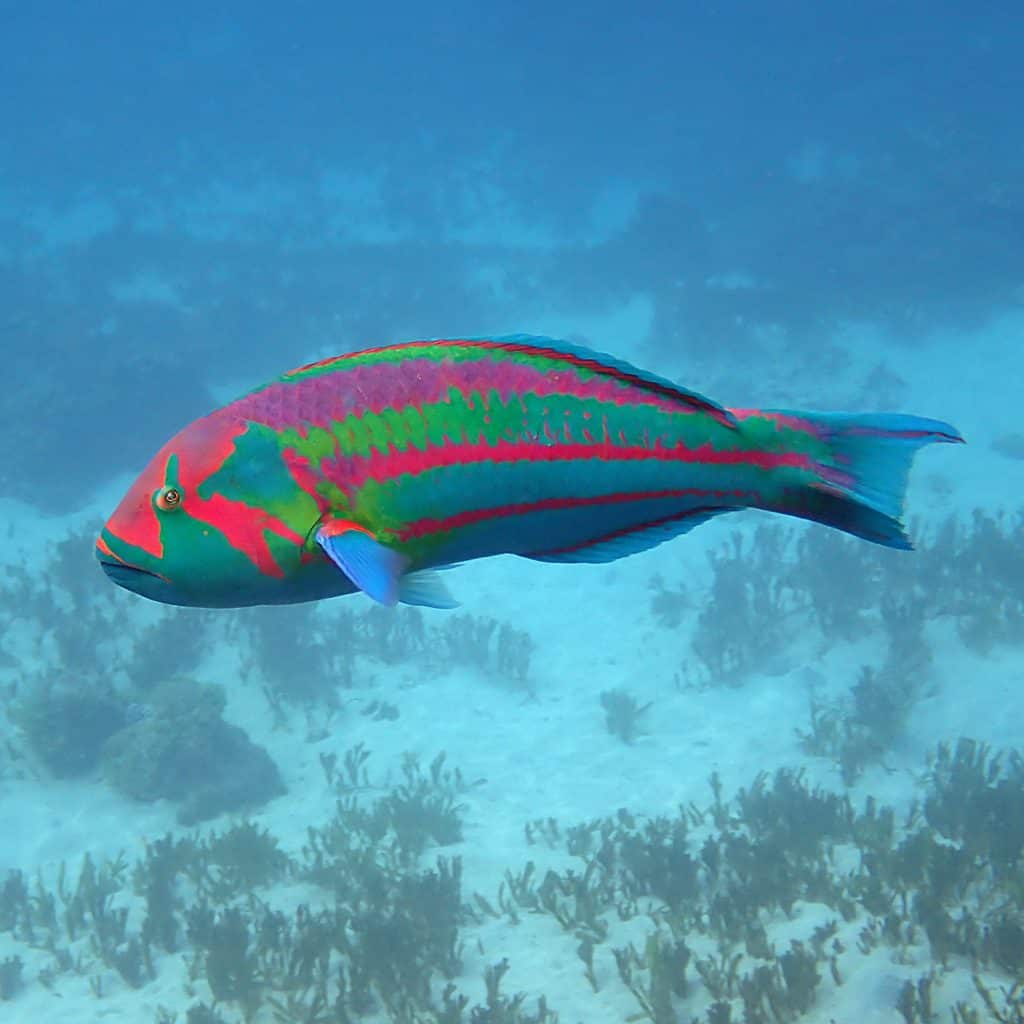
Surge wrasse are native to the southeast Atlantic, Indian, and Pacific Oceans.
14. Rainbow Parrotfish
Rainbow parrotfish (Scarus guacamaia) are some of the largest species of parrotfish in the world. In the Atlantic Ocean, where they are native, they are the largest parrotfish, measuring up to 4 feet in length and weighing up to 44 pounds. The rainbow parrotfish is a shallow-water fish. You can find them inhabiting areas such as mangroves and sea grass beds.
The extremities of the rainbow parrotfish, such as its head and fin tips, are brown. However, the rest of the body is a vibrant turquoise-green color. It also has blue-green dental plates, which gives it a striking appearance. They also have subtle orange markings, such as along their fins.

The rainbow parrotfish is the largest Atlantic parrotfish species.
©Denisse Pohls/Shutterstock.com
15. Coral Grouper
The coral grouper (Cephalopholis miniata), also known as the coral hind, has a bright, orange-red body with electric blue spots and yellowish-orange pectoral fins. Juveniles are yellower with fewer and fainter blue spots that become brighter as they mature.
These fish favor clear waters where there are coastal and mid-shelf reefs. They are widely distributed throughout the Indo-Pacific, from the coast of East Africa across to the Western Pacific and Australia. Coral groupers are relatively large fish that can grow up to 18 inches in length.
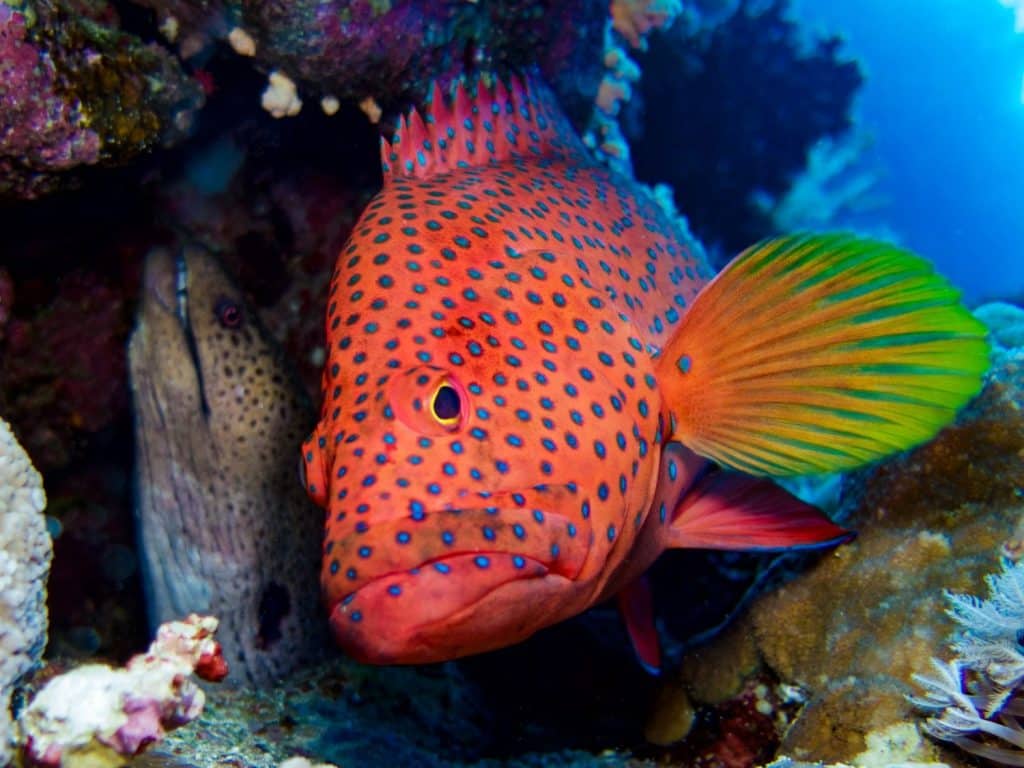
The coral grouper can reach a maximum of approximately 18 inches in length.
©Sakis Lazarides/Shutterstock.com