
Quick Take
- The octopus does something on camera that researchers almost never get to witness, and the behavior changes how it looks entirely. Watch the rare footage →
- Those oversized 'ears' aren't what they seem, and understanding them is the key to understanding how this creature survives where almost nothing else can. See how those fins work →
- The umbrella shape is striking, but there's a hidden adaptation on this octopus that scientists still don't fully understand. Discover the hidden adaptation →
- Its ghostly glow under the ROV lights looks like bioluminescence, though the reality is far stranger. Understand its pale appearance →
Nearly two miles beneath the Pacific Ocean, there is no sunlight, the water is bitterly cold, and the pressure is enormous. Yet that is exactly where researchers encountered an octopus that looked almost too strange to be real.
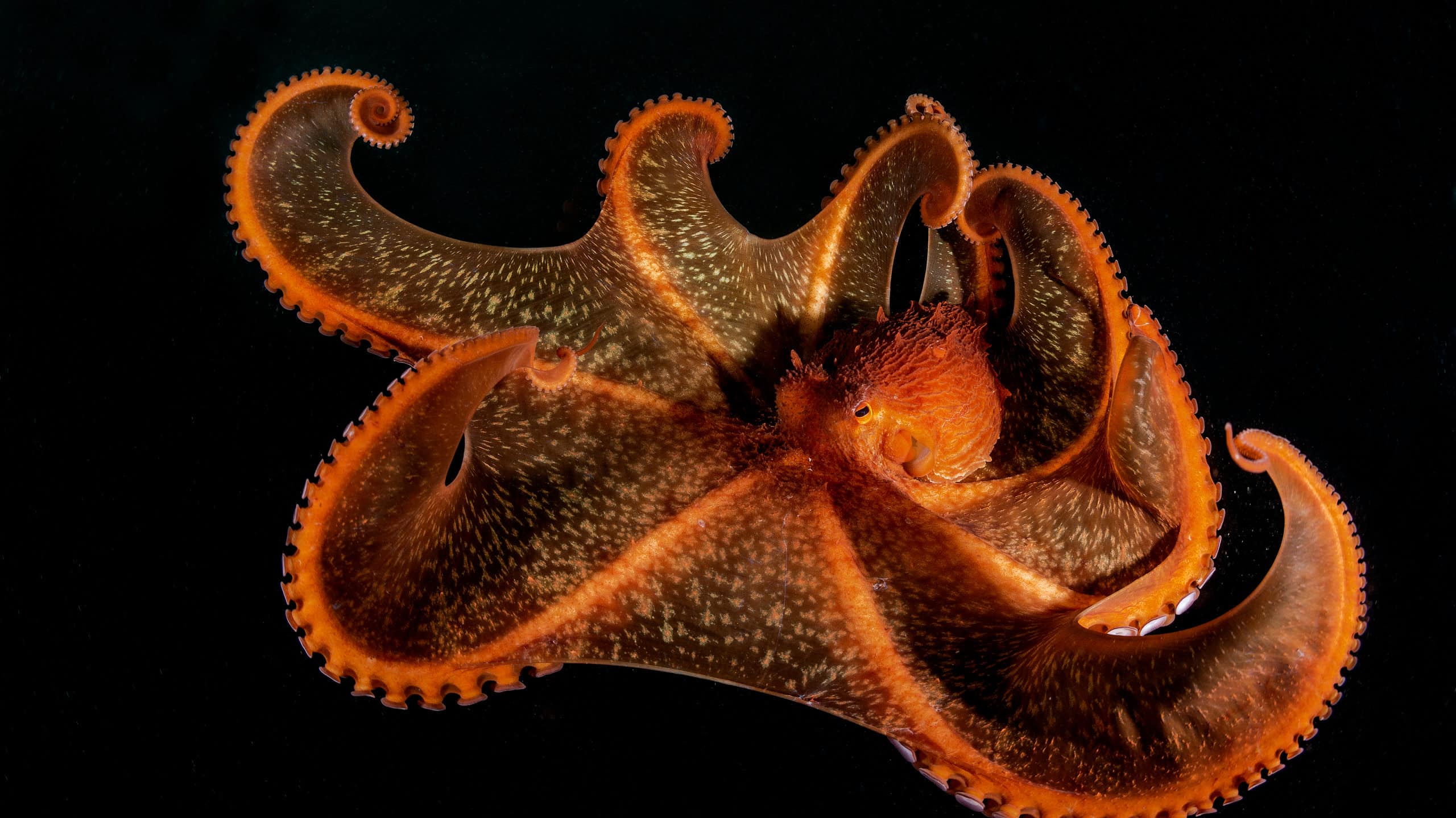
Footage captured by the ROV Hercules shows a pale Grimpoteuthis octopus gliding through the darkness near California’s Davidson Seamount. Then the animal does something even more remarkable: it unfurls its webbed arms and seems to transform into a living underwater umbrella.
Watch the Ghostly Octopus Open Its Arms
The footage was recorded during a 2018 expedition aboard the E/V Nautilus in Monterey Bay National Marine Sanctuary. As ROV Hercules explored previously unvisited rocky habitat southeast of Davidson Seamount, the octopus drifted into view and began flapping the pair of large fins on its body.
Then comes the moment that makes the video. The octopus turns its webbed arms outward, ballooning open and exposing the underside of all eight arms and their rows of suckers. Scaling lasers on the ROV allowed researchers to estimate the animal at about 60 centimeters, or just under 2 feet, long.
Those Giant “Ears” Are Actually How It Swims
Dumbo octopuses look very different from the octopuses most of us picture hiding in reefs or tide pools. Members of Grimpoteuthis have two prominent fins extending from the mantle above their eyes. The resemblance to oversized ears is what gave them their famous nickname.
Those fins are not just decorative. Cirrate octopuses can propel themselves by flapping their fins and can also pulse their broad, webbed arms. Smithsonian researchers describe dumbo octopuses as capable of combining those movements with limited jet propulsion, although fin-powered swimming is one of their defining characteristics.
The Umbrella Shape Hides Another Strange Adaptation
The webbing connecting the arms creates the umbrella-like shape visible in the video, but there is another feature that is much harder to see. Cirrate octopuses have tiny finger-like structures called cirri positioned along their arms near their suckers.

©MFiamengo/Shutterstock.com
Scientists are still learning exactly how the cirri function, but they are associated with feeding. Dumbo octopuses search near the seafloor for relatively small prey, including worms, snails, bivalves, isopods, and other invertebrates. That is a very different hunting strategy from the familiar image of a larger shallow-water octopus wrestling with crabs and lobsters.
It Lives Where Sunlight Cannot Reach
The animal’s ghostly appearance is fitting for its habitat. This particular octopus was recorded around 3,200 meters below the surface near Davidson Seamount, putting it roughly two miles underwater. At that depth, sunlight is long gone and the surrounding ocean would be essentially black without the ROV’s lights.
That also explains why calling the animal “fluorescent” would be misleading. It looks almost luminous under the powerful lights of Hercules, but the footage does not show the octopus producing its own light. NOAA notes that dumbo octopuses generally lack the elaborate color-changing abilities found in many shallow-water octopuses, and their pale or muted coloration works very differently in the darkness of the deep sea.
Seeing One Like This Is the Real Rarity
Dumbo octopuses live in parts of the ocean that humans almost never see directly. Researchers have recorded members of the group thousands of feet beneath the surface, with some observations exceeding 13,000 feet. Studying them therefore depends heavily on deep-diving remotely operated vehicles and other specialized equipment.
That is what makes this encounter more than just a strange-looking animal drifting past a camera. Hercules was exploring previously unvisited habitat around one of the largest seamounts in U.S. waters when the octopus appeared. For a few moments, viewers got an unusually clear look at an animal built for a world almost entirely hidden from us.