Quick Take
- Two colors keep showing up as the rarest across nearly every category. The genetics behind them are why.
- Some Persian color patterns are almost exclusively female. The reason sits on a chromosome.
- One eye color can disqualify a gorgeous Persian from competition, and the rules change by coat division.
- A cat can look nearly white and still carry a hidden mutation that shapes its look. Find out what it affects.
Persian cats are known for their exceptionally fluffy coats and amiable temperaments, but did you know that they come in almost every cat color imaginable? There are over 100 different colors broken down into seven color divisions by the Cat Fanciers’ Association (CFA). While it would be impossible to accurately rank every color, here are the seven categories of Persian cat colors, with the most popular categories at the end. Within each color division, we will also note the most popular shades.
Tabby
The tabby Persian has one of several tabby patterns listed below, as well as the classic M-shaped pattern of darker fur on the forehead, just above the eyes. Recognized colors include silver, blue, red, brown, cream, cameo, chocolate, and lilac. The classic brown and silver are common, while chocolate and lilac are the rarest colors in this category due to recessive genetics.
- Classic (Blotched) tabbies have a swirling, circular, marble cake-like pattern on the sides and a bullseye design.
- Mackerel is the most common pattern, with narrow, vertical, parallel stripes that branch off a line down the middle of their backs.
- Spotted tabbies have roundish spots scattered across their bodies instead of stripes.
- Patched (Tortie/Torbie) cats have classic, mackerel, and spotted patterns visible inside distinct patches of red or orange.

Like all tabbies, this red tabby has the classic M-shaped pattern of darker fur on its forehead.
©Zanna Pesnina/Shutterstock.com
Shaded and Smoke
Shaded and Smoke cats do not have agouti characteristics, such as alternating bands of light and dark pigment on individual hair shafts, which create ticking, tabby barring, or markings anywhere on the body. These cats have high-contrast coats where the hair shafts are tipped with a darker color over a pale undercoat.
In shaded cats, the tipping is generally about 1/3rd of the hair shaft, down to 1/8th for shell/chinchilla varieties. Shell/shaded cats include cameo (red), cream, tortoiseshell, blue-cream, black, and blue. Smoke colors include black, blue, cameo, tortoiseshell, and blue-cream. In smoke cats, the tipping covers around 2/3 to 1/2 of the hair shaft. Black smoke is the most common in this division.
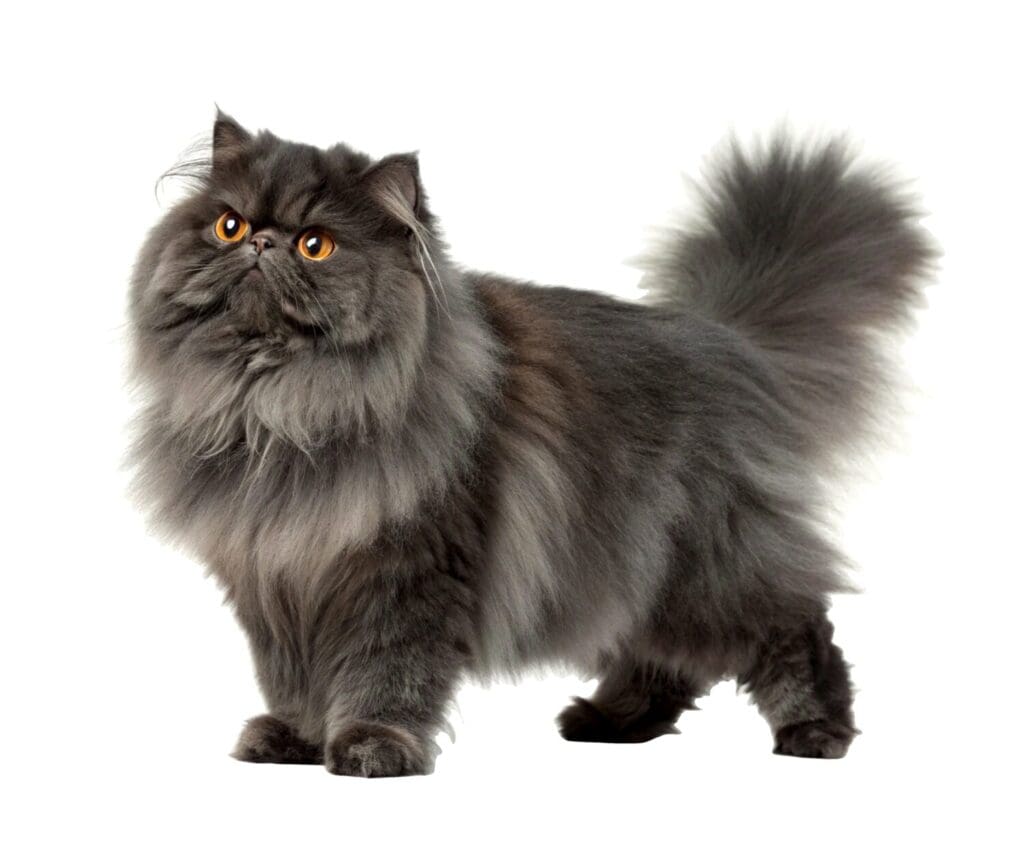
Shaded and smoke Persians have hair shafts tipped with a darker color over a pale undercoat.
©Sarwar Photos/Shutterstock.com
Parti-Color (Tortoiseshell)
Parti-color, or tortoiseshell, Persians can have either distinct patches or closely intermingled patches throughout the coat. Persians with this coloring are almost always female due to the sex-linked genetics required for red/cream or black/blue/chocolate/lilac colors to be expressed simultaneously. The pattern requires two X chromosomes carrying different color alleles.
Colors include the traditional black and red tortoiseshell pattern, blue-cream, chocolate tortoiseshell, and lilac-cream. Black and red tortoiseshells are the most common. Blue-cream tortoiseshells are uncommon, while chocolate and lilac are considered rare.
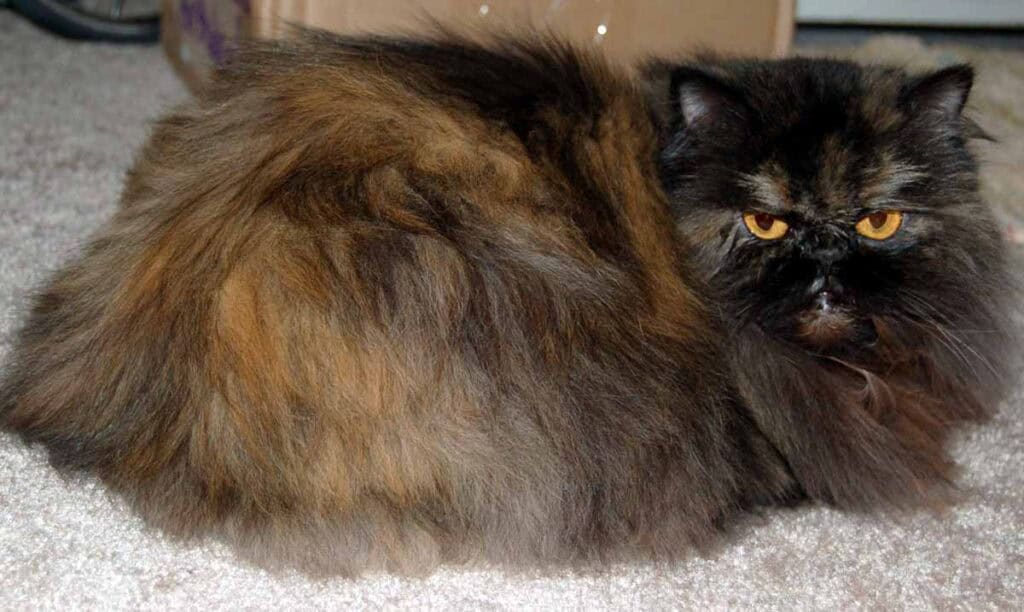
Tortoiseshells are nearly all female due to the genetics required for this color pattern.
Solid Colors
Solid-colored Persians have a uniform color from the root to the tip of the hair shaft. The coat should have no ticking, tipping, banding, or other types of patterns. Solid colors include white, blue, black, red, cream, chocolate, and lilac.
White cats with blue eyes are the most sought after, but white cats may also have one blue eye and one copper eye and still compete. Black Persians are also common. As noted above, chocolate and lilac are the rarest colors.

White Persians are the most desired solid color.
©dianewphoto/iStock via Getty Images
Silver and Golden
Silver coats must have white undercoats. Chinchilla silver cats have black tipping only at the very ends of the hair shaft, while shaded silver cats have black tipping on about 1/3 of the hair shaft. Golden coats must have honey to bright apricot undercoats, but tipping may be black or brown. Chinchilla golden has the least amount of tipping, while shaded golden has more.
Finally, blue goldens must have ivory to pale honey undercoats. Blue chinchilla golden cats have blue tipping at the ends of the hair shaft, but blue shaded goldens have more blue tipping. In the silver and golden division, the cat’s eye color must be green or blue-green in order to qualify for competition. In this division, the silver chinchilla color is most sought after, but all silver and golden colors are prized.
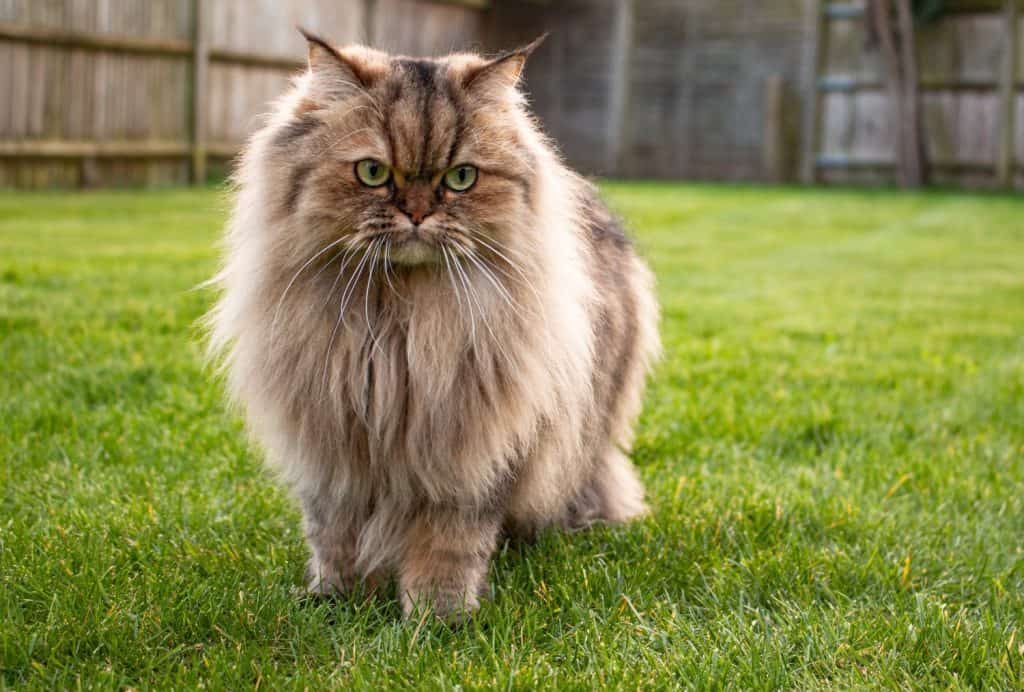
Golden chinchilla coats have light brown tipping and the cats must have green or blue-green eyes.
©Jacintne Udvarlaki/Shutterstock.com
Calico and Bi-Color
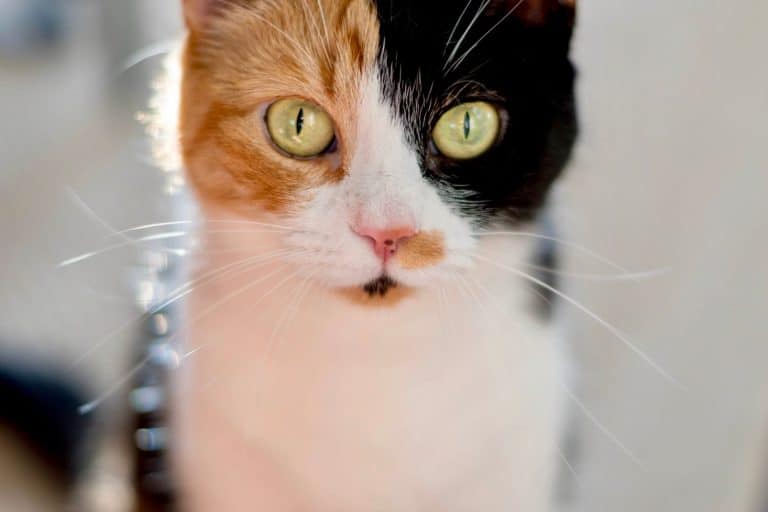
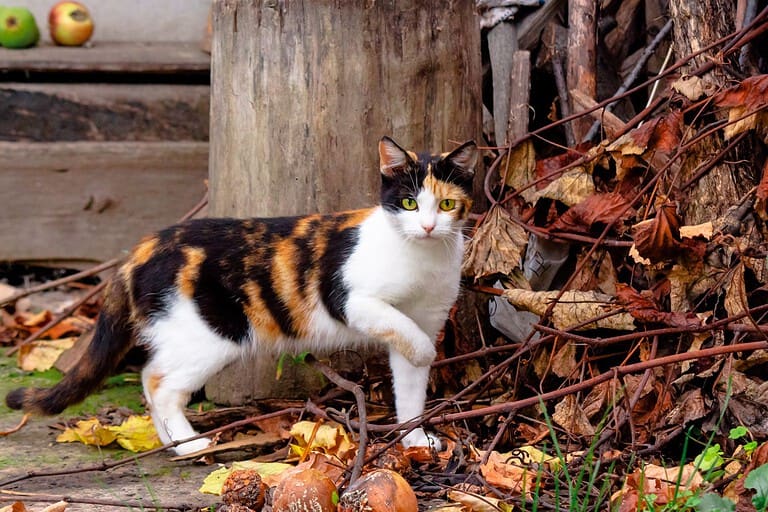
In the calico and bi-color division, the preferred minimum is white feet, legs, undersides, chest, and muzzle, a colored tail, and one or more colored patches on the body. Like tortoiseshell genetics, the calico pattern (red, black, and white) requires the black and red from two different X chromosomes, so calico Persians are nearly always female.
Calico is a tri-color pattern that allows any solid or tabby color (such as black, blue, red, cream, chocolate, or lilac) combined with red and white or cream and white. Bi-color cats may combine any solid or tabby color with white. Smoke, cameo, and shaded Persians may also be calico or bi-color, but the colored parts must adhere to the appropriate division’s standards. Traditional calico is the most popular tri-color shade, while the black-and-white (tuxedo) pattern is the most common and sought-after bicolor shade.

Calicos are white with distinct patches of black and red or dilute versions like blue and cream.
©auliazuswana/Shutterstock.com
Himalayan
Himalayan Persians have the colorpoint gene, which is a genetic mutation that restricts dark pigment to the extremities, including the ears, face, paws, and tail. The mutation also fails to create melanin in warmer areas of the body, so the rest of the body remains white. The toes must not be white and the eyes must be blue according to the CFA’s Persian breed standards.
Traditional point colors include chocolate, seal, lilac, blue, flame (red), cream, tortie, blue-cream, chocolate-tortie, and lilac-cream. The lynx point pattern is tabby-style stripes over the darker points. The mask must also include the M-shape of the tabby. Lynx point colors include seal, blue, flame (red), cream, tortie, blue-cream, chocolate, lilac, chocolate-tortie, and lilac-cream. The seal point Himalayan Persian is the most common, while chocolate and lilac shades are rare.

The Himalayan Persian’s colorpoint gene restricts dark pigment to the extremities.
©Cicafotos/Shutterstock.com