
Quick Take
- There’s a massive difference between vocal learning bird species and birds that rely on innate calls.
- You can teach certain birds to sing, but others don’t possess the abilities.
- Bird domestication can actually help vocal learning species with their song-singing abilities, especially since it decreases their overall stress.
Not all pet birds have the physical or cognitive ability to learn songs, and understanding the difference can help owners set realistic expectations. For example, vocal learning species—including parrots, canaries, and some finches—differ from birds that rely on innate calls instead of learned songs. In other words, some birds possess the ability to learn and sing songs, while others lack the brain development and even the muscles to create such sounds.
In this article, we consult an expert and analyze the anatomical factors and unique vocal learning abilities of birds. Keep reading to learn more about the syrinx (a bird’s vocal organ), intelligence differences among species, and how domestication has shaped singing abilities in certain species of birds.
How Do Birds Sing?
To produce their classic birdsongs, birds use a vocal organ that pushes air over flexible, vibrating membranes. This creates the unique bird vocalizations we recognize, especially in the springtime.
“Production of songs and calls is by the syrinx, an organ unique to birds,” says Dr. Margaret C. Brittingham, PhD, and birding expert at Kaytee. “It is located at the bottom of the trachea, just before the bronchi branch. The syrinx is a bony structure with elastic membranes.”
These membranes allow birds to produce complex songs and calls, giving them control over their pitch and volume.
“There are syringeal muscles that change the shape of the membranes,” Brittingham explains. “Birds vary the loudness and frequency by altering the air pressure passing from the lungs to the syrinx and the position of the muscles.”
Intelligence Differences Among Species
Different species of birds have different vocal abilities. While most birds are vocal, only certain groups are specialized natural vocal learners. For example, there’s a massive difference between a seagull’s classic, repetitive vocalization and a songbird’s lovely, melodic singing.
“Birds that are poor singers have no syringeal muscles and may just grunt or hiss (a vulture, for example),” says Brittingham. “Songbirds have up to six pairs of muscles. The amount of musculature determines the complexity of sound.”
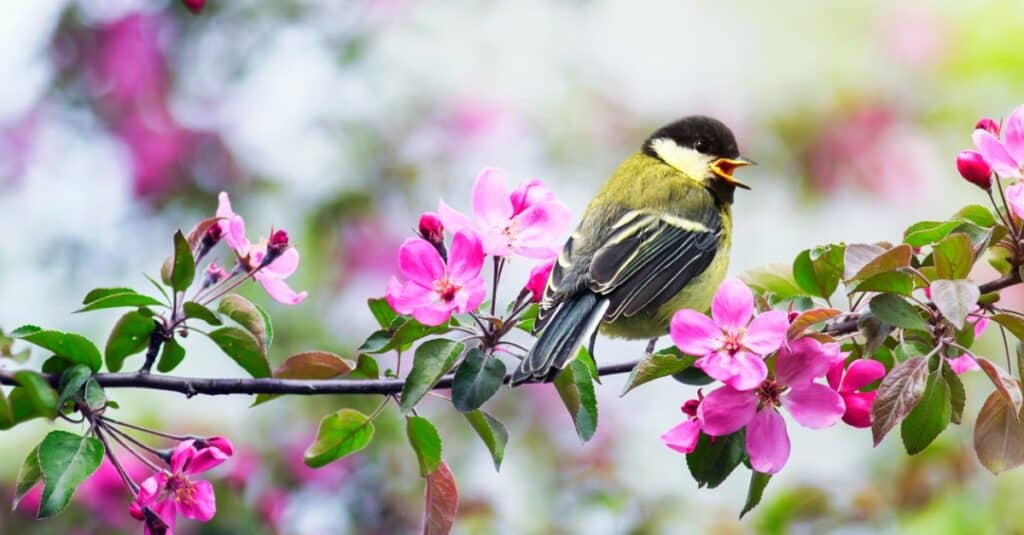
Chickadees are songbirds known for their chicka-dee-dee-dee” call and “fee-bee” song.
©iStock.com/Nataba
These muscles give birds control over their vocalizations, but that’s not the only reason vocal learners can sing. According to Brittingham, there are three groups of vocal learning birds: songbirds, hummingbirds, and parrots.
“These groups are able to modify the songs they produce in response to their environment,” she says. “The specific neural pathways and region of the brain that control vocal learning are developed in these species but not in non-vocal learners.”
However, these birds aren’t necessarily “more intelligent” than other species just because of this development.
“There are intelligence differences among species, but it is not directly associated with vocal learning,” Brittingham explains. “This expanded brain region does not in itself equate to greater ‘intelligence.’”
Production of songs and calls is by the syrinx, an organ unique to birds.
Dr. Margaret C. Brittingham, PhD, Professor of Wildlife Resources at Penn State University and and birding expert at Kaytee
How Domestication Has Shaped Singing Abilities
Domestication has greatly impacted birds’ singing abilities, particularly in species like canaries. In fact, researchers have found that domesticated birds can produce more complex and varied songs due to their decreased stress.
In the 2021 article, published in the journal Trends in Cognitive Sciences, researchers from the universities of Barcelona, Cologne, and Tokyo compared the communication systems of humans and birds.
“For instance, take how children learn to speak and how birds learn to sing: unlike most animal communication systems, juvenile birdsong and child speech only develop properly in the presence of adult tutors,” the researchers wrote. “Without the vocal support from adults, the great range of sounds available to humans and songbirds does not develop properly.”
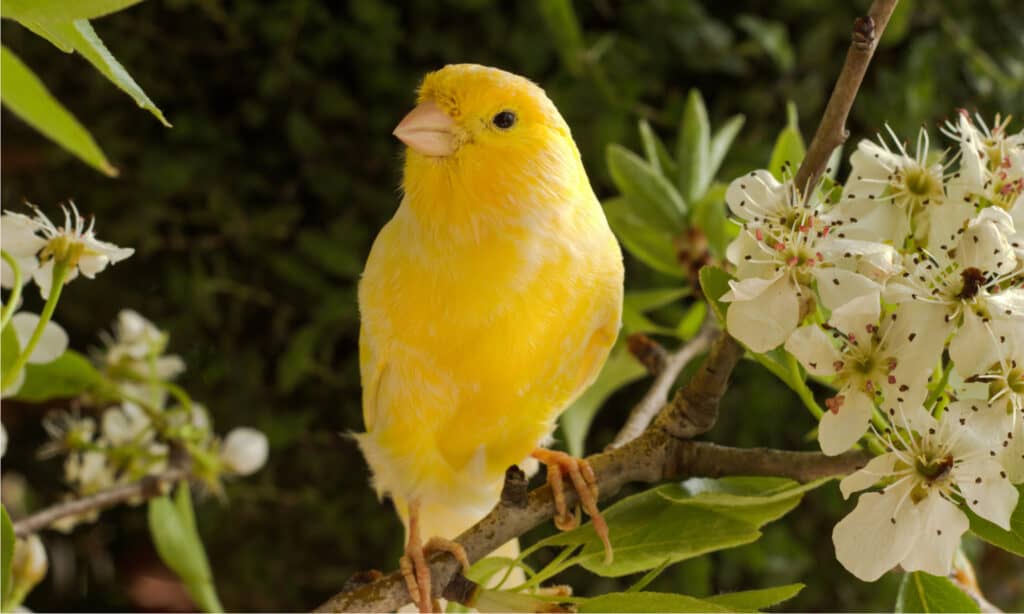
Some people keep canaries as pets, as they’re known for their gorgeous, elaborate songs.
©Yulia 0606/Shutterstock.com
Additionally, they identified similar patterns in brain connectivity, as well as similar impacts of stress on the communication systems.
“Birds that are regularly under stress during their development sing a more stereotypical song as adults, while children with chronic stress problems are more susceptible to developing repetitive tics, including vocalizations in the case of Tourette syndrome,” researchers wrote.
More specifically, “glutamate, the brainʼs main excitatory neurotransmitter, interacts with dopamine, in birdsong learning, aggressive behaviour, and the repetitive vocal tics of Tourette syndrome.”
The authors also cited evidence that multiple domesticated species have altered vocal repertoires compared to their wild counterparts.
“Breeders often select birds to retain or breed based on song quality,” says Brittingham. “Studies have shown they can alter song structure in subtle ways, but the basic structure remains the same. Selection is often for longer sequences of song.”