
Quick Take
- A viral video of dead fish swimming is given a scientific explanation.
- After death, the spinal cord and nerves can still trigger muscle contractions briefly.
- Muscles retain stored energy (ATP) that allows twitching or swimming-like motion for a short time.
- “Zombie fish” isn’t paranormal; it’s a misleading label for a well-understood biological process.
In a viral video on Instagram posted by Scienceboy, a dead fish with its body split open and its insides removed is placed into water, where it begins swimming around as if it were alive. This is not a paranormal phenomenon or evidence of a ‘zombie fish.’ Although it may seem astounding, it is simply a physical reflex. Let’s explore the science behind this so-called “zombie fish.”
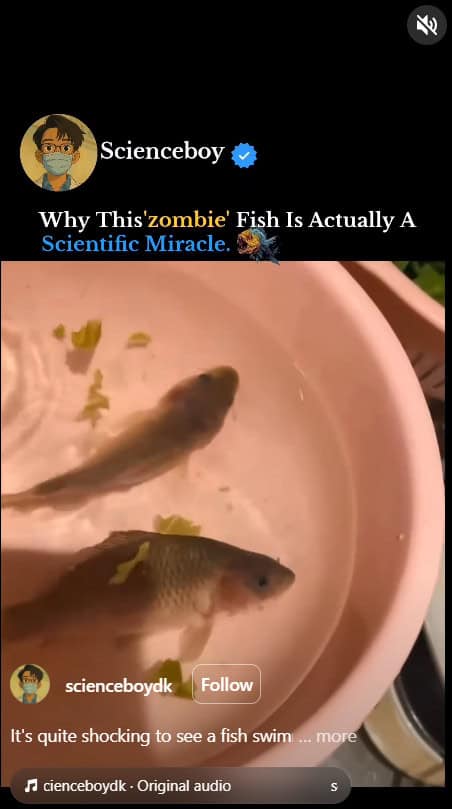
Instagram Post: Why This Zombie Fish Is Actually a Scientific Miracle by Scienceboy
©Science Boy / Instagram / Screenshot – Original
As Scienceboy explains in the post, “This isn’t magic or a miracle; it’s a combination of biology and timing.” The Environmental Literacy Council answered the question, “Why do fish still move after being killed?” Here’s how it works:
Reflex Actions and Residual Nerve Activity
When a fish dies, although its brain no longer sends signals to its muscles to move, the fish’s spinal cord and peripheral nerves are still working. If the fish receives stimuli, like physical touch, reflexes will cause its muscles to contract. Note that this only continues for a short time.
Cells Still Contain Energy For a Short Time After Death
Muscles contain adenosine triphosphate (ATP), which is a form of stored energy. It’s not just fish; humans and other animals can also twitch or move randomly after death. The remaining ATP acts like a leftover power supply, enabling muscle contractions for a short time after death until the energy runs out. When the muscles are triggered by nerve impulses, they twitch or move involuntarily.
The Fish Are Not Alive and Do Not Feel Pain
The fish in the Instagram video are moving by involuntary reflexes. They are no longer alive and cannot feel any pain. This is why a headless fish may still twitch and move. The fish are able to swim for a short time after death because of alternating muscle contractions, which are controlled by the still-intact spinal cord.
Do Zombie Fish Exist?
While these fish are not zombies in the sense of the mythical dead rising again, scientists sometimes refer to certain fish as “zombie fish” when they are infested with parasites. While the parasites don’t actually kill the fish, they do alter their behavior. For example, Euhaplorchis californiensis is a parasitic flatworm that alters the behavior of California killifish, making them more likely to be killed and eaten by birds. Once the bird eats the infected fish, the parasite continues its life cycle inside the bird’s intestine.