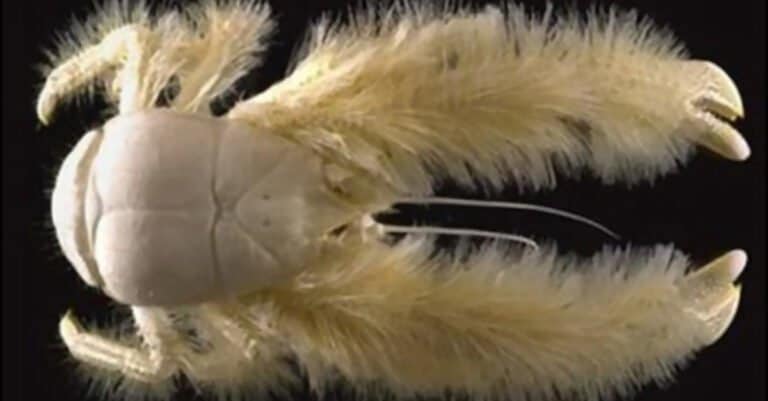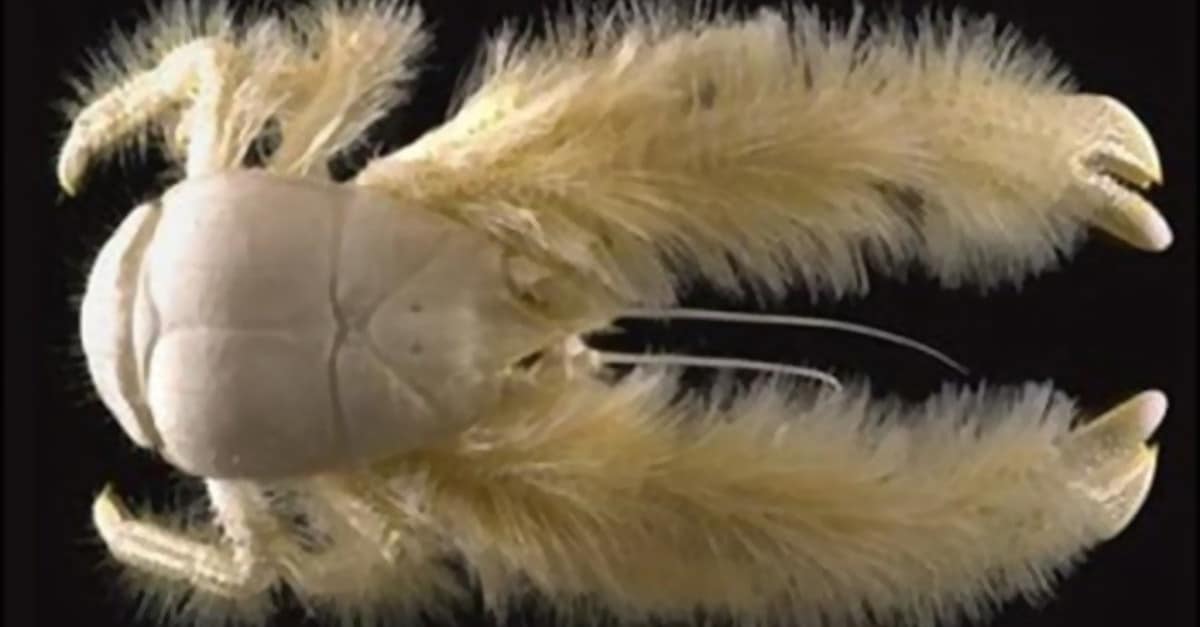

Deep in the waters of the Pacific-Antarctic Ridge in the South Pacific Ocean, there is a crab that has broken all the usual crustacean fashion rules. These crabs have developed what appears to be fur. As you can see in this extraordinary clip, it’s not hard to figure out how the Yeti crab got its name. These unique creatures live in environments where most crustaceans could not survive. Let’s discover how their unusual appearance helps them to do that!
Meeting the Yeti Crab for the First Time
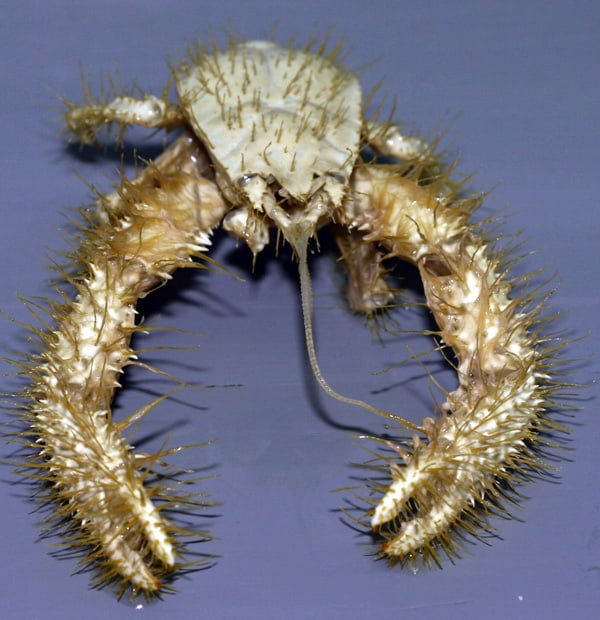
Yeti crabs (Kiwa hirsuta) were discovered as recently as 2005 by a group of marine biologists using the US Navy Alvin submersible. They were exploring a ridge near the Easter Island tectonic microplate. At a depth of 7,200 feet, they came across these extraordinary crabs squeezed between some rock crevices. The crabs were named after the fabled Himalayan creature with wild white fur. Their Latin name hirsuta is from the Latin word for “hairy.” They grow to around 5.9 inches long with a strong, compact body and are completely blind. There is no light at these great depths, and so there is no need for them to have eyesight.
Two other Yeti crabs have also been documented. The Kiwa tyleri crab was nicknamed the “Hoff” because its bristles reminded them of David Hasselhoff’s hairy chest! The third species, Kiwa puravida, has only been found living at cold seeps off the coast of Costa Rica, which is a distinct ecological setting. It is believed that these species originated from a common ancestor and diverged between approximately 13 and 26 million years ago.
Where Do Yeti Crabs Live?

Hydrothermal vents create unique ecosystems.
©Submarine Ring of Fire 2006 Exploration, NOAA Vents Program / CC BY 2.0 Deed – Original / License
These crabs are only found near hydrothermal vents thousands of feet below the surface of the sea. Hydrothermal vents create unique habitats at typically very cold depths. Hot lava (molten rock) rises from deep beneath the Earth’s surface, causing the crust to break apart. Geothermally heated water is discharged from the vents, which also emit a range of trace elements, including iron, zinc, and sulfur. These elements can be utilized by bacteria living near the vents, helping to create a unique ecosystem in the deep sea. The bacteria fix carbon into an organic form that can then be used by other living organisms – including crabs! It’s similar to the way that plants fix energy from the sun using photosynthesis.
It is unusual to see large crustaceans such as crabs and lobsters living in these sorts of waters. The conditions at these depths are very harsh, with a deadly combination of extreme pressures, total darkness, severely cold temperatures, and little food. Yet, the 10 square feet around a hydrothermal vent can support a population of as many as 700 Yeti crabs. That said, living here is still very dangerous. If the crabs get too close to the thermal vents, they risk being cooked alive. On the other hand, if they stray too far away, they may die of hypothermia. This is why they pile on top of each other and cling to the sea floor to stay in one place.
Do Yeti Crabs Actually Have Fur?
Although it may be fun to imagine a crab with fur, these creatures are not actually hairy. The fuzzy-looking structures that you can see moving in the water currents in the clip are specially adapted bristles called “setae,” which cover their claws.
There is still some debate about why they have these bristles. However, the most popular theory is that they are used for feeding.
We know that their claws are covered in a type of microorganism called chemoautotrophic bacteria. These tiny creatures break down chemicals in the water ejected from the vents. They turn it into a type of food that the crabs can eat – a bit like plants turn energy from light into a form that animals can use. The theory is that the crabs eat these bacteria. Yeti crabs have been observed performing a strange dance, waving their claws through warm water streams. This behavior provides the bacteria on their claws with a constant flow of oxygen, methane, and hydrogen sulfide, all of which are necessary for the bacteria to grow.
This suggests that the crabs are ‘farming’ the bacteria—a practice also seen in other animals. For example, some species of ants farm aphids so that they can feed on their honeydew. This type of relationship is called symbiotic. The bacteria use the crab to get the essentials they need to stay alive, and the Yeti crabs get a meal of bacteria. However, Yeti crabs have also been seen eating mussels, so the bacteria are not their only source of food.
An alternative theory is that the setae are part of the crab’s sensory mechanism. The special bristles may help them find food or a mate. Neither of which can be easy at these depths!