
Quick Take
- A rare, invisible culprit may be emptying one of Australia's greatest wildlife spectacles.
- Australian giant cuttlefish get exactly one chance to breed, and this year that chance nearly vanished.
- Some males win mates by pretending to be something they're not.
- The cuttlefish population collapse may be a warning that reaches far beyond one specific geographical area.
Each year, thousands of people travel to southern Australia during its winter, between May and August, to watch an incredible event: the mass-breeding aggregation of Australian giant cuttlefish (Sepia apama). The giant cuttlefish find the rocky ledges of Point Lowly the perfect place to mate and lay their eggs. How many giant cuttlefish gather there is subject to debate. The Australian Marine Conservation Society (AMCS) suggests the numbers can be upwards of a quarter-million annually; South Australia’s Department of Primary Industries and Regions (PIRSA) puts the number at 63,000 in 2025. But what’s not subject to debate is the severe and significant decline in the Australian giant cuttlefish population in 2026. PIRSA notes that the population has fallen by 97%. That means the population was estimated at only 1,811 Australian giant cuttlefish this year.
The scale of the change is alarming for several reasons. First, of course, is the fact that so many animals have disappeared. But the mating aggregation in Whyalla also represents the production of the next generation. Australian giant cuttlefish only reproduce once in their lifetime. Much of their energy goes towards preparing for this breeding season, after which they die. With such a low number of giant cuttlefish partaking in the Whyalla mating ritual this year, what does the future look like for these creatures?
What are Australian giant cuttlefish?
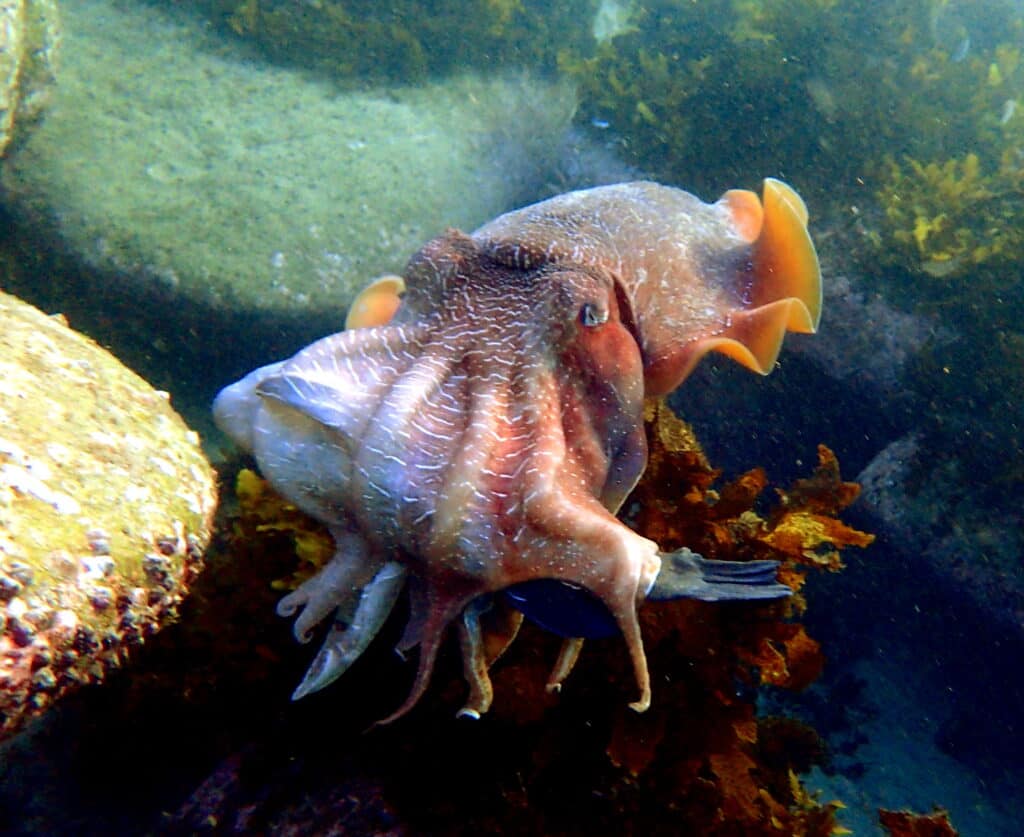
Known as the world’s largest cuttlefish species, Australian giant cuttlefish can weigh up to 23 pounds!
Endemic to southern Australia, the Australian giant cuttlefish can have a mantle up to 50cm (1.6 feet) and a total length of up to one meter (3.2 feet). These animals have three hearts, eight arms, and blue-green blood. Their blood uses hemocyanin to carry oxygen, which is what turns it blue, versus hemoglobin in humans, which turns our blood red.
Giant cuttlefish are known for their miraculous color-changing abilities, which is one reason why divers are so drawn to Whyalla; male cuttlefish may go through pulsing or high-contrast color displays to attract females or warn rival males. They do this with the millions of color cells in their skin. Chromatophores on the top layer of the skin can display colors like red, yellow, black, and brown. Iridophores in the middle layer are more iridescent, like silver, gold, and blue, while leucophores in the bottom layer reflect white light. This helps giant cuttlefish adapt to and camouflage within their environment.
The life cycle of Australian giant cuttlefish is relatively short. These animals live for approximately one to two years, with the mating aggregation signifying end of life. During mating season, bull males compete for female attention. Males often significantly outnumber the females. But in addition to competing with other bull males, they’re also competing with “sneaker” males. “Sneakers” are smaller in size and may even pass as females. They take advantage of when a bull male tries to shuffle them away from the other bull males by sneaking down and mating with the already separated females.
Because the mating cycle is so important to Australian giant cuttlefish, their absence from Whyalla is even more troubling.
Our seas are getting more toxic
In addition to the significant drop in Australian giant cuttlefish in Whyalla, mating season also seems to have been limited at best. Marine biologists in the area scoured the area’s rocky ledges to count how many eggs had been laid. They found only 440 eggs. For context, each female cuttlefish typically lays around 100 to 300 eggs each. Given the amount of female cuttlefish laying eggs in the area each year, the number of eggs found should have been in the hundreds of thousands or into the millions. 440 is a devastating and startling number.
1,811
Australian giant cuttlefish at Whyalla
- 2025 (PIRSA)
- 63,000
- 2026
- 1,811
- Change
- down 97%
Scientists believe the reason for this decline in both mating cuttlefish and eggs laid has to do with a toxic algal bloom, specifically Karenia cristata. This extremely rare algae species produces brevetoxins that are extremely harmful to animal life, and also potentially to humans. K. cristata is related to Karenia brevis, which commonly causes red tides in the southeastern United States, though research suggests K. cristata could be even more devastating to marine environments. Although Australia has managed to contain the K. cristata outbreak, it has not been eradicated.
What could this signify for the future?
While some marine biologists are confident that Australian giant cuttlefish populations could see a resurgence in the future, the low number of eggs found signifies a small number of cuttlefish available to mate next season. Since this species is already so vulnerable, given their short life cycle, this could be challenging to address.
The loss of the Australian giant cuttlefish could also have an economic impact for the Upper Spencer Gulf and those who typically rely on the influx of tourist funds.
However, perhaps the most worrisome aspect is what it means for our oceans, which are rapidly warming. An estimated 90% of excess heat from climate change has been absorbed by the oceans. Not only does warmer water facilitate algal blooms, but it bleaches coral, causes a loss of habitats for marine species, and harms the animals living within it.
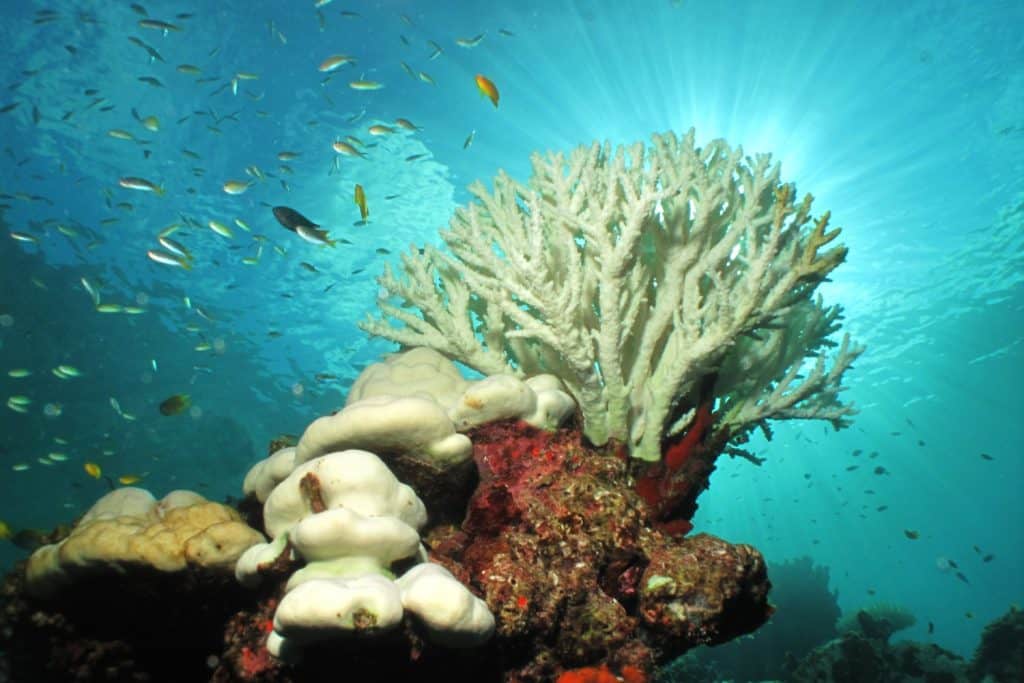
When stressed corals expel zooxanthellae (algae) in their tissue, they turn white. Zooxanthellae are corals’ source of food and energy, so without them, the corals might starve.
©acro_phuket/Shutterstock.com
In that sense, if we look at this from a big picture perspective, the loss of Australian giant cuttlefish is representative of marine imbalance. It’s incredibly important globally to invest in the preservation of oceans and marine life to prevent worse losses in the future.