
Quick Take
- A famous scientist burst into tears over one Instagram video. Find out why it meant so much to him.
- The first ID was wrong. One physical detail changed everyone's mind.
- These visitors are hundreds of miles from home. Something in the water may have opened the door.
- The footage shows more than a pretty swim. Look closer at what the rays are doing, and whether they'll stay.
Chris Hart, the drone operator behind the La Jolla Morning Report, was flying near The Marine Room at La Jolla Shores on Wednesday morning, Nov. 18, when he filmed a school of small rays.
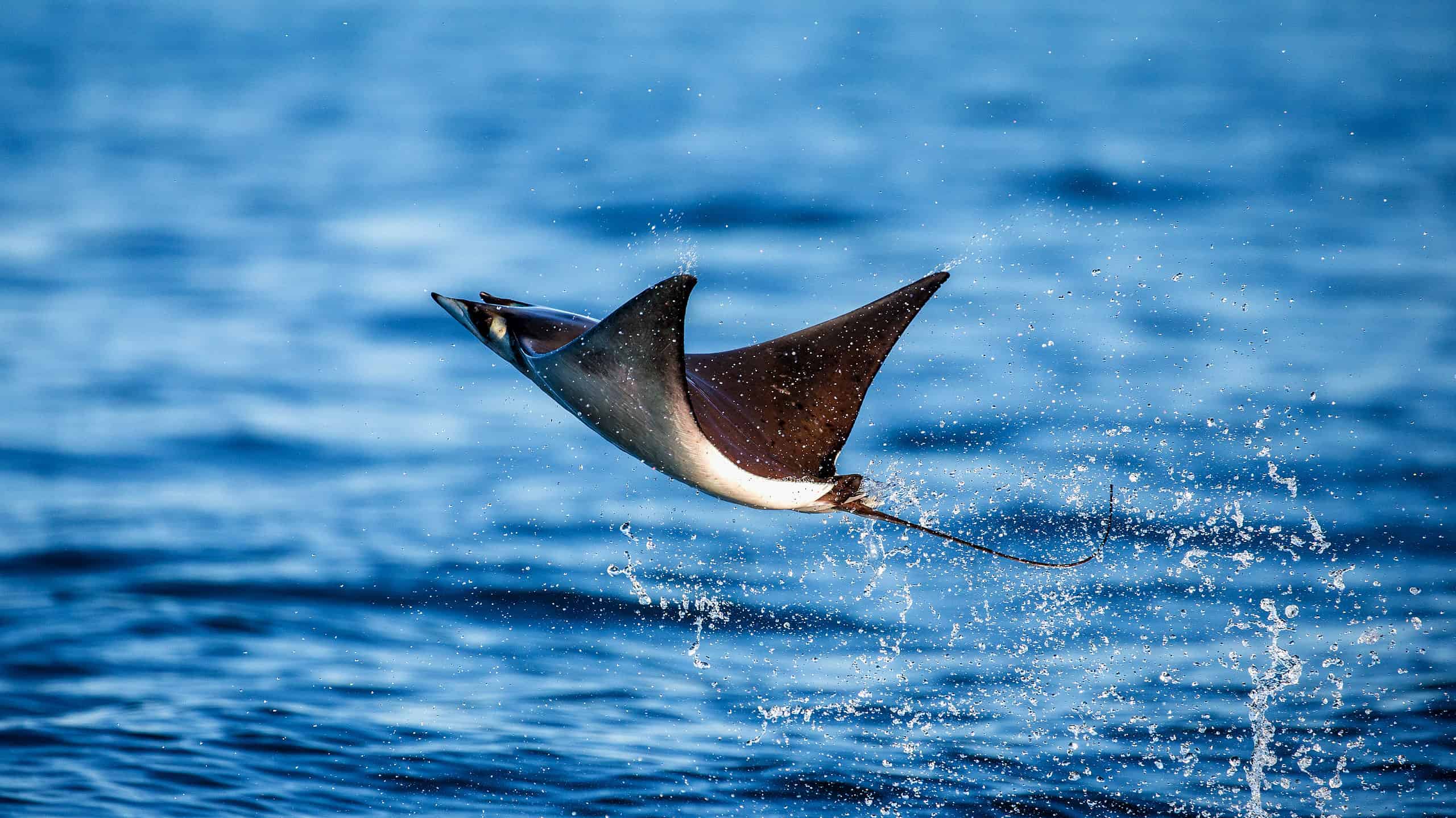
They were pygmy devil rays (*Mobula munkiana*), a species found from the Gulf of California to Peru. Ben Frable, senior collection manager of marine vertebrates at Scripps Institution of Oceanography at UC San Diego, told CBS 8 it’s believed to be the first documentation of the species in the United States.
Snorkeler Adena Lamar told CBS 8 she saw Hart’s footage on Instagram and reached out, and Hart helped guide her to the rays. She swam alongside the school Thursday morning and filmed it.
“I woke up at 8 a.m., and I immediately saw there were crazy rays I’d never seen before in the water, so I ran down as fast as I could to try and record them,” Lamar told CBS 8.
She told CBS 8 the rays were about one to two feet wide. Whales can be heard in her video, and she said they grew “so loud” toward the end of the swim.
“It was surreal, honestly,” she told CBS 8. “These animals that you would usually have to travel pretty far to go see, so it was pretty crazy seeing them here in La Jolla.”
How did anyone work out what they were?
Local diver Nick Meyers, known online as Nautical Nick, made the identification from Hart’s video. Meyers, a former biologist who runs an ocean conditions website, told the news site La Jolla that he first took them for spinetail devil rays, which made their own rare appearance off La Jolla several weeks earlier. The shorter wingspan changed his mind: pygmy devil rays measure 3 to 4 feet across, and spinetail devil rays stretch 6 to 11 feet.
Then Giuseppe Notarbartolo di Sciara, the marine scientist who described the species in 1987, contacted Meyers on Instagram. Meyers told La Jolla the sighting and his video brought Notarbartolo di Sciara to tears, and that the scientist confirmed the rays were *Mobula munkiana* and that this was the first sighting in the U.S.
The species has a La Jolla connection. Notarbartolo di Sciara, a former Scripps PhD student, named it for his mentor, the late Scripps oceanographer Walter Munk. Frable told CBS 8 it was historically called Munk’s devil ray until a North American naming committee dropped personal names from common names.
“They’re a fairly distinctive devil ray species, so it was pretty clear from the get-go,” Frable told CBS 8. Many other devil and manta rays have curved, sickle-shaped fins, while this species has a wider, triangular wedge shape.
What’s a pygmy devil ray?
It’s a small ray with no stinger and triangular pectoral fins, or wings. A 2021 study in Scientific Reports gives an adult width of up to about 3.7 feet and estimates newborns at roughly 14 to 17 inches across. The rays often gather in aggregations of thousands.
They breed slowly, according to the same study. Manta and devil rays bear one pup per litter on reproductive cycles of one to three years, which leaves them exposed to targeted fishing and bycatch. The pygmy devil ray is listed as Vulnerable on the IUCN Red List.
Frable told CBS 8 that Lamar’s video shows the rays feeding. They dig into the sand to scoop up small invertebrates, and some also filter plankton from the water.
Why are they 620 miles north of their usual range?
Published records along the Pacific coast generally stop around southern Baja California and Bahía Magdalena, about 620 miles south of San Diego, Frable told CBS 8. A corridor of warm water has stretched up Baja California and into Southern California for a couple of months, and he described the rays as “exploring newly available habitat.” NOAA’s Climate Prediction Center said Nov. 12 that El Niño continues to strengthen.
Meyers told La Jolla the species is “really good at traveling long distances,” with groups swimming in V-shaped formations like migrating birds.
Other tropical visitors have been turning up too. Frable told CBS 8 juvenile finescale triggerfish have been common under floating kelp offshore, and a Moorish idol was posted to iNaturalist from Catalina Island, a species he said hadn’t been recorded in California before.
Are the rays still there?
CBS 8 launched a drone several times on Friday and didn’t find them. Meyers told La Jolla he believes the rays will travel south to their typical range once the ocean water cools.