
Quick Take
- The German hairy snail (Pseudotrichia rubiginosa) is found in Britain but is not invasive.
- It has lived in Britain since the Stone Age, with the first British specimens at Syon Park on the Thames.
- A comprehensive 2025 survey by Citizen Zoo and partners maps its range and guides conservation actions like pollution management.
British conchologists (mollusc shell experts) and citizen scientists have teamed up to track a rare snail. The German hairy snail (Pseudotrichia rubiginosa) may not sound like a native British species, but names can be misleading! Read on to find out more about this fascinating snail and the humans who worked very hard to track it down.
Why Is a German Snail Living in Britain?
The German hairy snail is smaller than a fingernail and has thin hairs covering its shell. These hairs allow it to shed moisture so that its slime is sticky enough to cling to slippery surfaces around rivers. It is found in several countries throughout Europe, such as the Czech Republic, Slovakia, Poland, Ukraine, and the Netherlands. It is very rare and was not even recorded in the UK until 1982, but it is not an invasive species.
These little creatures have been living in Britain since the Stone Age, and possibly as far back as the last Ice Age. At this time, the Thames was connected to the longest river in Germany, the Rhine.
The very first British specimens were collected at the tidal Thames frontage of Syon Park in the London Borough of Hounslow. Since then, it has been found at other sites in the Thames corridor and around the River Medway in Kent, but it remains very rare.
Finding the German Hairy Snail
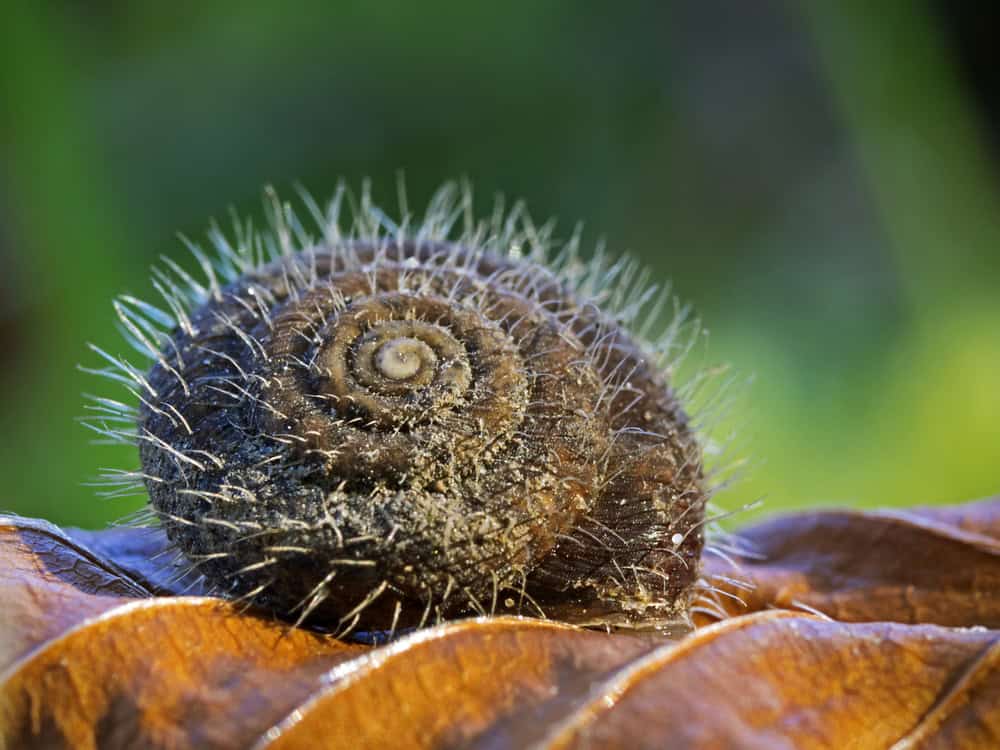
The Kentish snail looks very like the German hairy snail.
©scubaluna/Shutterstock.com
This snail is typically found amongst strand-line debris in bare mud beneath willows. It plays an important role in river ecosystems, but its distribution is still poorly understood.
A recent project brought together Citizen Zoo, the Zoological Society of London (ZSL), London Wildlife Trust, the Conchological Society of Great Britain and Ireland, Greenspace Information for Greater London (GiGL), the Port of London Authority, and other partners to carry out a comprehensive survey. Citizen scientists worked with experts to survey the snails during October 2025.
Detailed guidance was issued on how to identify the snails because they are very similar to the hairy snail (Trochulus hispidus), the silky snail (Ashfordia granulata), and the Kentish snail (Monacha cantiana), which live in similar locations. Searches have taken place in potential river sites in boroughs such as Newham, Richmond upon Thames, and Barnet.
It is hoped that by building an accurate picture of the snail’s range, the team will be able to identify how conservation measures such as pollution management can help the snail recover its numbers.