
Quick Take
- Aquatic turtles have evolved behaviors that boost their metabolic rates high enough for movement and digestion. See how basking protects shells →
- A vet explains why drying out is just as critical to a turtle's health as staying wet because of what grows on the shell.
- Skip the basking spot and your turtle's shell pays the price in ways that are harder to reverse than you'd expect. See proper UV-B lighting setup →
- Your turtle may be showing you it's stressed right now, though the signals look different from what you'd see in any other pet. Spot the stress signals →
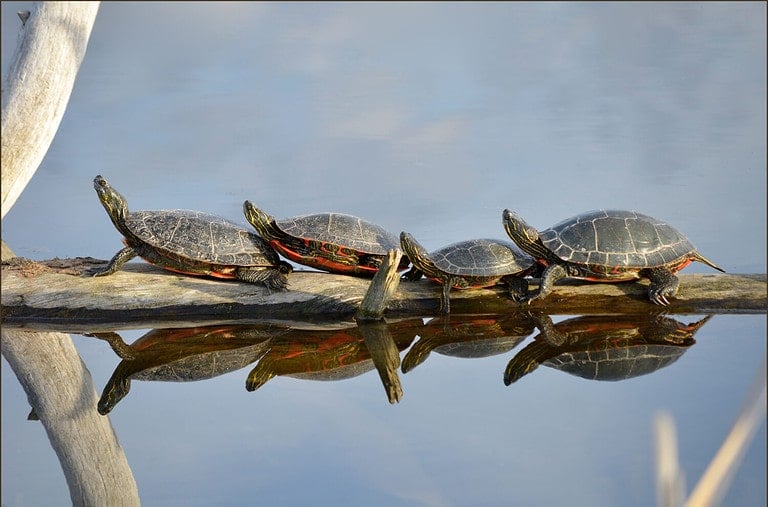
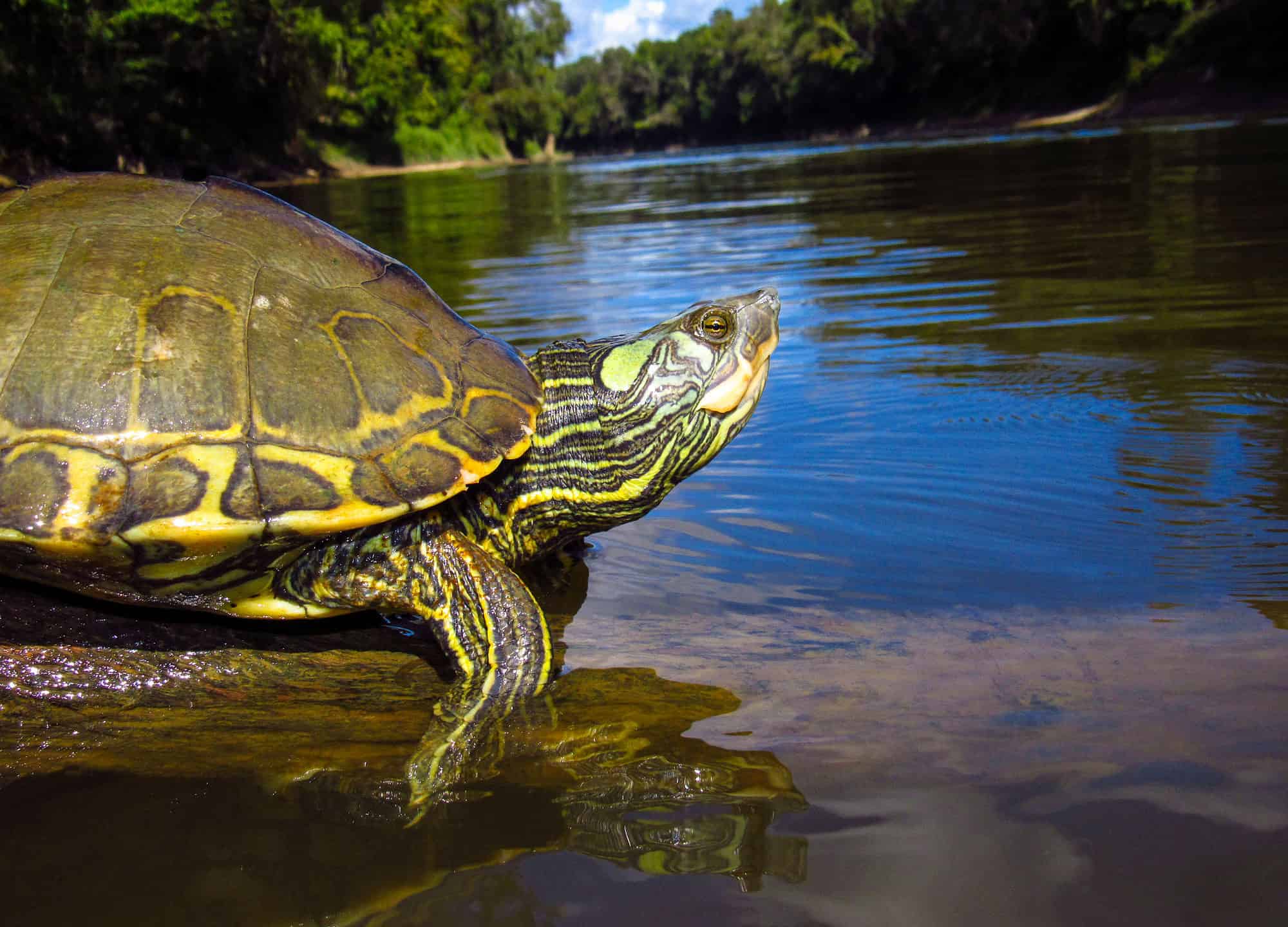
When you see a river or pond turtle in the wild, that’s often because it’s sitting out in the sun. Aquatic turtles spend a good proportion of their time “basking” on whatever they can climb onto. While humans and other mammals have internal systems that regulate their body temperature, turtles do not. Like other reptiles, they mostly rely on behavior to regulate their body temperature within the limits needed to grow and survive.
Basking on rocks, logs, or banks allows aquatic turtles to warm up, especially when water temperatures are cool. By basking, turtles raise their metabolic rates, which is essential for movement, digestion, and growth. Because aquatic turtles feed underwater, they need to bask on perches to warm up before returning to the water to catch food. A 1988 study in Ecological and Evolutionary Physiology found that feeding captive yellow slider turtles induced them to bask for significantly longer.
What About Captive Turtles?
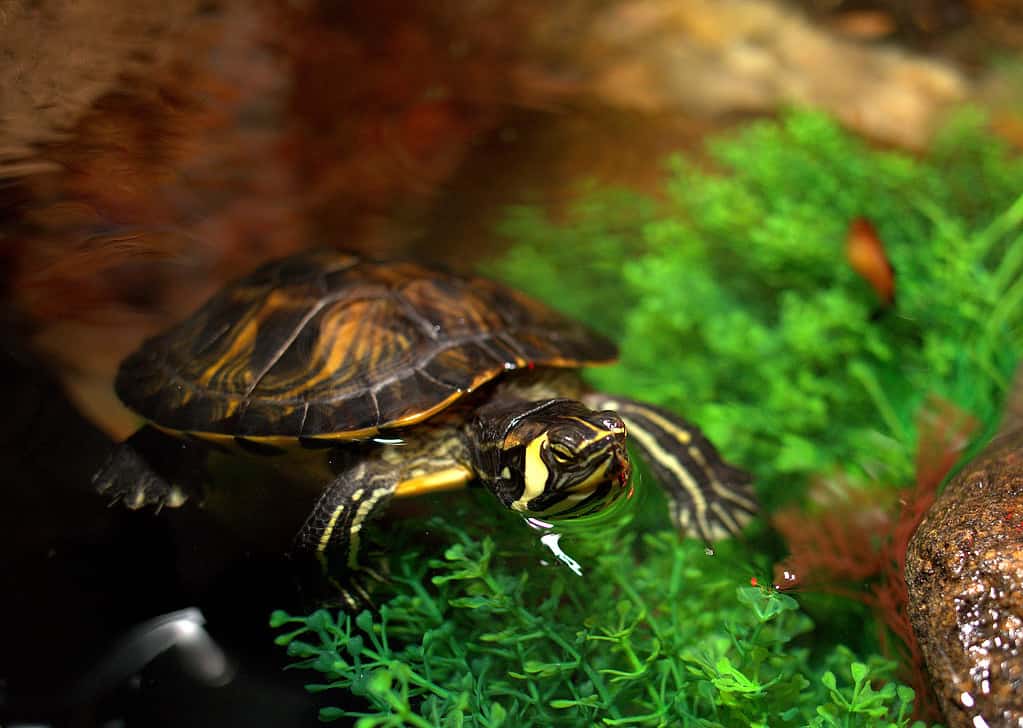
Captive turtles, even those considered aquatic, must have a warm, dry place to sit.
With turtles now the most popular reptile pet, according to a 2025 Fish & Reptile Report, understanding their captive care needs is increasingly important. People are taking reptile care seriously, with almost half (47%) of reptile owners designating follow-on caretakers, and almost a quarter (22%) putting money aside for their pets. Still, the significance of basking cannot be overstated.
Basking also plays a role in disease resistance by boosting the immune response against pathogens. As expressed in an email interview by Dr. Bradly Fountain, a veterinarian at Stahl Exotic Animal Veterinary Services in Virginia, “Besides providing heat and comfort, basking is a very important part of turtle hygiene and nutrition. Drying out and heating up the keratin of their shells and skin kills off or forces the shedding of bacteria and parasites, helping to keep the turtle healthy.”
How to Set Up a Basking Platform
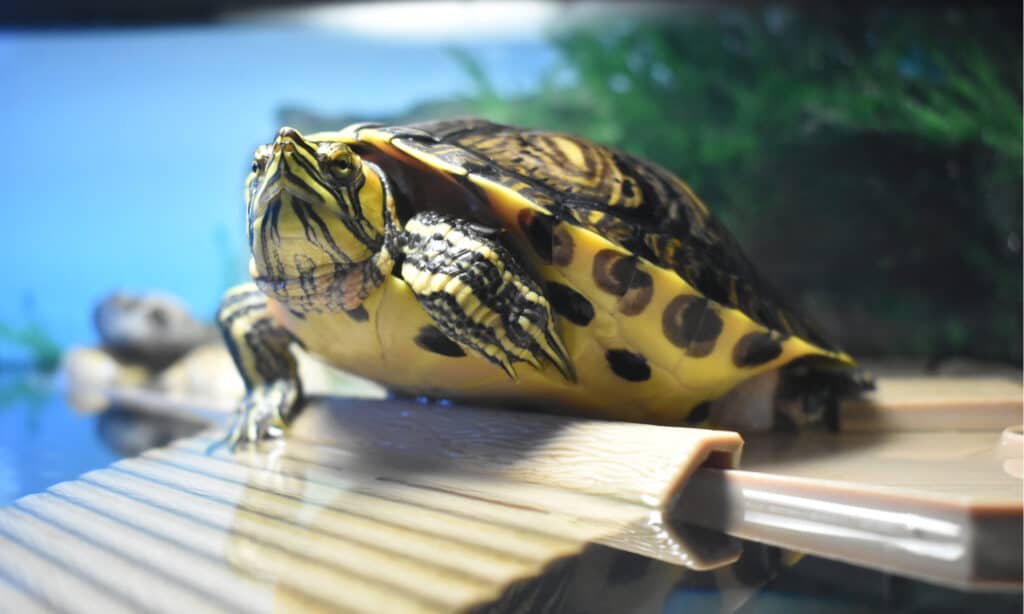
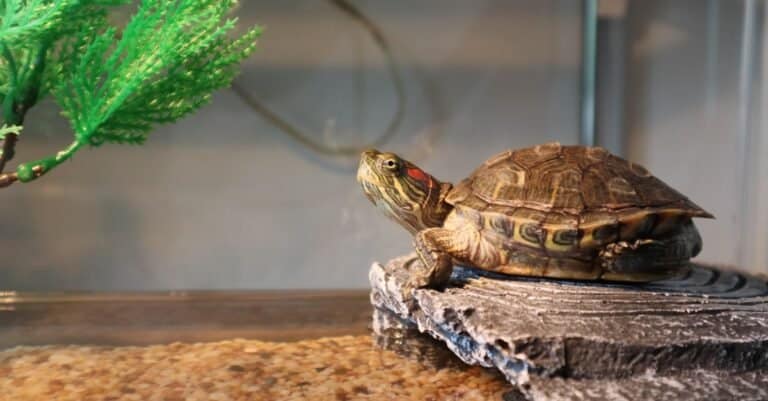
A turtle basking on a manmade platform, which gets it out of the water but can be slippery.
©John-J Anderson/Shutterstock.com
Your pet aquatic turtle needs an area where it can climb completely out of the water to dry off and warm up. According to the Turtle and Tortoise Trust, every turtle tank should have artificial lighting in some form. Ordinary lightbulbs provide heat but do not emit ultraviolet radiation, which is necessary for Vitamin D3 production and healthy bone development, just as it is in humans. The best choice for turtle tank lighting is a specialized UV-B heat lamp, which emits light at 5,500 degrees Kelvin to mimic the color of natural daylight. Placing your turtle tank near a window or in direct sunlight is not sufficient, as glass blocks UV-B rays.
“UVB is a critical part of vitamin D metabolism, which, among other things, also affects calcium absorption, making it an important part of their basic health. Without calcium, severe abnormalities and deformities can occur in their shells, spine, and long bones,” adds Dr. Fountain. “Lacking an appropriate place to bask means these can overgrow and potentially overwhelm the waterlogged keratin and lead to shell dermatitis, or ‘shell rot.’”
So, a basking platform with adequate lighting is essential for pet turtles. It doesn’t need to be purchased; indeed, you can craft a better one from everyday materials. Stacked bricks or rocks that protrude from the water, for example, offer a solid, heat-conductive basking space. A rough surface makes it easier for a turtle to haul itself out using its claws. Plastic platforms that sink when the turtle sits on them or retain a layer of water on the surface are not ideal. Once you set up a stable platform, make sure it’s big enough for the turtle to get its entire body out of the water, with enough space to choose whether to be directly under or adjacent to the basking lamp.
Besides providing heat and comfort, basking is a very important part of turtle hygiene and nutrition. Drying out and heating up the keratin of their shells and skin kills off or forces the shedding of bacteria and parasites, helping to keep the turtle healthy.
Dr. Bradly Fountain, a veterinarian at Stahl Exotic Animal Veterinary Services in Virginia
Your Turtle’s “Happiness”
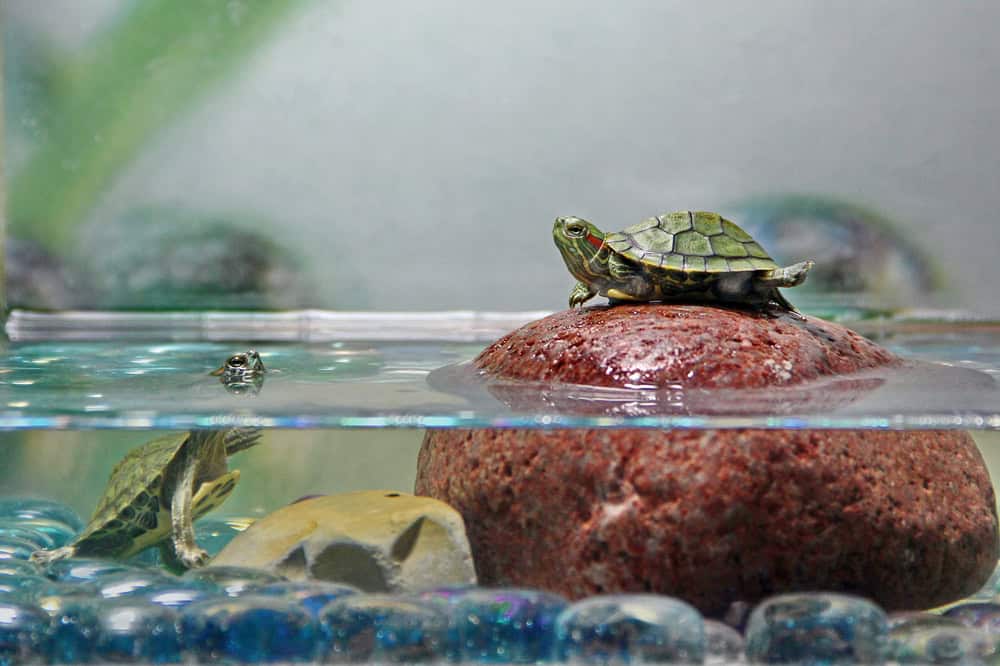
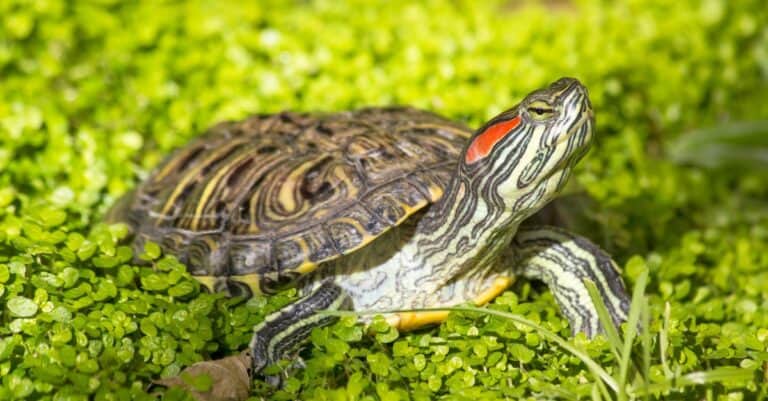
The best captive habitat is complex, with underwater space and basking sites.
©Rusinova Tatyana/Shutterstock.com
“In an enclosure that may not have a lot of variety in submerged terrain, basking platforms also provide basic places to rest from swimming and exploring,” explains Dr. Fountain. “Fatigue and stress can build up over time, leading to an increased propensity for disease, even in the cleanest of tanks.”
We don’t typically think of turtles as having emotions similar to those seen in mammals, such as dogs. However, research studies of turtles show how their behavior similarly reveals their level of comfort or stress. A 2013 In Practice study detailed the behaviors of turtles that indicate distress, such as retracting their heads and limbs for long periods of time, making squeaking sounds, or even grinding their jaws.
If your aquatic turtle is active—spending time swimming to forage and climbing out to bask with its head and limbs extended—it’s a strong indication that its basic needs are being met, resulting in a healthy and content pet.