Quick Take
- The fish isn't where the kingfisher thinks it is, so how does it still hit the target? See the dive's refraction challenge →
- Headfirst impacts should wreck a brain. Scientists went looking in the DNA for why they don't. Explore the genomic findings →
- The dive is only half the story. What happens next to the catch is surprisingly violent. See what happens to the catch →
- Not every kingfisher fishes. Some hunt in ways you'd never expect from the family. Meet the non-diving kingfishers →
Fishing takes patience, timing, and a little luck. Unless you’re a kingfisher, in which case it also involves launching yourself headfirst into the water at impressive speed.
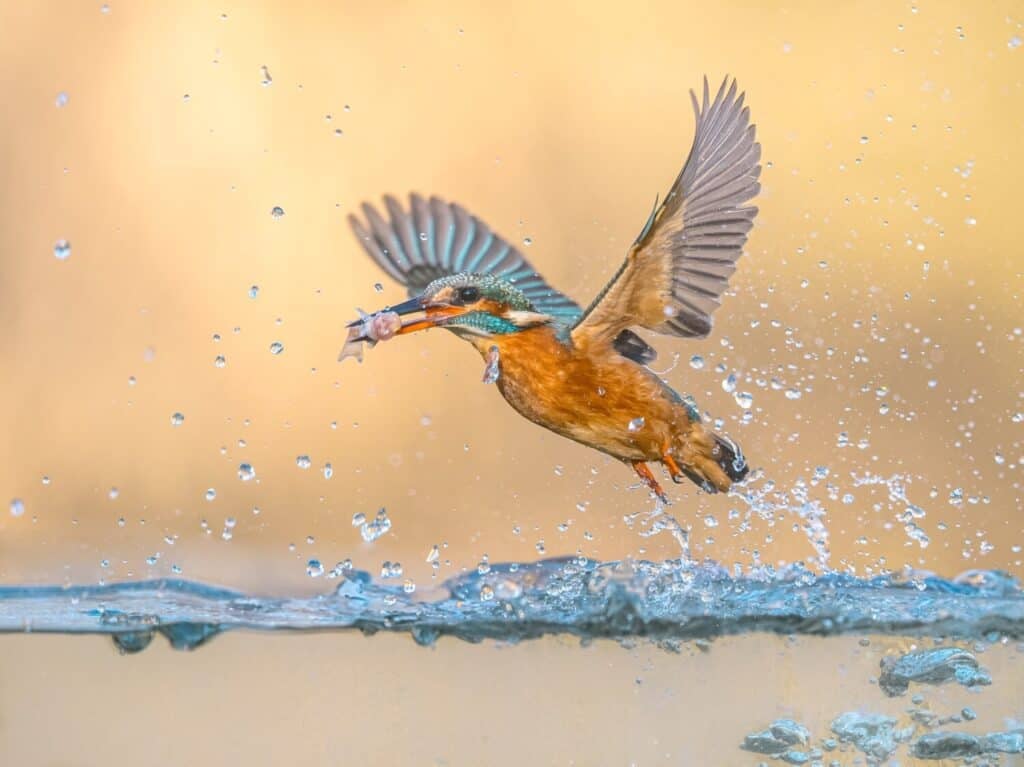
In this remarkable video, a common kingfisher demonstrates just how effective its hunting technique can be. The brightly colored bird spots a small fish beneath the surface, plunges into the water, and emerges with its next meal.
The entire sequence happens remarkably quickly. One moment, the bird is above the water. The next, it’s disappearing beneath the surface before returning with a fish in its beak.
It’s an impressive display of precision from a bird that has spent millions of years evolving into an exceptionally skilled hunter.
Watch the Kingfisher’s Incredible Dive
Common kingfishers (Alcedo atthis) are small birds, generally measuring around 6 to 7 inches long. What they lack in size, they make up for with brilliant blue and orange plumage, sharp vision, and an impressive ability to catch fish.
Unlike birds that wade through shallow water looking for food, common kingfishers typically hunt from a branch or another perch overlooking a river, pond, or stream.
When they spot a potential meal, they plunge toward the water, often entering beak-first with their wings swept backward. Their streamlined bodies and specialized hunting behavior allow them to move quickly between air and water.
And although a successful catch might look effortless on video, the bird has to judge its target carefully. Light bends when it passes from air into water, making a submerged fish appear to be somewhere other than its actual position.
For a kingfisher, getting that calculation right can mean the difference between catching dinner and coming up empty-beaked.
How Do Kingfishers Dive Without Injuring Themselves?
©Rudmer Zwerver/Shutterstock.com
Repeatedly diving headfirst into water might seem like a good way to get injured. Yet plunge-diving kingfishers have evolved physical and behavioral adaptations that help them perform these demanding maneuvers.
Scientists are particularly interested in how the birds tolerate the forces associated with moving between air and water.
A 2023 study published in Communications Biology examined the genomes of 30 kingfisher species, looking for genetic changes associated with plunge-diving behavior.
Researchers identified patterns of genetic adaptation involving brain function, vision, and other biological processes. Among the genes of interest was one involved in producing tau proteins, which help support structures inside nerve cells.
The findings suggest that evolutionary changes involving the brain may help plunge-diving kingfishers tolerate repeated impacts. However, the researchers did not demonstrate that a particular structure or gene completely prevents brain injuries.
Communications Biology, 2023 Peer-reviewed
Researchers examined the genomes of 30 kingfisher species for genetic changes associated with plunge-diving, and found patterns of genetic adaptation involving brain function, vision, and other biological processes, including a gene involved in producing tau proteins. They did not demonstrate that a particular structure or gene completely prevents brain injuries.
It’s a fascinating possibility, and another reminder that an ordinary-looking hunting behavior can involve some extraordinary biology.
What Happens After a Kingfisher Catches a Fish?
Catching a fish is only the beginning.
Common kingfishers typically return to a perch with their prey, where they may strike the fish against a branch to subdue it. They then reposition it in their beaks and usually swallow it headfirst.
Their diet consists mainly of small fish, although they also eat aquatic insects, crustaceans, and occasionally other small aquatic animals.
These birds are found across much of Europe and Asia, with populations also occurring in parts of North Africa. They favor waterways where they can find small fish and suitable hunting perches. Northern populations may move south during winter when freezing temperatures make their usual feeding grounds inaccessible.
Not every kingfisher hunts by diving into water. The kingfisher family includes more than 100 species, and some specialize in catching insects, reptiles, and other prey on land.
But for the common kingfisher in this video, the approach is wonderfully simple: spot a fish, take the plunge, and hope dinner doesn’t get away.