
Lions and hyenas are often considered natural enemies. They share much of the same range throughout sub-Saharan Africa. They also compete for the same prey. Both of these animals are fierce predators and live in groups. They have a few similarities that frequently bring them into conflict. However, their differences determine which animal comes out on top. Keep reading to learn more about these age-old rivals of the African savanna.
Lion vs. Hyena: Quick Comparison
Lion vs. Hyena Species
Lions are part of what is often referred to as the “big cat” genus Panthera, which also includes tigers, leopards, snow leopards, and jaguars. There is only one lion species, the African lion (Panthera leo). Lions are further divided into two subspecies: the Northern lion (Panthera leo leo) and the Southern lion (Panthera leo melanochaita).
Despite some resemblance to wild dogs, hyenas are not canids. Hyenas belong to the Hyaenidae family, and they are more closely related to mongooses, meerkats, and cats than dogs. There are currently four species of hyenas: the spotted, or laughing, hyena (Crocuta crocuta), the brown hyena (Parahyaena brunnea), the striped hyena (Hyaena hyaena), and the Aardwolf (Proteles cristatus).
Physical Characteristics of Lions vs. Hyenas
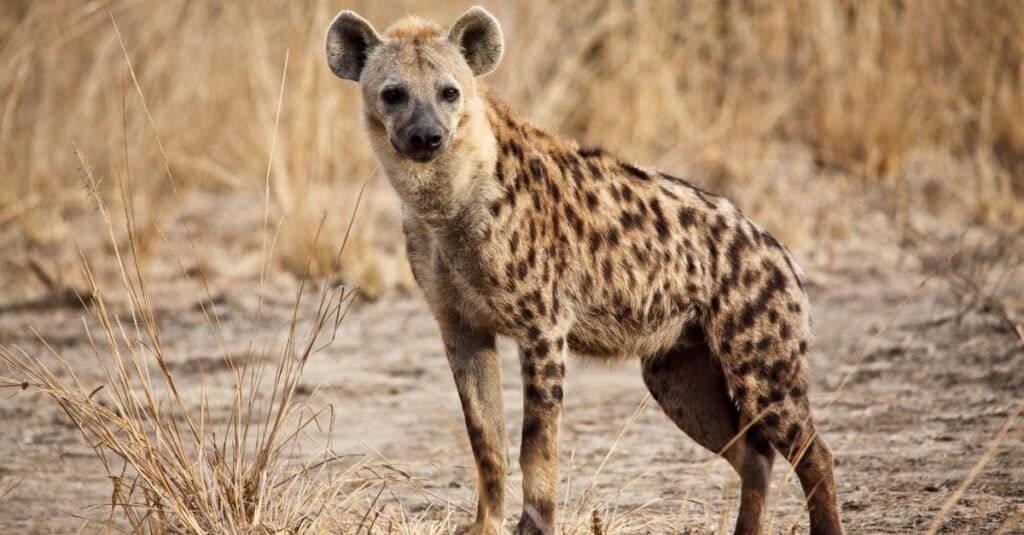
Hyenas are more closely related to cats than dogs.
©gualtiero boffi/Shutterstock.com
Only one hyena species, the spotted hyena, is in direct conflict with lions over resources. So this article primarily focuses on similarities and differences between lions and spotted hyenas. Let’s take a deeper look at how they compare in regard to size, physical appearance, teeth and bite force, sensory organs, and movement.
Size
Adult lions are significantly larger than hyenas. They can reach 4 feet tall at the shoulder, grow to 10 feet in length, and weigh up to 550 pounds. The largest lion ever recorded in the wild was said to weigh 595 pounds, while captive lions have been reported to exceed 800 pounds. Male lions are larger than the females.
The largest of the four hyena species is the spotted hyena, which is roughly the size of a very large, domesticated dog. They can weigh up to 190 pounds, stand up to 3 feet tall at the shoulder, and grow to 5 feet in length. Female hyenas are slightly larger than the males.
Physical Appearance
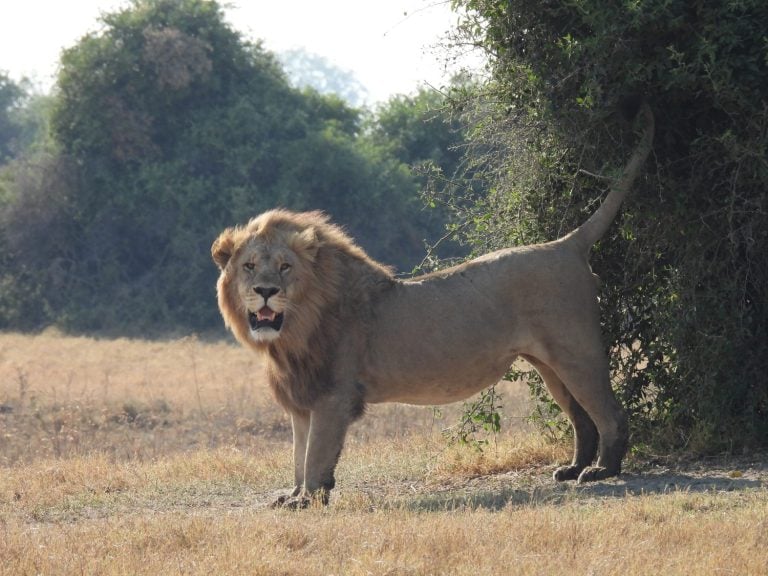
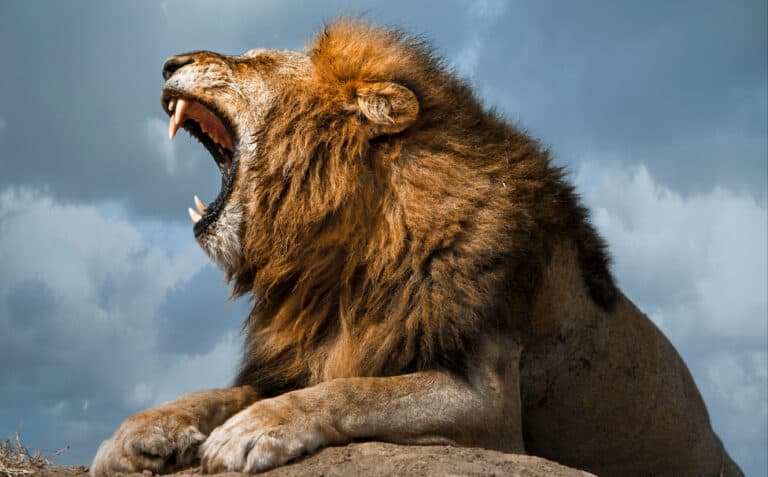
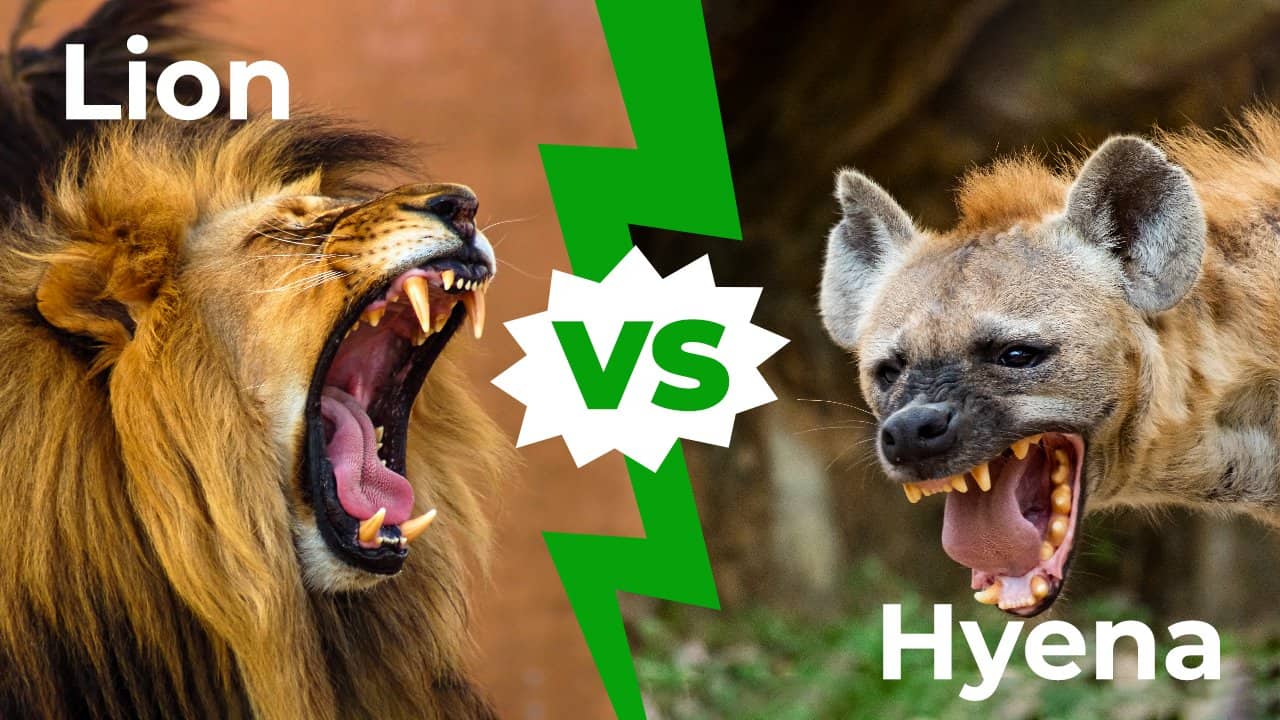
Lions typically have golden yellow to reddish-brown coats. Their long tails end in a darker tuft of fur. Lions have stocky, compact bodies, deep-chests, and powerful legs. They have broad heads and large eyes. Lions also have strong jaws, long canine teeth, and sharp, retractable claws that can reach over an inch long. The most characteristic feature of a male lion is his long, shaggy mane that grows on his head, neck, and shoulders. Females do not have manes.
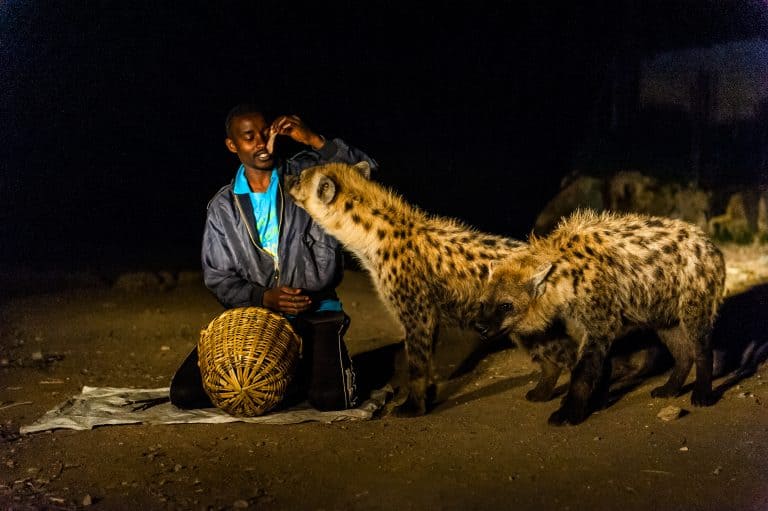
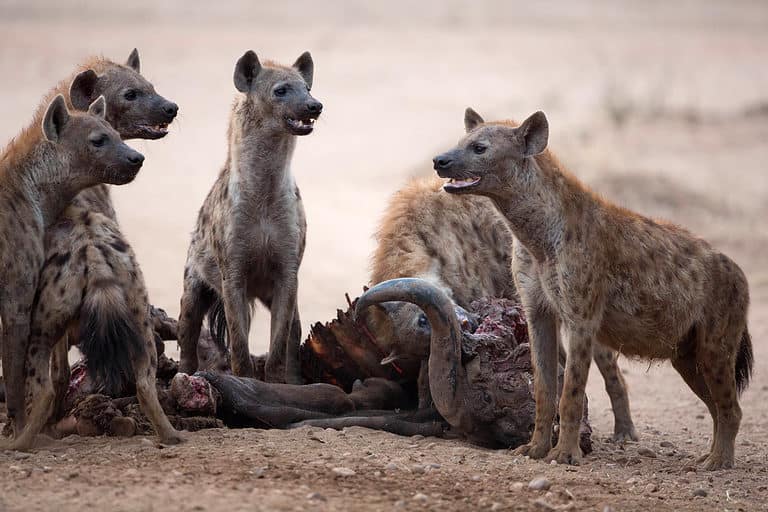
Spotted hyenas have coarse, yellowish to greyish-brown fur covered in darker spots. They have short manes that stand upright and bushy tails of about a foot long. These hyenas have large heads and long, muscular necks, with rounder ears than other hyena species. Their front legs are longer than their back legs, so their bodies slope downward at the back. They have powerful jaws and four non-retractile claws on each paw. Female hyenas have a more masculinized appearance, including a pseudo-penis, although the exact reasons for this sexual mimicry are still not well-understood.
Teeth and Bite Force
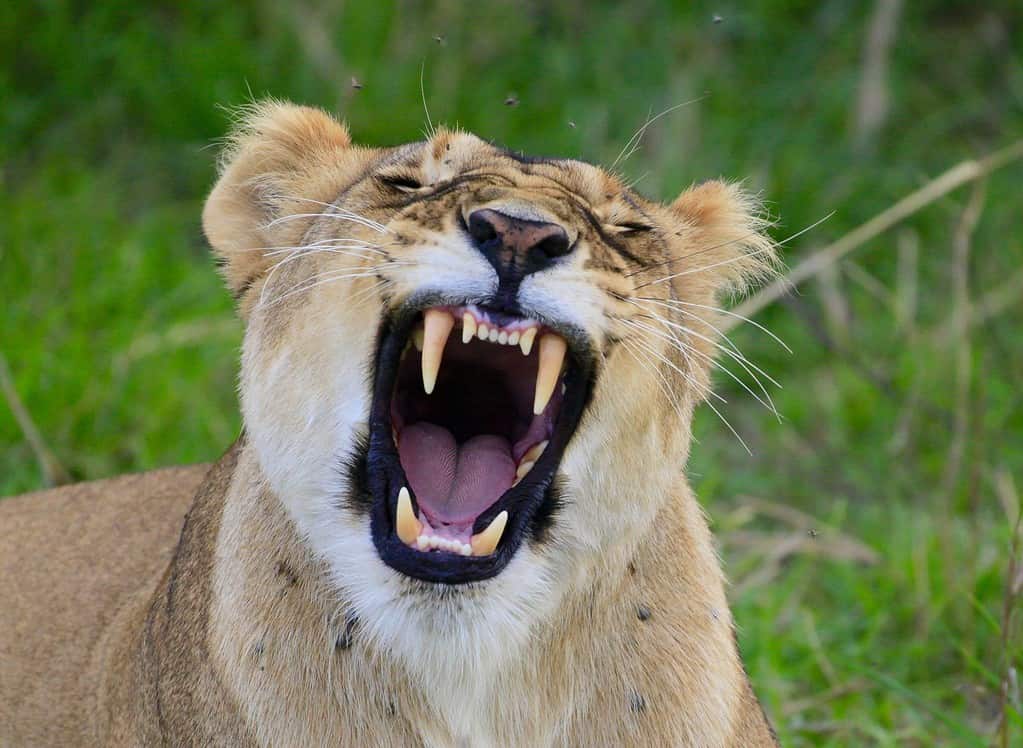
Lions have canine teeth that are 4 inches long.
©Dmussman/Shutterstock.com
Both lions and hyenas rely on their powerful teeth to kill and consume prey and for self-defense. Lions bite with a force of around 650 PSI, with some estimates suggesting up to 1,000 PSI. They have four 4-inch canine teeth to grip and pierce prey or deliver a killing bite to an animal’s throat. They have special teeth like our molars and premolars called carnassials that slice through tough tissues and tendons. Lions swallow chunks of food whole, as their teeth are not designed for chewing.
Hyenas have powerful jaw muscles attached to a bony ridge on top of their skulls called a sagittal crest. This gives them one of the strongest bites in the animal kingdom at an average of around 1,100PSI. Hyena species have recurved canines for gripping and tearing, while their powerful, cone-shaped premolars crush bones to access the marrow inside. Farther back in the jaw are their carnassials, used for shearing meat from bone in spotted hyenas and crushing in other species. Hyenas also have a special enamel structure that makes their teeth resistant to fracture.
Sensory Organs
Lions are primarily hunters, so their sense are designed to help them locate and track prey. Like most cats large and small, lions have excellent eyesight, especially at night and in other low light conditions. Their sense of smell allows them to scent prey from several miles away. They can hear prey from about a mile away, and their ears swivel, allowing them to determine the direction of the sound.
Hyenas are both hunters and scavengers, with superior eyesight in dark and low light conditions. They have exceptional hearing, with their large, round ears helping to channel the sound. They are said to be able to hear a kill from over 6 miles away. Hyenas have better olfactory senses than lions, too, with some sources suggesting that they can smell carrion from over 2 miles away.
Speed and Movement
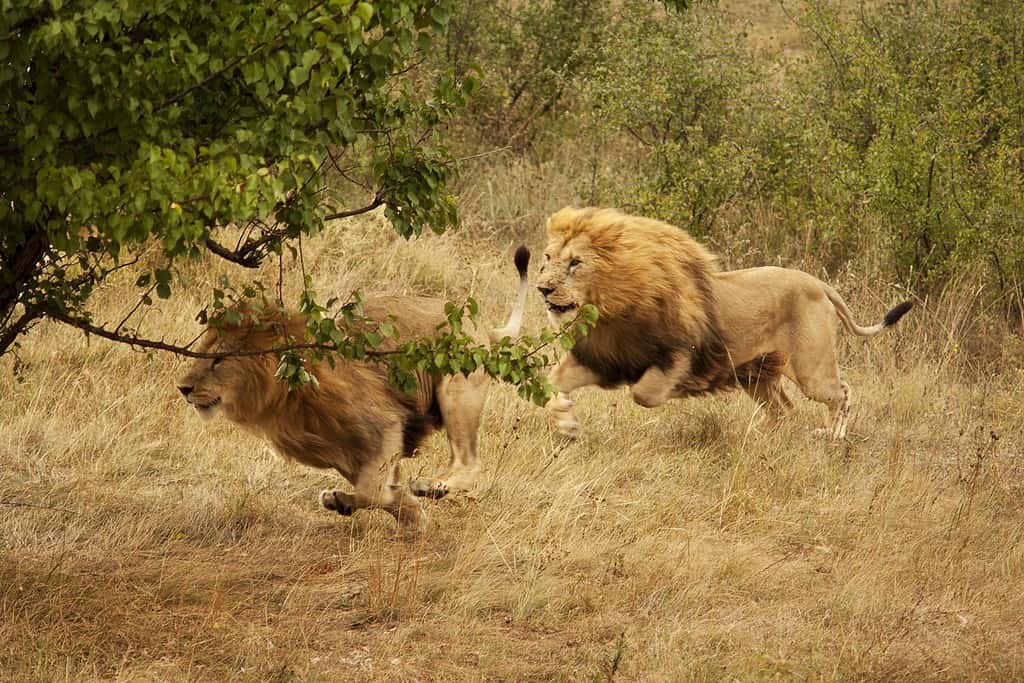
Lions can sprint up to 50mph.
©Elagina/Shutterstock.com
Lions undoubtedly have the edge when it comes to speed. They can typically run at speeds up to 35mph, but some reports have indicated they can reach 50mph in a sprint. Lions can leap up to 36 feet horizontally and jump 12 feet vertically, although higher jumps have been reported. Lions can also swim and climb trees, although they do so infrequently, as their heavier weights make them less agile than other large cats.
While hyenas are not as fast in a sprint, they have the advantage in endurance. They run at speeds of around 6mph when traveling, but they can reach top speeds of around 37mph. Hyenas are reported to be able to maintain that speed for about 2 miles, whereas lions can only run at top speed in short bursts. Hyenas are unable to climb trees and they are poor jumpers, but they are strong swimmers.
Lion vs. Hyena Behavior
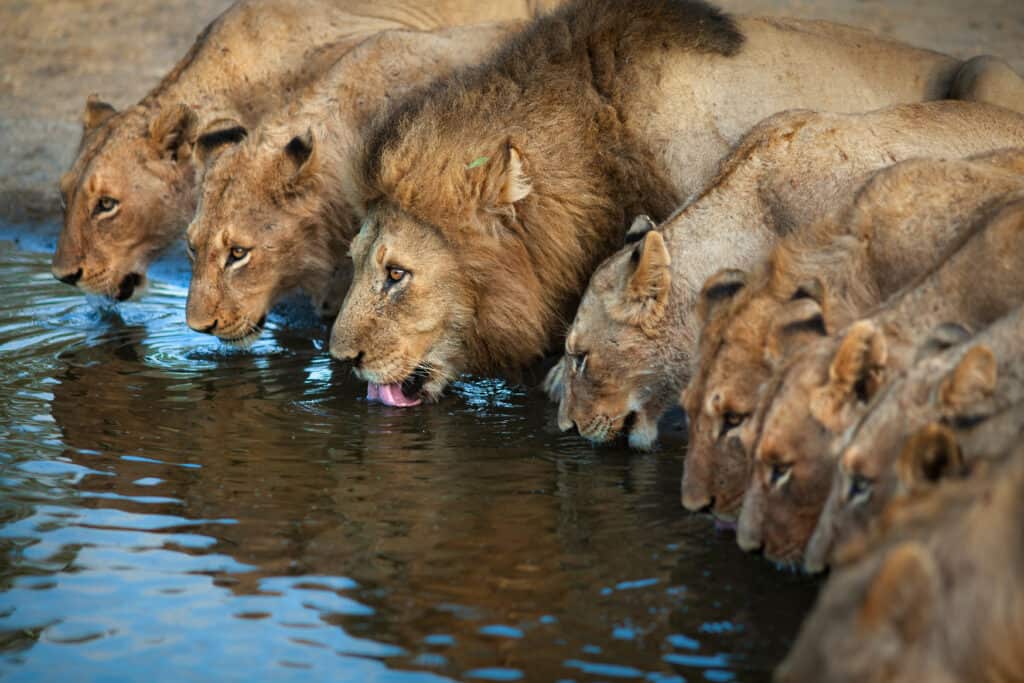
Lions live in large groups called prides.
©Henrico Muller/Shutterstock.com
Lions and hyenas also have some similar behaviors. They prey on the same animals, steal kills, hunt cooperatively, and live in groups. However, there are differences in habitat, social structures, and hunting and fighting styles that set them apart.
Habitat
Lions and hyenas are both are primarily found in sub-Saharan Africa. Northern lions can be found in West and Central Africa. There is also a small population of Northern lions in India. Southern lions inhabit East and Southern Africa. Lions prefer savannas, dense bush, grasslands, plains, and open woodlands.
The spotted hyena is found in a variety of similar habitats across sub-Saharan Africa. They prefer drier, more open areas including savannas, semi-desert regions, and mountainous forests. They generally avoid heavily forested areas and deserts. While their territories do overlap with lions in the savannas, woodlands, and grasslands, hyenas are more adaptable and tend to thrive in a wider variety of environments.
Social Structures
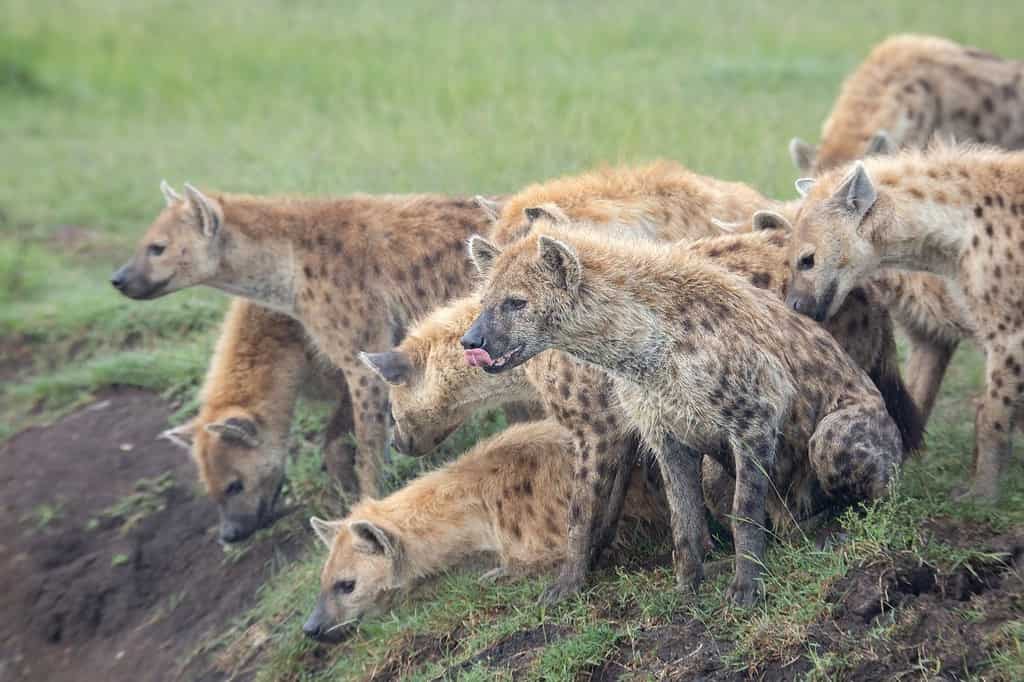
Hyenas practice mobbing behavior, where they approach lions as a group to try to drive them away from a kill.
©Chedko/Shutterstock.com
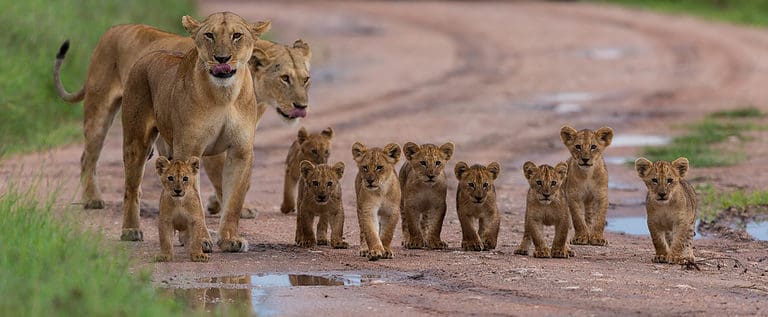
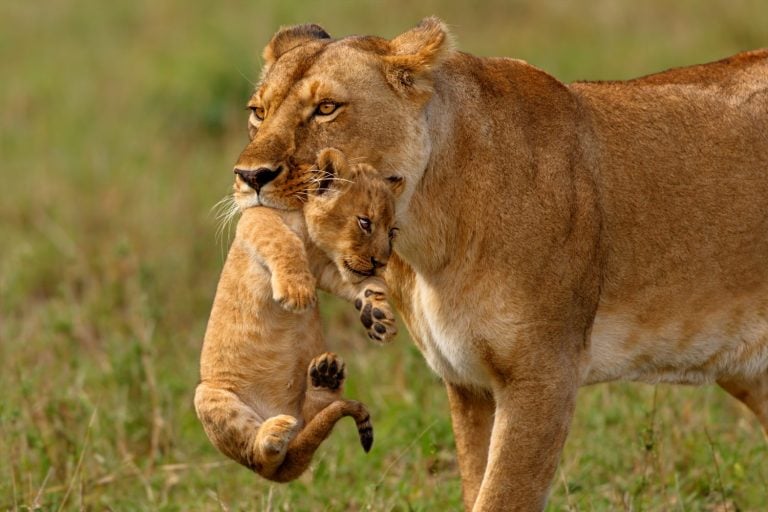
Lions and hyenas are both social animals. Lions live in large groups called prides, where dominant males are responsible for defending the pride and their territory, but lionesses are the leaders in decision-making. At a kill, the dominant male eats first, followed by the lionesses, then the cubs. The pride is typically made up of a few adult males and a large number of females and their offspring. The females are responsible for hunting and raising cubs. Young males leave the pride at around 2-3 years of age to establish their own territories. Females typically remain with the pride for their lifetimes.
In contrast, hyena clans are led by dominant females. The clan includes the dominant female and her relations, their offspring, and unrelated males. The females are more aggressive than the males and have a strict hierarchy where all females are dominant over all males. Females inherit their mother’s rank, becoming dominant over lower-ranking females, although younger females outrank their older sisters. Males leave their birth clans when they reach sexual maturity to join nomadic groups before they find a new clan in which to settle. After mothers nurse their own cubs, the cubs are raised in communal nurseries.
Diet
Lions and hyenas are both carnivores with a similar diet, preying on zebras, wildebeest, gazelles, and other large mammals. Competition for the same resources is the cause of most conflict between the two species. However, lions are said to prefer fresh meat. Recent studies have shown lions prefer larger carcasses, ignoring small carcasses almost completely. Although they are scavengers at times, lions frequently steal fresh kills from hyenas.
Due to hyenas’ strong teeth and powerful bite, they can eat more of the carcass than a lion. Hyenas are more opportunistic and are believed to rely more on scavenging than lions. While hyenas also prefer larger carcasses, they eat from small and medium-sized carcasses that the lions ignore. Hyenas also steal food from lions, but only if they have sufficient numbers to drive the lions away, and rarely if male lions are present.
Hunting Style
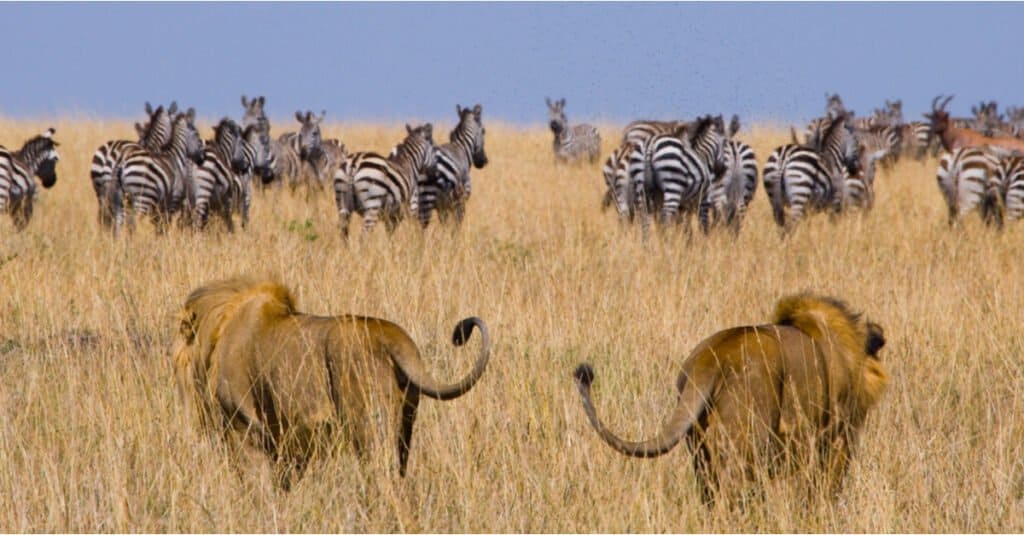
Lions prefer large prey and tend to hunt cooperatively.
©GUDKOV ANDREY/Shutterstock.com
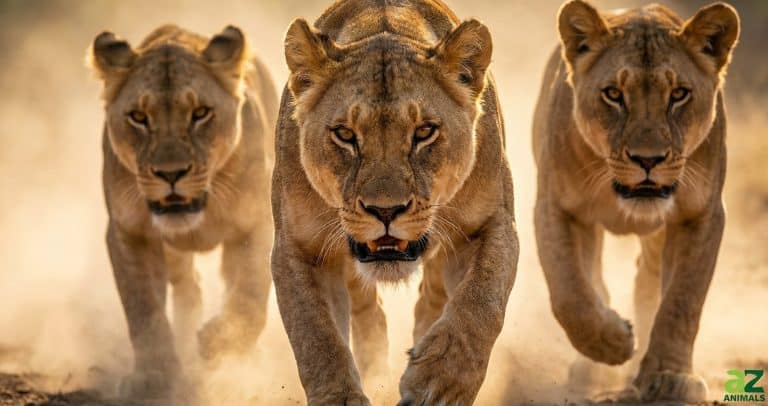
Lions are ambush predators in some cases and endurance predators in others. Lionesses are the primary hunters, typically partnering with other pride members to hunt cooperatively. Males are more solitary hunters and rely on stealth, but they will also sometimes partner with female hunters. Lions are also opportunistic and frequently steal kills from hyenas, depending on their superior size and strength to overcome resistance. In lion and hyena conflicts, lions are most often dominant unless hyenas have superior numbers.
Despite a reputation for being merely scavengers, hyenas are highly skilled predators, too. They are pack animals that hunt similarly to wolves, using their speed and endurance to wear down their prey. They often surround an individual target, separating the animal from its herd and striking from many directions.
Hyenas also steal food from lions. They utilize what is called mobbing behavior, where they approach lions as a group, vocalizing loudly to try to overwhelm the lions and drive them away from a kill. However, the presence of male lions has been shown to be a significant deterrent to mobbing behavior, and also decreases the likelihood of hyenas retaining possession of food. Hyenas have also been found to be more diurnal in place where lions are present, possibly to reduce competition.