Quick Take
- Octopuses punching fish isn't random aggression. Scientists studied it and found a much stranger explanation hiding in plain sight. See the scientific explanation →
- The color change after the slap might communicate something specific, though scientists draw a sharp line between what it looks like and what it actually means. Watch the color change →
- Octopuses can rewire their appearance in fractions of a second, and the mechanism behind it is stranger than simple pigment. Explore the color-change mechanism →
- Sometimes the fish being slapped actually had a working relationship with the octopus, which makes the strike even harder to explain. Discover why partners get punched →
Apparently, even underwater, getting a little too close to the wrong neighbor can earn you a slap. In this remarkable video, an octopus emerges from its hiding spot along a rocky reef when a nearby fish gets a little too close. Without much warning, the octopus extends one of its eight arms and gives the fish a quick smack.
But the slap isn’t even the most interesting part. Almost immediately afterward, the octopus changes color, transforming its appearance in a matter of moments. The fish remains nearby while the octopus continues moving away from its hiding place.
So, was this octopus defending its personal space, warning the fish to back off, or doing something else entirely? Scientists have actually studied octopuses punching fish, and their findings suggest there’s more going on here than a simple underwater disagreement.
Watch an Octopus Slap a Fish and Change Color
The encounter takes place along a reef, where a diver films several fish swimming around a rocky area. An octopus is partially concealed beneath a rock before extending an arm toward one of the nearby fish. The movement is surprisingly quick, and the fish appears to keep its distance afterward.
Then comes the color change. The octopus rapidly adjusts its appearance before continuing to move around the reef. It’s an impressive demonstration of two abilities octopuses possess: using their flexible arms to interact with other animals and changing their appearance almost instantaneously.
While the footage looks like an octopus telling a fish to mind its own business, there’s an important distinction between what we can see and what we can prove. The clip doesn’t establish why the octopus struck the fish or what happened before the encounter. Fortunately, scientists have documented similar behavior in the wild.
Why Do Octopuses Slap Other Fish?
Believe it or not, octopuses punching fish is a scientifically documented behavior. Researchers studying day octopuses in the Red Sea discovered that these usually solitary animals sometimes hunt alongside groups of fish. The fish help locate potential prey, while the octopus uses its flexible arms to investigate cracks and crevices where smaller animals might be hiding.
But these hunting partnerships aren’t always peaceful. A 2024 study published in Nature Ecology & Evolution documented octopuses delivering quick, forceful arm strikes to other members of their hunting groups. Researchers found that these punches could help regulate the behavior of fish competing for food or taking advantage of the octopus’s hunting efforts.
More recently, a 2026 study published in Behavioural Processes examined interactions between young Brazilian reef octopuses and several fish species. Researchers documented octopuses responding to territorial fish with defensive movements, including arm slaps and changes in body patterns. In other words, these encounters aren’t always about food. Sometimes the fish and octopus are simply getting in each other’s way.
Does that explain this particular video? Possibly, but not conclusively. Without identifying the animals and understanding the circumstances, we can’t say whether this was a defensive reaction, competition for space, or something related to hunting.
How Do Octopuses Change Color So Quickly?
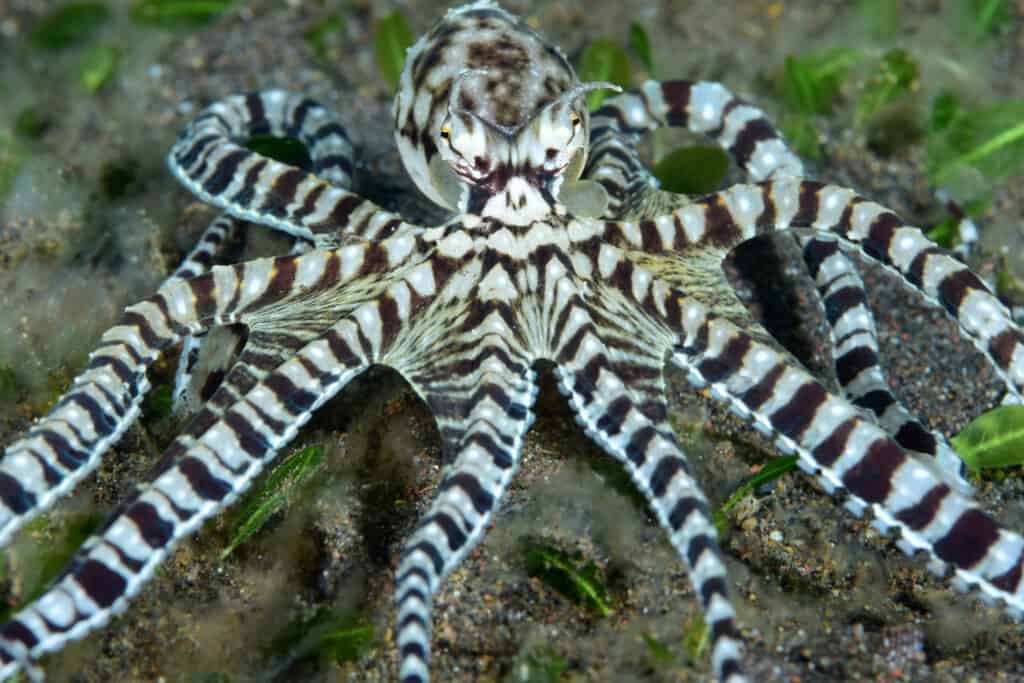
Many octopus species can rapidly change their color and pattern to camouflage themselves or respond to other animals.
©DiveIvanov/Shutterstock.com
The quick color change in the video might be even more impressive than the slap itself. Octopuses have specialized pigment-containing cells in their skin called chromatophores. By expanding or contracting these cells, they can alter the colors and patterns visible across their bodies in fractions of a second.
According to the Smithsonian Ocean, chromatophores work alongside other specialized skin structures that reflect or scatter light. Many octopuses can also change the texture of their skin, creating bumps and ridges that help them resemble rocks, coral, or other features of the seafloor.
Camouflage is one obvious benefit, particularly for an animal with a soft body and relatively few physical defenses. However, color changes can also occur during interactions with predators, potential mates, and other animals. Researchers have even identified particular body patterns associated with defensive encounters.
That means the color shift in this video could be related to camouflage, a defensive response, or another behavioral change. It would be tempting to say the octopus changed color because it was angry, but scientists can’t determine an animal’s emotional state from a brief color change alone.
What Do Octopuses Eat, and What Eats Them?
There are roughly 300 known species of octopuses, ranging from tiny animals that can fit comfortably in your hand to the enormous giant Pacific octopus. They live in oceans around the world, occupying everything from shallow coral reefs to deep-sea environments. Although their size and hunting techniques vary considerably, octopuses are carnivores.
Their diets commonly include crabs, shrimp, clams, snails, and small fish. An octopus uses its sensitive suckers to explore its surroundings and locate potential meals, then relies on its arms and hard beak to capture and eat prey. Some species even drill into the shells of their prey.
Despite their impressive hunting abilities, octopuses have plenty of enemies. Moray eels, large fish, seals, sea otters, and some whales prey on them. Their soft bodies make hiding especially important, which helps explain their remarkable camouflage abilities and preference for rocky crevices and sheltered dens.
And because octopuses lack a rigid skeleton, they can squeeze through surprisingly narrow openings, provided the opening is large enough for their hard beak. It’s one of several adaptations that help them escape predators and reach places other animals cannot.
As for the fish in this video, it appears to have received a quick lesson in respecting an octopus’s space. Whether the slap was defensive or part of a more complicated interaction, it’s another reminder that life along a coral reef is considerably more interesting than it might look from the surface.