
Quick Take
- Tigers are called solitary, but that label hides a surprisingly flexible social life most people never see. See their social flexibility →
- Six fully grown tigers in one place breaks the most basic rule about these big cats. Or does it? Understand why six is remarkable →
- There's a specific window in a tiger's life when family bonds override the instinct to go it alone, and that window is shorter than you'd think. Explore the dispersal timeline →
- The sanctuary where this happened isn't even an official tiger reserve, which raises the question of why its location matters so much to tiger survival. See why the location matters →
Tigers have a reputation for doing things alone. They hunt alone, maintain individual territories, and unlike lions, they do not live in permanent prides. That makes the sight in the video above especially unusual: six tigers gathered in the same stretch of Indian wilderness.
The footage was captured at Umred-Karhandla Wildlife Sanctuary in Maharashtra, India, an important tiger habitat within the broader central Indian landscape. Seeing several tigers together may look like it breaks one of the most familiar rules about these big cats, but tiger social lives are more complicated than the word “solitary” suggests.
Why Seeing Six Tigers Together Is So Unusual
The video takes us to Umred-Karhandla Wildlife Sanctuary in Maharashtra, where the camera captures an extraordinary number of tigers in one place. Without individual identification or field notes from the sighting, we cannot say with certainty how every tiger in the group is related. What we can say is that seeing six together is far from the typical image of tiger life.
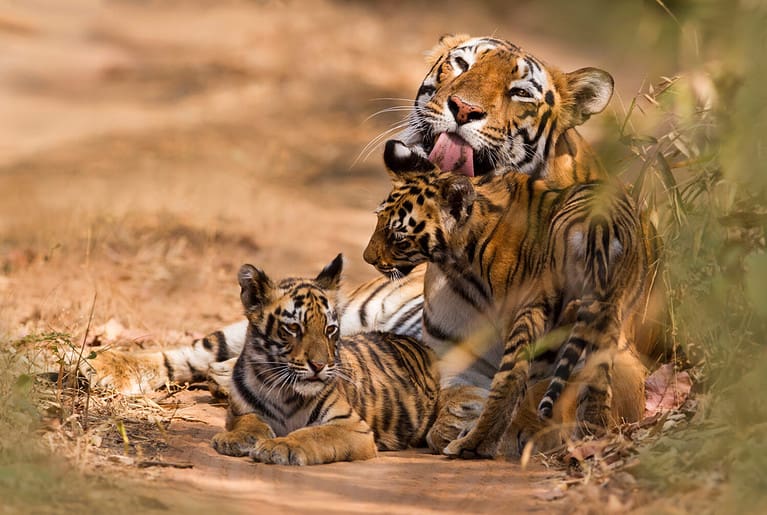
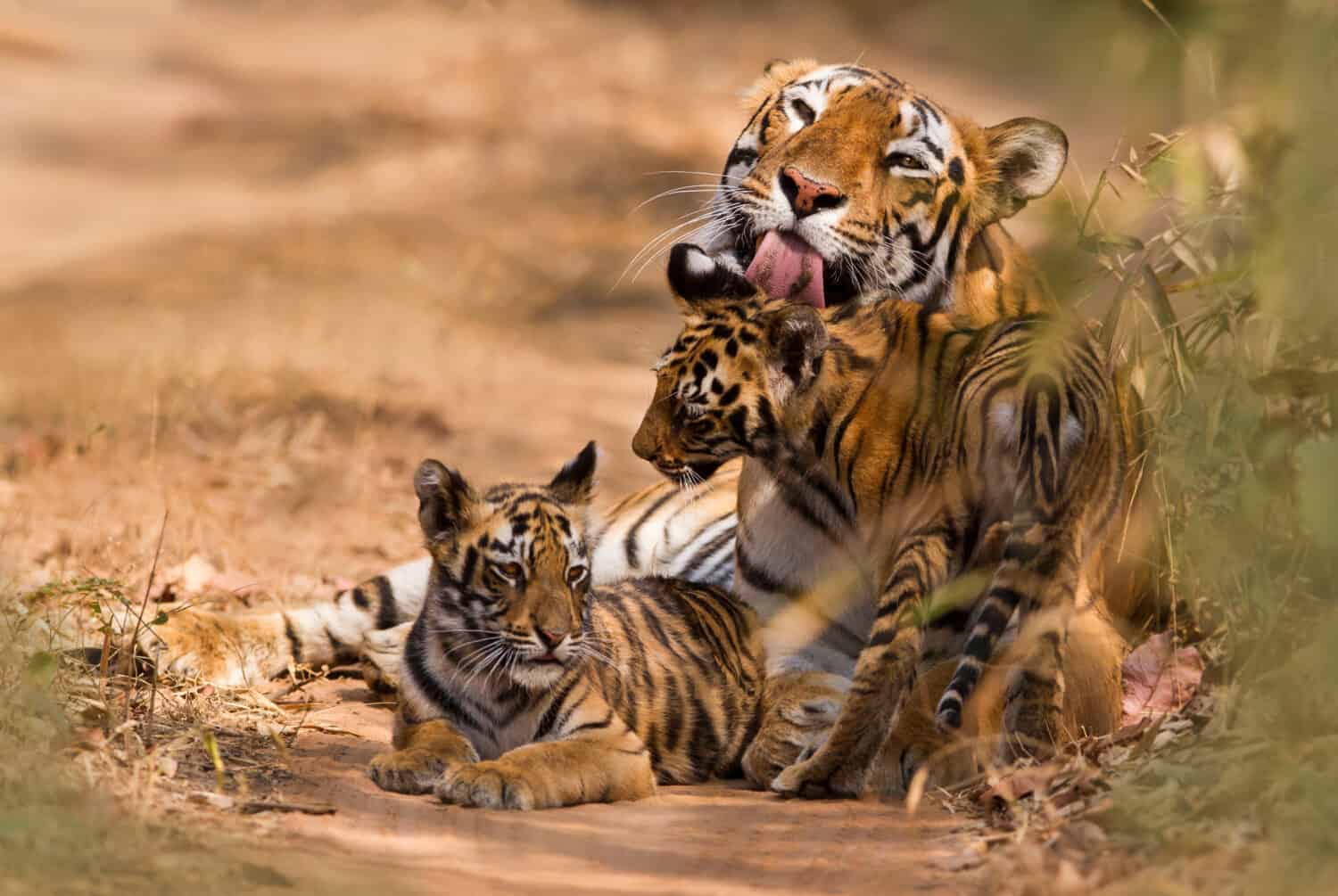
Unlike lions, tigers do not form permanent social groups built around multiple adults. Most mature tigers maintain their own home ranges and spend much of their lives alone. The major exception is a mother raising her cubs, which can temporarily create exactly the kind of scene seen in this footage.
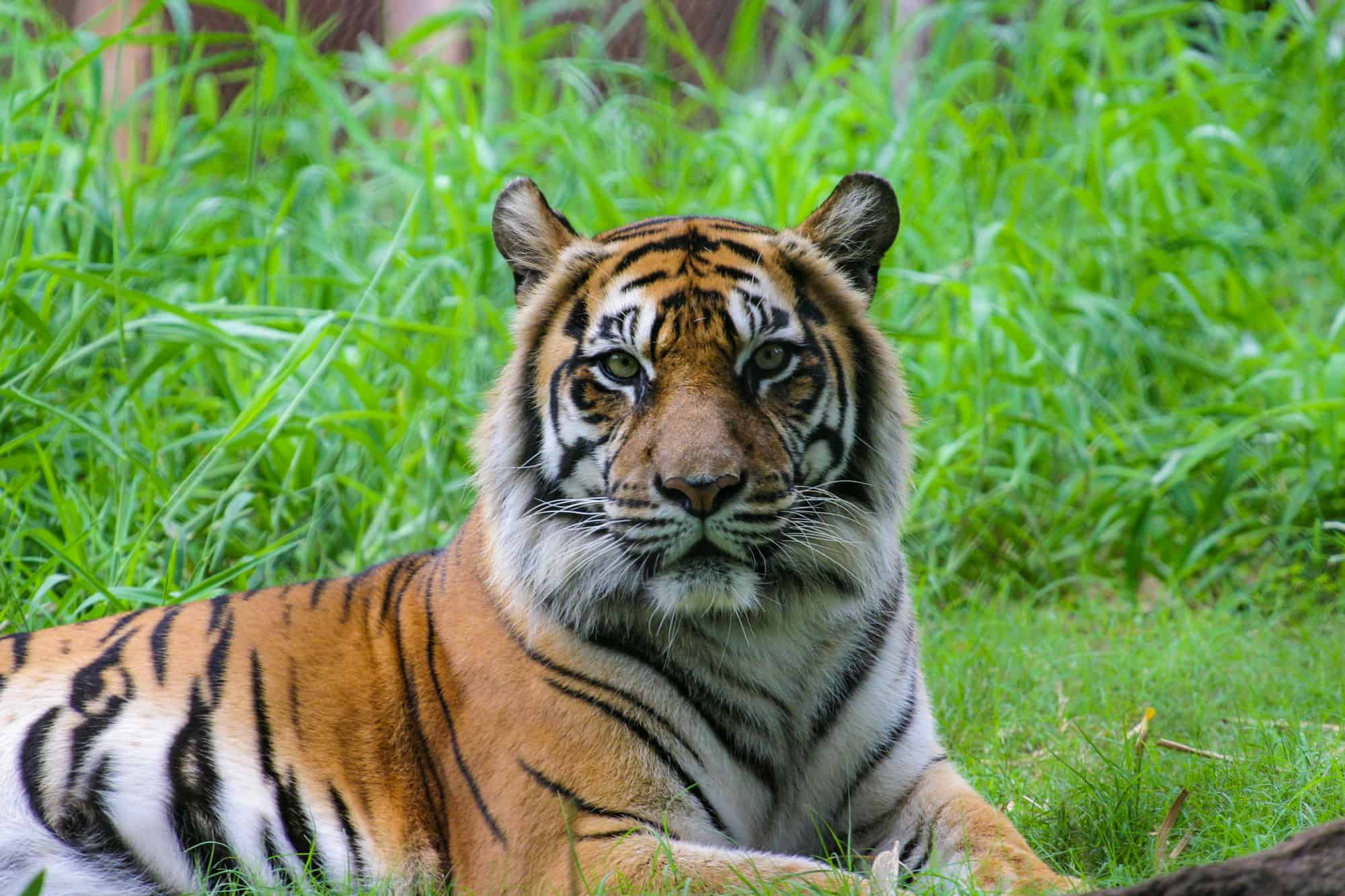
Tigers usually live alone once they become independent.
©iStock.com/Henris94
Solitary Does Not Mean Tigers Never Socialize
Calling tigers solitary can make it sound as though two of them should never willingly share the same space. Their behavior is more flexible than that. Females raise their cubs for an extended period, and the young usually remain dependent on their mother for roughly 18 to 24 months before beginning life on their own.
Even that separation is not always immediate. Research on wild tigers in India has found that female siblings may continue moving together before establishing their own territories. Tigers can also temporarily associate during mating or around a large kill. Historical observations from India have even documented adult males sharing kills with females and cubs.
That means a gathering like the one in the video does not turn these tigers into a lion-style pride. Instead, it offers a glimpse of the temporary family and social relationships that can exist during certain stages of a tiger’s life.
This Sanctuary Sits in an Important Tiger Landscape
Umred-Karhandla Wildlife Sanctuary was established in Maharashtra in 2012 and covers roughly 189 square kilometers, or about 73 square miles. It is not itself one of India’s officially designated tiger reserves, but its location makes it important for tiger conservation.
The sanctuary lies within the broader central Indian tiger landscape. The National Tiger Conservation Authority has placed it roughly 40 kilometers north of Tadoba-Andhari Tiger Reserve, about 50 kilometers southwest of Nagzira Wildlife Sanctuary, and approximately 80 kilometers from Pench Tiger Reserve.
That connectivity matters. Tigers need large areas of suitable habitat, and young animals eventually have to leave their mothers and find territories of their own. Protected forests and the corridors between them can give dispersing tigers room to move through the landscape rather than becoming isolated in a single pocket of habitat.
What Do Bengal Tigers Need to Survive?
Bengal tigers are found primarily across India, with additional populations in Nepal, Bhutan, and Bangladesh. Tigers as a species once occupied a much larger portion of Asia, but today they survive in only a fraction of their historical range.
They are also far more adaptable than the word “jungle” suggests. Tigers can live in tropical and temperate forests, grasslands, savannas, and even mangrove swamps. What matters most is access to enough space, cover, water, and prey.
In central India, that prey can include animals such as chital, sambar, and wild pigs. Umred-Karhandla surveys have documented all three, giving resident predators access to the kinds of large mammals that can support a tiger population.
When Do Young Tigers Finally Leave Their Family?
Young tigers cannot remain together forever. Cubs generally stay with their mother until they have learned the hunting and survival skills they need, usually around 18 to 24 months. They become fully independent as they mature and eventually disperse in search of territory.
Females sometimes establish themselves relatively close to their mother’s range, while young males tend to travel farther. Once established, adults return to the mostly solitary lifestyle tigers are famous for.
That is what makes footage like this so interesting. A group of six tigers is not necessarily evidence that tigers are becoming social animals. It may instead capture a brief stage when family bonds have not yet given way to the independent lives these big cats will eventually lead.